From Rules to LLMs: My First Step into AI
My notes from Lecture 1 of the NamasteAI learning journey
Why I Started This Journey
I recently started learning AI through Akshay Saini’s Namaste AI course.
As a developer, I’ve been using AI-powered tools more and more, but I realized that using AI and actually understanding how it works are two very different things.
I knew the terms — Machine Learning, Deep Learning, Neural Networks, Transformers, Generative AI, LLMs — but I couldn’t confidently explain how they are connected.
So I decided to go back to the fundamentals and learn the concepts step by step.
This article is my first attempt at documenting that journey in public — not as an AI expert, but as a developer learning and building a stronger understanding of the technology that is rapidly becoming part of everyday software development.
For a long time, I used AI-powered products without really understanding what was happening behind the scenes.
This is the beginning of my AI learning journey, and this is what I understood from my first lecture.
What is Artificial Intelligence?
The simplest definition I found useful is:
Artificial Intelligence is the field of making machines perform tasks that normally require human intelligence.
Think about tasks such as:
- Playing chess
- Detecting spam
- Recommending products or movies
- Recognizing images
- Understanding speech
- Generating text or images
The interesting question is not only what AI can do, but how machines evolved from following rules to learning patterns and eventually generating content.

The early idea: Can machines think?
One of the important early milestones was Alan Turing’s 1950 paper, “Computing Machinery and Intelligence.”
Turing asked a deceptively simple question:
Can machines think?
Instead of trying to define “thinking” directly, he proposed what became known as the Turing Test — a way of evaluating whether a machine could imitate human-like conversation well enough to be difficult to distinguish from a person.
At this point, AI wasn’t yet the huge industry we know today.
1956: AI becomes a field
A major milestone came with the Dartmouth workshop in 1956, where the term Artificial Intelligence was used for the emerging research field.
The ambition was huge: researchers believed that aspects of learning and intelligence could, in principle, be described precisely enough for machines to simulate them.
That idea became the foundation for decades of AI research.
Rule-Based AI: “Tell the machine the rules”
One early approach was rule-based AI.
Imagine building a simple spam detector.
You might write rules such as:
IF message contains "FREE"
OR "$$$"
OR "LOTTERY"
THEN → SPAM
A medical expert system could similarly use rules:
IF fever + cold + body ache
THEN → possible flu
The problem?
Humans had to write the rules.
As problems became more complex, the number of rules exploded.
And real-world situations rarely fit neatly into a fixed set of IF/THEN statements.

The shift to Machine Learning
Researchers increasingly explored a different idea:
What if we don’t explicitly program every rule? What if the machine learns patterns from data?
For example, instead of writing thousands of rules to distinguish cats from dogs, we could provide a large collection of labeled examples.
Millions of examples
        ↓
Machine Learning model
        ↓
Learn patterns
        ↓
Prediction
This was a fundamental shift:
Rule-based AI: humans define the rules.
Machine Learning: humans provide data, and the model learns patterns.
Deep Learning: Let the machine learn features too
Machine Learning still often relied on humans deciding which features were useful.
Deep Learning changed this significantly.
Deep Learning uses neural networks with many layers that can learn increasingly complex representations from data.
For example, in image recognition, we can think of the network learning progressively:
Pixels
  ↓
Edges
  ↓
Shapes
  ↓
Parts
  ↓
Objects
  ↓
"Cat"
This became especially powerful when three things came together:
- Large datasets
- More powerful computing, especially GPUs
- Better neural-network techniques
One landmark moment was AlexNet in 2012, which demonstrated the power of deep neural networks for large-scale image recognition.
From understanding images to understanding language
AI wasn’t only evolving in computer vision. Another major challenge was Natural Language Processing (NLP) — getting machines to work with human language.
Language is difficult because meaning depends heavily on context.
Get Rydham’s stories in your inbox
Join Medium for free to get updates from this writer.
Consider:
I saw a man with a telescope.
Who had the telescope?
Or:
The chicken is ready to eat.
Does that mean the chicken is ready to eat something, or ready to be eaten?
Earlier approaches such as Bag-of-Words and n-grams captured useful statistical patterns, but they struggled with longer-range context and the complexity of language.
Then came approaches such as RNNs (Recurrent Neural Networks) and LSTMs (Long Short-Term Memory networks), which improved the ability to process sequences and retain information.
But there was still a major challenge:
How do we handle long-range relationships in language efficiently?
2017: The Transformer changes the game
In 2017, Google researchers published the paper:
“Attention Is All You Need.”
It introduced the Transformer architecture.
The key idea that caught my attention was attention.
Instead of processing language strictly one step at a time like traditional recurrent approaches, Transformers can look at relationships between tokens and determine which parts of the input are important to one another.
A simple intuition:
"The animal didn't cross the street
because it was too tired."
What does "it" refer to?
↓
The model needs to connect
"it" with "animal"Transformers became the foundation for modern large language models.
From Transformers to Large Language Models
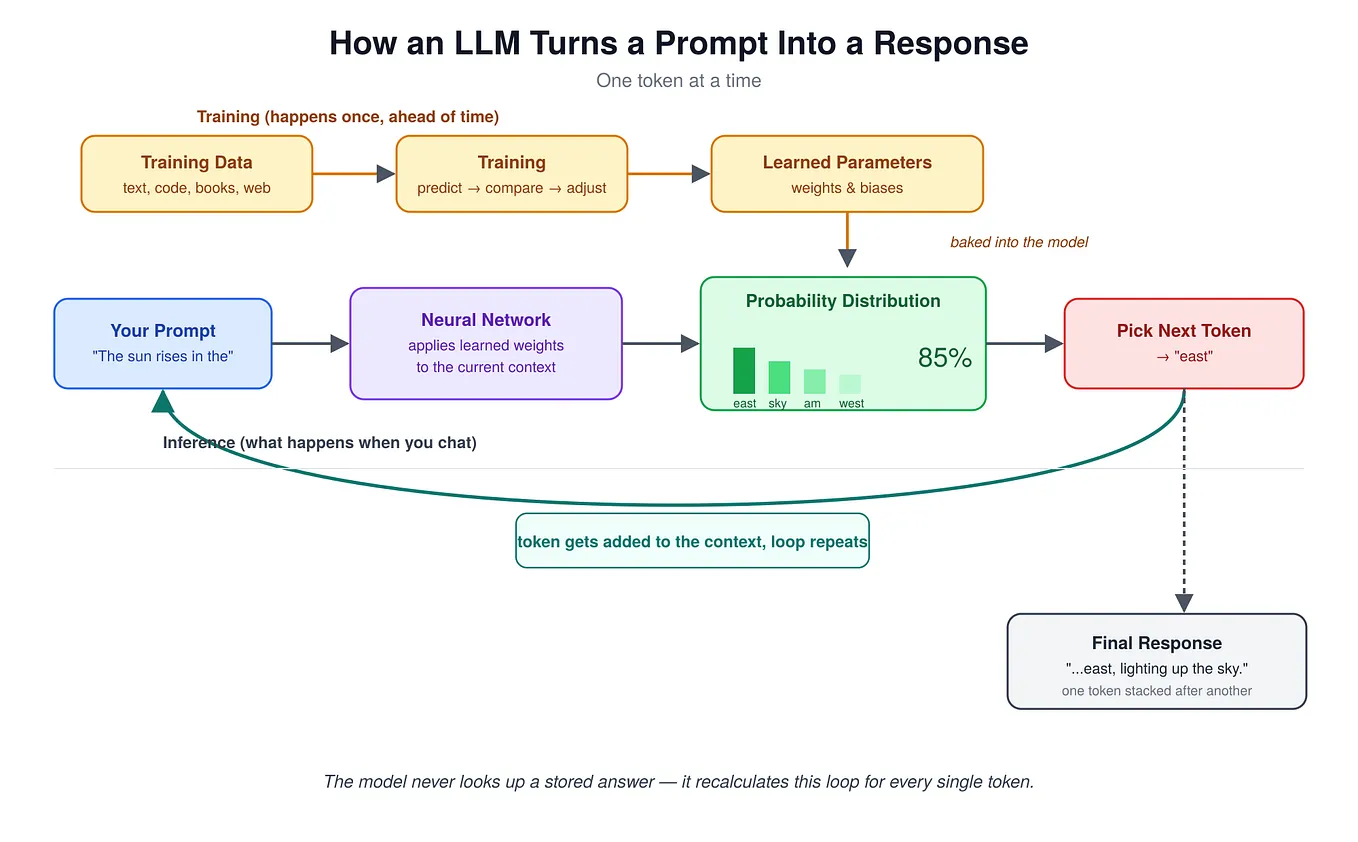
Once Transformers could be trained effectively at large scale, researchers began training them on enormous datasets.
The basic idea:
Large datasets
      +
Large compute
      +
Transformer architecture
      ↓
Large Language Models
These models learn statistical patterns in language and can perform tasks such as:
- Text generation
- Summarization
- Translation
- Question answering
- Code generation
- Classification
- Reasoning-like tasks
And this brings us to something that completely changed the public perception of AI.
The ChatGPT moment
In late 2022, ChatGPT brought conversational generative AI to a massive mainstream audience.
Instead of interacting with AI through a narrow interface, people could simply have a conversation with a machine.
That changed how many people thought about AI.
And this was part of the larger rise of Generative AI.
Earlier AI systems were often used for:
- Classification
- Prediction
- Recommendation
Generative AI can create new content:
- Text
- Images
- Audio
- Video
- Code
So the shift became:
AI that predicts/classifies
          ↓
AI that can generate
          ↓
AI that can interact
          ↓
AI that can use tools and perform tasks
Where we are heading
The evolution doesn’t stop with chatbots.
The next direction is increasingly multimodal and agentic AI.
Instead of only processing text, models can work with combinations of:
Text + Images + Audio + Video + DocumentsAnd AI agents can go beyond generating an answer:
Understand a goal
      ↓
Plan
      ↓
Use tools
      ↓
Take actions
      ↓
Observe results
      ↓
Continue / adapt
That is a very different idea from the early rule-based systems where humans had to explicitly define every possible rule.
My biggest takeaway from Lecture 1
The biggest thing I took away wasn’t a particular technology.
It was the evolution of the approach.
RULES
"Tell the machine what to do."
        ↓
MACHINE LEARNING
"Give the machine data and let it learn patterns."
        ↓
DEEP LEARNING
"Let neural networks learn useful representations."
        ↓
TRANSFORMERS
"Model relationships and context at scale."
        ↓
LLMs / GENERATIVE AI
"Generate and interact using what was learned."
        ↓
AGENTIC AI
"Use models + tools to accomplish goals."
I’m realizing that learning AI isn’t just about learning how to use ChatGPT or calling an API.
It’s about understanding what is happening underneath the abstraction.
And that’s exactly where I’m starting.
I’m looking forward to continuing this journey through Namaste AI, while also going beyond the lectures by revisiting concepts, asking questions, building things, and documenting what I learn.
#AI #ArtificialIntelligence #MachineLearning #DeepLearning #GenerativeAI #LLM #LearningInPublic #TechLearning #NamasteAI #AkshaySaini