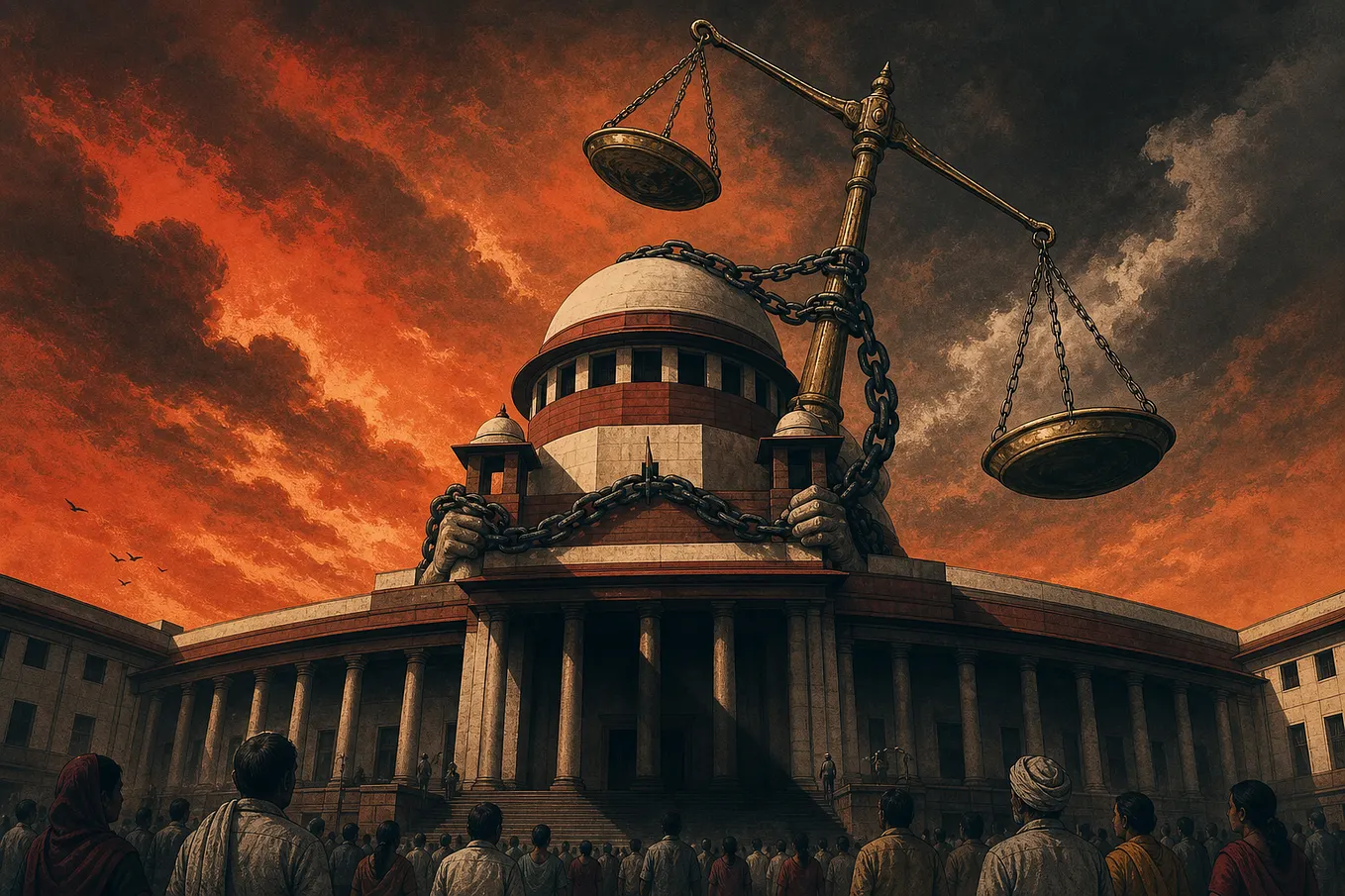
Story of Bad Ideas

Recently I was scrolling through Instagram stories and my feed, and I noticed how many people had reposted something in support of Sonam Wangchuk. It was everywhere. People who didn’t post political stuff otherwise seem to have started posted it.
This reminded me of a story I once read by Ajay Shah.
Activism and wonkery are the yin and yan
Ajay makes great points. Activism brings attention to the problems of society. At its best, it sparks public outrage and breaks the tyranny of the status quo. But activism alone is not enough. You also need wonks: people who take interest in the subject, study the status quo, analyse incentives of stakeholders, propose solutions, poke holes in those solutions, workout the unintended consequences, misplaced incentives and Reflexivity. The boring parts that do not fit into a story.
He makes a very useful point about complexity. There are too many moving parts for these problems to be “solved” by technocrats sitting above society. The better path is to build public consensus through delegation and debate rather than have a new sweeping legislation.
But this blog is not about that.
This blog is about what I fear most when activism succeeds a little too well.
Widening of the Overton window
Every society has a range of ideas that feel discussable, reasonable, and politically possible. Outside that range are ideas that sound extreme, unserious, or dangerous. That range is often called the Overton window.
Crisis widens this window. Ideas that were once ignored become discussable. Suffering that was once private becomes public. Institutions that felt unchallengeable suddenly have to answer for themselves.
But the Overton window often widens on all sides. It is not only better ideas that enter. Bad ideas that were once unacceptable also start to become discussable.
When public anger is high, the ideas that rush into the centre are not necessarily the best ones. They are the loudest ones. The simplest ones. The ones that punish someone visible. The ones that let the state look decisive. The ones that feel like moral victory.
Once one such idea enters the Overton window, it becomes hard to oppose without looking heartless. You do not get debated as someone worried about incentives or state capacity. You get painted as someone who does not care about the victims.
That is a dangerous place for lawmaking.
The rise of the Nazi party and the Reichstag fire
The clearest historical case of a window widening on all sides is Weimar Germany.
After defeat, humiliation, hyperinflation, and depression, German politics was already unstable. Ideas that once sat outside respectable debate : racial hierarchy, the destruction of liberal constraints, rule by emergency decree began to feel discussable to larger and larger parts of the public. Crisis did not invent those ideas. It made them sound urgent.
Then came the Reichstag fire.
Get eprogrammer’s stories in your inbox
Join Medium for free to get updates from this writer.
In February 1933, the german parliament building burned. All sorts of conspiracy theories were put out. Democracy and a free society was made to look like a weak fraile thing that was the bottleneck to the prosperity and rise of the german people. Guess what happened next.
Populist narratives in the near past in India
Without wanting to discuss this too further, I want to point out two incidents that some or most of us might remember or know about
Nirbhaya Rape Case
If you read the article of ajay linked above and may have followed up on what happened next. The perpetrators were hanged. But along that came the legislation(s).
Let me first ask how should the justice system of country work. The universally accepted defination would go something as follows:
1. The crime should fit the punishment
2. Type 1 errors (acquitting the guilty) and Type 2 errors (convicting the innocent) should be minimised.
3. Justice shouldn’t take too long (especially relevant for India)
The following were the legislations passed for anyone interested:
Criminal Law (Amendment) Act, 2013
Juvenile Justice (Care and Protection of Children) Act, 2015
quick summary
The legislations broadened the legal definition of rape to include acts beyond penetration. It also criminalized new offenses like stalking and voyeurism. They established life imprisonment or the death penalty for repeat offenders or cases where the victim is left in a persistent vegetative state and they lowered the age at which juveniles can be tried as adults for heinous crimes (such as rape and murder) from 18 to 16 years.
consequences
A good law should always be analyzed by their outcomes and not intentions.
Did women’s safety improve because the statute became harsher? Did investigation quality improve? Did courts become faster? Did police become more competent, less discretionary, more accountable? Those are the questions that matter. Severity is easy to announce. Capacity is not.
Now, the first question to answer does the crime fit the punishment.
Harsher penalties not only raise the cost of error. They often lay the ground for false cases and legal extortion. To give a small example: we all agree stalking is a bad thing. This legislation laid down rules to award at least one year of prison for stalking. Well, now think of all the ways one could accuse you of falsely stalking someone, if they wanted to. Now think of all the ways this could be used for a wrongful purpose in some negotiation (or for extortion) when the stakes are high.
This however by no means suggest that there should be no punishment for a crime for the fear of being misued, it simply means that having a punishment that doesn’t fit crime increases the tendency of it getting misused.
Jan Lokpal Bill
This was a way worse bill..
The Anna Hazare movement put a real problem under the searchlight: corruption. That part was valuable. What rushed into the opening was a cartoon solution. A super-ombudsman with investigative, prosecutorial, and punitive powers concentrated in one largely unaccountable body. In the name of cleaning up the state, the draft asked us to create something that looked uncomfortably like a state within the state.
Everyone was against corruption. That made dissent about design sound like dissent about values. If you worried about concentration of power, checks and balances, or the incentives inside such an institution, you risked being painted as soft on graft. The question was whether you were with the people or with the corrupt.
The good thing is that it did not pass, thanks to the sensibilities of some intellectuals and critics who were willing to say the unpopular things.
The fear of bad Ideas
My purpose of this article wasn’t to get you interested in the history of legislations but to make you cautionary of the changes that are brought about by activism and populist law making that often follows it.
My article is nor about bashing activism. Activism is still necessary. Without it, many injustices would never enter public life at all. However, One should always be vigilant and cautious of the people and ideas that are leading such protests