When Should We Use AI, and When Should We Think Without It?

On relational metacognition, judgement, and the space we need to keep thinking for ourselves

In a Big Think article, Shai Tubali asks three philosophers what humans should never give up to AI. Michael Hauskeller argues for our ability to remain puzzled and think things through. Susan Wolf highlights curiosity and the discovery of what genuinely matters to us. Luciano Floridi reminds us that meaning is tied to history, intention and the relations surrounding something, including the process through which it came into being.
Their perspectives touch on something I‘m exploring in my own work:
- How does AI influence the way we notice, interpret, and make decisions?
- How can we remain attentive to what happens to our thinking while we interact with it?
These questions have become increasingly relevant as AI enters everyday professional practice. We are learning how to use the tools, how to formulate prompts and how to assess their outputs.
I am interested in what happens during that process:
how our attention moves, how we interpret what comes back, which possibilities we pursue and which ones disappear from view.
When we stop noticing the thinking we leave to AI
Hauskeller makes an important point about the value of thinking things through. Working towards an answer develops capacities that we may need later, including the ability to interpret, question, and exercise judgement. When we skip that work, we may also miss opportunities to develop those capacities.
I see three different ways in which AI can enter our thinking.
- Sometimes AI extends our thinking. We bring our own knowledge, questions, and ideas to an interaction. The response helps us explore them further. It can expose gaps in our reasoning, introduce unfamiliar perspectives, or help us articulate something we were struggling to express.
- At other times, AI takes over parts of the thinking process. We ask it to summarise, structure, interpret or formulate something, and we rely on the result to varying degrees. This can be useful, depending on the task and what we need to learn or accomplish.
- Deserves closer attention: we introduce AI so early in the process that we no longer notice which thinking steps we are skipping.
We may start with an AI-generated summary before trying to make sense of a text ourselves. We may ask for possible explanations before spending time developing our own. We may accept a structure offered by AI without exploring other ways of organising the material. Over time, some of the work that used to be part of our own process may simply disappear from it.
I am not suggesting that this happens to everyone, or that every task requires us to work without AI. The point is that we may not always recognise what we are practising less often. That makes it difficult to judge the longer-term consequences for our knowledge, skills and independent judgement.
A professional recently described noticing that AI had changed the time and space he allowed himself to think things through. His observation struck me. Recognising such a change already involves a degree of reflection on one’s own thinking and on the influence of the tool being used.
What happens when we do not notice that change?
The analogy with practical skills is worth considering. Pilots train for situations in which automated systems are unavailable. Surgeons develop practical expertise through training and repeated experience, even as technology changes how procedures are performed. In both cases, competence involves more than producing a successful outcome with the available tools. It also depends on capacities that people can draw on when circumstances change.
Thinking and judgement develop through practice, too. We need to investigate what happens when AI changes the opportunities people have to exercise them, especially when the effects become visible only over time.
There is an organisational dimension here. People work within time limits, performance targets, professional norms and expectations from colleagues and managers. If speed and output are rewarded consistently, taking time to investigate a problem independently can become difficult to justify. Using AI may be the sensible response to the conditions in which someone works.
Organisations therefore have a role in shaping the conditions under which people can think, learn and maintain their expertise.
Efficiency gains in the short term may come with costs that only become apparent later. Some processes need time for knowledge to develop, practical skills to be maintained and judgement to mature.
I want to understand more about the conditions that give people room to think for themselves, and those that gradually reduce that room.
Curiosity needs room to develop
Susan Wolf draws attention to curiosity and to the experience of discovering what genuinely interests us. A question can open up a line of inquiry that we had not anticipated. It can also take time to discover what we really want to understand.
AI can be excellent at helping us explore unfamiliar territory. It can suggest connections, introduce concepts and offer starting points for further investigation. Sometimes an answer prompts a question I would never have thought to ask. That is one of the things I value about working with AI.
Yet an AI response also shapes the possibilities that become visible to us.
The answer depends partly on the prompt, the model, the context available to it, and the limits of the system. It presents certain interpretations and directions. Others may remain absent. Even when the response is useful, it gives the interaction a particular direction.
This becomes especially apparent in creative work. When I imagine something, the idea may remain open and unfinished for a while. An AI-generated image turns one interpretation into something concrete. That can be frustrating when the result differs from what I had in mind, especially when the image feels polished before the underlying idea has had time to develop.
The image can also surprise me and open up possibilities I had not considered. Both experiences matter. The tool can expand my imagination while giving it a particular shape.
The same dynamic can occur in research, writing, or problem-solving. An answer may help us articulate an emerging idea. It may also lead us away from the interest that prompted us to start exploring in the first place.
AI interaction is iterative. We respond to an answer with another prompt, and that prompt is shaped partly by what the system has just offered. Each response influences what becomes thinkable or worth pursuing in the next step. The process can develop in directions that neither the initial question nor the user alone had fully anticipated.
I am interested in how people experience this.
- Do they notice when their curiosity changes direction?
- Can they distinguish a question they genuinely want to pursue from one that has become attractive because AI put it in front of them?
- When does an unexpected suggestion enrich their thinking, and when does it pull their attention away from something they wanted to understand?
These are questions about imagination, attention, and judgement. They deserve investigation rather than assumptions about what AI inevitably does to us.
Meaning has a history
Floridi’s emphasis on origin and history brings another dimension into view. The meaning we attach to something depends partly on where it comes from, how it came into being and the relations in which it is embedded.
Meaning has always involved interpretation. When we read a book or article, we cannot know exactly what the author intended. We bring our own experiences, knowledge, and circumstances to the text. When a story passes from one person to another, the person retelling it may change its emphasis or give it a different meaning. Meaning is never simply transferred intact.
Human communication, however, takes place between relational beings. A listener can ask the storyteller to clarify something, challenge an interpretation, or respond in a way that changes what is said next. Such exchanges do not guarantee mutual understanding, but they allow people to negotiate meaning and reconsider their interpretations in relation to one another.
Get Evelien Verschroeven’s stories in your inbox
Join Medium for free to get updates from this writer.
A book cannot participate in that negotiation. AI introduces another kind of interaction. It processes material produced in particular contexts, identifies patterns, and generates interpretations that can influence how we understand the original material. We can question its responses and continue the exchange, but AI does not share the author’s lived history or participate in a reciprocal human relationship with either the author or the reader.
Its responses can shape what we notice, which interpretations become plausible and what we take to be meaningful. The output is shaped by the material available to the model, its training, the context provided and the interaction itself. The person reading that output brings their own history, knowledge, expectations and relationships to the process.
Several processes of interpretation therefore shape the meaning that emerges. Understanding how this happens requires attention to our own position, to the influence of AI and to the relational context in which we interpret its responses.
- What do we recognise in an answer?
- What do we assume it means?
- Which parts do we accept, question or overlook?
- How do our experiences and relationships influence those responses?
Paying attention while we think
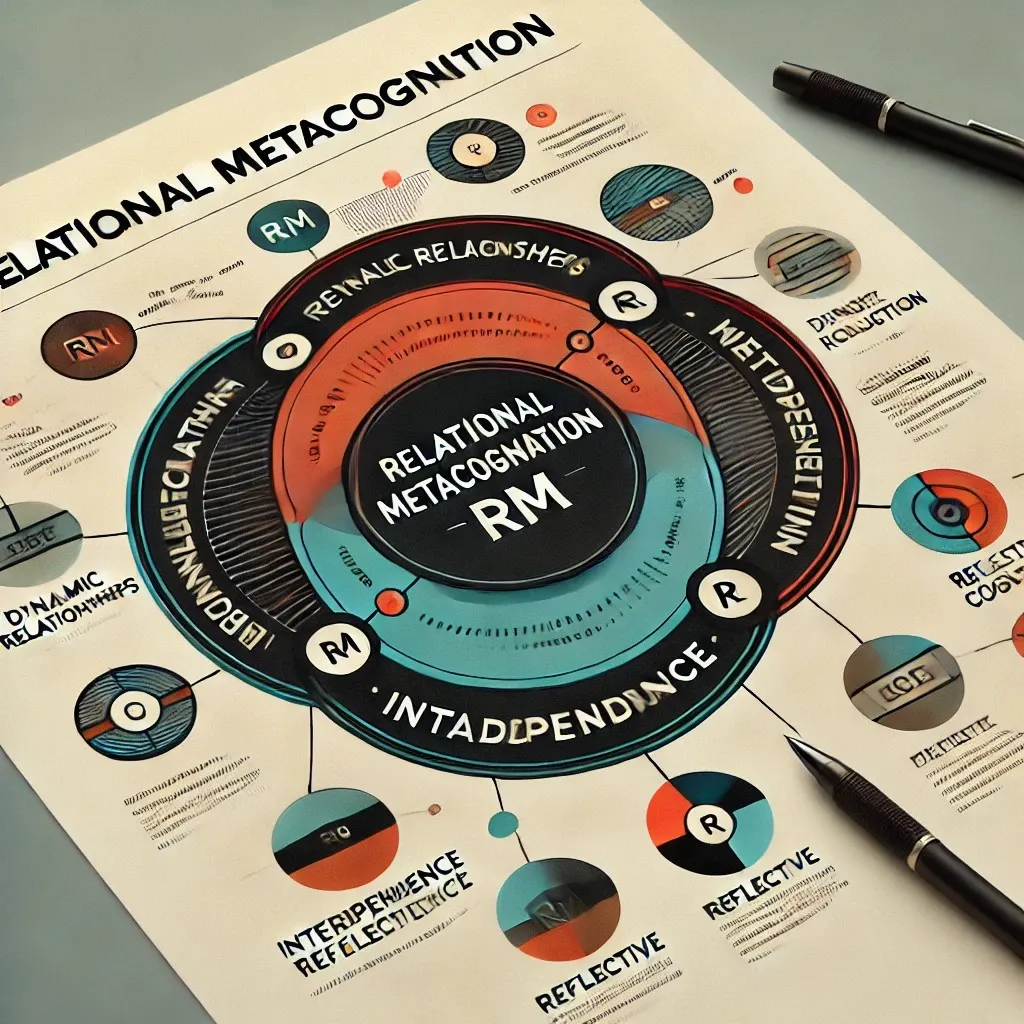
This is where my interest in relational metacognition comes in.
By relational metacognition, I mean paying attention to how our thinking develops within the relational field in which we act. Our interpretation of an answer is shaped by more than the answer itself. Our prior knowledge, experiences, expectations, relationships, institutional context, and the particular AI system all play a part.
Relational metacognition involves noticing these influences while we are thinking and using that awareness to adjust our direction. It goes beyond checking whether an AI response contains errors. We can verify the facts and still fail to notice how the interaction has shaped the question we ask, the possibilities we consider, or the judgement we reach.
I use four temporal directions* to help examine this process. They are prompts for reflection, rather than a checklist to complete.
Past: What do I bring to this interaction?
- Which knowledge, skills, and experiences can I draw on?
- What assumptions am I bringing with me?
- Do I have enough knowledge to evaluate the response, or am I relying on AI because I cannot yet judge the subject independently?
Present: What is happening to my thinking now?
- Is this interaction still helping me investigate the question I started with?
- Have I drifted into a different direction without noticing?
- Am I taking time to think through the response, or moving straight to the next prompt?
Near future: What does this make me curious about?
- Has the response raised a question I genuinely want to explore?
- What interests me about it?
- Am I following a direction that matters to me, or simply continuing along the path suggested by the system?
Further future: What will I be able to do with this?
- Does the interaction help me move towards my goal?
- Am I developing knowledge and skills that I can use independently?
- If I use AI to help write a thesis, for example, will I be able to explain and defend the argument myself?
The temporal directions can help people examine how they engage with AI and how their thinking develops during the interaction.
They do not prescribe when AI should or should not be used. The same tool may be helpful at one stage of a task and less helpful at another. Someone may need AI to open up possibilities, then put it aside to work through an argument independently. Someone else may first need to establish their own understanding before asking AI to challenge it.
The value lies in being able to notice what is happening and make a considered choice about the next step.
Who gets the space to think?
Individual awareness matters, yet people do not make these choices in isolation. A professional may recognise the value of thinking something through and still work in an environment where there is little time to do so. A student may want to explore a question independently while facing pressure to produce a polished result quickly. A team may encourage experimentation while evaluating its members mainly on speed and measurable output.
These conditions influence how people use AI and what they get to practise. They also shape what counts as good work: the speed of delivery, the quality of the result, the reasoning behind it, or the ability to act independently when circumstances change.
If we want people to maintain their capacity for judgement, organisations and educational institutions need to consider how their working and learning environments support it. This includes making room for uncertainty, exploration, practice and reflection, even when these activities do not produce an immediate result.
Hauskeller, Wolf and Floridi each point towards something valuable:
- the ability to think through uncertainty,
- the curiosity to pursue what matters and
- an appreciation of the history and intentions behind what we encounter.
Their perspectives help us see what is at stake when AI becomes part of our everyday thinking.
My own interest is in how these capacities develop during interaction with AI, and how people can become more aware of their own position in that process.
We will not always need to think without AI, and we will not always benefit from bringing it in. Sometimes it helps us move forward; sometimes we need time to work something out ourselves. The choice depends on what we are trying to do, what we already know, what we want to learn and the conditions in which we are working.
For me, using AI wisely starts with paying attention to when and why it helps, what it changes along the way, and when thinking without it may serve us better.
That requires space to notice how our thinking unfolds, including the parts we might otherwise stop practising.
*I explore similar questions through BOBIP, a method for individual and collective learning.