A long meeting

This piece was originally published in the Cambridge Somerville Independent
The Somerville city council had another exhausting meeting last week. It started on Thursday evening and stretched into the early minutes of Friday morning — a total of more than five grueling hours. Towards the end, the proceedings edged towards chaos, with councilors talking over each other, disagreeing as much about parlimentary procedure as the substance of the votes they were taking.
A New Neighborhood Council
The first substantial topic before the council was a set of agenda items about the Davis Square Neighborhood Council (DSNC). Somerville’s neighborhood councils are not created or run by the city. Instead, residents create nonprofits that must meet certain benchmarks of scale, representation, and transparency in order to be “recognized” by the city council. Davis would join Union (USNC) and Gilman (GSNC) squares in having one of these.
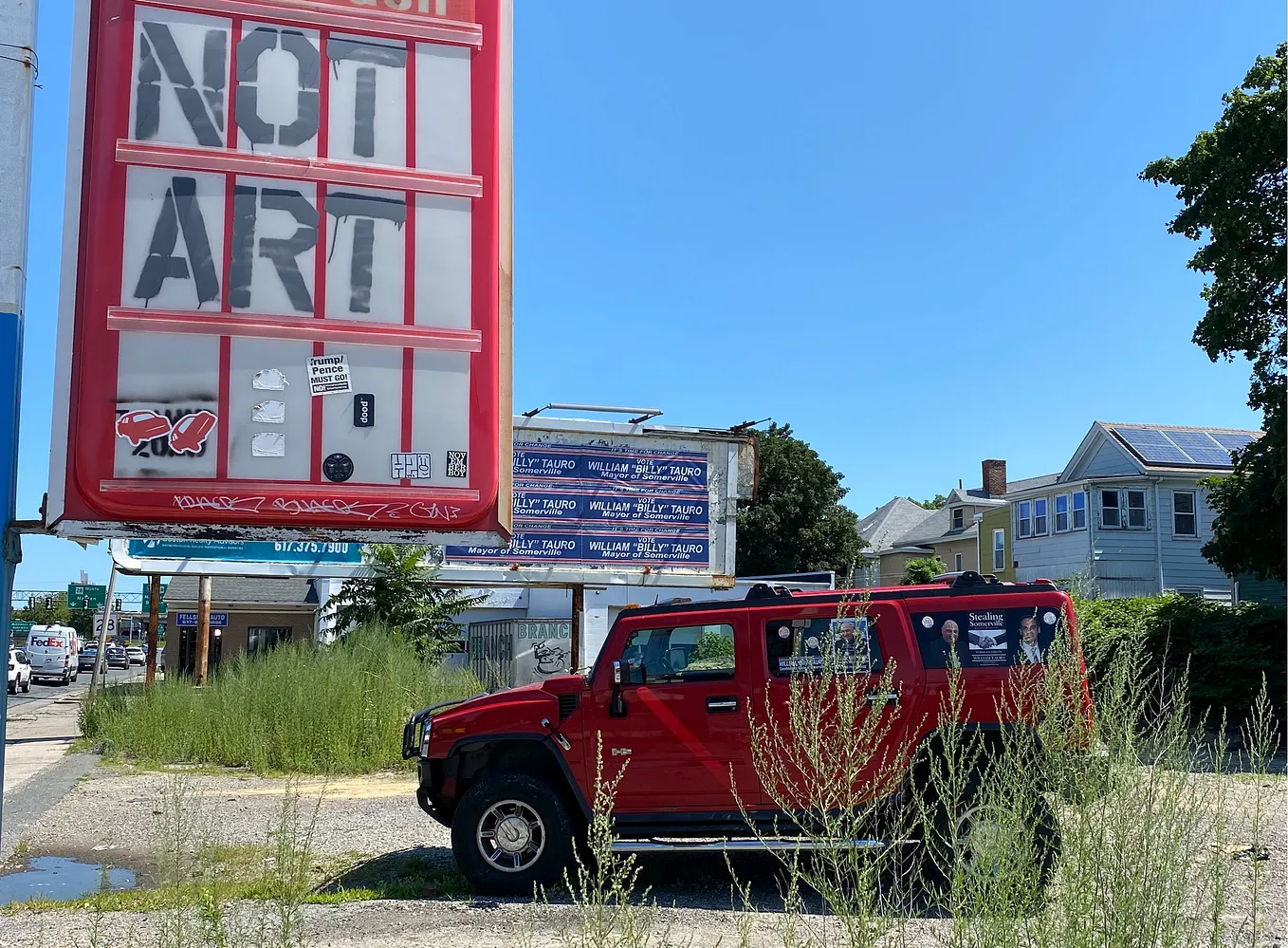
Recognition grants a privileged position to hold neighborhood meetings and to negotiate community benefits agreements with developers. For DSNC, that will put them out in front of conversations about Copper Mill’s proposed 26 story tower at the corner of Elm and Grove street — from The Burren to Dragon Pizza. While it’s nowhere near the scale of the ongoing 20 acre redevelopment of Union Square, the 10 acres at Brickbottom, or even the 7.4 acres of Somernova, the tower is has already generated a lot of conversation — as well as some occasionally mystifying stickers on local light posts.

Neighborhood councils have two major challenges: They struggle, rightly so, to avoid being labeled as obstructionists. They are also structurally challenged to demonstrate their legitimacy as the neighborhood’s representative and negotiating body.
On obstructionism: Getting a large development approved by the city is already time consuming. Putting a 3rd party into the mix inevitably slows and complicates the conversation. Anybody with the nerve to question the details or (heavens) push for changes on any development these days opens themselves to accusations of NIMBY-ism and worse. In order to be effective negotiators, these councils need to be willing to walk away from bad deals without also making those accusations true. Bringing enough benefit to the community to make the extra time and effort worthwhile is a challenge. USNC’s hard fought community benefits agreement with Somernova is a great example of what a neighborhood council can accomplish — though the neighborhood is still repairing relationships damaged through 18 months of name-calling and flyering.
On legitimacy: The people with the time, energy, and resources to spend hours at community meetings tend to skew along predictable demographicn lines. That makes it easy (and usually valid) to lob accusations that neighborhood councils are just a bunch of mostly white, mostly affluent busybodies who somehow mange to simultaneously oppose development while at the same time accelerating displacement and gentrification. Neighborhood councils therefore need to commit a huge amount of energy to outreach and community engagement. That’s the genius of GSNC centering their mission on an an annual arts and music festival.
The conversation about DSNC was mostly celebratory. It has been operating for two years and claims more than 600 members. While they did not get a vote of recognition on Thursday, it seems very likely happen in the fall.
Nurses Strike
The next major item before the council was a resolution in support of the nurses of Mass General Brigham (MGB). They are on strike seeking better workplace conditions, more humane hours, cost of living pay increases, and more affordable health insurance. The council was, of course, enthusiastic in its support, with several councilors speaking about how they had joined the nurses on the picket line at Assembly row that day.
Councilor Jesse Clingan recalled how when Partner’s Health Care merged with Mass General Brigham, they told the nurses that there would be no bonuses that year, offering them cookies and other treats instead. He said that MGB must have spent millions of dollars on updating signage, stationary, and other branding — but somehow they couldn’t find any spare money to do better than some plates of cookies for the staff.
Disability Pride
The council then took up a resolution proclaiming July, 2026 to be Disability Pride Month. Mayor Wilson made brief remarks before passing the microphone to Holly Simione, who serves as the co-chair of the Somerville Commission for Persons with Disabilities (SCPD). Simione’s remarks were powerful, and the usual murmur of side conversations in the chamber fell silent as she spoke.
Simione told the council that, while she supports the idea of a pride month, not every disabled person is or has to be proud of their status. “What we need is for disabled kids to know that they are fully supported. Once somebody is an adult, they can make up their own mind.” She told the council about Geraldo Rivera’s 1972 expose on the Willowbrook State School on Staten Island. Rivera cut through a chainlink fence to film institutionalized patients in abysmal, horrifying conditions. While some of the patients had severe mental illness, others had been locked away for what might today be identified as attention deficit disorder, autism, or just social difficulty. That reporting was part of years of activism that led to the Olmstead act, currently under threat by the Trump administration, which requires state medical care to offer an in-home option if at all possible.
Get Chris Dwan’s stories in your inbox
Join Medium for free to get updates from this writer.
Simione told the council about the “capitol crawl”, a 1990 disability rights protest in which activists left their mobility aids at the base of the US capitol building and dragged themselves up the steps of the building. She paused before going on to say that doing disability work in Somerville often feels like dragging herself up those steps. The friction between SCPD and the city staff assigned to support them has boiled over in several recent council meetings, and the ADA coordinator role — tasked to receive complaints about accessibility — is vacant.
Simione asked the council if they had noticed that the closed captioning was not working for the early part of the meeting. “I wear bilateral hearing aids. Even with the microphones it can be hard. If the microphones had gone out, would you have stopped the meeting?” She tapped her hands on the podium where she stood. “This podium doesn’t adjust in height. If someone were to be in a wheelchair, how would they address you?” She concluded her remarks: “I’m not here to make anybody feel bad. You don’t know what it is like to be us. That’s why you have a state mandated commission for persons with disabilities. That’s why you need to give us a seat at the table.”
A $130M Loan
With all of that talking and resolving, the council was a full two hours into its meetings by the time it turned to a request by the administration approve a bond of $130M — about a third of the city’s annyal operating budget, that very same night. The proposed work would place a “box culvert” underneath the entire length of Morrison Avenue. Director of infrastructure Rich Raiche described it as taking the flooding that currently happens on the street surface and moving it underground.

Usually this sort of request would be sent off to committee, but the funds are available under a program started by the Biden administration which has subsequently been cancelled by Trump. Somerville’s application was in process, and seemingly we were all surprised when it was accepted. The terms are great, it’s a 30 year loan at 2% interest with the possibility that a significant portion will be forgiven. The deadline to accept was June 30, but we have been granted an extension to July 15.
Of course the council said “yes,” but not without a lot of questions first.
90 Washington
A little before 10pm, the council heard about a revised proposal for 90 Washington Street, former site of the abandoned Cobble Hill mall. The city took the property in 2019 intending to use it for a new public safety building. After substantial resistance, that plan was abandoned. The city then solicited proposals for a mixed-use development. There were only two bids, and on Thursday the council heard that one of those has been withdrawn.

The remaining proposal met with mixed reviews from the council. Ward 2 councilor JT Scott said that the project was “fantastic for Dedham, or perhaps Norwood.” He pointed out that the site is close to both the green and the orange lines, and that just across the train tracks a proposed project is 15 stories tall rather than the 5 in this proposal. Ward 1 councilor Matt McLaughlin questioned the removal of the grassy berm and stand of trees that separates the development from the Cobble Hill residences. He said that it didn’t make sense to him to remove the only remaining green space on the street, especially since it would be replaced by an access road to serve a parking garage.
The council then went into executive session to hear about the financial details, emerging at 11:30 in the evening.
Body Worn Cameras and Other Topics
That’s how it came to be that the council finally started their regular order of busines a full four and a half hours into the meeting. A few audience members were still in the chambers hoping to hear the fate of a state grant to purchase body worn cameras for the police department. The finance committee voted 4–1 on Tuesday against accepting the $231k grant, citing the half million dollar annual operating cost that acceptance would obligate the city to pay. At the mayor’s urging, tired councilors struggled with the procedural niceties of separating the agenda item from the committee report so that they could take it up for further debate.
At this point, the back and forth became fractious. Councilor Scott said that he was ready to vote immediately, while Ward 3 councilor Ben Ewen-Campen, acknowledging that if he was pressed to vote that evening he would vote “no,” said that he would prefer to return the item to committee to leave space for more conversation. Councilor McLaughlin chimed in to opine that he was in favor of whatever would avoid another half hour of speeches at 11:30 in the evening.
After sending the grant back to committee, the council then took up an item on the same topic. Before any new public-facing camera or sensing system is deployed, the council must approve a Surveillance Technology Impact Report (STIR) that details how the data will be collected and stored. The STIR on body worn cameras has been in the legislative matters committee for weeks. The mayor submitted an updated version of the STIR on Thursday, requesting that it be left “on the table” for a special meeting which is still to be scheduled. The council instead sent it to committee, which seems likely to push the question out to September.
All of that left the council, grouchy and occasionally confused about what they were voting on, to pass several minor laws, approve block parties, and acknowledge public comment on everything from off leash dogs to the proposed bus network redesign. They finally adjourned about 20 minutes after midnight.