By Francis Ivanovich:
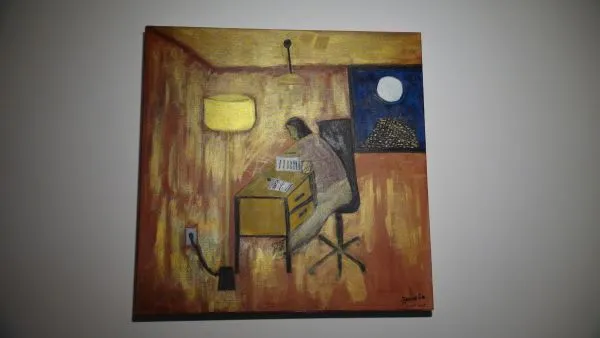
A fatigue from screens. They are everywhere. Digital eye strain—asthenopia. Perhaps I am suffering from computer vision syndrome, perhaps. The first “screen” to occupy our gaze was probably the work of art painted by artists of the past, usually depicting the divine, power, a battle scene, or life itself.
Then photography appears, officially dated to 1826, created by the Frenchman Joseph Niépce. People began to stand before this new screen, this “miracle” that captured reality forever.
We arrive at the year 1895, and a great screen is born before human eyes: cinema. The first public exhibition takes place in Paris, thanks to the Lumière brothers, through the cinematograph. On December 28 of that year, Parisians were astonished by the scenes projected onto the big screen, in which workers could be seen leaving a factory.
It would not take long, and in the 1920s, it was time for the emergence of a screen that would revolutionize the world: television. This screen would enter every home and become a permanent member of every family. Mr. John Baird made the first demonstration of television in 1926.
Only 49 years later, a screen was born before our eyes that would change our lives and the way we see the world: the personal computer. It is the year 1975, when the Altair 8800 computer arrives on the market. Thus begins the era of PCs which, with IBM and Apple in the 1980s, would conquer the world, making old forms of communication obsolete.
The internet, which emerged in the military in the 1960s, gained life among ordinary people and businesses with the popularization of PCs. The computer screen becomes the new altar to which we direct our gaze.
While all this was happening, back in 1973, a man named Martin Cooper, an engineer at Motorola, invented the cell phone, giving rise to mobile telephony. This was the cradle of a new screen that would become dominant: the mobile phone screen, which, with Apple and Steve Jobs, took center stage in our attention.
The cell phone screen is today our world, our daily life, for better and for worse. Screens are everywhere. They seduce us, they imprison us. There is no longer any escape from them: they are everywhere. It was no coincidence that last Saturday I went to the market at Praça XV, Rio de Janeiro, in search of a typewriter.
I found it.
Beautiful, a little dirty, abandoned: an Olivetti Lettera 25, created in the 1970s. Despite its condition, it still even had the ink ribbon. The seller did not know how to operate it. I examined the beautiful white keyboard, its body, its typebars, its mechanism.
I fell in love.
I will take Lourdinha home. It even has its original case. A relic.
Lourdinha needs a bath, a roof, and attention. I promise her eternal love. And the best part: Lourdinha has no electronic, digital, illuminated screen, tiring my eyes, causing headaches, fatigue.
Lourdinha still knows how to sing. Her song reminds me of a train traveling along a road of letters that are imprinted on the white page—this real, tangible, concrete “screen.”
(This chronicle was written by Lourdinha.)
I feel revitalized. I have become more human, less machine, because Lourdinha is a real extension of my hands, my fingers, my ears.
Lourdinha does not need electricity, batteries, Wi-Fi, or internet. She only needs me, whole. And I need her, who is now my rest from the oppression of digital screens that dominate the world.
Welcome, Lourdinha. You have always been, since I was a boy, my favorite “toy” in my Aunt Lourdes’s house.
Get Francis_Ivanovich’s stories in your inbox
Join Medium for free to get updates from this writer.