Why More ARM Developers Are Choosing Modular Solutions

As embedded and edge devices become more complex and intelligent, ARM developers are reevaluating how they architect their hardware. Traditionally, the System on Chip reigned supreme — offering high integration and cost-efficiency. But the push toward faster deployment, hardware reusability, and AI capability has opened the door to a more flexible path: the System on Module.
Modular solutions are quickly gaining favor among development teams building industrial systems, edge AI devices, and intelligent gateways. This shift isn’t just about convenience — it’s about staying competitive in a rapidly evolving market. Let’s explore why more engineers are choosing modular design over custom silicon-based integration.

What Is a SoC? The Classic Embedded Design Approach
A System on Chip condenses CPU, GPU, memory controller, I/O interfaces, and sometimes connectivity features into a single silicon chip. This makes SoCs highly compact, energy-efficient, and cost-effective — especially in consumer electronics where high-volume manufacturing offsets development overhead.
SoCs are commonly found in smartphones, smartwatches, and IoT sensors. Their compact nature reduces the bill of materials and enables sleek, low-profile designs. However, leveraging a raw SoC in an embedded design usually requires deep hardware expertise and lengthy development cycles, including custom PCB layout, power management, and thermal optimization.
What Makes SoMs Different — and More Flexible?
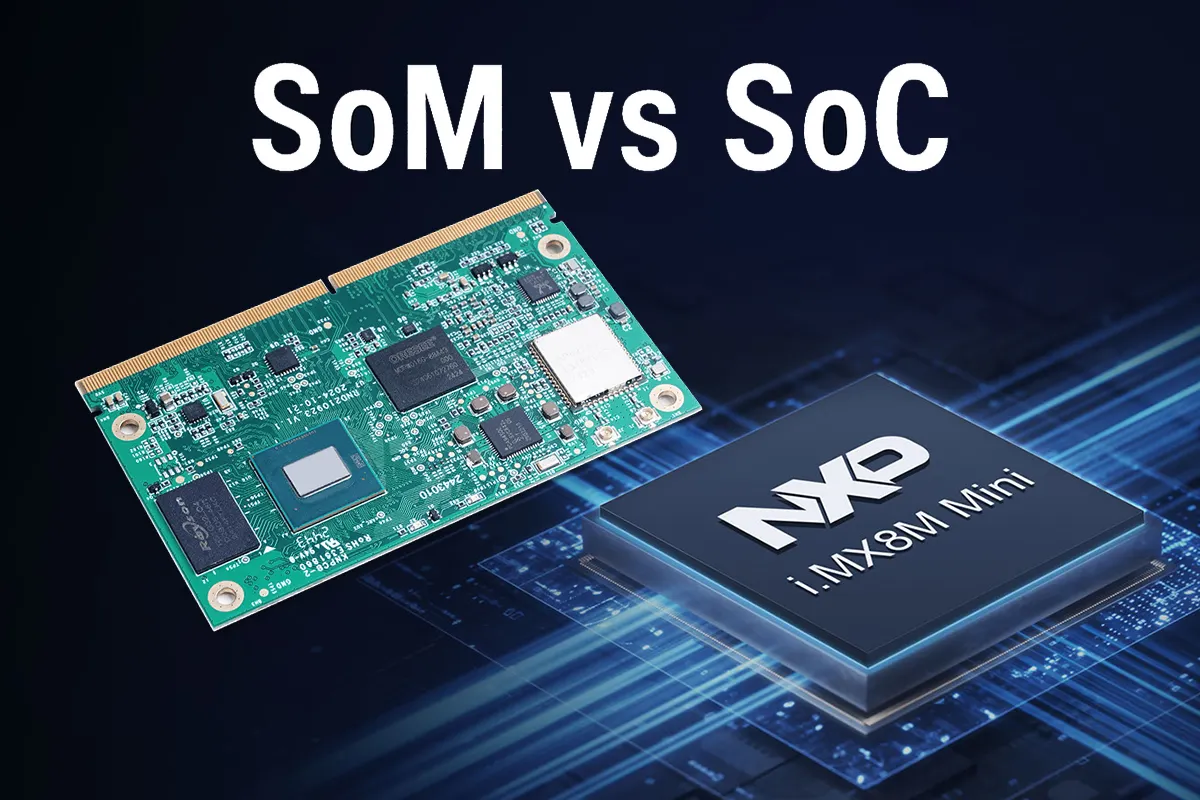
A System on Module takes a different approach. It packages the core processing unit — often a SoC — along with memory, storage, power management, and common interfaces on a compact board. This module plugs into a carrier board that handles application-specific I/O and connectors.
Key advantages of SoM-based designs:
- Separation of concerns: Developers can iterate on the carrier board without touching the compute core.
- Reduced complexity: No need to design DDR layout, power rails, or high-speed signal routing from scratch.
- Faster time-to-market: Pre-certified modules come with BSPs, compliance support, and documentation.
- Scalable performance: You can swap modules with higher-performance variants without redesigning your carrier.
This modularity makes SoMs ideal for product lines that need flexibility, upgrade paths, or quicker turnaround.
Why Developers Are Moving Toward Modular Solutions
SoCs remain an excellent choice for simple, high-volume devices. But for industrial systems, edge AI platforms, and configurable gateways, developer needs have evolved:
- Speed: Time-to-market pressure makes full SoC design risky and slow.
- Adaptability: Hardware requirements change — especially for connectivity, storage, or display interfaces.
- AI Integration: Many SoMs now integrate NPUs (Neural Processing Units), making AI acceleration easier.
- Maintenance: Modular hardware allows field upgrades or product variations without a redesign.
- Team efficiency: Fewer hardware engineers are needed to launch a working prototype.
The result? Developers now prefer to offload low-level hardware design and focus on application logic, system integration, and value-added features.
SoM vs SoC: Key Differences That Matter
Here’s how System on Module vs System on Chip compares across key categories:
Get Geniatech’s stories in your inbox
Join Medium for free to get updates from this writer.
FeatureSoCSoMDesign ComplexityHigh — full board design requiredLow — module handles critical subsystemsTime-to-MarketLongerMuch fasterFlexibilityLow — fixed I/O and layoutHigh — customizable carrier boardScalabilityLimited reuseSwap modules to scale product linesSoftware SupportVariable — depends on vendorUsually includes BSPs, SDKs, and toolsCost EfficiencyBest at high volumesBetter at low-to-mid volumeMaintainabilityCostly to modify or patchEasy to upgrade or replace compute unit
Software & BSP Support: A Big Reason Developers Choose SoMs
ARM developers working on embedded Linux or Android platforms value robust Board Support Packages (BSPs). SoMs usually come with pre-built software stacks, kernel drivers, and documentation that align with your chosen operating system.
This simplifies software development and allows for:
- Faster debugging and bring-up
- Easier integration with AI toolkits and middleware
- Better community and vendor support
- Long-term kernel maintenance (critical for industrial deployments)
In contrast, raw SoC designs may require building your own BSP, porting drivers, and validating custom hardware — an expensive and time-consuming process.
Real-World Examples: From Prototypes to Scalable Products
Consider an industrial automation company developing a smart controller for predictive maintenance. Originally built with a custom SoC board, the product faced long delays due to layout complexity and EMI compliance issues.
By transitioning to a SoM-based solution, the team:
- Cut development time by 40%
- Gained flexibility to add 5G connectivity and AI acceleration
- Easily scaled the same carrier board across multiple performance tiers
Similarly, many edge AI startups now prototype with SoM development kits and bring the same compute module into production with minor adjustments. This reduces engineering overhead and ensures consistency between proof-of-concept and deployment.
Geniatech’s Role in Supporting Modular Transformation
Geniatech has long supported embedded developers with a wide range of modular computing platforms. Our ARM-based SoMs are built on leading SoCs from NXP, Rockchip, and Qualcomm, and are available in industry-standard form factors like:
- OSM (Open Standard Module)
- SMARC and Qseven
- Custom B2B and edge AI modules
We offer full BSPs, reference carrier boards, and long-term support programs — helping developers reduce risk and focus on building differentiated solutions. Whether you’re working on a vision AI product, gateway, or industrial HMI, Geniatech provides scalable platforms that evolve with your needs.
Conclusion: The Future of Embedded ARM Design Is Modular
The conversation around System on Module vs System on Chip is no longer just academic — it’s a practical decision that impacts project speed, flexibility, and total cost of ownership.
While SoCs still serve ultra-compact and cost-sensitive products well, the demands of modern edge computing and embedded AI increasingly favor modular approaches. By shifting to SoMs, ARM developers can accelerate innovation, reduce complexity, and build more adaptable, scalable products.
Modularity is no longer a convenience — it’s a strategic advantage.