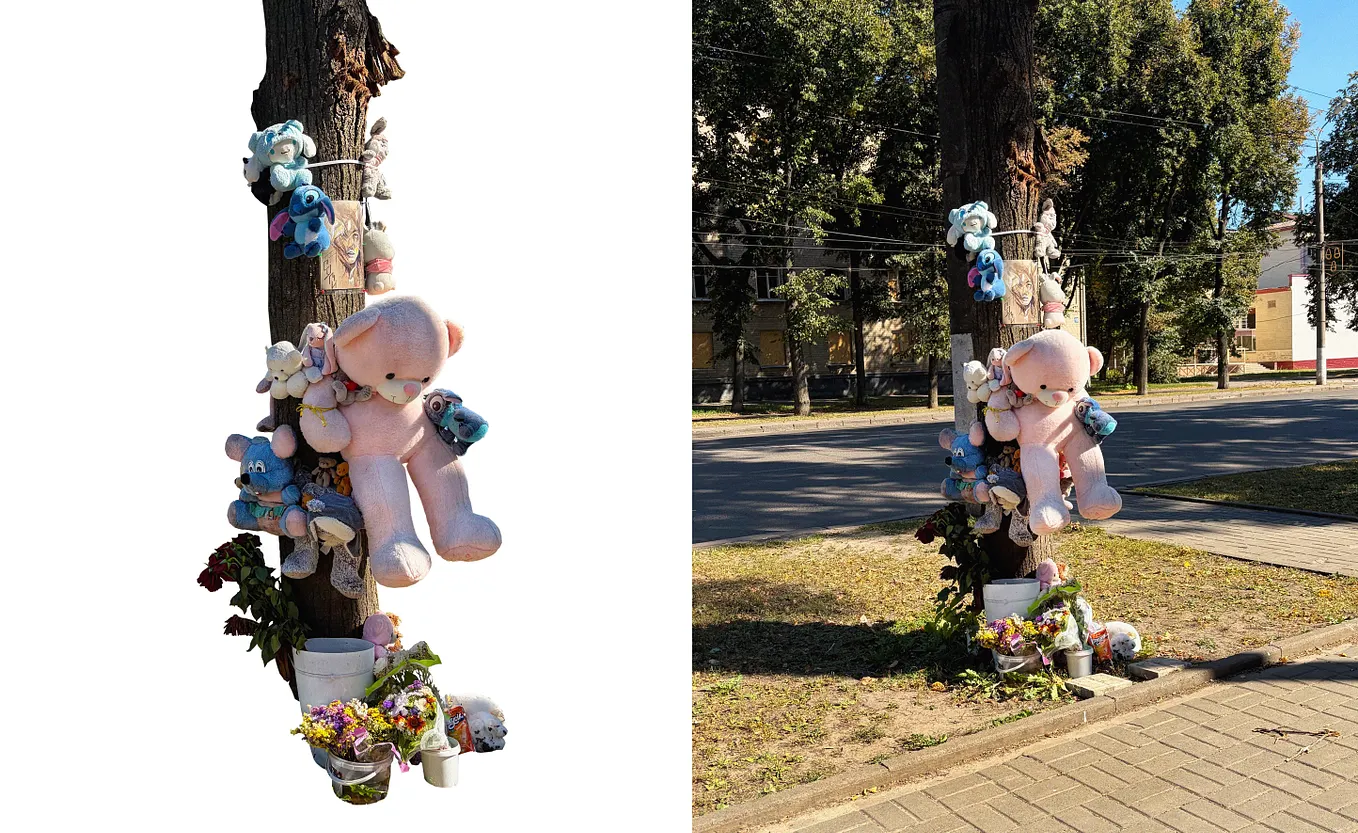
‘Around Here, Everything Is a Memorial’
The Stones That Hold Kramatorsk’s Memory

Just as I was preparing to go there in spring 2026, I was warned: don’t go, because you could die there and never finish your book — there are wait-and-strike drones lurking everywhere along the highway. But I went anyway. In the city, I was met by journalist Maksym and photographer Denys from the local media outlet Kramatorsk Post.
“Everything around here is already considered a memorial,” Denys remarked as we walked from one bomb-damaged building, where people had died, to another.
For instance, one section of the street has already become a kind of ‘wartime calling card’ — not only because of the ruined structures, but also because of the graffiti left on the rubble surrounding them: “Take revenge on the Russian bastards”, “I hate Russia,” and tags from the Kyiv volunteer group Los Solomas scattered across different parts of the wrecked high-rise.


Seven people were killed in this building, which was split in two by an aerial bomb on July 31, 2025. In photographs from that year, you can see that someone had hung fresh flowers here. They withered, and a year later, a more durable mourning wreath of artificial flowers was hanging on the fence instead.

In another spot, inside a local park, there were markers of a different kind — not spontaneous memorials, but official foundation stones announcing plans to erect permanent monuments on those sites.
Get Grassroots Memory Project’s stories in your inbox
Join Medium for free to get updates from this writer.
“In memory of all those who died,” reads one.
On another: “A chapel will be erected at this site to honor the memory of the citizens who died during the tragic events in east of Ukraine, specifically in Kramatorsk”.
These memorial markers were erected long before the full-scale invasion — as a reminder of the war’s early years. In the spring of 2014, Russian forces controlled Kramatorsk for nearly three months, and on February 10, 2015, seventeen people were killed here by a Smerch rocket artillery strike.


A similar foundation stone stands at the railway station, placed to mark April 8, 2022, when a Russian Tochka-U missile struck evacuating civilians, killing 59 people. In the days following the attack, the entire station grounds were covered in flowers and soft toys brought by locals. The next day, Ukrzaliznytsia, Ukraine’s national rail operator, carried out a poignant commemorative action: on long-distance trains across the country, seat number 52 was left empty, occupied only by flowers for the 52 victims confirmed at the time.
If you’d like to support my independent field research and documentation, you can donate directly via Ko-Fi.
For over three years, as Ukrainian soldiers continued to say goodbye to their loved ones on these platforms, that stone remained the site’s primary marker. In a city living under constant threat — and even more so now, with occupying forces reported to be just 10 to 14 km away and Kramatorsk classified as an active combat zone — erecting permanent granite monuments was simply out of the question. Survival was, and remains, the sole priority.
On my way back by bus, a man who got off in Sloviansk immediately switched on his drone detector. As soon as the driver stepped on the gas, the woman next to me began crossing herself. She kept crossing herself as we drove under anti-drone nets, past signs warning “Caution: Drones” and through the remaining stops on to Izium — all the way to Kharkiv.