When the Forest Returns


Not long ago this land was dirt and pasture, not suffering complete death but in ecological purgatory. Today we are under a covered platform and have views of lively, verdant hills, a winding river, and a small town below. A hotplate and coffeemaker are the centerpieces of a wooden table. I imagine our host, Eduardo, spends countless hours here admiring the view. We are in the outskirts of Oxapampa, in the ceja de selva (“eyebrow of the jungle”), where the Andes drop into the Amazon Basin. Eduardo passionately explains Peru’s Private Conservation Area system.
This system permits individuals and communities to obtain special designation for areas under environmental protection. These areas are typically much smaller than a national reserve, but they can hold ecological importance. Owners have to live up to their end of the bargain (for example, by reforesting land that was previously pasture) in order to obtain and keep the designation. However, they can earn income via a variety of methods such as ecotourism or by selling produce.
Eduardo left the grey metropolis of Lima after retiring from 30 years at IBM. Having already fallen in love with Oxapampa, he was convinced to buy a parcel of land and protect it under the Private Conservation Area designation. He’s now part of a network of such owners around Oxapampa.
Food Forest

We commence the tour in an area of coffee bushes and fruit trees, a small food forest. Eduardo is talking the whole time, pointing out avocado, coffee, and quito quito plants. His passion is obvious; Eduardo seems to know the Spanish, English, and scientific name of each plant and animal in the region. We are strolling on a steady incline, and the path is shady despite having been pasture only two decades ago. Birds are squawking and tweeting, and the buzzing of insects is constant.
Before long the path narrows, and we appear to head into a mesh of leaves, lichen, and moss. The entire spectrum of green is before us. Eduardo explains his straightforward strategy for reforesting: remove invasive plants, leave everything else, and plant 1000s of new plants. One walnut tree the he planted six years ago is already four stories tall.
Get Brad Goodman’s stories in your inbox
Join Medium for free to get updates from this writer.
In short time we arrive to a lookout platform. The view is pleasant, including the hills, river, and thousands of trees. A handful of walnuts and ulcumano trees peep out from the sea of palm leaves.
The Top Mirador (Lookout)

From here we zigzag up the path to the top lookout platform. Eduardo is still talking about conservation in the jungle and pointing out his favorite plants. I notice that he never rolls up his sleeves or his pants, and he even sprayed repellent on his hands. At one moment we all go silent, as we lightly approach a stand of trees often visited by monkeys. The seconds stretch out, each pregnant with anticipation as we tilt our ears towards the canopy.
Alas, we were the only primates around that day.
Eduardo tells us about a small creek leading down the hill in this section. It died with the forest, when people cleared the area for pasture. Yet after Eduardo and his team reforested the area, they wondered about the creek. Sure enough, after the trees and soil were back in place, the ecosystem began functioning again, and the creek returned.

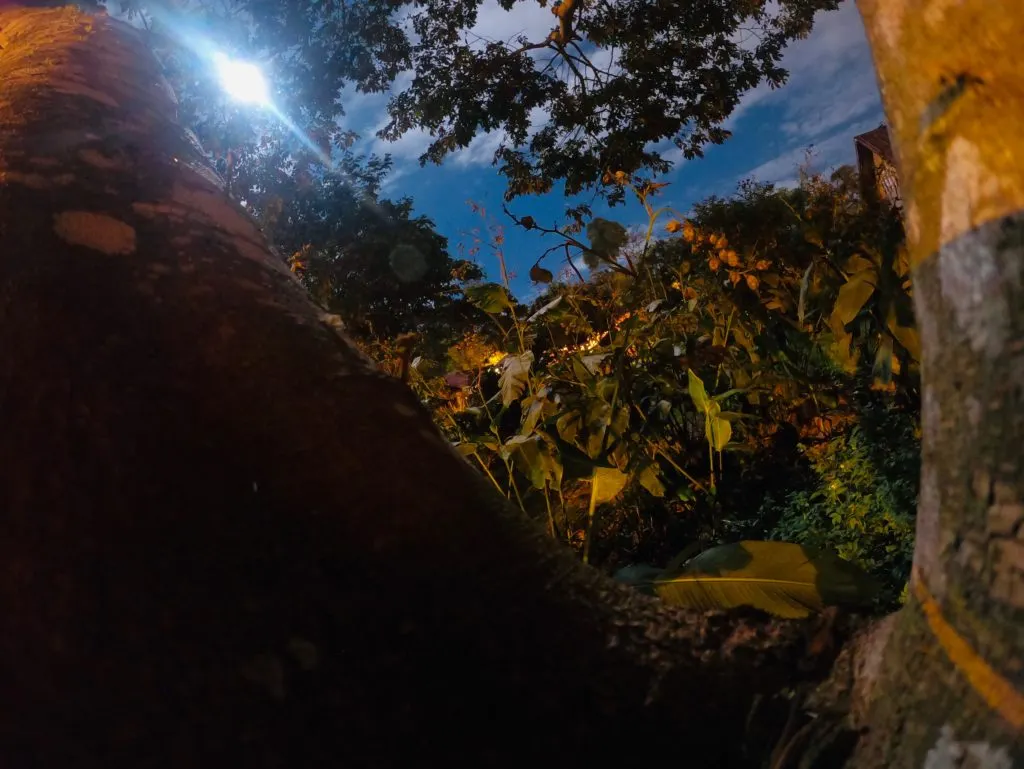
From here, the trail dips into the final section, the only one with primary yungas forest. It smells fresh and wet, of hummus but a distinctly new type to me. This is an ancient, healthy hummus. Our steps are bouncier, as the centuries of layering have made the soil rich and spongy. The old growth forest was intoxicatingly relaxing, like a mind massage. The living ecology textbook that is Edcuardo describes the crucial role that soil plays in rainwater absorption and filtration.

As if on command, the rain starts and provides a real-life lesson as we head back through the secondary forest. The canopy prevents us from getting wet, so we hear the drip drip dripping but stay dry. Twenty years ago, the area would have flooded, sending a dangerous flow of mud, sediment and water to river and town below. Today water filters into the hillside, and it nourishes the plant life as it makes its way to the river. Instead of rushing to the valley in a matter of minutes, the rainwater will take half a year to reach the same spot. We marvel at this restoration success as we approach the end of the walk.

Ten minutes later, we are approaching the first platform, the one with the coffee maker. Eduardo is excitedly motioning me over to a tree. On a branch is a black, ladybug-like insect with white spots. Eduardo made the first-ever sighting of this species in the entire region, demonstrating that the insect’s range is considerably larger than previously thought. It is all logged in his iNaturalist account. His ever-present smile is even larger as he finishes the story.
The forest at Churumazu, with the exception of the primary yungas section, is not even two decades old. Yet it is full of native trees, food forest, animals that had scattered away, and even a regenerated river. Of course, the town now benefits from cleaner water and fewer floods, too. The lesson is both humbling and obvious; restoring ecosystems also recovers elements crucial to our survival.
If you’d like to visit Churumazu, book a tour on their webpage: https://linktr.ee/bosquedechurumazu