Language Is Leadership — How Words Shape Educational Belonging (Article 1 of 6)
If language creates culture, what does the language of our education system say about who we value?
When nations talk about education, their words do more than describe — they reveal what they believe about people. Language is a leadership tool and a mirror. It shapes how societies imagine community, who they consider worthy of investment, and what it means to learn.
In every country, education policy is crafted through words, and those words carry power. They are not neutral. The language that governments choose to describe students, citizens, or communities is a form of rhetorical leadership — the ability to lead through meaning. Some countries use language that unites; others use it in ways that isolate or obscure responsibility.
Rhetorical Leadership: Policy as a Mirror of Culture
Language and leadership are inseparable. As the essay explains, “Language is a leadership tool and is only as capable as the people who use it” (Muhammad, 2016). When policy writers speak, they do more than issue mandates — they articulate a society’s sense of community.
Policies are “performative,” not static. They act. They embody the shared values and power relationships of a nation. When leaders choose words like “our children” instead of “students,” or “citizens” instead of “workers,” they frame education as either a communal mission or a transactional service.
In nations where education policy is grounded in a shared sense of belonging, language becomes a catalyst for humanizing practices. Where policy language is impersonal or bureaucratic, education risks becoming a system that reproduces privilege rather than cultivates learning.
The Language of Privilege and Compromise
A comparative analysis of national education policies reveals how rhetoric encodes privilege or compromise into the very structure of governance. The contrast is striking.
United States — Key Language: “Promote student achievement and preparation for global competitiveness.” (U.S. Department of Education)
United Kingdom — Key Language: “We work to achieve a highly educated society in which opportunity is equal for all, no matter what their background or family circumstances.” (UK Department for Education)
Canada — Key Language: “Parents have the primary responsibility for educating their children… provincial governments assist.” (Government of Canada)
Finland — Key Language: “All people must have equal access to high-quality education… irrespective of their ethnic origin, age, wealth, or where they live.” (Ministry of Education and Culture)
Singapore — Key Language: “The wealth of a nation lies in its people — our young, our children, our citizenry.” (Ministry of Education, Singapore)
This analysis shows that the United States and United Kingdom tend to use object-specific language — “student,” “children,” “family” — without relational context. The absence of possessive or inclusive terms (like “our” or “citizens”) reflects an education system that treats people as data points rather than participants.
By contrast, Canada, Finland, and Singapore use subject-specific language — “our children,” “all citizens,” “every resident” — that centers the learner as a person (Muhammad, 2016). This subtle linguistic difference signals a profound moral distinction: some systems educate to compete, while others educate to belong.
(All excerpts drawn from official government education websites as cited in Muhammad, 2016.)
Visual Rhetoric: How Websites Tell the Same Story
A visual analysis of government education websites reinforces linguistic divides.
- The U.S. Department of Education homepage hides its mission statement behind an “About Us” link buried at the bottom of the page. Its most visible links — Loans, Grants, Data, Laws — suggest a system concerned with compliance and cost.
- The United Kingdom’s Department for Education site presents similar challenges; policy information sits several layers deep and is accessible only through bureaucratic navigation.
- In contrast, Finland’s Ministry of Education and Culture and Singapore’s Ministry of Education both feature education prominently on their homepages, linking immediately to accessible statements about purpose, equality, and people.
These design choices are rhetorical acts. When information about national education values is hidden behind administrative layers, it communicates who is expected to seek it — and who is expected to already understand the system.
Get Dr. Mursalata Muhammad’s stories in your inbox
Join Medium for free to get updates from this writer.
When it is public, direct, and people-centered, it communicates trust, inclusion, and purpose. “In this sense, education remains a privileged resource available to those who can find it” (Muhammad, 2016).
(All excerpts drawn from official government education websites as cited in Muhammad, 2016.)
Language as a Measure of Leadership
Words reveal who belongs to the learning community and who must fight to get into it. They can build bridges or boundaries. Paulo Freire writes in Pedagogy of the Oppressed that “when a word is deprived of its dimension of action, reflection automatically suffers as well.” In other words, language without praxis — without the willingness to act on what it says — is reduced to “idle chatter” (Freire, 1970, p. 87).
Freire’s insight remains urgent today. When national education policies use rhetoric that isolates rather than includes, the result is an education system that sounds fair but operates unjustly. Leadership begins not with grand reforms, but with words that model inclusion and accountability.
Human Literacy and the Language of Belonging
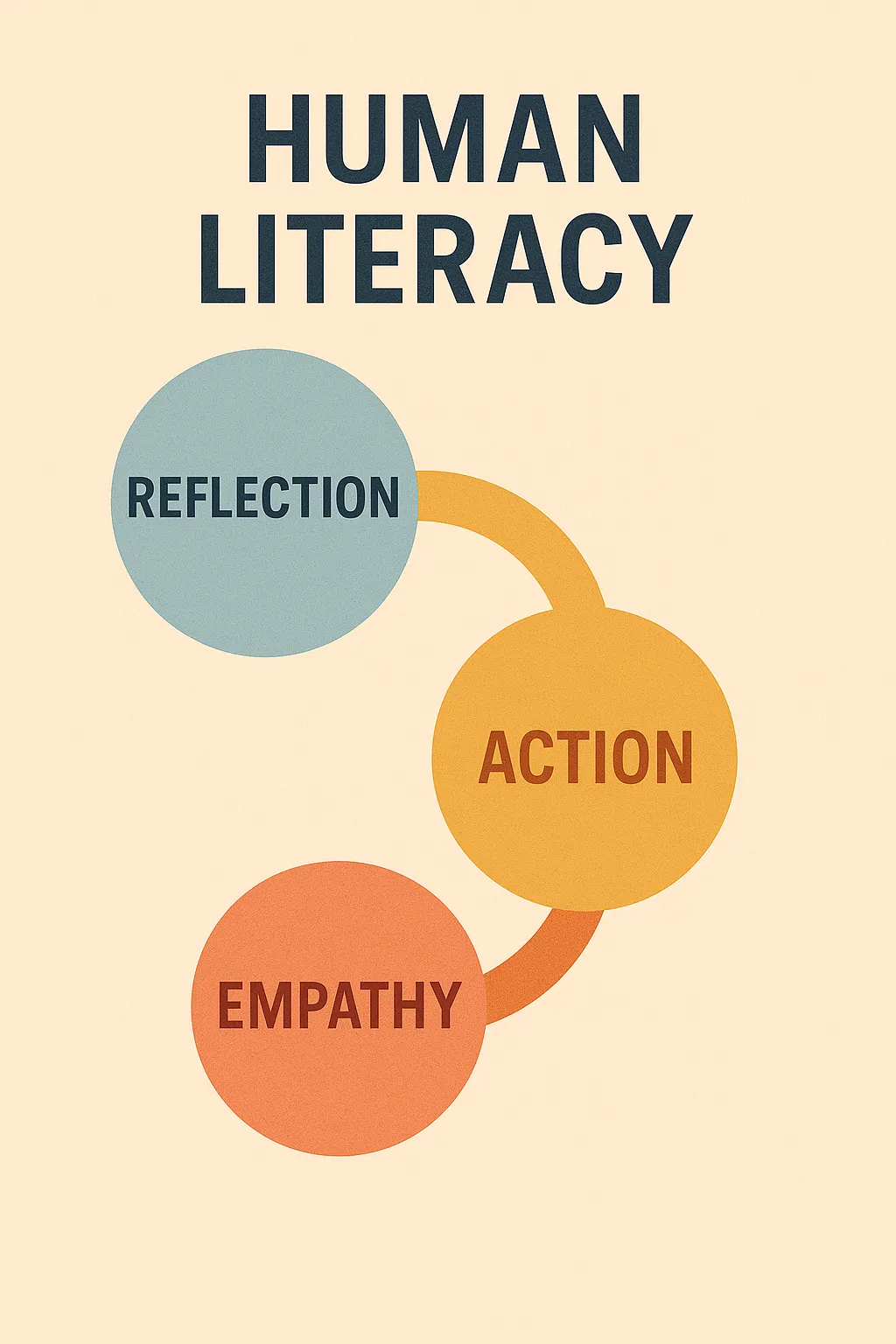
At its core, this discussion returns to the concept of Human Literacy — the ongoing process of “becoming and being human through practices that allow us to recognize our humanity and the humanity of others” (Muhammad, 2016). When leaders and institutions use humanizing language, they invite people into a relationship. They make education a shared project rather than a private privilege.
Language, then, is not just a policy instrument. It is an ethical practice. It signals whether a nation’s education system is designed for achievement or for understanding, for competition or for cooperation.
My Takeaways:
- Leadership begins with language and the rhetoric ingrained in it. The way our institutions speak reveals who belongs, who is seen, and who is left out.
- If we want educational systems capable of humanizing rather than sorting people, we must start with the words we use to describe what learning — and being human — actually means.
Share Your Takeaways.
References and Further Reading
- Council of Ministers of Education, Canada. (2016).
- Freire, P. (1970). Pedagogy of the Oppressed. Continuum.
- Ministry of Education and Culture, Finland. (2016).
- Ministry of Education, Singapore. (2016).
- Muhammad, M. (2016). The cultural economics of global education: Privilege, compromise, and human literacy [Unpublished essay]. PhD in Leadership and Change Program, Antioch University.
- Organisation for Economic Cooperation and Development. (2016).
- Organisation for Economic Cooperation and Development. (2025). Learning Compass 2030.
- U.S. Department of Education. (2016).
NOTE: This is one of six articles in The Educational Architect Series | The Cultural Economics of Education — Why Human Literacy Matters. The Educational Architect Series (T.E.A.) shares reflective articles that explore how learning, care, and equity shape the world we build for one another. Specifically, the writing published here explores what it means to design education that honors human dignity, fosters access, and strengthens our shared democratic promise.