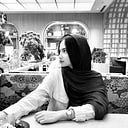
There is a voice that never tires of calling me home, even when I myself don’t know where to return. That voice is not the echo of the adhan, nor the gentle whisper of the night that cradles the starlit sky. It is Bunda’s voice. Perhaps, there will never be a sound more perfect for a child than the low and steady hum that rises from a mother’s chest, when she utters their name with both affection and silent worry.
Bunda is the home I never built, yet have lived in all my life. She has no tall pillars nor majestic walls. She is a structure formed by prayers whose beginnings I never witnessed, by tears that fell silently on long prayer mats, and by a patience that seems impossible for any human being to possess — except a mother.
When I was a child, I believed all mothers were like Bunda. Serving fried rice at dawn despite racing against the office clock. Mending a torn skirt at one in the morning. Nursing her feverish child while refusing the luxury of a nap for herself. But time, with its slow and steady hand, revealed that not every mother is Bunda. And that I have been, and will always be, living in a kind of luxury that many will never know: the love of a woman who chooses to love unconditionally, and lose without complaint.
Bunda is not a woman who writes poetry. Yet the way she arranges rice on a plate, wraps love inside banana leaves, and tucks prayers into folded clothes, is more poetic than any verse I’ve ever read. She may not be able to explain Stoicism or existentialism, but she knows how to simplify sorrow into a single sentence: “You can do it, dear.”
If life is a stage, then Bunda is the spotlight no audience ever sees — but without her, not a single scene would make sense. She stands behind the curtain, preparing costumes, fixing hair, encouraging from a distance, and smiling just small enough not to steal the spotlight, yet deep enough for my heart to know I am loved — without needing to be perfect.
Now, as the years race forward and the lines on her face begin to form a map of loyalty, I am haunted by a fear I have never truly been able to voice. The fear that one day, that voice will be gone. That the plates will be empty, not because we forget to eat, but because there are no longer hands that serve love. That the house will still stand, but feel collapsed — because its soul is no longer there.
Bunda was not born into a gentle world. Nor did she grow beneath a calm sky. She met the cruelty of life long before she ever knew the meaning of “comfort.” While girls her age played jump rope and mimicked songs from the village radio, Bunda was knee-deep in the muddy coast, hunting oysters between coral rocks, walking faithfully under the scorching Banda Aceh sun that spared no mercy.
Get Iffaizh’s stories in your inbox
Join Medium for free to get updates from this writer.
That little girl — who would later become my Bunda — walked the shore not to witness sunsets, but to survive the day. The sea was no postcard view; it was her classroom in resilience. Every morning, her small body not yet twelve years old, she combed the beach with a cloth sack, searching for oyster after oyster. The cold seawater, sharp coral, and the peeling skin from salt and tides were her daily companions. Yet never once did Bunda curse life, nor weep in complaint to the world.
And through it all, one thing in her never dimmed: her passion for school. She never missed a day, though her shoes were torn and her uniform faded. She borrowed pencils to write, copied lessons by hand, and at night, studied under the dim light of an oil lamp. Bunda came from a fisherman’s family — in a village at the western edge of Indonesia, a place that in those days barely received a glance from the nation. But Bunda was never pessimistic. She believed books could be boats to sail her dreams beyond poverty.
Then came the year that tore through time: 2004.
That day, the world was cruel to Bunda. She was already a wife. Already a mother to two small children, heavily pregnant. But she was still a daughter to her own mother. A daughter who lost her mother to the Tsunami. The sea, once her teacher in endurance, now took away the thing she loved most. The tsunami swept away her home, her city, and half her soul. Bunda lost her mother — the anchor of her life.
To this day, I can never fully imagine that wound. I was born during the heaviest years of her life. I only grew up in the arms of a woman who silently bore a tremendous grief — with a calmness that made me believe she had never been broken. But now, as I write this, I realize that Bunda’s life had long been battered by waves — far greater than I will ever understand. And yet she stood tall. She smiled still. She cooked rice for her family every morning, as if life had never stolen anything from her.
And among the ruins, the tears, and the salty stench of death, Bunda never gave up on life. She kept walking. She kept learning. She kept loving, even though life had repeatedly treated her with cruelty.
As a child, I often felt guilty. Sometimes I was angry when the rules at home felt too tight. Sometimes I complained because my lunch wasn’t like my friends’. Sometimes I wanted to break free from her embrace and seek my own version of “freedom.” But in every rebellion, Bunda never stopped loving me. She loved me even when I didn’t know how to love her back.
Bunda is the poem I’ll never finish, the prayer I’ll never grow tired of whispering. Bunda is the woman I honor with all my body and soul — and if I could, I would ask time to be a little kinder to me, so I could love her longer, so I could hold her tight enough that my body memorizes her shape, so my soul remembers every detail of her face even when time tries to make me forget.
And to Allah, I whisper in my most delicate prayer:
“Among all the things You must take from me one day… please, not Bunda first.”