It Was Bengal Before The World Knew Her
In the evening, Sagarika was already standing on the terrace watching the sun setting down, wondering how the world beyond her village was. She was nineteen. Old enough to have opinion about everything and young enough to believe world could surprise her.

She lived in a small village in Nadia district, West Bengal, in a house with a huge courtyard, a terrace, and a pond that reflected the sky better than any mirror in the house. Her mother had told her a hundred times not to stand too close to the edge of the terrace.
“Otto Dhare Jashna, Pode Jabi” — “You’ll fall one day.” But Sagarika never listened.
To her, the terrace was her window to the world.
She spent days sitting there, watching the fog in the morning, people nearby doing their household chores while others went for work. During the monsoon, when the earth smelled of rain, she would sit beneath the old mango tree, beside a pond and imagine if she could swim in a swimming pool someday.
The terrace and pond was her favourite place, but she couldn’t decide which one she loved the most. In the morning she would watch the sky from the terrace, the clouds passing by, the smell of nature, listening to birds chirping. Sometimes, she would dance, sometimes she read books, sometimes she would draw, and sometimes, she would imagine how the world beyond her village road was. What is it like? How are the people there? What type of lifestyle do they have?
Morning in Her Bengal
The first sound Sagarika heard every morning was the broom sweeping across the courtyard.
Jhar-jhar-jhar.
That was her alarm clock. Then came the bicycle bell of the milkman. Tring-tring. Then the distant sound of a temple bell. And finally, her mother’s voice. “Maa, uthe por. Cha ta thanda hoye jacche.” Get up. The tea is getting cold.
The kitchen was already alive. Rice was being washed in a steel bowl. Mustard oil was heated in a small iron kadai. Potatoes sat on the wooden chopping board. A green chilli was being crushed with salt.
Then came the sound Sagarika loved the most. The moment the panch phoron touched hot oil. The tiny seeds crackled. The smell travelled through the house before the sun had properly risen. Bengal entered Sagarika’s day through smell. Mustard oil, fried potatoes, steamed rice, wet earth, incense and shiuli flowers. The food was simple. A plate of steaming rice could hold an entire afternoon. Dal. Alu bhaja. A little shukto. Greens when they were in season. Fish curry when there was fish. And on special days, payesh.
She knew that food could tell you where you belonged. A particular smell could take her back to Durga Puja. A certain sweet could remind her of a neighbour who specially used to make it for her. And the taste of her grandmother’s fish curry could make her feel six years old again.
Her grandmother never wrote the recipe down.
“Why would I?” she would say. “You have eaten it your whole life.”
Perhaps that was how traditions survived in their house.
Not through instruction manuals, through repetition, through memory, and by observing while sitting beside people in a kitchen long enough to understand what their hands were doing.
The Language of Her Home
Bengali was not merely a language in Sagarika’s house. It carried relationships.
There were words of affection that sounded too intimate when translated into English. There were expressions of irritation that somehow sounded funny even when someone was genuinely angry. There were sentences that could be simultaneously rude, affectionate and deeply familiar.
Get Sumana Sarkar’s stories in your inbox
Join Medium for free to get updates from this writer.
Her grandmother could scold her in one breath and feed her another piece of fish in the next.
“Ei mey ta sara din phone er moddey dhuke thake”. This girl is always staring at her phone.
Then, five minutes later: “Payesh ta khabi?” Will you eat the rice pudding?
Sagarika would laugh. That was home. She did not know the linguistic history of Nadia. She simply knew that when her grandmother said “aay”, come here, it sounded different from when her teacher said it. One felt like love and the other felt like instruction.
Durga Puja and the Art of Belonging
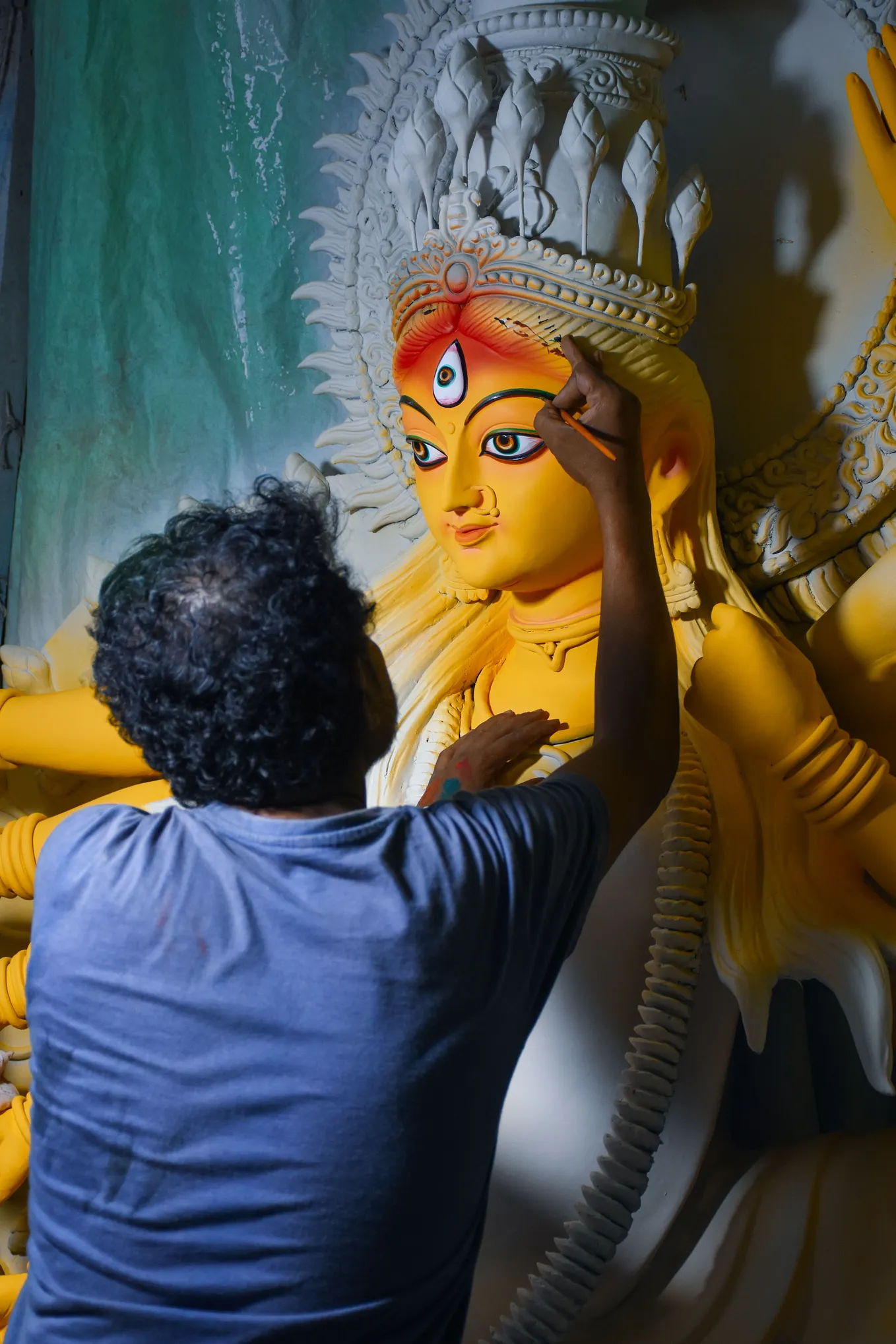
Bengal transforms into a different way when sharad (autumn) arrives, so does the whole village. The quiet streets became louder. Homes were deeply cleaned and decorated with alpona (rangoli made in every corner with rice flour) and the smell of shiuli flowers. New clothes appeared. Food was prepared in larger quantities than anyone could possibly finish. Neighbours who rarely spoke during ordinary weeks suddenly had reasons to visit each other. Men argued over arrangements. Someone always knew where the best bhog was being served.
Sagarika loved the anticipation more than the actual festival. The days before the Durga Puja. The smell of new clothes. The sound of music. The excitement in her mother’s voice. The first glimpse of the idol. The moment the entire community seemed to breathe differently. She understood then that festivals were not only religious occasions. They were social memories. They reminded people who they were. And perhaps more importantly, they reminded them that they belonged to one another. Years later, when she would be living somewhere else, she would miss this most. Not the decorations. Not even the food. The feeling that for a few days, everyone was part of something larger than themselves.
The Road Beyond the Village
Sagarika often stood at the edge of the village road and wondered where it went.
Of course, she knew where it went. There was a railway station that reached a larger town and then towards Kolkata and beyond that. She wanted to reside in cities where nobody knew her family. She wanted to sit in places where people spoke different languages. She wanted to travel by flight. She wanted to work and earn her own money. She wanted to wear skirts without her grandmother asking whether she had become too modern and a saree without anyone assuming she was trying to be traditional. She loved the contradiction. She loved the choice. And perhaps most of all, she wanted to discover whether the world outside her village would feel as large as she had imagined.
While she loved the idea of family but wanted a life of her own. She could spend an evening listening to Rabindra Sangeet and the next morning argue with her mother about why daughters were expected to behave differently from sons. She would touch her grandmother’s feet and still disagree with her. That distinction mattered to her. For her, culture was not a museum. It was alive.
One evening, her mother found her standing by the road.
“Ki dekhchish?” What are you looking at?
She said “Rasta ta”. The road.
Her mother smiled. “Rasta toh roj-i ache.” The road is there every day.
She said “Jani”. I know.
Mom said “Tahole”. Then?
She replied: “Shudu Jante chai ei rasta ta kothay jaye”. I just want to know where it goes.
Her mother looked at her for a long moment. Then she said something Sagarika would remember for years. “Jekhanei Jaash, Bari ta mone rakish.” Remember your home no matter where you go. Sagarika smiled and said “ Oboshoi Rakhbo”. I will.
The Girl Who Left
Eventually, Sagarika would leave her village. Perhaps for somewhere beyond India. She would learn new languages. Eat unfamiliar food. Live in apartments without ponds. Wake up to traffic instead of birds. Work late. Make new friends. Fall in love with places she had never imagined. Her world would become wider. Her sarees might become fewer. Her grandmother’s hands would become slower. Her mother’s voice would change with age. What will stay is the memory of her village life, that old photo, the smell of the soil when it rains, her grandmother’s “macher jhol”, fish curry recipe, and her mother’s voice “Jekhanei Jaash, Bari ta mone rakish”, and that would take her to the nineteen-year-old girl again.
Till then she would realise: Some places do not simply belong to your past. They become part of the person you carry into the future. And Sagarika — wherever the road takes her — will always belong in her heart, to Bengal.