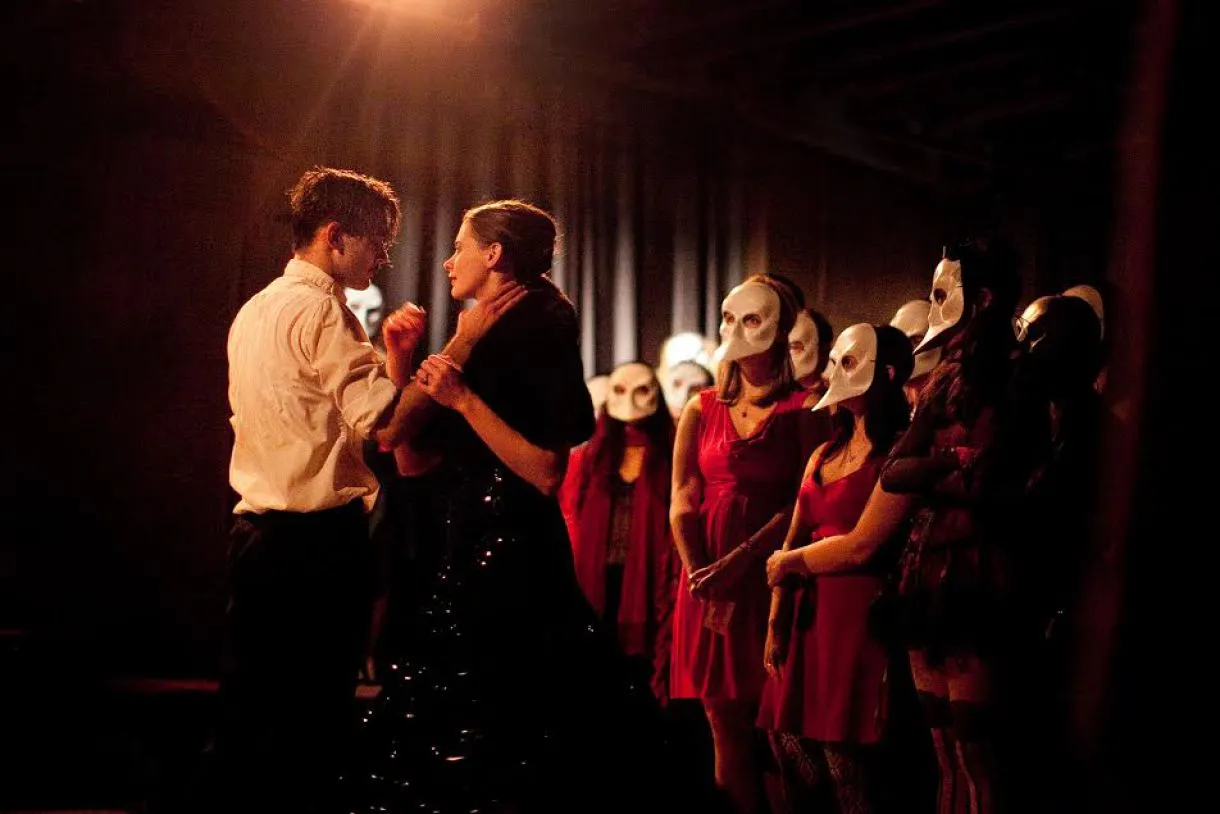
Masquerade
An Immersive Phantom of the Opera Experience

Experienced in New York City ~ June 2026

The Experience & How It Works
You purchase a ticket to the experience and, the day before, receive a secret password that grants admission to the show.
Upon arrival, guests may check bags at coat check and receive a mask if they did not bring one. Attendees whose attire does not match the dress code (see Hot Tips below) are provided with a black cloak to wear over their clothing.
Guests are then invited into a room where they are offered a glass of champagne. An actress welcomes the audience and reads a letter from the Phantom of the Opera. Then, after learning a simple dance move, the audience is ushered into a masquerade ball where they song that the dance move matches is playing.
For the rest of the experience, the audience moves from room to room as the story unfolds. Sometimes this means simply walking down a hallway. Other times it involves traveling up or down stairs or using an escalator. Typically, a single scene takes place in each room; occasionally, there is more than one.
Some rooms contain limited seating while others are standing-room only. Most of the time the audience remains together as a single group, though at least one scene divides the audience into smaller sections before bringing them back together.
Audience presence is essential, but direct participation in the story is limited. Guests may be offered the opportunity to throw roses following a performance or hold an object for a character. That being said, audience members are generally up-close observers rather than active participants.
Why It’s Interesting, IMHO
“The Phantom of the Opera is there…” In other words, it’s a well known—dare I say “mainstream”—show! Masquerade uses a well-known piece of intellectual property to introduce new audiences to immersive entertainment. Several audience members shared with us that it was their love of or interest in Phantom of the Opera that brought them to the show. The immersive element was intriguing, but secondary.
This show is ambitious. The production occupies a large footprint—at least, it feels large. (They seem to have cleverly reused some of the rooms for different purposes during the evening.) Audiences move through numerous spaces, each with its own scenic treatment, props and atmosphere—often quite detailed. (While unknown at the time of booking, it turns out that the venue occupies the former home of Lee’s Art Shop, a longtime New York institution. We expect the escalators are from that previous life.)
Masquerade is also currently one of the most talked-about immersive productions in New York City and commands a substantial ticket price.
On a personal note, nearly a decade ago, I performed in an improvised sitcom show in Los Angeles called Instant Friends, in which the cast improvised entirely new episodes of Friends. In one particularly memorable episode, Chandler somehow discovered a Phantom-of-the-Opera-style lair beneath his New York City gym, complete with underground boating and an appearance by the Phantom himself.
As a result, one of my favorite moments in Masquerade was the boat sequence. It immediately reminded me of that show and, more broadly, felt like one of the moments where the immersive format was being used to create something that would be difficult to replicate in a traditional theatre. The sequence had a theme-park quality to it — in a positive sense — and was one of the moments that most fully transported me into the world of the production.

Initial Impression & Critical Discussion
Audience Frame vs. Audience Story
One of the questions that surfaced throughout the evening was: What exactly is the audience within this experience?
At the beginning of the show, a letter is read that appears to invite the audience into the Phantom’s memories. I think this framing is extremely important if not exactly clear. It uses phrases written by the Phantom himself, like “witness my private Masquerade,” “the spectacle here presented,” and “guide you through my darkest dreams.” This language makes it unclear whether what the audience is about to witness is fiction or fact and, if fact, whether it’s past, present or future.
The only way parts of the show logically work is if one understands from the outset that one is entering someone’s memories rather than witnessing events unfolding in the present. And yet, dreams are not the same thing as memories and a Masquerade is not clearly reflection rather than event.
Therefore, the challenge is twofold: the framing goes by very quickly, and the framing may not accurately or instructively frame the show. As a result, I spent much of the show trying to understand what role the audience was intended to play.
We wear masks. Characters acknowledge our presence. Physical objects are handed to audience members. At the end of the show, audience members are asked to remove their masks in parallel with the Phantom’s younger self being unmasked.
This raises interesting questions.
Are we observers?
Are we memories?
Are we manifestations of the Phantom’s psyche?
Are we participants within the world?
I never felt entirely certain.
There is arguably a story for the audience, but it is unclear what it is. That led to the question of whether there is an audience story at all, or even a successful an audience frame.
Memory, Fantasy, and Reality
Related to the audience-role question is a larger question of what is memory, what is fantasy, and what is reality.
One example involves a mirror.
During one scene, a younger version of the Phantom breaks a mirror. Later, Christine appears to notice the broken mirror as though it has only recently been damaged.
If the mirror was broken in the past, and Christine has spent years performing in the Opera House, it is unclear why she would react as though she is seeing it for the first time.
Perhaps there is an explanation I missed. Perhaps the moment is intended symbolically. Either way, rather than being emotionally invested in the moment, I was asking how the memory structure was meant to function.
A similar question arose at the end of the show.
Christine leaves with Raoul and then appears to return to the Phantom. It was unexpected based on what we’d just seen of the story. Only when she disappears did I shift my interpretation to recognize that this second appearance seemed intended to represent the Phantom’s fantasy or wish. But because she entered from the same location wearing the same costume, it was difficult to distinguish between the two readings in the moment.
There are other examples as well. At one point, a score that the Phantom appears to value greatly bursts into flames when opened by another character. Earlier scenes suggested that the score was important to him and perhaps unique. As a result, it was hard to determine whether the burning was intended to be literal, symbolic, or something else entirely.
Individually, these moments seem relatively small. Collectively, however, they repeatedly prompt the question of what is actually happening within the story world.

Sympathy for the Phantom
Several audience members I spoke with after the show noted that Masquerade expands the Phantom’s backstory and places greater emphasis on his childhood than previous versions of the material.
I could see how this production supports that take: The younger Phantom appears throughout the experience. There are moments involving the Phantom’s inner child that seem designed to generate sympathy and understanding. At the conclusion, the unmasking of the younger Phantom appears intended to represent some form of self-acceptance. I understood all of this intellectually, but it didn’t land for me emotionally. It’s possible that this is a side-effect of the unclear role of the audience; as the Taxonomy of Experience explains, certain POV combinations take the audience out of an experience rather than inviting them to empathize with the characters. Immersive is not necessarily empathy-inducing.
I also noted how this production made me feel about the Phantom in general. It did not make me love Phantom of the Opera more and, interestingly, it brought into focus some aspects of his character that are quite troubling. The Phantom repeatedly demands love. He attempts to control Christine’s choices. He threatens the man she loves. Up close and in the same room as him, those dynamics felt not romantic but coercive.
That being said, some people I spoke with had the opposite reaction. One audience member told me that the additional focus on the Phantom’s childhood resonated strongly with her and brought her to tears. She had consumed the show in various formats extensively in her own childhood and brought a personal history to the Masquerade performance.
For me, a casual audience to the show on a couple of occasions, what the show provided wasn’t enough to prompt a strong emotional reaction. Out of a desire to support the success of immersive, I’m tempted to blow it off and wonder if I was just in a critical mood or question if I am the sort of person to have an emotional reaction to shows. But earlier in the week I also saw Every Brilliant Thing and Chess—each slightly immersive in their own way while still being presented in a traditional Broadway theatre—and both brought me to tears in different moments. I understood what Masquerade was trying to do emotionally. In those moments intended to create an emotional impact, I simply didn’t feel it.
Character Agency & Stakes
When it comes to the question of character agency, one scene that particularly stood out involved Raoul being restrained while Christine remained physically free.
Get The Look Club’s stories in your inbox
Join Medium for free to get updates from this writer.
The situation presents extremely high stakes. Yet Christine makes no effort to free her love, attack the Phantom, escape, or otherwise alter the situation. If the man she loves is about to be killed, I would expect her to try to do something. She could try to free Raoul. She could grab one of the heavy objects in the room to attack the Phantom. She could engage with the problem in some way—any way. Even if such attempts would fail, seeing them would make her character more believable. It’s hard to believe her love is strong when she does nothing in the face of imminent death for her beloved. When a character acts out of character, it breaks the audience’s belief and shatters the world of the show, immersive or not.
The restraints themselves also raised questions. Throughout the scene, the audience is asked to accept that Raoul is trapped. We’re willing to suspend our disbelief, however, if we are to do so, the performers need to join us in that effort for it to work. The restraints appeared more symbolic than convincing especially since, when the Phantom ultimately releases him, Raoul is able to remove himself from them relatively easily. Even if the shackles appeared neither tight nor difficult to free oneself from, if he acted as if it were difficult to get out of them, the audience would be able to maintain their belief.

Comfort, Consent, & Proximity
During the performance, cast members physically touched me six times without ever requesting permission in any way (verbally, gesturally or other). This sort of handling did not bother all audience members; some attendees specifically cited audience interaction as one of the reasons they enjoyed the experience. However, interactivity and physical contact are not the same thing. Being physically handled without consent when it is neither necessary—there were other easy ways for performers to achieve their objectives—nor at all related to the story was unpleasant if not downright inappropriate.
The show also contains a circus sequence involving fire performance and other acts that audiences may find difficult to watch at close range. One performer swallowed and manipulated fire. Another appeared to hammer nails into her nose. While I understand that audiences have long been fascinated by sideshow performance, these can be hard for empathetic individuals to stomach up close. These same acts presented on a traditional stage would elicit a different level of discomfort. Proximity that changes the experience.
Relatedly, in a small rooms containing fabric scenery, the performers lit open flames and performed with fire. I don’t know whether the show met the fire code, but assuming it did, it’s worth nothing that audience experience is affected not only by actual safety, but by perceived safety. Standing in a flammable room with open flames, led to more greater contemplation of emergency exit strategy than the Phantom’s story. (This was compounded by the fact that the fire performance was not directly related to the story.)

Immersion vs. Imagination
One of the interesting questions raised by Masquerade is what it takes for immersion to strengthen emotional engagement. Traditional theatre asks audiences to imagine. Immersive theatre often replaces some portion of that imaginative work with physical presence. Is presence more powerful than the imagination?
One of the reasons musicals work is that they establish a layer of theatrical fantasy. Audiences accept that characters sing their emotions because the form itself invites them to do so.
Masquerade presents an interesting tension. Some of the music is diegetic. The story takes place in an opera house and characters are literally rehearsing and performing. Other moments are less literal. Characters sing emotions, desires, and internal states in ways audiences have traditionally accepted within musical theatre. What happens when those fantastical moments occur not on a stage fifty feet away, but three feet in front of you?
Immersion may reduce the need to use one’s imagination, but—unexpectedly to some—that may not always be a good thing for emotional investment. The closer I was physically to the performers, the more closely I found myself examining the mechanics, assumptions, and logic of the world. In making it immersive, the creators are asking us to believe, to some extent, in its reality.

HOT TIPS
- Dress the Part. The requested dress code is black, white, or silver formal/cocktail attire. Comfortable shoes are strongly recommended. Guests should expect significant standing and walking throughout the experience. This is probably not the place for stilettos.

- Arrive Together. Arrive early and make sure your entire party is present before entry. Members of the same party need to enter together; a late arrival can create serious complications.
- Prepare to Check Your Bag. Bag check is available, required and useful for guests arriving from work, sightseeing, or another event.

- Temperature May Vary. Different rooms have noticeably different temperatures. Some spaces felt quite almost unbearably warm (after a 90 degree day) while others were cold. Those sensitive to temperature may wish to dress in layers.
- Cocktails. Some alcohol is served during the show. The onboarding materials mention that non-alcoholic options are available; the were not easy to find in the moment. If this is a concern, ask an usher prior to entry. Additional cocktails are available after the show in the bar area.

- Audience Contact Occurs. Cast members physically touch audience members without requesting permission. If this is of concern, inquire before entry.


- Merchandise Exists. Merchandise is available for purchase. Guests who spend over a certain amount receive a complimentary glass of champagne. (Promotions subject to change.)


- Say Cheese. Photo opps are available after the show. If you leave your phone or camera in your checked bag, you may retrieve it and return to the bar area for post-show photos.
Experiential Viewpoint Expression (E.V.E.)
Disembodied, 1st Person Visual, 3rd Person Narrative, Entity, Mortal
The show is “disembodied” because the narrative and visual perspectives of the audience do not match. The audience sees the show through their own eyes and yet are not clearly in the storyworld—they have no clear role. Sometimes they are invisible in private moments and at other times they are given objects to hold. While audience roles can change, in this show they never seem clearly assigned.

Story Anchor
When the Phantom invites you by letter into his memories, you enter the world of the Paris Opera House to better understand his experience, and then witness the unmasking of his younger self.
One of the questions raised by the experience is whether the audience has a story of its own or merely a frame through which to experience the Phantom’s story. There is arguably an audience story, but it is not entirely clear what it is. In that sense, the audience may have more of a frame than a dramatic arc.

Pillars of Game
Voluntary Participation — check!
Goal — none identified.
Rules — none identified.
Feedback — none identified.
Conclusion: This is not a game (for the audience).
While audience members are directed where to stand and when to move, these instructions appear to function as staging and crowd management rather than game mechanics.

Who Should Experience This?
People who love Phantom of the Opera.
People who enjoy immersive theatre.
People who are curious about immersive experiences and looking for an accessible entry point into the form.
One thing worth noting is that several audience members I spoke with appreciated that the story felt more linear and easier to follow than other immersive experiences they had attended. For audience members who found works such as Sleep No More difficult to navigate narratively, Masquerade may provide a more approachable introduction.