Cyprus


This is my land, a land that has long remained thirsty under the scorching sun of injustice and the relentless winds of discrimination.
In this soil, I have, time and again, with my bare hands given life to a withered forest; “the dreams, rights, and futures others had abandoned” A land where i stood alone, time after time, against storms meant to uproot everything.
They have told me:
“Leave, there is no hope here anymore.
The endless droughts, the betrayal of allies, and the silence of the law have all brought you to your knees. Leave”
But here, my roots run deep.
This land, whether tainted or pure, is my home.
I have witnessed how the clouds of darkness cast their shadows without bringing a single drop of justice.
I have witnessed how the jackals and the crows have cried without pause, trying to drown out the voice of truth.
I have witnessed how institutions that should have been a refuge turned their backs on what is right.
And yet, I remain. This perseverance is not merely a personal choice; it is a legal right and a civic duty.
I will not relinquish my right to life, to property, to freedom and to justice.
I will stand against any corrupt structure and any institution that refuses to uphold the law, in the courtroom, in the court of public opinion, and in the memory of history.
This is my commitment:
Until my last breath, If you, too, believe that justice must take root where it is most denied, then this is not only my fight, it is ours.
Rooted in the Soil (this is my take of a poem by Fereydoon Moshiri)
In this sun-scorched, wind-battered land,
I have, with bare hands, coaxed life into the withered.
I have stood alone against storms that sought to uproot all.
This is my soil.
I am bound to it in love, whether it is clean or stained.
I will remain while breath still fills my lungs.
Though hope may flicker dim in these darkness,
I will ride across this dry, thirsty plain.
One day, from this very earth, I will raise flowers with empty hands.
One day, from the peak of Mount Olympus,
I will sing the song of victory.
And I know, on that day, those who have left will return.
For Sogol. For Rasa. For Ahmad.
For the truth I will not abandon again.
Exemplary Citizenship and Double Standards
Throughout my 20+ years in Cyprus, I have strived to be an exemplary resident, contributing to society and never becoming a burden on the state or my fellow citizens. From day one, I made a conscious decision to give more than I take. Here are some ways I upheld that principle:
- No Burden on Welfare or Healthcare: Despite being entitled to certain refugee benefits, I never took a penny of welfare assistance. I even refrained from using the public health system (GESY) for my own needs, choosing to pay for private healthcare so as not to add weight to the government system. (The only exception was using GESY for my son’s vaccinations, because I trusted the official system as the safest option for children.) Even during two periods of extreme hardship when I found myself homeless and could barely afford food, I never sought a welfare check or government housing support. I was determined not to take resources away from others who might need them more.
- Investing in Education and Rule of Law: At the age of 46, I decided to pursue a bachelor’s degree in Law during my limited free hours. This wasn’t for career advancement (I already had a successful business), but because I believe that being a responsible citizen and raising a responsible child requires understanding the law and the justice system. I paid all my own tuition fees, not using my refugee status for any grants or scholarships. My aim was purely self-improvement and civic awareness, funded by myself.
- Supporting the Community Financially: As my business became successful, I made it a point to share that success with the community. I was a proud sponsor of the Paphos Tigers rugby team, as well as a youth volleyball team in Paphos. I have also donated to and volunteered with St. Michael’s Hospice, a charity supporting cancer patients. In one instance, with the support of the Paphos Mayor and Municipality (who provided a venue free of charge), I personally funded an Iranian classical music concert in Paphos, spending around €30,000 of my own money to bring renowned Iranian musicians from around the world. The event was free to the public and was my way of honoring Paphos’s status as a European Capital of Culture while sharing my heritage with my adopted city. I was proud to give back to a country that I called home.
- Helping Those in Need: Beyond these public initiatives, I have quietly helped many individuals who were struggling financially. Whenever I encountered someone in true need whether a neighbor, an employee, or even a stranger, I did my best to support them, often with personal funds or free services. I won’t name these individuals to protect their privacy, but a few have even offered to testify on my behalf if needed. My philosophy has always been that when you are fortunate in life, you should help lift others up. I never wanted to be seen as just a “refugee” in Cyprus; I wanted to be a productive member of society and earn my place through good deeds and hard work.
Despite this record of positive contributions, my application for Cypriot citizenship was rejected. The main reason given was that I have not been “integrated” into society, essentially because I do not speak Greek fluently. This was a painful irony: after everything I had done to integrate and contribute, a language barrier was used to deny me. I’m not proud that after all these years I still haven’t mastered the Greek language, it’s something I truly wish I had more time to devote to. But I want to stress that for decades, knowledge of Greek was never an official criterion for citizenship in Cyprus. Cyprus did not historically require any language exam for naturalization; until very recently, the requirements were primarily about years of residency, good character, and having Cypriot guarantors. The language requirement (a Greek certificate around B1 level) was introduced only in the last few years with a new law. In my case, all my work and business life in Cyprus revolved around English speaking environments, so I got by with English. Many long-term residents similarly never learned Greek because it wasn’t needed in daily life or enforced by law. Yet now this has been held against me as proof that I’m “not integrated.” It feels like a technicality was used to overlook a lifetime of genuine integration through community involvement and social contribution.
Double Standards in Citizenship Approvals
What makes this rejection even harder to accept is the double standards in how others have obtained Cypriot citizenship. I have personally witnessed individuals who did the opposite of what I strived for, people who exploited the system and contributed nothing fast-track their way into citizenship. Some examples I saw with my own eyes include people who:
- Filed False Refugee Claims: A number of individuals I knew came to Cyprus around the same time as me with dubious asylum stories. Unlike genuine refugees, they treated the status as a convenience. In fact, many of them returned to their country of origin immediately after obtaining the Cypriot passport, which is clear proof that their initial refugee claims were false. (If they truly feared persecution, they wouldn’t be vacationing back home with a European passport in hand.)
- Worked Illegally and Evaded Taxes: Several of these people spent years working in the black market earning income off the books, paying no taxes, and sometimes engaging in shady businesses. They were effectively breaking the law and undermining the economy, while ordinary citizens and lawful businesses paid their dues.
- Engaged in Criminal Activities: I know of cases where individuals awaiting citizenship were involved in drug dealing and even smuggling other migrants from the island’s occupied northern areas for profit. These are serious crimes that harm society. It baffled me that such people could be rewarded with citizenship.
- Defrauded and Lied to Authorities: Some openly lied to the authorities about their circumstances (for example, hiding assets or income while claiming poverty). I met one person who bragged about providing fake documents and still getting approved. Others blatantly abused welfare benefits for years taking monthly checks, rent subsidies, and free services all while bad mouthing the country that was feeding them.
- Contributed Nothing to Society: The common thread is that these individuals gave nothing back. No community service, no cultural integration, no respect for the law. They took and took welfare money, under the table earnings, even engaged in corruption and yet somehow they were deemed to meet the criteria for citizenship.
Meanwhile, I — who avoided all those pitfalls and tried to do everything right was being effectively punished for my success and integrity. Because I never asked for financial help, I suspect my personal savings and business made the authorities assume I didn’t “need” anything, or worse, that I didn’t show enough neediness to integrate into local networks. It’s as if playing by the rules and not causing trouble actually worked against me in the end.
This hypocrisy remains incredibly frustrating. Why were people who broke laws or milked the system accepted, while someone who upheld the law and helped society was rejected? It genuinely perplexes me and makes me question the fairness of the process.
One high profile example of these double standards was the “Golden Passport” scandal that rocked Cyprus in 2020. Demetris Syllouris, then President of the Cypriot Parliament, was secretly filmed in 2020 promising to help a fictitious investor with a criminal background obtain a Cypriot passport for the right price. In the undercover video (exposed by Al Jazeera’s Cyprus Papers investigation), when the fake investor’s representative hinted at his criminal record, the Cypriot official laughed and replied, “Of course, this is Cyprus!” aljazeera.com implying that rules can be bent if you have money or connections. The ensuing scandal was so severe that within days the entire “Golden Passport” investment scheme was terminated by the government aljazeera.com.
That case was just one egregious example of the “anything goes” culture that pervaded the citizenship by investment programme. It was horrifying to see a Member of Parliament on camera, wine glass in hand, effectively bragging that money laundering was not an obstacle and that his influence could secure a passport for a criminal. His exact words “This is Cyprus, my friend” were delivered with a smile, as if our country’s citizenship was a commodity to be sold to the highest bidder. I was disgusted, not only as someone who was aspiring to that very citizenship, but as a person who loves Cyprus and hates to see it cheapened in that way.
The fallout of that scandal was telling. The Speaker of Parliament (Syllouris) and another MP resigned in disgrace, and thousands protested against the corruption in Nicosia aljazeera.com. Investigations revealed that this was not an isolated incident: leaked documents showed that between 2017 and 2019, Cyprus had approved passports for more than 30 people who were under criminal investigation, international sanctions, or even serving prison sentences aljazeera.com. A further 40 applicants in that period were politically exposed persons (with sensitive positions) considered at high risk for bribery or money laundering under EU guidelines aljazeera.com. In total, over 1,400 passports were granted in those three years (nearly 2,500 including family members) despite these red flags aljazeera.com. A subsequent inquiry found that 53% of all citizenships granted via the investment scheme from 2007 to 2020 were actually unlawful aljazeera.com. Think about that: more than half of those passports should never have been approved. So when I talk about double standards, it’s not just anecdotal; it’s documented fact that people with wealth or dishonest intentions had a much easier time getting a Cypriot passport than law abiding, hard-working residents like me aljazeera.com.
The Cyprus I Believe In
All these experiences could easily make someone cynical. Hearing “This is Cyprus” used as a punchline for corruption is enough to shake anyone’s faith. But I want to make one thing clear: I do not accept that this is the true Cyprus. The Cyprus I know and love is very different from the sordid picture painted by those scandals. Whenever I had foreign investors or friends visiting who were skeptical about the country some would compare it to flashier places like Dubai, or point out that Cyprus isn’t in the Schengen zone I wouldn’t respond with statistics or sales pitches. Instead, I would show them what I believe is the real Cyprus.
One of my favorite examples is a small stretch of road on the way to Polis Chrysochous. Along that road, local farmers often set out little roadside stalls with their harvest: bags of oranges, lemons, avocados, whatever is in season neatly packed. There’s usually a handwritten sign with a price (say, €3 for a bag of oranges) and a simple bowl or box for the money. Here’s the remarkable part: the farmer is not there watching over it. There is no attendant, no CCTV camera, no enforcement at all. It’s the honor system. If you want some fresh fruit, you take a bag and leave the payment in the bowl. If you need change, you make it yourself from what’s in the bowl. And people do this honestly. It would be unthinkable to most Cypriots to steal from that little stand not because anyone is watching, but because it would feel deeply wrong to abuse the trust of that farmer who woke up at dawn to pick those fruits. In fact, I’ve often seen that by the end of the day, the bowl is left with a bit of extra money in it; some folks throw in a few coins more, perhaps as a thank you.
I remember telling one of my prospective investors, who was debating between Cyprus and another country: “Look at this. This is something you won’t find easily elsewhere.” In a world full of cynicism, here was trust and mutual respect flourishing in the simplest of settings. To me, that little roadside honesty box spoke more about the soul of Cyprus than any glossy brochure or high profile investment scheme ever could. It embodies the idea that in Cyprus, community and integrity still matter. Neighbors trust neighbors; a farmer trusts strangers with his goods and livelihood, and that trust is respected. This is the Cyprus I fell in love with and chose to build my life in.
So when I hear an official say “This is Cyprus” to justify corruption, I refuse to accept that as our identity. Cyprus is not just shady deals in back rooms or passports for sale. Cyprus is also an old man in a village who leaves his produce by the road, trusting in the goodness of others. Cyprus is the sense of philotimo — honor and empathy, that ordinary people carry in their hearts. That’s the Cyprus I have been proud to promote and contribute to. And it’s that vision of Cyprus that makes my current situation so heartbreaking: I feel that the authorities who rejected my citizenship don’t see the Cyprus I see. They only saw a missing language certificate, whereas I wish they could have seen the years of loyalty, love, and service I have given to this country.
In the end, I want a Cyprus where citizenship is a reward for those who love and uplift this country, not a bargaining chip for those who manipulate or exploit it. My story whether it ends in success or failure is not just about me getting a passport. It’s about standing up for the values that should define Cyprus, and shining a light on the injustices that occur when those values are ignored. I hope that by sharing this, I contribute in my own way to making Cyprus a better place, true to its best self.
Below is my personal jurney trugh life facing injustice, until the point im in today:
My Soul Never Left Iran: A Refugee’s Journey of Faith and Resolve
Being a refugee means learning the true pain of being uprooted and exiled. I know this firsthand. I was chased away from my home and my rights, forced to flee Iran as a young man. I had to leave behind my family, my friends, and every place and memory I cherished, knowing I might never see them again. The cost of losing one’s homeland is immeasurable; it’s not just the loss of a physical place, but the loss of one’s entire world. Even though I escaped with my life, a part of me remained behind. As the poet Oliver Wendell Holmes Sr. observed, “For there we loved, and where we love is home — home that our feet may leave, but not our hearts”. I physically left my country, but my soul never left it, part of my heart will always be in Iran. One Syrian refugee described it well: being a refugee is “not only leaving a country it is leaving much more than that. You leave your everything and remain empty”.
I want to make one thing clear: I did not leave my homeland in search of wealth or opportunity. In fact, despite the discrimination I faced growing up, I was very successful in Iran, I worked hard, achieved in school and career, and proved myself. I didn’t want to abandon my country at all. What drove me into exile was something far more perilous than economic hardship: I was literally flogged in public for my beliefs, and I knew that if I stayed, worse would likely happen. I was a refugee not by choice or ambition, but because staying had become impossible if I wanted to survive with dignity.
Life After Revolution: Growing Up Under Persecution
I was four years old when the 1979 Islamic Revolution swept through Iran, and it upended my family’s life overnight. We belonged to a minority faith that the new regime refused to tolerate. The authorities seized our home and assets, and my father, Ahmad, was fired from his job and banned from working. In effect, he was placed under house arrest simply because of our religion. Many of our dearest family friends and community members were imprisoned or even killed during those years, martyrs we mourned deeply. Our experience was far from unique: in the decade after the revolution, more than 200 members of our faith were executed, hundreds more were tortured or jailed, and tens of thousands lost their jobs, education, and basic rights, all solely because of their religious beliefs. I grew up in the shadow of this persecution, seeing loved ones jailed for their faith and hearing whispers of those who vanished or were executed.
Get Farid Mahmoodi’s stories in your inbox
Join Medium for free to get updates from this writer.
Instead of breaking our spirit, these hardships became a source of pride and conviction in my upbringing. I was raised to embrace suffering as a badge of honor. My father, Ahmad, constantly reminded me that in times of oppression, those closest to the truth and to God will suffer the most and this was a test of faith we should welcome. He taught me never to fear injustice or run from it, but rather to stand firm for what is right. I saw him live by these words every day. When our property was confiscated or when he was insulted and threatened, he would still smile and say these trials were gifts from God, opportunities to prove our devotion. My father’s greatest wish was to give his life for his beliefs if necessary. He often said that to become a martyr for the truth is the highest honor and blessing, one that God grants only to a very few whom He loves and finds worthy. With such lessons, I grew up viewing our struggles not as misfortunes but as a proud part of our identity.
Punished for My Beliefs
As I came of age, I tried to put my father’s principles into practice. Despite the risks, I spoke out for freedom and justice, not only for my own religious community but for others as well. I believed deeply in the truth of my ideals and I was prepared to suffer for them if needed. However, nothing could truly prepare me for the day I was arrested and publicly lashed for my beliefs. The authorities decided to make an example of me. They tied me up and flogged me in front of a crowd as punishment for the things I dared to say and believe.
That experience was more than just physical agony, it was a profound humiliation and heartbreak. As I was being whipped, I looked at the crowd gathered to watch. To my horror, I saw some of the very people I thought I was fighting for among them. These were ordinary local people, my fellow Iranians, people I genuinely wanted to help through my activism. But instead of supporting me, they were cheering and jeering at my suffering, watching my lashing like it was some kind of theater. I could hear their voices laughing at my pain. In that moment, something broke inside me. I had been willing to bleed and endure torture for the sake of helping others, yet here those others were enjoying my humiliation. It felt like the ultimate betrayal. The people whose rights I championed had become bystanders even gleeful spectators to my torment.
Leaving Home: My Hardest Choice
In the days and weeks after that public flogging, I wrestled with despair. I was badly bruised and scarred on the outside, but the deepest wounds were in my heart. I had always imagined myself standing unflinchingly for the truth, no matter the cost. My father had endured every trial with courage, and I wanted to do the same. But now I had seen the faces of those who watched me suffer, and I felt utterly alone. I asked myself: What am I sacrificing myself for, if even the people I try to save will not care? The seed of an unthinkable thought began to sprout in my mind: perhaps I could not continue like this. Perhaps I needed to escape, to find a place where I wouldn’t be beaten down for simply believing differently.
Making the decision to leave my homeland was the hardest choice I have ever faced. It felt like betraying everything I stood for. For a long time I resisted the idea, I was afraid not just of the unknown, but of the shame of running away. In my father’s eyes, I had been raised to never run from persecution. Yet after that lashing, I found myself at a breaking point. Eventually, with a heavy heart, I told my father that I could not stay in Iran any longer. I will never forget the sorrow in my father’s face when I announced I was leaving. In all the years of hardship, I had never seen him look so sad. This man who always smiled through pain now had tears in his eyes because of me.
My father did not argue or attempt to stop me, that was not his way. He believed in individual choice and fate, so he silently accepted my decision. But I knew him well enough to feel how deeply it hurt him. He had dreamed I might carry on the struggle in Iran, perhaps even attain the martyrdom he so honored. Instead, here I was, choosing exile over the “test” of staying. When I hugged him goodbye, it felt like a piece of my soul was ripped out. His silent disappointment was like a weight on my shoulders. I understood that by leaving, I might never see them again and indeed, I never did. Leaving home was not a single moment but a heartbreak that has lasted a lifetime.
Living with Shame and “Survivor’s Guilt”
Escaping Iran may have saved my life, but it came with a heavy burden of shame and guilt. In the years after I fled, I was tormented by the feeling that I had failed, failed my father, failed my principles, failed the test that my faith demanded of me. All my life I had been taught to stand firm, to face persecution with my head high. Yet when it truly came down to it, I ran away. I felt weak, cowardly, and unworthy of the sacrifices of those who stayed behind. The image of my father’s grief-stricken face on the day I left haunted me. Every time I recalled that moment, a wave of regret and self-reproach washed over me. I wondered if he could ever forgive me for what I saw as my failure to endure.
Over time, I have also gained a bit of perspective. I came to realize that many people think they know how much they can endure, but very few truly understand their limits until they are tested. I had always believed I would willingly die for my beliefs, that nothing could break me. Reality proved far more complicated. When I was actually confronted with extreme pain and the collapse of any support around me, I reached a limit I didn’t know I had. This doesn’t mean my choice sits well with me (it doesn’t), but it has taught me compassion, even for myself. I’ve learned that human beings often “fail” their own expectations under unbearable pressure, and that I was not alone in finding my breaking point.
In fact, I have learned that the guilt I carry is something many refugees around the world experience. We leave our countries to save ourselves, but then we agonize about those we left behind in danger. Psychologists even have a term for this: “survivor’s guilt.” It’s the guilt of living through a tragedy that others did not. I’ve read accounts of others like me and seen my own feelings reflected in theirs. “Like millions of others, I feel guilty for leaving my country while so many people continue to suffer. It’s called ‘survivor’s guilt,’” wrote one young refugee recently. That line could have come from my own heart. I constantly ask myself why I deserved to find safety when my friends, my cousins, even my own father were not safe. This survivor’s guilt has at times been a heavy shadow over any happiness I find in my new life. Even when I laugh or succeed at something, a voice in my head whispers, “How dare you feel okay when so many of your people are still suffering?” I have had to work hard to remind myself that feeling guilt does not mean I am guilty and that my escaping was the result of circumstances I could not fully control.
A Promise to Stand Firm (No Matter the Cost)
I cannot change the past. I cannot go back in time and choose differently. What I can do is learn from my journey and make it count. I have made a solemn promise to myself that I will never again allow myself to be chased away from what I know is true. If life ever puts me to such a test again, I will face it head-on, no matter the cost. I have found a new resolve that is forged out of the very shame and pain I carried. In a way, my “failure” in the past has become the fire that hardens my steel for the future. I am determined that this time I will stand any test. I will not abandon my beliefs or my people again out of fear.
This vow is also a tribute to my father and the way he raised me. Every day now, I strive to live up to the ideals he lived and died for. My father passed away some years after I left, I was not there at his side, which is a regret I will always carry. But in my heart I talk to him often. I hope that he watches over me from heaven and sees the person I am trying to become. I hope he can understand why I left, and I pray that I have his blessing as I move forward. More than anything, I want to make him proud. This time, I will not shame my soul. This time, I will prove that I have the strength to remain steadfast in truth. If ever I face persecution or injustice again, I will remember the promise I made, to stand firm and never run and I will imagine my father, Ahmad, smiling down with pride. That thought gives me all the strength I need to keep going, to keep fighting for what’s right, no matter how great the cost.
Here is the story of my life in Cyprus and a Poem dedicated to my dear wife Sogol and my beloved son Rasa
Dear Sogol, dear Rasa,
I want to share the story of our journey, a tale of love, hope, sacrifice, and an island that brought us together. It’s a personal history written with the ink of our hearts. We have been married for eight years, but our story began long before that, back in 2010, the year fate intertwined our lives with Cyprus.
In 2010, I was a man with a dream, building a company to promote investment in the sunny land of Cyprus. I was searching for someone to help operate in Iran and across the Middle East, someone passionate, trustworthy, and capable. That search led me to you, Sogol. We connected through work, but something deeper was at play. To train you for the job, I invited you on a trip to Cyprus, a country you had never visited and knew nothing about. You arrived on this island as a stranger, but soon Cyprus worked its magic on you. In those first days under the Mediterranean sun, we both found something we didn’t expect. We fell in love, not only with each other, but you also fell in love with Cyprus itself. I still remember the wonder in your eyes as you saw the island’s golden beaches and felt its gentle sea breeze for the first time. In your heart, Cyprus bloomed like a newfound beloved, and that love shone through in everything you did.
As we began working together, your genuine passion became the true soul of our business. When you spoke to potential investors about Cyprus, your eyes sparkled and your voice lit up with sincerity. Prospective clients could feel that you weren’t just doing a sales job, you were sharing a piece of your heart. You talked about Cyprus not as a product to sell, but as a home you cherished. Because everything you said was absolutely what you believed, people trusted you. They could see that your love for this island was real, and that made all the difference. Our business promoting Cyprus properties flourished, and the true secret of its success was you. It was your authentic love for Cyprus, the island that became your second home, that convinced so many others to invest here. Looking back, I realize that Cyprus brought us together and, in turn, our love for Cyprus helped build our dream.
Those early years were not easy. We loved each other deeply, yet for a long time we had to endure the pain of distance. Our work and our mission forced us to live separately, far from each other. I remained in Cyprus, managing things on the ground, while you returned to Iran to handle operations there. All those years, we were apart physically, longing for each other, suffering the separation, but always united in purpose and heart. We told ourselves that this sacrifice was for our dream: to bridge two lands we loved, Iran and Cyprus, and to build something meaningful. Through countless lonely nights and challenging days, our love only grew stronger. I witnessed your unwavering commitment from afar and it humbled me. Despite the distance and all the obstacles, we held on to each other. We knew what we had was special, a love born from destiny and nurtured by trust and understanding.
Throughout this time, I was in awe of you, Sogol. I watched (sometimes from a distance, sometimes up close) how you gave your all to our mission. You were promoting Cyprus with a zeal that went beyond business. Even when doing so offered no benefit to us, even when it actually cost our business in areas outside our interest, you didn’t hesitate. If something was good for Cyprus, you embraced it fully, regardless of whether we gained from it. I remember times when you organized events or supported causes that helped the island’s communities, even though it didn’t bring us any profit. You did it because you truly believed in Cyprus’s beauty and potential. Your dedication to serving Cyprus’s interests was genuine and selfless, and I was proud of you beyond words. You taught me what it means to love a place as deeply as one can love a person. You showed me that success isn’t only measured in money, but in the passion and integrity we bring to our work.
Finally, after years of working apart and nurturing our love across borders, we couldn’t bear the distance any longer. Seven years ago, you moved permanently to Cyprus so we could finally share our life in one place. We were overjoyed to put an end to the years of separation. Soon after, we married, a beautiful day that made it clear to the world what we already knew in our hearts: we were partners for life. Cyprus was not just the country we worked for; it became the backdrop of our family’s new chapter. We made a home here, full of hopes for the future. And before long, we were blessed with our precious son, Rasa. I still recall the day our Rasa was born, the overwhelming love and promise of a new life. With you by my side and our infant son in my arms, I felt that Cyprus had truly become home for our family. We dreamed of raising Rasa with the best of both of our worlds: the rich heritage of Iran and the warm embrace of Cyprus. Our hearts were full, and our little family was ready to thrive on the island that had given us so much.
But life can be cruel and fate can turn in ways we never expect. Cyprus — the island we loved so dearly, did not treat us with the same love and fairness that we had given it. In the years that followed, we came face to face with a harsh reality: despite all we had done for this country, we were still seen as outsiders. We started to encounter discrimination in ways both subtle and blatant. There were doors closed to us because we were not born Cypriot, opportunities denied because we had foreign names and backgrounds. We tried to ignore it at first, focusing on the positive, believing that in time our contributions would be recognized. But as years went by, the injustice only grew.
The most painful blow came when my application for Cypriot citizenship was flatly rejected. I had lived in Cyprus for years, worked hard, built a business that brought investment to the country, paid taxes, married a Cypriot resident (you), and made Cyprus my home. We hoped that all this would count for something, that I would be welcomed as a citizen of the country we both loved. Instead, the answer was “no.” No clear reasons, no appeals that made a difference, just a refusal. That decision cut deep into our hearts. It was as if the country we loved turned its back on us at the official level. I remember the day the rejection letter came: I felt a mix of disbelief, anger, and heartbreak. It wasn’t just about a passport; it was about belonging. In that moment, I felt that I didn’t belong to the place I called home, and it broke me in ways I struggle to describe. You tried to comfort me, reminding me that a piece of paper doesn’t define who we are or where home is. But still, the pain of that rejection lingered like a dark cloud over us.
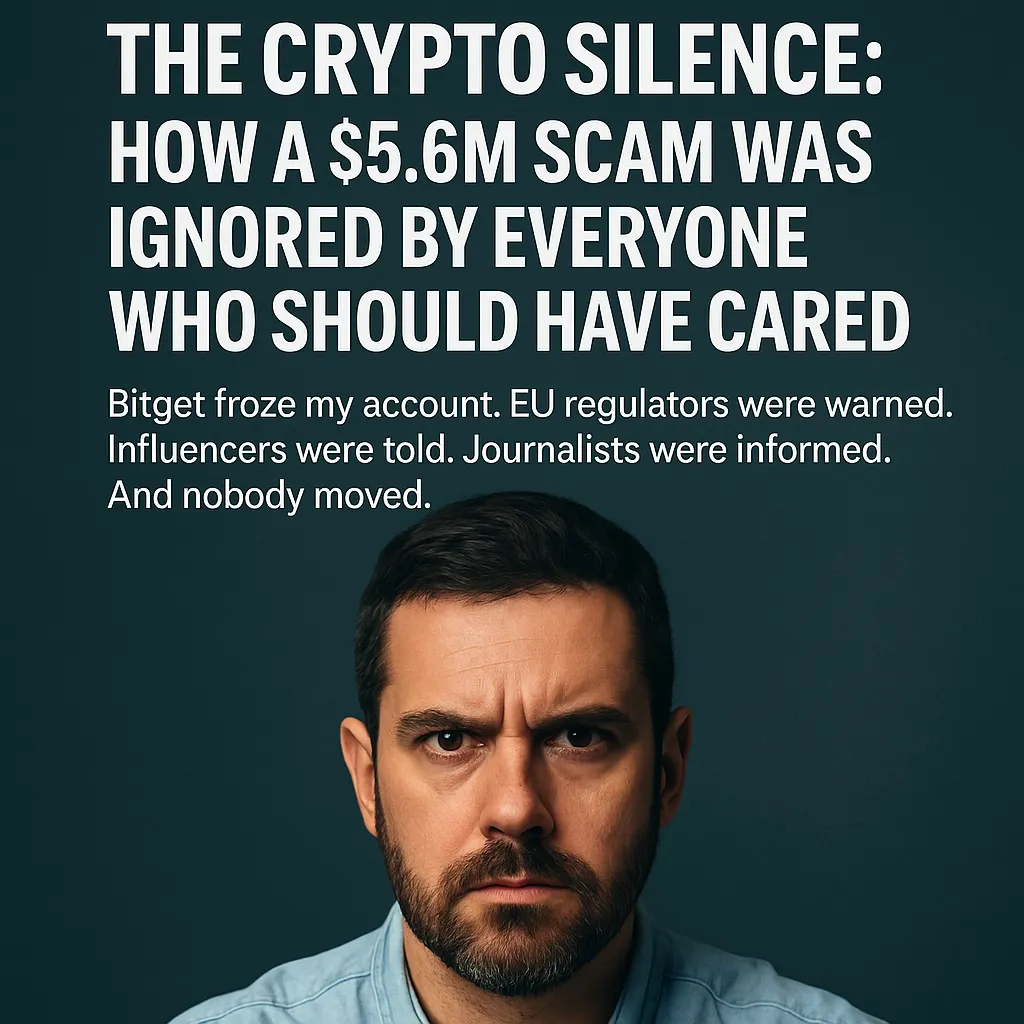
Worse still, that uncertain legal status, being a person living in Cyprus without the full rights and protections of a citizen, left us vulnerable. And there were those who were eager to take advantage of our vulnerability. Predatory, unscrupulous institutions saw an opportunity in our weakness. I am talking about companies like Bitget and eToro, and others like them. These institutions, which I can only describe as criminal in their behavior, exploited the fact that I was not a fully protected citizen. They saw that the law might not defend us as strongly, and they struck. Through deceit or loopholes, they seized what we had worked so hard for. In a short span, we saw the fruits of all our years of labor being snatched away. The savings we had set aside, the investments we made for our family’s future, it was stolen or lost because these companies could abuse my unprotected status. It was like watching the life we built crumble, piece by piece, taken by greedy hands while we stood by, horrified and helpless. I will never forget the nights we sat together at the kitchen table, documents spread out, trying to make sense of how our world was collapsing. Everything we had planned for our future and for Rasa’s future seemed to be slipping away because of these injustices. We were thrown into chaos and fear, unsure how to keep our family safe and secure.
Yet, even as we were reeling from this betrayal, we did not give up. Despite all the desperation, we fought back. For one extremely hard year, we pushed against the tide of misfortune with every ounce of strength we had left. We took legal action, filed complaints, sought help from authorities any and every avenue to seek justice and reclaim what was ours. That year was one of the darkest times in our lives. Every day felt like a battle. We were fighting discrimination from the system that should have protected us, and simultaneously fighting those criminal opportunists who had wronged us. There were days when hope was so faint, we could barely see it. I remember seeing tears in your eyes when you thought I wasn’t looking, and I know you saw the frustration in mine that I tried to hide. We held each other up as much as we could, often taking turns being strong for the other. Through endless meetings with lawyers, through the maze of bureaucracy and the cold indifference of institutions, we pressed on. We were driven by our love for each other and our determination to secure a safe life for our son. We wanted to believe that if we just fought hard enough, we would prevail, or at least survive intact.
But by the end of that year, we were exhausted and heartbroken. We had to face the possibility that, despite all our efforts, we might not win this fight, at least not in the near future. We also had to face what this struggle was doing to us as individuals and as a family. It was draining the joy from your smile and the energy from my spirit. And worst of all, it was affecting Rasa. Even though he was young, he could sense the stress and sadness around him. Our home, which should have been a haven, was filled with tension. That realization hit us hard: our son was growing up in the shadow of our struggles. This was something neither of us wanted. We had always agreed that we did not have the right to drag our child into our misery or let him suffer because of problems he never caused. We knew we had to make some difficult choices, for the sake of our son’s happiness and future.
So here we were, at a crossroads that no family ever wants to face. We began to discuss our options, painfully aware that none of them were ideal. You, Sogol, had opportunities elsewhere, chances to live and work in places without this constant struggle, places where you would be respected and could succeed without discrimination. You had every right to say “enough” and to seek peace away from all this. I could see in your face that you were torn. On one hand, you loved me and you loved Cyprus so much that you kept enduring the injustices. On the other hand, I knew deep down you had had enough, even if you wouldn’t say it out loud. I could see the weariness in your eyes, the accumulating scars of all the unfairness you had faced. You didn’t deserve any of this pain. You stayed by my side out of love and loyalty, but I often asked myself: was it fair to you?
As for me, I also had options. After everything we went through, we explored the possibility of starting over somewhere new, maybe going back to our roots in Iran, or moving to another country entirely for a fresh start. We thought about what it would mean to leave Cyprus behind, the island that had given us love and a life, but also so much hurt. Logically, leaving might have been the safest choice for me too, to protect our family and find a place where we could all be together without fear. And yet, when I looked into my own heart for the answer, I found something unexpected. There was a feeling deep inside me that I could not shake, a feeling that told me I must not leave Cyprus. I cannot fully explain it in words, it was more than just stubbornness or pride. It was as if the very soil of Cyprus had become a part of me over these years, entwining with my soul. Despite all the injustice, I felt a profound love and responsibility for this place that wouldn’t let me go. Perhaps it was the memory of how we fell in love here, or how we built something beautiful that changed people’s lives. Perhaps it was the hope that the country I loved might one day redeem itself, or the principle that I should not be chased away from my home by those who wronged us. It might even be that I wanted to keep fighting, to stand my ground against what was done to us. All I know is that some inner voice, a quiet, resolute voice, told me I had to stay. It was a feeling I trusted completely, even though I knew it meant choosing a harder road.
We talked for countless hours, through many long nights, trying to make the best decision. They were some of the hardest conversations of our lives. How could we choose a path that meant breaking our own hearts? How could we balance what was right for our son with what our own hearts yearned for? In the end, through tears and with heavy hearts, we arrived at the path that we believed was best for Rasa. I told you, Sogol, that I would remain in Cyprus, and that you should take Rasa and build a new life somewhere safe and happy. Saying those words to you was the most painful thing I’ve ever done. I hated myself for not being able to give our son and you the peaceful life you deserved here. It felt like I had failed at everything that mattered. But I also knew that if we stayed together here as things were, we would be trapping our son in a situation full of uncertainty and hardship, and neither of us could allow that.
When I gave you my answer, I saw your tears fall, mirroring my own. We held each other for a long time that night, scarcely able to breathe through the sorrow. We both understood what this meant: that for now, our family would be separated. You did not want to leave me, I know that. I felt your hands tremble as you said you couldn’t imagine life away from me. And my heart screamed inside my chest at the thought of coming home to an empty house without your laughter and without Rasa’s playing feet. But we also knew that our son must come first, and that we had to be strong for him, even if it meant great personal anguish. We promised each other this separation would not break our bond; rather, it would be a sacrifice we make out of love, to give our child a chance at a better life. Not every love story has a perfect ending, and right now, ours has taken a very difficult turn. But our story isn’t over, I refuse to believe it is.
Before I end this letter, I want to speak directly to both of you from my heart:
To Sogol: My love, I need you to know that I never wanted to hurt you with this decision. You have sacrificed so much for me and for Cyprus, and you deserved so much better in return. I am profoundly sorry that this country you loved did not love you back as you deserved. I understand why you must go, and I support you in every way, even though letting you go tears me apart. Thank you — thank you for believing in me and standing by my side through every storm. You left your home to join me in mine, you poured your soul into our life here, and you stayed even when the skies turned dark. I am forever grateful for your love, patience, and bravery. You are the strongest, most compassionate woman I have ever known. Please, find the happiness and peace that you so much deserve. And remember that no matter where you are, my heart is with you. I will love you until my last breath, and one day I pray life will bring us together again under kinder skies.
To Rasa: My dear son, you are too young now to understand all of this, but one day you will read these words. I want you to know that everything your mother and I have done, we did it for you. You are the brightest light in our lives, our hope, our joy, our precious boy. I am not leaving you or abandoning you, Rasa. Even if I am far away, I am with you always, watching over you in spirit and loving you every second of every day. This separation is the hardest thing I have ever had to bear. Not seeing your smile every morning, not tucking you into bed at night, it breaks my heart. But I do it because I truly believe it is for your good, for your future. You deserve a life free from the troubles that weighed us down. I hope as you grow older, you will understand that my distance was an act of love. Never doubt that I wanted to be with you, I wanted it more than anything. And never doubt that you are in my heart wherever I am. You and your mother are my family, my everything. Be happy, my son. Hold onto your innocence and joy. I will always be here for you in whatever way I can, and I will work and fight and hope every day that we will be reunited soon. I love you more than words can ever tell, my son, and that love will never change, no matter the distance or time apart.
I have poured our story onto this page with all the love I have. It’s a story of how an island brought two souls together, how those souls gave everything to that land, and how they were tested by injustice. It’s a story of a mother and father who would sacrifice even their togetherness for the sake of their child. It is our story, and it is one of love above all else. Now, at the end of this letter, I lay down my pen and offer you both a piece of my heart in the form of a poem. This poem carries my feelings, my hopes, and my unbroken love for you, Sogol and Rasa:
- *Our Love, Our Home**
We met by the shores of an unfamiliar sea,
Two hearts drawn together by destiny’s design.
In the embrace of Cyprus, our love grew wild and free,
You and I, Sogol, in that sun-kissed land divine.
Together we built dreams under the Mediterranean sky,
Believing in each other, hand in hand, you and I.
I remember how the sea breeze wove through your hair,
As you fell in love with an island and with me.
Your voice carried Cyprus in it, a love honest and rare,
Every word from your heart like a truth flying free.
Our business bloomed because your passion was true,
Everything prospered through the devotion in you.
But even the kindest seas can turn rough and grey,
And our radiant island revealed a darker face.
We gave it our hearts, yet fate led us astray,
We faced hatred and hurdles that time can’t erase.
The country we served with pride and with trust
Denied us its embrace, left us out in the dust.
They refused to call us one of their own,
Though this land had become our home in every way.
In that refusal, a seed of injustice was sown,
And cruel winds blew, turning bright skies to grey.
Others took advantage when we were brought low,
Stealing our future in one devastating blow.
Through that storm, our love held firm, an anchor in pain,
We fought every battle, side by side, through the night.
When one of us faltered, the other courageously rose again,
Trading tears for hope, refusing to give up the fight.
Oh Sogol, how brave you were through it all,
Lifting me up each time I’d stumble and fall.
Now the time has come for a heart wrenching choice,
To protect our sweet Rasa, we tread this difficult road.
The laughter of our child, his innocent voice,
Deserves to live free of this heavy load.
So you carry him forward, to safety and light,
While I stay behind in this arduous fight.
Just like Cyprus, My heart is an island torn in two,
Half with you both, half anchored here on these shores.
No ocean between us can dull love so true,
Nor distance diminish the bond that endures.
Rasa, you are the star guiding me through the dark,
Sogol, you are the fire that still warms my heart’s arc.
We may be apart, but our story isn’t done,
Our souls remain connected across sea and sky.
Every dawn I’ll whisper your names to the sun,
Every night, to the moon, in tears and reply.
May each of us find peace under heavens above,
Till we reunite in hope, in freedom, in love.
With all my love, always,
Farid