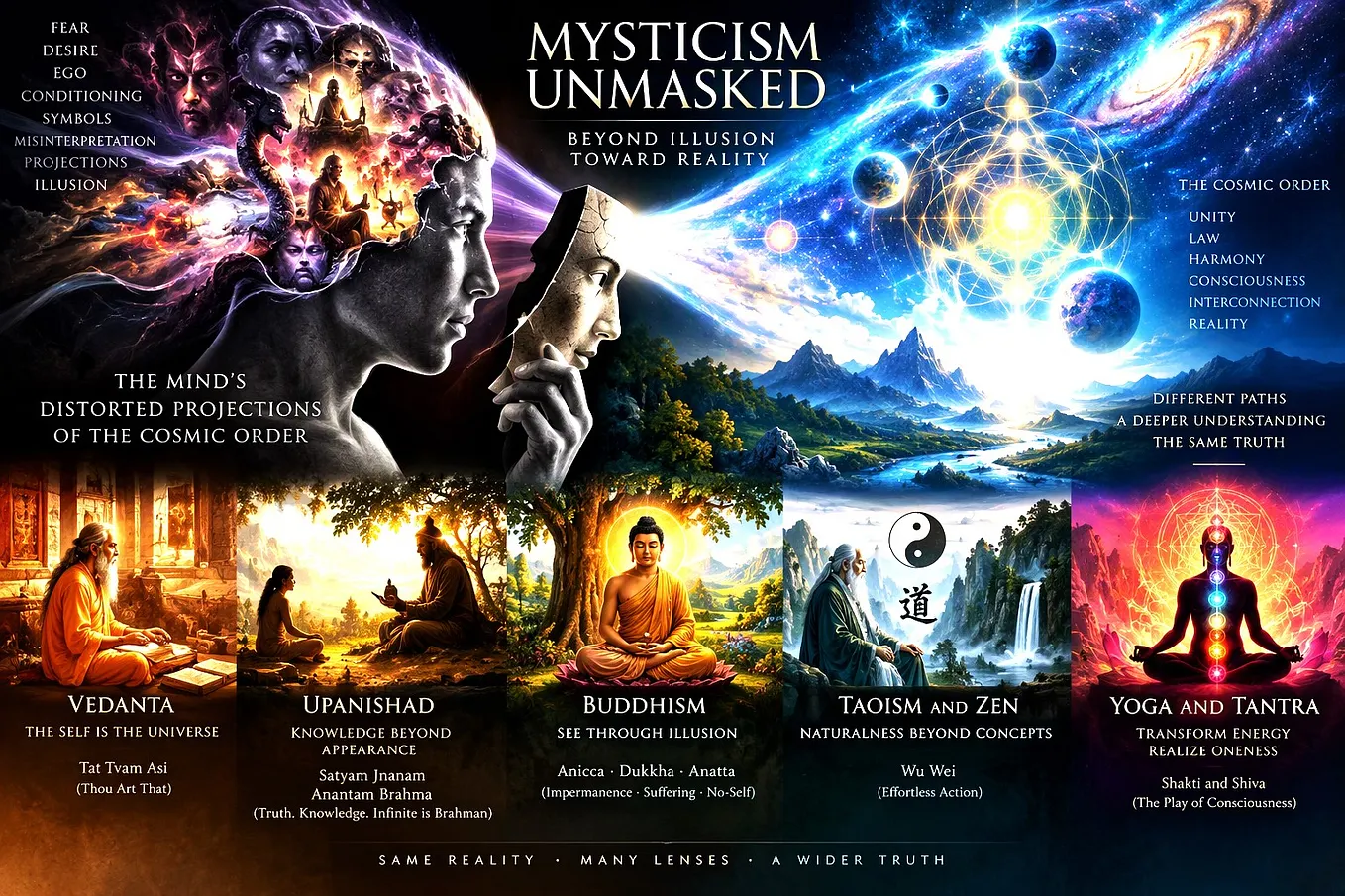
Unboxing Reality


Have you ever felt completely exhausted by the relentless attempt to figure out the world through your intellect? We continuously try to make sense of existence using rational tools that inherently miss what matters most: the living, breathing realm of genuine human feeling, intuition, and direct experience.
Purely analytical paradigms fall short. Neither cold rationality nor rigid phenomenology — though the latter promises a return to direct experience — can capture the totality of being. But do we even need to “understand” the world we inhabit in order to truly live in it?
The Pragmatism of Stepping Back
At first glance, understanding seems essential. It appears to help us navigate daily life, mitigate risks, and make efficient choices. But is utility the ultimate goal of human existence? Are we here merely to function, or is there a deeper possibility — to understand ourselves and our surroundings so deeply that we gain the freedom to consciously make decisions, or even better, the freedom to make no decisions at all?
Get Joanna Staniszewska’s stories in your inbox
Join Medium for free to get updates from this writer.
Perhaps the highest art of living lies in the ability to simply stop. To pause mid-stride, look around, and absorb the breathtaking beauty of nature without needing to label, classify, or dissect it. In that moment of absolute stillness, you achieve the seemingly unachievable: you achieve nothing. And yet, this “nothing” turns out to be the most profound treasure available to human consciousness.
Key Reflection: “To achieve nothing in a world obsessed with everything is the ultimate liberation of presence.”
The Interconnected Dynamics of Life
This might sound abstract or deeply philosophical, but it is intensely practical. When we question how to attain happiness, we quickly realize how limited our control actually is. We react to external events, fall prey to fluctuating moods, and trigger emotional responses based on hidden patterns.
Who are we beneath these automated reactions? To what extent can we adjust our internal frequency — the energy we emit and the signals we tune into? As we observe the subtle dynamics at play around us, we begin to realize how intimately interconnected everything is.
Life is not a static picture; it is a tapestry of shifting vectors. How many variables must we calculate, and how many academic models must we construct, before we realize that trying to grasp it all intellectually is a fool’s errand? You do not need a master’s degree in epistemology or formal philosophy to live fully. The world is full of mystery and uncharted depths that we rarely dare to inspect. Yet, cultivating simple openness and innocent curiosity can trigger a profound awakening.
Breaking the Form & Evolving Beyond the Default Mode
Who decided that a box must be a cube? Rigid mental frameworks try to force something that is alive and unique in every second into stale, predefined forms. Life resists containment.
Operating on autopilot and relying on default behavioral patterns (default mode) is a biological reality, but it is not an unchangeable fate. Our sense of self is not a static sculpture; it is a continuous evolution. In every single second, our “I” is being reshaped — not by the past itself, but by our emotional attachment to past narratives and our fear of unfulfilled potential in the future.
Science demands empirical proof, and faith operates on a different axis. Yet, on a subconscious level, a transformation begins with a simple willingness: the desire to see what has always been right here in front of us.
You do not need to figure out every equation or master every philosophical term. You don’t need to know everything — you only need to be ready. Open your eyes, step out of the box, and allow reality to unbox itself.