AT RISK, A “GEOGRAPHY OF THE SOUL”
The massive Bears Ears and Grand Staircase-Escalante national monuments in southern Utah of three Democratic presidents using the unilateral authority of the 1906 Antiquities Act were created despite continuous, seemingly irresolvable conflict. That’s to say conservation of America’s public lands has always faced powerful obstacles. Case in point: Executive Orders of a fourth president, Donald Trump, a Republican, shrunk those earlier versions of the monuments in 2026, renewing questions over whether the federal government had the wherewithal to protect the country’s most sacred, beautiful, archeologically significant, and fragile public lands.


This report is divided into the following sections:
- PART ONE: On July 13, 2026, President Trump signed Executive Orders that shrunk Bears Ears and Grand-Staircase Escalante national monuments by about 3 million acres combined. What happened in the Oval Office that day was arguably the biggest assault on public lands protections in modern U.S. history.
- PART TWO: A precedent-setting collaboration among groups with often-disparate and competing goals lobbied to create the monuments. But 12 years into their national campaign, success in creating those monuments that could withstand interminable political challenges remained elusive.
- PART THREE: The vision of Indigenous activists fueled the pro-monument campaigns and helped persuade presidents Barack Obama and Joe Biden of the monuments’ value — and of a precedent-setting, co-stewardship role they could play in managing those lands.
- PART FOUR: The intransigence of political partisans with an ideology historically aligned with intractable commercial interests raised questions about whether Congress and the Executive Branch of the federal government and the laws that it administers had the wherewithal to protect public lands.
- PART FIVE: Indigenous Americans, whose ancestors cared for the land for generations and, importantly, held a perspective gleaned from more than 250 years of resistance to genocidal policies of the United States government and its military offered lessons toward a possible long-term resolution of the conflict.
PART ONE


Anyone who has made a random discovery of 1,000-year-old artifacts of human habitation in the cranny of a cliff while wandering through the vast wilderness surrounding the twin Bears Ears buttes in southeast Utah or ascended to a perch overlooking Canyonlands National Park to watch the sun set or spent a deathly silent, starry and crystalline night camping miles from nowhere gazing at the canopy of Creation at once discerns hózhó, the Diné (Navajo) word that attempts to capture a sense of living in harmony with the universe.
Environmentalist Terry Tempest Williams described the areas as “soul geographies, landscapes of our imaginations” in the forward of Conservation in America: A Chart for Rough Waters (University of Chicago Press, 2018).
A week before President-elect Donald Trump took office and a little more than three years after President Joe Biden resurrected and even expanded President Barack Obama’s original Bears Ears National Monument to 1.36 million acres, a blueprint to guide decisions on maintaining the hózhó of that “soul geography” — or Record of Decision in bureaucracy-speak— was approved and put into effect.
The Bureau of Land Management had unveiled its joint Draft Resource Management Plan and Environmental Impact Statement in March 2024 then tweaked it a bit to become the formal proposal released the following October. (The formal record of those drafts and the final Record of Decision — were no longer accessible on the BLM website as of July 2026.)

Biden’s management plan replaced the one written and approved during Trump’s previous term as president when he formally reduced the sizes of Bears Ears and Grand Staircase-Escalante national monuments with great fanfare at a ceremony on Dec. 4, 2017, inside the Capitol of the deeply red state of Utah. Trump slashed two of his Democratic predecessors’ monuments: Bill Clinton’s Grand Staircase by half and more than 1 million acres from Barack Obama’s Bears Ears.
Then on July 13, 2026, 18 months into his second term, Trump again scuttled the two monuments. This time Biden’s versions were targeted (In 2017, it was Obama’s version of Bears Ears and Clinton’s Grand Staircase-Escalante); this time 2,000 miles away from Utah in his gilded Oval Office surrounded by Utah’s highest-ranking lawmakers using what he might’ve believed to be his authority under the Antiquities Act of 1906.
The land targeted by Trump didn’t change ownership. It remained publicly owned and federally managed. What did change (by a lot) was the level of protection — from parts of the monuments approaching wilderness-level, the highest, to the “multiple-use” level the BLM and Forest Service uses to manage most of their public land.
According to Our Public Lands & Waters on Substack:
Areas excluded from the monuments could once again become available for activities such as mining, drilling, road construction, and other development under ordinary public-land laws.
Journalist Jonathan Thompson, who focused primarily on public land-use issues in southwest Colorado and southern Utah, wrote that Trump’s reduction of the monuments this time around was far, far worse than the first time.
The move reopens huge swaths of Utah’s canyon country to new mining claims and mineral leasing, reviving the potential for oil and gas drilling, uranium mining, and potash, lithium, and coal extraction in previously protected areas. It also scraps the existing resource management plans for both national monuments, throwing even the remaining shards of protected areas into regulatory uncertainty.
Additionally, the proclamations order the managing agencies, the Bureau of Land Management and the U.S. Forest Service, to ease restrictions on motorized travel, vegetation management, and livestock grazing within the remaining national monuments. …
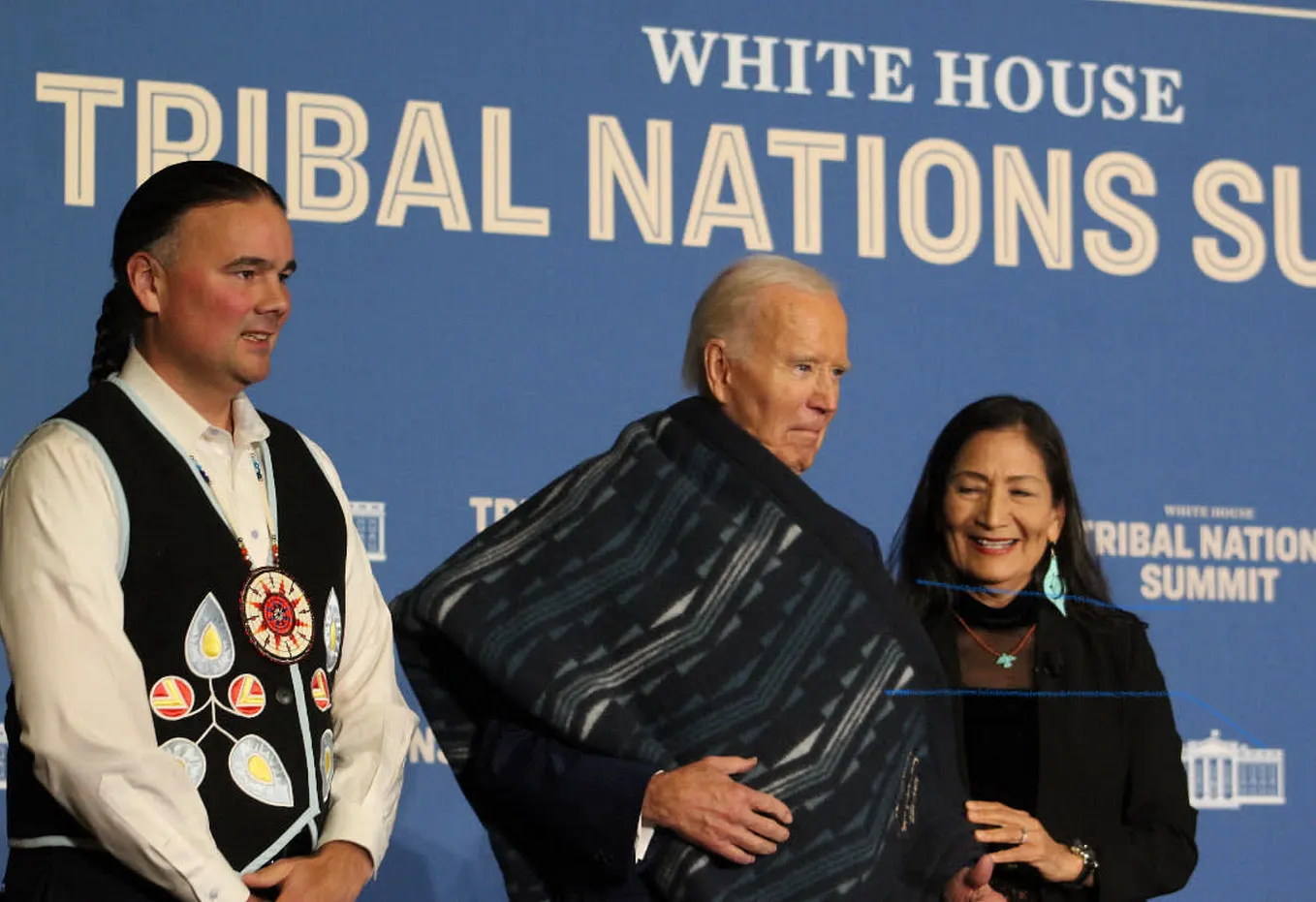
He also disbanded and terminated the Intertribal Bears Ears Commission, a direct attack on the tribal nations that first proposed a national monument for their homelands and that have been co-managing it until now.
Although Trump’s Executive Orders modifying Grand Staircase-Escalante and Bears Ears national monument were hardly unexpected, there wasn’t much of a reason to believe a political solution was in the offing.
There was every reason to believe that it was exactly what right-wing hardliners and Trump loyalists inside the administration figured would trigger lawsuits, forcing federal courts to eventually answer the question that had been lingering over creation of the two landscape-scale national monuments since 2017: The 1906 Antiquities Act allowed a president to create monuments, but did it allow any president to shrink or even completely rescind monuments for any reason under the sun?
Conservation groups challenged Trump’s executive order three weeks later in a lawsuit filed in U.S. District Court seeking to reactivate litigation against Trump’s 2017 monument rollbacks and challenge both sets of illegal proclamations together.
More from Our Public Lands & Waters:
This move potentially puts that question on a direct path to the Supreme Court, which would then rule on a president’s authority to shrink national monuments under the Antiquities Act or even eliminate them altogether.
If the Supreme Court were to rule that a president could, in fact, abolish a national monument, the Antiquities Act would effectively be dead. If that happens, all national monuments established in the past by a president and not protected by an act of Congress would be on the chopping block.
That’s essentially all 31 national monuments currently managed by the BLM, from Utah’s Grand Staircase-Escalante and Bears Ears to Arizona’s Baaj Nwaavjo I’tah Kukveni-Ancestral Footprints of the Grand Canyon, California’s Chuckwalla, New Mexico’s Organ Mountains-Desert Peaks, and Montana’s Upper Missouri River Breaks.
And getting the Antiquities Act to the Supreme Court is an explicit goal of Project 2025, which says that ‘the new Administration must vigorously defend the downward adjustments it makes to permit a ruling on a President’s authority to reduce the size of national monuments by the U.S. Supreme Court.’
The stakes couldn’t have been higher. An unappealable ruling from the Trump-friendly U.S. Supreme Court could’ve effectively killed (or strengthened) that 120-year pillar of public-land protection. The Antiquities Act had been used not only to create national monuments but also to pave the way for the eventual establishment of national parks. This process allowed presidents to immediately protect significant lands to be approved later by Congress for inclusion in the Interior Department’s national park system.
Nearly half of the 63 national parks in the U.S. were originally established as national monuments under the Antiquities Act before later being redesignated as national parks, including four of Utah’s “Mighty 5”: Arches, Zion, Capitol Reef, and Bryce Canyon — a bit ironic given the obsessive, multi-year resistance of Utah lawmakers to Clinton’s, Obama’s, and Biden’s monuments and their potential as powerful economic engines.
The National Park Service reported that 15.8 million visitors to national parks in Utah spent $2 billion in the state in 2024. That spending had a cumulative benefit to the state economy of $3.1 billion.
The National Park Service report, 2024 National Park Visitor Spending Effects, finds that visitors spent $29 billion in communities near national parks. This spending supported provided $18.8 billion in labor income and $56.3 in economic output to the U.S. economy. The lodging sector had the highest direct contributions with $11.1 billion in economic output. Restaurants received the next greatest direct contributions with $5.7 billion in economic output.
Monument supporters were confident Trump’s order was without legal merit. Journalist Jonathan Thompson:
The legal argument behind the lawsuits is clear and potent: The 1906 Antiquities Act authorizes presidents to establish national monuments, but not to shrink or revoke them. Therefore Trump’s 2017 and 2026 shrinkages are illegal and should not stand.
History backs the plaintiffs. In 1938, President Franklin D. Roosevelt sought to revoke the Castle Pinckney National Monument, a former military installation in South Carolina. His attorney general’s analysis, however, determined that the Antiquities Act “does not authorize [the President] to abolish [national monuments] after they have been established.” FDR, respecting the rule of law, let the monument stand. Eventually, Congress, which does have the power to alter national monuments, voted to revoke national monument status for the site.
In 2017, a quartet of legal scholars, including Mark Squillace, of the University of Colorado Law School, published their own analysis in the Virginia Law Review. They, too, found that in 1906 Congress did not delegate to the president the authority to downsize or abolish a national monument or weaken the protections granted by the original national monument proclamation. Furthermore, the Federal Land Policy Management Act of 1976 clarified that only Congress has the power to modify or revoke a national monument.
Trump’s reduction of the monuments revives an old story: the friction between Americans who passionately believe in preservation of the nation’s natural beauty and culture and those who would tap its resources for profit (or other reasons, such as national security) with Indigenous Americans sidelined as their ancestral lands — sacred to many of them–were divvied up.
Beginning in the 1870s Americans started to realize that left unchecked “vandals” would “despoil beyond recovery” the “rare wonders” of Yellowstone Valley.
Historian Heather Cox Richardson’s tracked the shift in her July 14, 2026, Letter from an American:
The House Committee on Public Lands praised Yellowstone Valley’s beauty and warned that ‘persons are now waiting for the spring…to enter in and take possession of these remarkable curiosities, to make merchandise of these bountiful specimens, to fence in these rare wonders so as to charge visitors a fee, as is now done at Niagara Falls, for the sight of that which ought to be as free as the air or water.’ It warned that ‘the vandals who are now waiting to enter into this wonderland will, in a single season, despoil, beyond recovery, these remarkable curiosities which have required all the cunning skill of nature thousands of years to prepare.’ …
(Republican Theodore) Roosevelt was concerned that moneygrubbing was eroding the character of the nation, and he believed that western land nurtured the independence and community that he worried was disappearing in the East. During his presidency, which stretched from 1901 to 1909, Roosevelt protected 141 million acres of forest and established five new national parks.
More powerfully, he used the 1906 Antiquities Act, which Congress had passed to stop the looting and sale of Indigenous objects and sites, to protect land. The Antiquities Act allowed presidents to protect areas of historic, cultural, or scientific interest. Before the law was a year old, Roosevelt had created four national monuments: Devils Tower in Wyoming, El Morro in New Mexico, and Montezuma Castle and Petrified Forest in Arizona.
In 1908, President Roosevelt used the Antiquities Act to protect the Grand Canyon.
With a stroke of a pen, the Republican president set aside 800,000 acres above and within the Grand Canyon as a national monument. Then, in 1919, under President Woodrow Wilson, a Democrat, it became what it is today, one of the crown jewels of the national park system, extending over 1.2 million acres.
The Trump administration’s BLM OK’d its management plan for the earlier version of Bears Ears NM, the one he signed into being in late 2017, a little over two years later. It comprised two geographically disconnected units called Shash Jáa and Indian Creek.
From the reaction of environmental activists during that period, you would’ve thought the Earth was about to stop spinning.


Outdoor Retailer, which had sponsored giant expositions in Salt Lake City every year to showcase the latest in high-tech “must have” outdoor gear, decamped to Denver in January 2018 to protest what it considered to be the anti-environmental culture of Utah politicians. As part of that Bronx Cheer, activists at Patagonia, Conservation Lands Foundation, the Wilderness Society, and the Center for American Progress projected on the sides of two buildings, the McNichols Building in Civic Center Park and the Bureau of Land Management’s headquarters in nearby Lakewood, a doomsday-style clock that depicted time remaining before oil, gas, and mineral leases would become available on the public lands targeted by Trump.
The stunt painted a picture of an unrestrained drilling bonanza, apparently intended to whip up a frenzy among “tree huggers, bunny lovers, and rock lickers,” using former Utah Rep. Mike Noel’s colorful coinage.
By the first week in February, two months after the cuts, the BLM office in Salt Lake City had seen no bump in mining or drilling claims. “Environmental groups are once again raising fears about this being mined, but practically speaking there’s very little chance of that happening,” said Luke Popovich, a spokesman for the National Mining Association.
By June, same story: The first new claim was staked by two freelance writers hired by the outdoor-recreation retailer REI. They explored Bears Ears, got stuck on mud-slick roads, then wrote a blog to see whether a claim they staked without any intention of ever prospecting could serve as “an unusual public lands preservation tactic.”
The only other even remotely similar activity within the original Bears Ears NM boundary during that period were placer claims staked March 13, 2018, by Ronald and Brooks Hammond of Dallas. They were “forfeited or abandoned” five months later.
(A placer operation typically attempts to access minerals that aren’t bound to rock. Those claims are often associated with water sources like rivers, streams, and beaches where loose minerals accumulate. Extraction methods for placer claims usually involve surface techniques like panning, sluicing, or dredging — none of which would be particularly useful on the drought-parched sage and sand Colorado River plateau of Bears Ears.)
Popovich’s remarks, the bloggers’ stunt, and the placer claims staked then abandoned by the Dallas operators buttressed findings of the Utah Geological Survey:
- There have been 287 oil and gas wells drilled in the Bears Ears NM boundary. All wells have been plugged and abandoned.
- Of those drilled wells, only nine produced oil and six produced gas. 302,027 barrels of oil have been produced with 77 percent of it coming from one well and 94 percent coming from just three wells. These locations were all near each other on the Bluff bench.
- There has been no production from these wells since 1992. Only the two highest producing wells produced into the 1990s; all others pre-date 1985.
- Most of Bears Ears NM has low oil and gas potential, except the northeastern and southeastern corners; these areas have moderate oil and gas potential. No APDs (applications for permit to drill) exist within Bears Ears NM.
There are no coal resources within Bears Ears NM, and there’s not enough lithium to bother with. However, the Utah Geological Survey in 2021 rated coal resources of the Kaiparowits Plateau within Grand Staircase monument as high for development potential.
Political jawboning for and against the monument masked the fact that coal production in Utah had plummeted more than 41 percent in the decade leading up Trump’s proclamation that shrunk the monument.
According to The Salt Lake Tribune:
In 2024, coal only made up 46% of the state’s total electricity generation, with only five coal mines operating — the fewest active mines in 150 years. Coal’s presence in Utah’s electricity mix has been on the downhill for years; electricity generated from Utah’s coal-fired power plants has decreased almost 60% since 2008.
Coal-fired power plants were shutting down across the country. And any company coming in would’ve had to persuade investors to fork over money to truck in heavy-duty mining equipment over roads the company would’ve had to build and maintain through wilderness often accessible for all-terrain vehicles only, even in the best of weather, string power lines for miles, and haul out the coal on those same roads.
In 2025, the Trump administration attempted to re-invigorate the coal industry:
Energy experts say any bump for coal under Trump is likely to be temporary because natural gas is cheaper, and there’s a durable market for wind and solar power no matter who holds the White House.
The apocalyptic forecasts of coal development after Trump redrew Bears Ears and Grand-Staircase boundaries and before Biden resurrected both Clinton’s and Obama’s versions in 2021 and four years never materialized.
(BLM approved a management plan for Trump’s version of the monument on Feb. 6, 2020, exactly a month after an insurrection at the Capitol attempted to block the presidential transition.)
Possible uranium mining in Bears Ears was another story. Prices were down then; they were up a bit when Trump once again assumed office. There was more of an incentive to rescind the monument’s restrictions on mining.
According to the Utah Geological Survey:
BENM has been productive for uranium deposits in the past, and some of the mining districts within the monument continue to hold some promise for future uranium production.

While Trump’s grand shrinkage of Bears Ears NM in 2017 did not produce the kind of oil and gas development that environmental activists predicted (and upon which they based much of their pro-monument rhetoric), at least 14 new uranium and vanadium claims were filed within the boundary of the original Bears Ears NM after the monument was slashed — six of them since March 2021, according to Tim Peterson, cultural landscapes director at the nonprofit Grand Canyon Trust.
The global financial company Goldman Sachs asked: Is rising demand a boon for nuclear and geothermal power?
Yes, it is driving a higher level of engagement on technologies that a few years ago were viewed as too expensive or too far out.
We’re seeing momentum in nuclear power with clients across our business. There have been a number of deal announcements from hyperscalers committing to the procurement of nuclear fusion and fission power from newly planned and existing plants. The deals are driven by the need for reliable, baseload power, and have led to increased investments in advanced nuclear technologies such as Small Modular Reactors (SMRs). Fusion energy, in particular, is showing signs of progressing towards commercial production, with potential for commercialization in the 2030s.
We are supporting clients in this space, including through the raise of approximately $1 billion in the public markets for a nuclear power company developing next-generation fission technology. To support the buildout of nuclear capacity, you are also going to need a lot of uranium. This makes its supply chain, including everything from uranium mining to manufacturing the fuel for different SMR designs, really important. In the US specifically, we are doing a lot of work to finance critical supply chains of minerals related to uranium.
By 2025, the Utah’s public officials were ramping up to fast-track uranium-fueled nuclear power production in the state, and that included a million-dollar-plus public relations campaign to persuade Utahns their tax dollars were being wisely spent, according to The Salt Lake Tribune.
A month after Trump took over in January 2025 then in July 2026, those placing bets on whether the trifecta of Trump/his newly installed Interior Secretary Doug Burgum/Utah politicians would throw its political weight behind preserving President Biden’s version of Bears Ears NM or digging for uranium were closer to having an answer: If not “drill, baby, drill,” possibly “dig, baby, dig.”
PART 2
The years-long campaign
An unprecedented multi-million dollar, multi-year public-and-private collaboration was behind creation of Bears Ears National Monument. Remnants of that team lawyered-up in 2021 and again in 2026 to protect it.

The collaboration that resulted in versions of Bears Ears NM under Obama and Biden came close to realizing what authors of Conservation in America might’ve had in mind.
Jon Jarvis, President Obama’s director of the National Park Service, and Gary Machlis, former Park Service science adviser, called for a “unified vision” among conservation groups, outdoor recreation businesses, and Indigenous tribes with often disparate, often conflicting goals, tactics, and funding sources. They wrote their mini-manifesto shortly after watching Trump unravel what Obama had put into place, and in 2025 the stage was set for an encore of Trump’s 2017 performance.
As if taking a cue from the two career conservationists, the national campaign to create Bears Ears NM included:
- First and foremost, Native American sovereignty activists (many of whom represented tribes with continuing historical animosities toward each other) and non-Native nonprofits brimming with billionaires, big bucks, and passion (many of whom heretofore had shown little interest in tribal concerns);
- Historic preservation and archeological groups and wilderness advocates (the latter sometimes litigated for removal of structures the preservationists wanted untouched and studied);
- Environmental justice advocates, Native rights activists, and flora-and- fauna guardians (the latter’s goals of protecting biodiversity, important to long-term human survival that often conflicted with and sometimes overrrode efforts to ensure access to electricity and clean water and air, as well as reduce chronic poverty and life-shortening illness caused, in the Bears Ears case, by years of racist-fueled neglect by the federal government and Cold War-era uranium mining on the Navajo Nation and nearby);
- And outdoor-oriented corporations selling goods and services to mainly non-Native, affluent campers, hikers, mountain bikers, and climbers (many of whom conflated their “stoke” with saving the planet), climate-change activists (who watched their allies burn fossil fuel, further heating up the planet to get to sites of fun and fitness) and old-school conservationists with missionary zeal (who sacrificed their weekends and vacations by picking up or scooping up what the adventurers left behind).

Over the years, some of the same environmental groups and their allies tried to get their massive America’s Red Rock Wilderness off the ground. Various iterations of it had been introduced into Congress every year since 1989. A 2024 version had 96 co-sponsors, all Democrats, and, like every other version it had a performative quality and was dead on arrival.
Undeterred, in 2013, the Southern Utah Wildness Alliance, Sierra Club, Natural Resources Defense Council, Grand Canyon Trust, Great Old Broads for Wilderness, and more than 100 like-minded local and national businesses from the outdoor recreation industry lobbied the Obama administration for creation of a 1.4 million-acre Greater Canyonlands National Monument.
It would’ve encircled Canyonlands National Park, including the northern part of what was in 2025 Bears Ears NM.
Was their goal to finally complete a project Harold Ickes, Interior Secretary during the administration of President Franklin Roosevelt, first envisioned in 1936: a 4.5 million-acre Escalante National Monument?
Stalled by the Depression and World War II, Ickes’ proposal attracted renewed attention in the post-war years, and, after a bit of political wrangling, became the considerably smaller Canyonlands National Park in 1964.


The quixotic — and continuing — project of the latter-day activists raised questions that has dogged the larger environmental movement. Namely, although it raises millions and pays its leadership handsomely, it seems to want credit for successes but shirks responsibility for losses. Big nonprofits have invested a ton of money in the Bears Ears project since at least 2014 without lasting change.
Here’s Len Necefer, PhD, an Indigenous environmental consultant:
There is a contradiction at the center of the national environmental movement’s story about itself.
When a protection is won, these organizations speak in the language of agency. Their lawyers defended the law. Their advocates moved the administration. Their supporters demanded action. Their leadership developed the strategy. Their donors made the victory possible.
The win becomes evidence that the organization is effective, influential, and deserving of continued support.
When the protection is lost, the language changes. Now the organization is confronting forces beyond its control: a hostile president, an unprincipled Congress, an unfavorable judiciary, corporate money, misinformation, and a difficult political environment.
All of those forces are real. But the division of responsibility is much too convenient.
They privatize the credit and socialize the failure.
Environmentalists pushing Red Rocks Wilderness never overcame long-standing opposition of, mainly, Republicans who were concerned about locking up the extraordinary resource potential of the region, lingering mistrust generated by President Bill Clinton’s politically ham-handed creation of Grand Staircase-Escalante National Monument in 1996, and caution of Obama’s first Interior secretary, Ken Salazar.
Their campaign was launched roughly a decade after two members of Utah’s congressional delegation, former U.S Sen. Bob Bennett, a Republican, and Rep. Jim Matheson, a Democrat, brought together adversaries, cajoled and arm-twisted, added enticements here and there after resurrecting and modifying a 2006 bill that went nowhere. The result was the Washington County Growth & Conservation Act of 2008. It was inserted into the massive Omnibus Public Lands Management Act of 2009 as the Washington County Lands Bill. The Omnibus act was passed by a Senate and House controlled by Democrats and signed into law by Obama.
Bennett:
After five years at the table with all interested stakeholders, Congressman Matheson and I have produced a bill that successfully strikes a balance between conservation and growth in Washington County. Parties on all sides of this debate have repeatedly told me it would be impossible to broker a deal on this emotional issue which, for decades, has caused people to dig in their heels. The persistence we’ve applied now appears to be paying off as our bill has gained extremely diverse support and a very good chance of passing.
According to a 2014 analysis published by the Environmental Dispute Resolution Program at the Wallace Stegner Center for Land, Resources and the Environment within University of Utah’s SJ Quinney College of Law:
The Washington County Lands Bill was praised by academics, politicians, and community organizers for its grass-roots origins and balanced approach to conservation and development. Vision Dixie, the collaborative community planning process, was celebrated for being widely inclusive and highly effective.
The legislation was acclaimed for protecting lands and rivers, addressing wilderness issues and allowing for future development. Many hope both can be replicated within the state and across the West.
The Lands Bill conveyed 353 federally owned acres to the county and the cities of St. George and Hurricane, which were used for open space, expansion of the county jail, an equestrian park, recreation, and administrative offices.
However, reminiscent of the ways in which Indigenous Americans had been dispossessed of their ancestral lands to create the national park and monument system — America’s “best idea,” according to writer Wallace Stegner — and, more recently, to build Glen Canyon Dam, they played only marginal roles in the Washington County conservation effort and no meaningful roles in pretty much every other conservation effort over the years in Utah; that is, until Bennett came along in 2010 with an initiative he believed would build on the Washington County success and resolve land-management issues on the other side of the Colorado River, the Bears Ears side.
(See American Indians and National Parks by Robert H. Keeler and Michael F. Turek, 1998, University of Arizona Press; and Erika Marie Bsumek, The Foundations of Glen Canyon Dam: Infrastructures of Dispossession on the Colorado Plateau, University of Texas Press, 2023)

According to a timeline put together by Utah Diné Bikéyah, a nonprofit that sometimes conveyed a sense that it was acting as a surrogate for tribal governments:
March, 2009: President Obama signs Senator Bennett’s Washington County Lands Bill. Many counties throughout Utah request inclusion in the next bill.
March, 2009: Utah Tribal Leaders Association begins regular discussions on how best to engage in future land-use negotiations to advance Native American interests on public lands. (UTL Agenda-6/25/09, 8/6/09, 11/12/09)
February, 2010: Senator Bennett initiates land-use planning initiative in San Juan and seven other counties in Utah. An intensive and collaborative land-use negotiation process ensues that involves dozens of organizations that meet every few weeks for six months.
May, 2010: Kenneth Maryboy invites Mark Maryboy and Gavin Noyes, Utah Program Director for Round River, to help develop a plan to represent Utah Navajo interests in the Bennett process. Mark serves as a consultant and community liaison to a small team of land planning experts and prioritizes the opinions of grassroots people, elders and the inclusion of all Tribes throughout the region.”
Bennett was a prominent and respected senator with conservative bona fides stretching back 19 years. But in a state party increasingly dominated by purity tests of Tea Party activists at the time, he was a “RINO,” Republican in Name Only, not conservative enough, Bennett placed third at the state Republican Party’s May 2010 convention. As a result, he failed to make the cut and his name was not on the primary-election ballot. Mike Lee won that primary and became the party’s candidate. He easily beat Democrat Sam Granato in the November general election to replace Bennett in the Senate.
The former senator died six years later. He was 82.
Bennett prided himself on knowing how to get things done, and even after he left public life to become a political consultant, he was publicly optimistic that he could bring people together to solve long-simmering land-management issues.
In an interview with High Country News in 2012, he was asked:
High Country News: What’s the focus of your work these days?
Bob Bennett: “A little over a year ago (2010 or 2011), The Wilderness Society retained my firm to replicate what we did in Washington County in several other Utah counties. That raised some eyebrows; I had a League of Conservation Voters voting score of less than 5 percent. But the Utah Legislature has indicated its support for what we are doing, the governor is behind it, and Interior Secretary Ken Salazar has said publicly that the Obama administration’s views on public lands will follow the Bennett pattern.” …
The end of his political career foreshadowed an era when politicians and their constituents and non-governmental activists seemed to pride themselves on their abilities to exploit legal and administrative mechanisms designed, for example, to prevent “waste, fraud, and abuse” for political gain and stymie initiatives of political opponents.
High Country News : Utah’s Tea Party instigated a “take back federal lands” campaign when it pushed you from office. Why did it take this tack?
Bob Bennett The rise of the Tea Party was based on the idea that “we hate the federal government.” Anything connected to it is bad, including Sen. Bob Bennett, so get rid of it. And they did.
My young replacement came up with the strategy of turning all the federal lands in Utah over to the state. (After the Utah Legislature passed a bill demanding the turnover of federal lands) every one of Gov. Gary Herbert’s lawyers told him to veto the bill. But the governor was looking at what the Tea Party did to me and thought, ‘I don’t want them to do that to me.’ So he signed the bill. The sound and fury will fade, but it will be back sometime, because ‘we hate the government’ is a proud Western tradition.”
Bennett’s initiative — one of the first politically viable, post-World War II attempts by the federal government to include Indigenous Americans in decisions affecting their ancestral lands in southern Utah — went no further after Lee took over and became arguably the most anti-public lands legislator in Congress as chair of Senate Committee on Energy and Natural Resources on Jan. 3, 2025,.
And there are many tribes in the region. The National Park Service acknowledged the following as having traditional ties to Bears Ears, Canyonlands and southwest Utah landscapes, but systematically excluded from policy-making over the years: Hopi Tribe, Kaibab Band of Paiute Indians, Navajo Nation, Ohkay Owingeh, Paiute Indian Tribe of Utah, Pueblo of Acoma, Pueblo of Isleta, Pueblo of Jemez, Pueblo of Laguna, Pueblo of Nambe, Pueblo of Picuris, Pueblo of Pojoaque, Pueblo of San Felipe, Pueblo of San Ildefonso, Pueblo of Sandia, Pueblo of Santa Ana, Pueblo of Santa Clara, Pueblo of Taos, Pueblo of Tesuque, Pueblo of Zia, San Juan Southern Paiute, Santo Domingo Pueblo, Southern Ute Indian Tribe, Ute Indian Tribe, Ute Mountain Ute Tribe, White Mesa Ute, Zuni Tribe.
The 2014 analysis by the dispute resolution at the University of Utah law school program was prescient:
If congressional leadership is a linchpin to these bills then the outlook in the near future is not good. At a time when the Sagebrush Rebellion is again rising up and Congress is not accomplishing anything, the prospect of another lands bill like Washington County’s is remote. Political leadership cannot be guaranteed and communities should not unreasonably hope that their collaborative efforts will be memorialized by legislation.
In the years since, Utah’s congressional delegation had failed to match the kind of bipartisan leadership demonstrated by Bennett and Matheson, who left office in 2015.
For example, Rep. Celeste Maloy, who represented the southwestern part of Utah, inserted an amendment into a 2025 budget bill that would’ve allowed the sale of BLM land in Washington County. But it was removed shortly thereafter by GOP leaders at the national level who backed down in the face of public outrage. The Shivwits Band of Paiutes, whose reservation lies adjacent to the parcels was not consulted, as required by law.
However, tribal efforts continued to gain ground thanks in large part to a few Navajos who persevered and non-Native non-governmental organizations, such as Round River Conservation Studies of Salt Lake City, that began to offer political, financial, technical, and legal support. By 2014, that support had ballooned to tens of millions of dollars and was increasing.
Conveniences of modern life come with trade-offs that require environmental compromises.
It’s a dirty story.
This report was researched and written using an iPad and iPhone, both manufactured by Apple, a giant among transglobal corporations. The electrical power of those devices, which is critical to maintaining my First World lifestyle, was stored in lithium-ion rechargeable batteries that need cobalt.
Consumers in the United States, like myself, use the majority of the world’s cobalt. Prices for it on the world market reflect our skyrocketing demand.
But there’s a darker cost: a history of human-rights violations, including use of child labor associated with production of 66 percent of the world’s supply in the Democratic Republic of the Congo.

As consumers, we have an absolute moral and possibly a national security imperative to explore alternatives to cobalt dug up overseas under conditions of unimaginable horror and embedded in our lifestyle.
(The Department of Homeland Security considered one cobalt mine in the Congo so vital that its “incapacitation or destruction … would have a debilitating impact” on U.S. security or the national economy.)
One alternative — albeit minuscule relative to a grand solution — could’ve been a proposed subsurface cobalt and copper mine on Colt Mesa, 30 miles or so east of Boulder, Utah. It was just outside the boundary of Trump’s version of Grand Staircase-Escalante NM, but within Biden’s and, as a result, untouchable in the months after his version of the monument became a reality.
The power stored in those lithium-ion rechargeable batteries that breathe life into my computers was more than likely generated by a power plant fueled by coal (or possibly natural gas), whose operations are contributing to the inability of our great blue planet to sustain life and heavily subsidized by Utah legislators, many of whom, in turn, rely on the generosity of those operators and their investors to maintain their seats in said Legislature.
The coal was dug up in eastern Utah and transported by trains and trucks to a power plant, then burned up to fuel it. The trains and trucks were powered (mostly) by diesel fuel, possibly refined several hundred miles away in Salt Lake City or Wyoming after being pumped up from oil fields, also located in eastern Utah.
That’s to say consumers in the United States, like myself, were deeply embedded in this dirty system and use much of the world’s lithium.
The possibility of a well or mine “marring” the landscape sometimes unleashed a backlash of NIMBYism, “Not In My Backyard” if you please.
The refrain went something like this:
Hey, we like our cell phones. Electric cars can power a clean transportation future. Just don’t go digging holes in our desert or close to our nature and recreational preserves for the stuff that makes ’em work. Dig for lithium someplace else.
One of those “someplace elses” was southeast Utah.

While Biden’s proclamation specifically prohibited new mining and drilling within Bears Ears NM, that wasn’t the case outside of it. And despite heated criticism of Biden and his public-land agencies from Trump and his allies within Utah and remnants of the Tea Party that had morphed into an even more politically powerful conservative movement under Trump, Make America Great Again (MAGA), BLM gave lithium prospectors the go-ahead to drill exploratory wells on public land to the north of the monument adjacent to Utah’s Canyonlands National Park.
In addition, several firms were staking claims in the Lisbon Valley, located roughly between Moab and Monticello, east of the national park. Some of the claims were within BLM-owned parcels that could’ve been transferred to the state in a swap for land within the monument. But the whole thing was scuttled by Republican lawmakers in Utah, including the governor, who felt snubbed by what they believed was BLM’s lack of collaboration with them in writing the Bears Ears NM management proposal. The state of Utah would’ve gotten what was described as “a gold mine” by one official to help fund its educational system from revenue generated by roughnecks drilling down or miners digging up public lands. Ownership of the state-owned land would’ve been transferred to the federal government for safeguarding inside the monument.
According to a Land Desk report published by the Durango (Colo.) Telegraph, an Australian company, Anson Resources’ Paradox, and its subsidiaries — A1 Lithium, Blackstone Minerals and Blackstone Resources — had been staking claims aggressively among the sandstone formations northwest of Moab between the Green and Colorado rivers during this period, amassing more than 1,000 federal mining claims. They also acquired private land surrounding the Department of Energy’s uranium tailings disposal site on the southern edge of the town of Green River, as well as leases on Utah state land.

Uranium caches in and around Bears Ears are plentiful and, theoretically, could help power a new generation of nuclear reactors. Prices paid to miners for their ore were up in 2024 compared to several years earlier. But the market was still pretty volatile.
Mills that would process uranium were either about to re-open or were on the drawing board, according to The Salt Lake Tribune.
At roughly the same time, the Trump administration’s Department of Interior announced the first uranium-mining project to undergo an expedited environmental review in response to the president’s declaration of a national energy emergency. The plan limited environmental reviews — which typically take at least a year — to 14 days, or 28 days for especially complex projects.
A mine in southeastern Utah’s San Juan County that was shut down in 1984, the so-called Velvet-Wood Mine, was the first project to go through permitting under the new process.
And it was approved in short order.
Anfield Energy, the owner of the mine, planned to reopen the old mine, and intended to produce uranium and vanadium. Anfield also owned and planned to reopen the shuttered Shootaring Canyon uranium mill in neighboring Garfield County.
The compressed time frame of the permitting process effectively prevented public input, tribal consultation, and any meaningful analysis of the project’s potential impacts or dangers, according to Jonathan Thompson, writing in the Durango Telegraph, which were very real. They included hazards associated with radioactive waste disposal and trucking uranium ore from mine to mill.
Velvet-Wood ore hauling trucks would have to travel about 200 miles to Anfield’s mill, either by going through Moab and Hanksville, or through Monticello, Blanding, and Bears Ears National Monument.
Other potential hazards include surface and groundwater contamination:
Underground mines typically hijack the hydrology of the landscape they’re in, pulling groundwater into the mine’s drifts and tunnels, where it can pick up naturally occurring heavy metals and radioactive elements before it flows out into the environment. An estimated 50 million gallons of water have built up in the mine workings over the last four decades, meaning Anfield will have to dewater the mine prior to commencing operations. Anfield’s operating plan notes that the accumulated water is ’of marginal quality with elevated concentrations of dissolved solids and sulfate and elevated radionuclide activity levels.‘ It would run the water through a treatment plant prior to discharging it.
A Center for American Progress (CAP) report released December 2025 highlighted how national monuments such as Bears Ears NM perched within the Colorado River Basin adjacent to the Velvet-Wood mine serve as crucial “water monuments” protecting clean drinking water for over 13 million Americans, with threats from potential downsizing jeopardizing sources for cities like LA, Phoenix, and Denver, as 83 percent of these waters lack other strong conservation safeguards beyond the monument status
Meanwhile, 15 states filed a lawsuit challenging the emergency declaration, arguing that no actual emergency exists and that the use of emergency procedures to bypass proper environmental reviews was illegal.
During roughly the same period, Utah lawmakers were laying the political, public relations, and legal groundwork to help develop nuclear power through passage of HB249, “Nuclear Power Amendments.”

To guide lawmakers, the state Office of Energy Development (OED) wrote a series of documents under the title “Utah’s Strategic Nuclear Energy Pathway.” The first one, published in July 2024, said the Legislature needed to create a “facilitative policy framework, siting considerations, and the early site permitting process;” the second one, published in September of 2025, looked at what Utah could learn from other states; the third one focused on spent fuel recovery and recycling; and a fourth one in the series was being written as of October 2025, according to the OED website.
Gov. Spencer Cox said he wanted Utah to lead the nation in a “nuclear renaissance,” signing non-binding agreements with nuclear energy developers in 2025 working toward that goal. They include: TerraPower and Flagship Companies, Valar, Hi-Tech and Holtech International, and Battelle Energy Alliance, a giant government contractor that manages the federal government’s Idaho National Laboratory, west of Idaho Falls.
The Battelle Energy Alliance comprises Battelle, BWX Technologies, Inc., Amentum, Electric Power Research Institute (EPRI), and university partners — MIT, The Ohio State University, North Carolina State University, University of New Mexico, Oregon State University, University of Idaho, Idaho State University, and Boise State University.
Another piece of that nuclear renaissance Cox promoted could be a uranium enrichment plant built smack dab in the middle Utah’s densely populated urban core about 20 miles south of Salt Lake City by a start-up company called General Matter. Plans called for the plant to be built at Camp Williams, a National Guard facility. The new plant would be one of four funded by the U.S. Department of Energy (DoE) responding to a nuclear-fuel supply gap exacerbated by United States’ ban on uranium from Russia in response to the war in Ukraine. The only commercial plant that was operating in the United States at the time was in Eunice, N.M., in the southeastern part of the state.
Utah’s involvement in subsidizing nuclear power was, in part, a response to an ambitious plan, promoted by the Cox administration, to double the state’s power production over a 10-year period to meet rapidly rising demand across the country caused largely by projected growth in the use of artificial intelligence, or AI, for myriad smartphone uses, digital assistants, chatbots, social media websites, home electronics such as robot vacuum cleaners or security systems, and auto-navigation and robotics.
The nuclear power buildout could eventually cost billions of dollars with no guarantee of eventual success or direct benefit to Utah taxpayers, according to a report by Utah Investigative Journalism Project.
Initially, the state provided grants, tax credits or other financial incentives; offered low-interest loans or loan guarantees; and restructured tax rates to lure nuclear power entrepreneurs to build in Utah.
For over a decade, Utah, through a political subdivision of the state that provides energy services to 46 community-owned power-system members throughout the Intermountain West called Utah Associated Municipal Power Systems (UAMPS), NuScale Power, an Oregon-based company, and the U.S. Department of Energy had their eyes on what they considered promising new technology: relatively small, modular, more easily constructed nuclear reactors that could be installed in remote rural locations.
UAMPS formally launched what it called the Carbon Free Power Project in 2015 as part of a long-term strategy to reduce carbon emissions and replace aging coal-fired plants with a nonfossil fuel, medium-sized, flexible power generating source.
The project called for constructing a Small Modular Reactor (SMR) power plant at Department of Energy’s Idaho National Laboratory near Idaho Falls using a SMR technology being developed by NuScale Power. The technology envisioned six modules cooled by a pressurized loop of water to deliver 77 megawatts each to produce a combined 462 megawatt hours of electricity per year, according to the Deseret News.
According to a High Country News report, NuScale was mostly owned by the Fluor Corporation, the global construction conglomerate that was the lead contractor on the $60 billion cleanup of the former Hanford nuclear weapons complex in eastern Washington. Fluor had spent over $12 million on lobbyists over a three-year period ending in 2018; it was a major political donor, primarily to Republican campaigns, and it put $250,000 into Trump’s Inauguration Day fund. The feds have been generous in return: NuScale has received nearly $288 million in grants from the federal government since 2014, including $47 million in 2018.
In early 2023, the U.S. Nuclear Regulatory Commission issued its final rule in the Federal Register to certify NuScale Power’s reactor, and it became the first SMR design certified by the NRC.
However, by the end of the year the Carbon Free Power Project was terminated by NuScale Power and Utah Associated Municipal Power Systems.
According to the Deseret News:
As the permitting dragged on and costs became more uncertain, especially highlighted by critics of nuclear power who railed on the ‘unproven technology,’ subscribers began to drop out via off-ramps deliberately built into the subscription program to allow a seamless exit if nuclear power as part of their portfolio looked untenable. …
The approval process took years and cost hundreds of millions of dollars of investment by NuScale.
NuScale said in January 2023 the target price for power from the plant was $89 per megawatt hour, up 53 percent from the previous estimate of $58 per MWh, raising concerns about customers’ willingness to pay.
In 2020, the U.S. Department of Energy approved $1.35 billion over 10 years for CFPP, subject to congressional appropriations, according to a Reuters report. The department had provided NuScale and others about $600 million since 2014 to support commercialization of small reactor technologies.
Critics believed that generally the SMR technology was a boondoggle specifically foretold by NuScale and UAMPS Carbon Free Power Project backed by the state of Utah:
In a rational world, no utility or government would invest another dime on these theoretical reactor concepts. …
As announced in 2015, the UAMPS project initially involved constructing 12 reactor modules capable of generating 600 MW, with the aim of starting operations around 2023, and at an ‘overnight cost’ of $3 billion. In 2018, NuScale announced a design modification with each module now producing 60 MW of electricity, or 720 MW for the whole plant, claiming this would lower the cost ‘on a per kilowatt basis from an expected $5,000 to approximately $4,200.’
The estimated costs of the project rose to $4.2 billion in 2018, then $6.1 billion in 2020, and finally $9.3 billion in 2023, after it was scaled down to 462 MW in 2021. In the end, the costs were clearly too high for UAMPS members to bear.
The engineers and accountants on the project were evidently unrealistic about the likely costs, or perhaps NuScale preferred to gently break the bad news about how immense the bill would be. Or both. NuScale also managed to retain members by claiming an unreasonably low cost of power from the project once operational, a cost derived using an opaque economic methodology without clarity over its assumptions. There is a lesson here: one just cannot trust initial cost estimates for nuclear reactors and their electricity.
The UAMPS project ran into early resistance in Price, Utah, where leaders feared it would help kill the local coal industry; in Truckee, California, because it would hamper the community’s efforts to go 100 percent renewable; and in Los Alamos, N.M., where residents were leery of investing in unproven technology, not to mention the high projected operating costs relative to other energy sources, according to Jonathan Thompson, a freelance writer and contributor to High Country News.
There were thorny problems that, as of October 2025, went unmentioned in the grand plan, “Operation Gigawatt,” Cox envisioned.
SMRs will not be safer. In fact, in scavenging for cost savings, the industry is proposing eliminating numerous standard safety features. Water consumption will still be intense, about the same as a coal-fired power plant and almost the same as large nuclear reactors, per kilowatt of electricity.
Thompson, who followed nuclear development in the West as closely as anyone:
The latest generation of reactors may go by slick, newfangled names, but they are still expensive, require dangerous and damaging mining to extract uranium for fuel, produce waste, are potentially dangerous — and are still largely unproven.
Taxpayers continued to pay for cleanup of what miners of the Cold War years left behind. Residents living close to the mines across three generations suffered from abnormally high rates of cancer.
Members of the Ute Mountain Ute Indian Tribe, who live a few miles from the only operational conventional uranium processing mill in the United States, were concerned that leaks from the mill’s operation could contaminate their groundwater. A video primer produced by The Salt Lake Tribune explains why.
According to a 2022 analysis by ProPublica:
When cleanup began (in the late 1970s and 1980s), federal regulators first focused on the most immediate public health threat, radiation exposure. Agencies or companies completely covered waste at most mills to halt leaks of the carcinogenic gas radon and moved some waste by truck and train to impoundments specially designed to encapsulate it.
But the government has fallen down in addressing another lingering threat from the industry’s byproducts: widespread water pollution.
“Regulators haven’t made a full accounting of whether they properly addressed groundwater contamination. So, for the first time, ProPublica cataloged cleanup efforts at the country’s 48 uranium mills, seven related processing sites and numerous tailings piles.
At least 84% of the sites have polluted groundwater. And nearly 75% still have either no liner or only a partial liner between mill waste and the ground, leaving them susceptible to leaking pollution into groundwater. In the arid West, where most of the sites are located, climate change is drying up surface water, making underground reserves increasingly important.”
Navajos didn’t even want trucks hauling the unprocessed ore on Navajo Nation roads.
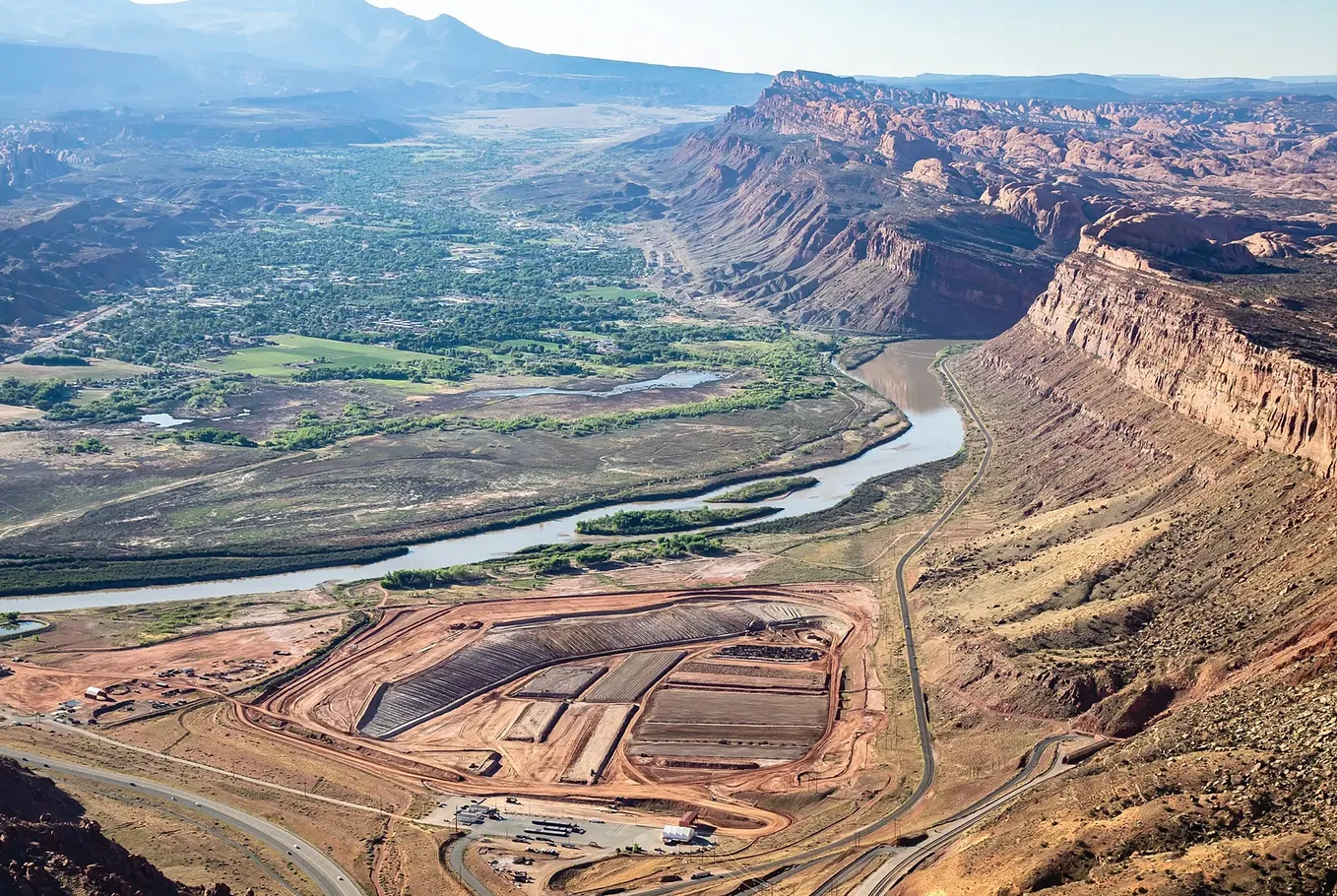
During the first years of the 21st century, vacationers and outdoor-recreation enthusiasts driving south into Moab and Spanish Valley were first greeted not by Utah’s scenic wonders. Instead, they saw an expanse of old uranium mill tailings along the Colorado River at the site of the former Atlas Uranium Mill being dug up and hauled away to a God-forsaken patch of sand and sagebrush to a permanent disposal site 30 miles north near Crescent Junction.
In its heyday, the mill was one of the most productive processing facilities of the raw radioactive ore. Atlas was one of dozens in the U.S. that turned the stuff into so-called yellow cake that fueled power plants and helped create nuclear weapons.

When demand for uranium waned and the plant was shuttered in 1984, a dangerous environmental legacy remained: an 80-foot-tall, 16-million-ton mound of radioactive (colloquially “hot”) waste. The heap contains radium, which uranium produces when it decays. Radium’s half-life — how long it takes for half of a given sample to decay — is 1,600 years. But the real problem is that it becomes radon, a gas that can increase humans’ risk of cancer when inhaled. The waste also transmits radioactive material, metals, and other unwanted substances into the groundwater and the Colorado River, harming wildlife. All just three miles from the city center.” (Popular Science)
Environmentalists believed that if Trump again re-drew the boundary of Bears Ears NM — which he did — the likelihood of uranium mining within the boundary of Biden’s version would’ve been much greater.

Choose your parable to describe Jim Stiles, founder of the Canyon Country Zephyr.
His admirers (and he had many) might be partial to the little Dutch boy who sticks his finger in a dike to prevent inevitable flooding or Don Quixote tilting at windmills. Maybe the child who, when the emperor parades before his subjects in his new clothes, dares to say, “But he isn’t wearing anything at all.”
Possibly closer to the mark is “The Strange Case of Dr. Jekyll and Mr. Hyde.”
Founder, editor, writer, opinionator and most everything else at the Canyon Country Zephyr, Stiles, was an acolyte of Edward Abbey.
For the better part of 30 years, until his death in March of 2024, Stiles kept alive as best he could Abbey’s style of journalistic truth-telling.
As pioneering conservationists and writers of the 1960s foretold; as Abbey passionately envisioned; as Stiles’ work foreshadowed — sometimes humorously, always unabashedly — the threat posed to flora and fauna on public lands and Anglo-Western and Indigenous cultures by the evolution and increasingly sophisticated marketing of real-estate and commercial development, outdoor recreation, and unregulated tourism was very real. He, Abbey, and other writers, conspicuously Wendell Berry, used variations of “industrial tourism” to describe what they saw as an inevitable onslaught.
Stiles was born on December 11, 1949, to Sue Montfort Stiles and James Ogden Stiles, Sr. of Louisville, Kentucky. Stiles died at his home in Coldwater, Kansas, on March 11, 2024, when, stupefied by pills and whiskey, shot himself in the head with a handgun he had carried around for years.
Stiles published a mea culpa of sorts a year and a half before his death
I’ve never written anything like this before — not in the 33 plus years I’ve been publishing The Zephyr. Not ever. It’s personal and it’s painful; it’s about mistakes I have made, and regrets I will carry to my grave. It’s about loss and unexpected events in our lives, and how we deal with them. We all seek our own paths — some find comfort with family and friends. Others turn to their church. Some try to ride it out on their own….still others seek ‘professional help.’ …
It probably helps to explain in general that I grew up in a very angry, unhappy family, with a mother who suffered from, but was never treated for, a lifelong mental illness. In fact, mental illness, alcoholism, and suicide, or the threat of it, has historically existed on both sides of my family. To quote Hank Williams, Jr,:
‘Son, how did you get in this condition?
‘I’m just carrying on an ole family tradition.’
His account — which focused primarily on shortcomings of the mental health services he sought in rural Kansas — masked a decade of abuse silently absorbed by his young wife, Tonya Audyn (Stiles née Morton) and partner in newspapering and online journalism at the Zephyr.
She struggled to come to grips with what was a textbook case of psychological injury after escaping Stiles in 2022 then reclaiming her life (When I Disappeared, July 2022; A Ghost’s House, June 2024; The End of Everything, Part One, Sept. 2024; The End of Everything, Part Two, Sept. 2024; The Bad Guy, Part One, Jan. 2025; The Bad Guy, Part Two, Jan. 2025; and The Song about Farewell, Aug. 31, 2026)).
At the clinic in Kansas, Stiles was diagnosed as suffering from a “major depressive disorder, Recurrent episode, Severe Sedative, hypnotic, or anxiolytic use disorder, Severe Alcohol use disorder, Severe.” Stiles could not accept the psychiatrist’s diagnosis, much less any treatment: “The Doctor had written into my hospital record that I was a severe drug addict and alcoholic,” he wrote.
Morton’s essays — heart-wrenchingly candid and beautifully written — seem to confirm Stiles’ degree of debilitating, life-threatening illness: dangerous to him and everyone close to him.
She never identified Stiles by name.
Morton published them in her online “creative journal with dirt in the corner” called Juke.

Stiles moved to Southeast Utah in the early 1970s, after a friend of his father’s gave him a copy of Abbey’s Desert Solitaire. He was hired as a seasonal ranger at Arches National Park and fell in love with the history and landscape of the canyon country. He quickly became an integral member of the Moab community and a passionate voice for wilderness.
In 1989, he founded his newspaper, which covered both local news in Moab and also the broader environmental and societal questions of the time.
Stiles decamped to Kansas — with intermittent excursions back to Utah. But Kansas became the base where he continued to write and publish until his death.
Once upon a time, many newspaper editors of Stiles’ ilk believed they were “watchdogs” of the common good, called to comfort the afflicted and afflict the comfortable. They took particular pride in tweaking the powerful and their sense of privilege.
It was mostly mythology. Yet sometimes a watchdog came along and just wouldn’t let go, and, more often than not, paid a personal and financial price.
A few years ago, Stiles celebrated 30 years of playing that watchdog role in southeastern Utah.
The print version of the Zephyr was one of the best “indies” in the western United States. It was for the most part a one-man show that had a long run. Missoula, Mont., filmmaker Doug Hawes-Davis attempted to capture a bit of its attitude in the 2008 film “Brave New West.” The movie was screened mainly at film festivals in 19 states, New Zealand and the United Kingdom, over 70 locations. It was shown in Ogden, Moab and twice over the Utah Education Network (UEN) but never found a mainstream audience in the state. Among public TV stations with audiences in the nation’s big urban media markets only San Francisco’s KQED broadcast it.
Toward the end of Stiles’ life, the Zephyr was published online, refreshed six times a year. But it never lost its quirkiness, cultural sensibility or wit. The “Planet Earth Edition” was always the place to find “all the news that causes fits.”
“It was a foolish notion, but what is the point of living without foolish notions? And for a while, Moabites did pursue their visions in ways today’s residents can only … well … dream,” Stiles told Todd Wilkinson, founder of Mountain West Journal, in a 2017 interview for an article headlined “The New West: One of the toughest local papers in the West perseveres against change.”
Stiles wrote and published point-of-view journalism and deeply felt personal essays that celebrated a rural way of life.
And more, much more:
- On environmental negligence: “On election night 2016, the decision to designate a large national monument in San Juan County went from being a questionable theoretical proposition to a clear act of environmental negligence. There was no plausible scenario at that point in which the new monument would be implemented with any enthusiasm. A more realistic expectation was for the catastrophe that has unfolded.”
- Beautifully crafted essays: “You can learn that you never needed to leave home, because home will follow you on dreadful plastic straw-ed legs wherever you travel. Or you can choose the crummy old decaying roads, where the concrete breaks off in chunks and falls into the grass. The roads that go out of everybody’s way. You can open the sticky doors to old pawn shops, laundromats. You can sleep warily in motel rooms with unvacuumed carpets. Eat from ungentrified taco stands. You can feel the fear that comes from walking into a world that isn’t your own. A world that doesn’t care about you, or accommodate for you. And, in doing so, you can give the universe a chance to do its work. Whether that work will land you among the choirs of angels or face-down in the gutter–well, nothing is promised.”
- On media malpractice related to national and regional coverage of all things Bears Ears National Monument: “Does the network and the producer, and the reporter, in this case CNN’s Van Jones, have an obligation to know and understand all the facts related to the story, even the ones that fail to fit their preconceived agenda? Do they have a duty as honest journalists to challenge comments by the selected participants when they don’t accurately reflect the truth? Can a journalist omit information that provides the very ‘balance’ that is being sought?”
- Historical nuggets: “From the 1890s to the 1930s, my great-grandfather, John Wetherill, outfitted and guided many parties on pack trips into the wilds of the Colorado Plateau, far beyond any traces of modern civilization. … Their destinations were often well-known archaeological or geological wonders of the region, such as ancient Native American cliff dwellings or the incomparable Rainbow Natural Bridge, but some explorers chose to venture into terra incognita in search of theretofore unknown treasures.”
- Photography of cultural significance, ramblings, and musings of good friends: “He (Herb Ringer) blessed me with the kind of friendship that rarely exists across generations, like a very special love between father and son. And, in fact, because Herb never had children, he once asked me if I could ‘fill in’ as the son he never had. I always told him it was an honor. He also bestowed upon me the role of ‘keeper’ of his memories, magnificently told via the extraordinary collection of words and images he assembled in a lifetime.”
- Raw-edged illustrations.
- Alternatives to destructive tourism: “Taos (N.M.) Pueblo, the Navajo Nation and other tribes also have recognized the downside of tourism and commercial development: overloaded infrastructure, damage to nature and threats to their culture and heritage. Each tribe, given their unique circumstances, found the wherewithal to fend off a bit of the onslaught … by limiting or even banning tourism and related commercial activities, regulating the supply of accommodations and preventing infrastructure development.”
One of several slogans Stiles embraced for the Zephyr was “Hopelessly clinging to the past.” It could’ve also been “Sound-bite journalism not practiced here.”

Stiles published Abbey’s last original story in the Zephyr’s premier edition. Abbey died as those first Zephyrs were birthed by ink-stained wretches in Cortez, Colo.
Stiles reflected on that day a few years ago: “A couple days before I carried the layout boards to Cortez, I’d heard a rumor that Abbey was ill. The same rumor had hovered over us for years, in fact, but Abbey had always kept his health issues private. In January, I called the Abbeys and learned he’d had ‘an episode’ but was on the mend.
So at 5 a.m. on March 14, 1989, I packed the layouts and my checkbook into my 1963 Volvo and drove the 120 miles to Cortez News. It took about five hours to produce Volume 1 Number 1. I worried about typos and scrambled layouts, knowing that once it rolled off the presses there wasn’t a damn thing I could do to fix them. By noon, The 2,000 Zephyrs were printed, boxed and loaded into my Volvo. The trunk and back seat and passenger seat were stacked to the ceiling. I barely had room to sit.
I got back to Moab after 2 p.m. and had just unloaded the first box when a friend of mine, Jean Akin, pulled up to the curb. ‘Did you hear about Ed Abbey?’ she asked. I shook my head. Jean said, ‘Edward Abbey died this morning.’ … I couldn’t believe it. I was absolutely paralyzed. …
In late May, a larger public memorial service was organized by Ken Sleight, Ken Sanders, Terry Tempest Williams and me. My job was to find a site for the event. I inquired about a location at Arches but when I was hit with permit applications and fees and a requirement to provide Porta Potties, I decided Abbey would prefer a different venue. I finally picked a site on the mesa above Arches but outside the park.
In the early hours before the service, I couldn’t sleep and so I drove up Moab Canyon at three in the morning to watch the night sky. All through the night, a slow but steady stream of car lights climbed the old road. Mourners came from all over the West, from all over the country. By the time the service began, a thousand people had come to say goodbye to Edward Abbey.
Ken Sleight was there. Doug Peacock. Dave Foreman. Terry Tempest Williams. Perhaps Abbey’s best friend, John DePuy, was too moved to speak. Later in the afternoon, I took Foreman to my favorite spot at Arches — Abbey’s Arch, the rock span Ed had found in 1956 and that I had re-discovered 20 years later. Less than a week after our hike, Foreman and other Earth Firsters! were arrested in a government sting operation.”
Stiles’ worldview had begun to shift in the decade or so after Abbey’s death. His 2007 manifesto of sorts, Brave New West: Morphing Moab at the Speed of Greed, marked a divorce from Salt Lake City- and Moab-based environmentalists.
Some members of Utah’s environmental community and their allies were not particularly receptive to the kind of criticism that a decade ago or two or three earlier was commonplace — especially coming from the likes of Stiles, who refused to give up the ghost of Abbey: namely, that a reliance on corporate largess threatened the raison d’être of the movement. As a result, Stiles was vilified in print and became a pariah in Moab.
Here’s an example taken from a profile of Stiles published in 2006 by High Country News (The report is no longer available online):
This all reached an argumentative crescendo earlier this year when Stiles submitted a column to the High Country News opinion syndicate, Writers on the Range, chastising SUWA for, of all things, having such a large war chest. According to tax documents Stiles hunted down, in 2004 SUWA had almost $5 million in ‘net assets and fund balances.’ He argued that, rather than letting its money sit in the bank, SUWA ought to disperse some of it to other, less-funded environmental groups that are tackling New West issues.
In a response published in the Salt Lake Tribune, (Scott) Groene (executive director of Southern Utah Wilderness Alliance) called Stiles the desert country’s ‘own Barney Fife. He’s worth having around, even if we have to clean up after him now and again.’ Groene said SUWA’s ‘rainy day fund’ was similar to those of comparable environmental groups, and said, ‘True enough, for almost the first time in its 23-year history, SUWA can pay its bills.’
Misinformation, speculation, unsubstantiated opinion, and outright fabrications were routinely and unabashedly expressed in the battle over Bears Ears and Grand Staircase-Escalante by political partisans and elected officials at the state, local, and federal levels, as well as activists using their messaging as advocacy tools.
Among the most egregious examples came from the president of the United States, Donald Trump, during the ceremony in July 2026 to formally shrink the two monuments.
Perhaps as a way to justify the scale of his cuts, Trump declared the monuments were set aside “for nobody to use, right? Can’t do anything. You can’t go hunting. You can’t go fishing. You can’t do anything. You can virtually not even walk on it.”
Katie MacGregor, deputy secretary at the Interior Department, replied, “That’s exactly right, sir.”
Utah’s highest ranking elected officials, all Republicans, posing for photos, smiling, behind Trump seated at the Resolute Desk, did not correct Trump.
According to documents The New York Times obtained through a public records request, Utah officials briefed the administration a month earlier about “current recreational access” to the monument, naming trails used by backpackers, hikers, and off-road drivers. One route, the Peavine Corridor, was even flagged as motorized access running deep into the land.
The muddle of misinformation is less understandable and perhaps at least as concerning when reported, published, and distributed worldwide by mainstream media outlets such as The Washington Post, CNN, NPR, The Guardian, and others — the “big foots” that divine truth and consequences.
Stiles meticulously documented journalistic malpractice at CNN related to its coverage of Bears Ears NM and published it in his Edward Abbey-inspired Canyon Country Zephyr. The CNN report was part of its “Van in the van” series.
I don’t claim to be knowledgeable on many issues, and I try to limit my participation to stories that I know enough to comment on. But I have lived in southeast Utah for more than 40 years, I have been intimately connected to the vast wild country in San Juan County and to the two buttes known as “the Bears Ears” for even longer. I was once a strong proponent of the environmental lobby in Utah and many years ago even served on the board of directors of the Southern Utah Wilderness Alliance. But in the past 20 years, environmentalists have forged alliances with the outdoor industry and turned a blind eye to the impacts their partnerships were creating
In 2018, misinformation about southeast Utah, the monument and the people has been a particular source of frustration. In an effort to set the record straight, this publication has written and posted more than 50,000 words on the subject of Bears Ears National Monument. It’s been a Quixotic effort — not once has a major media source been able to contradict a single word, but the truth is, they won’t even try.
Stiles pointed to selective editing that distorted facts on the ground.
At one point in the CNN report, as three sources, Eva Ewald (Diné or Navajo), Angelo Baca (Hopi/Diné), and Jana Pfeiffer Ewald (Diné) were interviewed by Jones while driving the CNN van on the road in southeast Utah, Ewald noted that after the Trump reductions, the environmental community and the outdoor industry claimed a “land rush” to mine and destroy the monument was imminent. Ewald said that many people were convinced that “if it’s not a monument, its going to become a mining mecca. That’s the biggest fear tactic.”
She was right (about the fear tactic), and the land rush never happened. But one of the other participants disagreed. Angelo Baca replied, ‘That’s not a fear tactic. Just look around you. There’s pumpjacks all over this place. This place is decimated.’
But there’s a problem; at the time Baca made that remark (while looking out of the van’s window), the CNN vehicle and its occupants were driving east on US 191 toward Montezuma Creek, Utah, and the pumpjacks he refers to are far outside the original monument boundary and 30 miles away from Bears Ears.

Did Baca realize they were nowhere near the original monument boundary? In fact, according to Ewald, when the group arrived in Montezuma Creek, participant Pfeiffer asked (that question). Ewald explained that they’d been driving away from Bears Ears for an hour and that the monument was in the exact opposite direction.
In any case it was misleading for CNN to allow the false perception that they were anywhere near the monument. Didn’t Van Jones have an obligation to at least set the record straight?” …
While producer (Terese) Jordan later insisted (to Stiles in an email exchange) that ‘we never distort anyone’s point of view,’ I had enough basic knowledge of the issues being discussed to know that such a disclaimer was simply untrue.”
Pfeiffer also mentioned the oil wells. She said in part:
All these wells that are being built. Somebody is taking the money from us. We’ve never had a stake in the royalties that have been distributed.
But that’s no longer true, wrote Stiles. While historically there have been abuses of the Navajo Nation’s energy revenues, in 2018 when the report aired, both the Navajo and Hopi tribes depended on energy revenues to help support their economies.
Should the CNN report have been noted that in 2014, the federal government agreed to pay the Navajo Nation $554 million to settle claims that it mismanaged reservation funds for more than 60 years? Stiles asked. It was the largest settlement ever secured by a Native American tribe against the federal government. If there is a complaint about the fund from Utah Navajos, Stiles opined, their main grievance is with the leaders of the Navajo Nation at Window Rock, Ariz.

Another national news report triggered Stiles. This on the PBS NewsHour, generally considered the gold standard of broadcast news.
The six-minute segment was assembled by students from the Annenberg School of Journalism at the University of Southern California under the supervision of former ABC and CBS reporter Judy Muller and NewsHour editors who could just as easily been from another planet called Washington, D.C. The students were participating in a two-week learning laboratory in collaboration with the San Juan County Record. County residents, including Native Americans, rural politics, and Bears Ears were their sources and subjects of scrutiny.
The project was envisioned as a groundbreaking effort to bridge the gap between so-called “coastal elites” and rural Americans:
Students will learn to search for nuance in stories, rather than ‘air-dropping in’ with preconceived notions based on what they might have heard or read.
Their intentions seemed admirable.
Stiles:
On June 21, 2018, PBS aired the segment. In the opening moments of the story, USC intern Tommy Brooksbank sets up the conflict like this:
‘San Juan County is the largest county in Utah, about the size of New Jersey. It stretches from the predominantly white Mormon towns of Monticello and Blanding in the north, to the vast Navajo Reservation in the south.’
They say a picture is worth a thousand words. Two images in quick succession, were supposed to tell the tale. The first showed a white couple (practicing) golf; the second, an old cabin on the Navajo reservation.
That was to be the established narrative — the Indians versus the Mormons. The rest of the segment played to that conflict. But it lacked the ‘nuance’ that the USC students felt was so vital to the discussion when they were still in San Juan County.

The after-action report from Muller and Rebecca Haggerty (associate professor of Professional Practice, Annenberg School for Communication and Journalism, USC; formerly: NBC News, public television):
I think it’s safe to say that we all learned more than we could have imagined from the experience. (San Juan Record Editor Bill) Boyle told us he thought the students may, in a small way, have started to heal some of the bitter divisions in the community. Residents were surprised at their willingness to listen, to ask questions and their genuine desire to figure out a way to do better in their future as journalists.
We’re not naïve enough to think a two-week trip out of a bubble will solve the issues of mistrust of the media or the partisanship divide in the country. But we do think small experiments like these can help jump start ongoing conversations about trust, responsibility and the role of journalism education for both the public and the industry. Perhaps the highest compliment came from Boyle, who asked, ‘Can you do it again next year?’
Stiles:
In both the CNN and PBS stories, comments and observations were deleted or edited ‘to create a narrative that had clearly been pre-determined before the interviews ever happened. Basic facts were ignored or never pursued. They were lies of omission, plain and simple.’
It’s worth noting that Stiles, as part of a series of reports on Bears Ears NM, also mentioned that KUED, the PBS station in Salt Lake City, premiered a one hour documentary titled “The Battle Over Bears Ears.”
In 2017, producer Nancy Green and her crew came to San Juan County and spent weeks there, trying to do justice to the issue. They sought out and interviewed a diverse group of people, including me, regarding the ongoing and seemingly never-ending controversy. Green asked important questions, listened and recorded all sides of the issue, and seemed to grasp the complexities of the debate surrounding the recent history of public lands in southeast Utah.
I followed up with Green a few weeks later.
Bill Keshlear: The film gives voice to several marginalized voices that have been either inadvertantly omitted or consciously edited out of similar reports — even by some of the most prestigious news organizations in the country.
Nancy Green: I dove into some very deep waters on this one.
Bill Keshlear: What surprised you about the residents of San Juan County, both for and against the monument?Nancy Green: There’s a deep love of the place among residents of San Juan County — almost at a cellular level.
Stiles extensively documented the fusion of elite journalism and elite academia (CNN, PBS Newshour, and University of Southern California’s Annenberg School of Journalism), public relations, and environmental politics (Baca, a source in CNN’s story, was a staff member of the Native advocacy nonprofit Utah Diné Bikéyah based in Salt Lake City, unidentifed by CNN as such, and in 2025 continued as an activist).
The flow of information often begins with environmental nonprofits, such as Baca’s Utah Diné Bikéyah, and sympathetic regional media, such The Salt Lake Tribune, whose reporters several of whom had previously been employed as environmental activists — specifically, Zach Podmore, Brian Maffly, a one-time writer at the Wilderness Society, and Alastair Bitsóí, a member of the Navajo tribe and former staff member employed by Utah Diné Bikéyah — quote pro-environment authorities or just prominent advocates. Ironically, the prominence of those sources, quite often, was created and amplified by like-minded media outlets, becoming a virtually endless loop within a self-fulfilling bubble.
One such example was restaurateur Blake Spalding. Her perspective on Grand Staircase-Escalante NM and other Utah conservation issues had been picked up, distributed, and aggregated online to tens of thousands, possibly millions, of readers around the nation and the world, accepted as true then hard-wired into conventional wisdom.
Spalding was chef and co-owner of Hell’s Backbone Grill, an upscale-rustic restaurant in the remote town of Boulder, Utah. She and her lifestyle personified Utah’s brand of tourist development and outdoor recreation-oriented environmentalism — eloquent in describing southern Utah’s splendor, embraced among political progressives, embattled, and uncompromising.
According to writer and board member of the environmental nonprofit Southern Utah Wilderness Alliance Terry Tempest Williams:
Blake Spalding and (co-owner) Jen Castle are alchemists, truly changing the world through their hands, their hearts, their farm, their food. In community, everything is possible. Theirs is a leadership of love.
Spalding’s reaction in 2018 to a proposed cobalt mine (the Colt Mesa Mine, mentioned above) in her neck of the woods was visceral. It echoed messaging of powerful nonprofits allied to block land-use plans of Trump and his Interior Secretary Ryan Zinke for Grand Staircase and Bears Ears national monuments (and virtually anything that could be even remotely connected to mining, oil and gas development, ranching, and the good-paying jobs that would follow ) no matter how environmentally responsible or unlikely given market realities, ground-level logistical obstacles, or miners’ expectations of profits.
At the height of pro-monument activism, roughly after 2014, she was a frequent source for regional and national media.
In July 2018, Spalding was among notable speakers at a Salt Lake City rally who were critical of then-Utah Gov. Gary Herbert:
Our governor needs strong medicine to understand what he (Trump) has done to our state by not standing up for public lands.
They included Amy Roberts, executive director of the Outdoor Industry Association; Adam Cramer, executive director of the Outdoor Alliance; John Sterling, executive director of The Conservation Alliance; Conrad Anker, a renowned professional mountain climber who promotes outdoor recreation products sold by The North Face; Jerry Stritzke, CEO and president of REI; and Salt Lake City Mayor Jackie Biskupski.
In a piece published online by NPR, Spalding said
We’re the Shire, and the Orcs are gathering on our borders,” (She likely was referring metaphorically to her opponents as depicted in “The Lord of the Rings,” not tourists). It’s heavy, it’s dark, it’s frustrating. I feel like no one is listening to us or the millions of people who care very much that the monument be left intact.

On July 29, The Salt Lake Tribune, whose reports played a role in forming regional and national narratives on environmental issues in Utah and across the West, published an op-ed by Spalding.
She wrote:
Already the bulldozers have arrived on the Burr Trail to begin the destruction of our priceless landscapes, in order to provide access to the mine.
It was not true, according to Kimberly Finch, then communications director of the Bureau of Land Management’s Utah state office:
The Bureau of Land Management looked into the question of bulldozers near the Colt Mesa Mine and on the Burr Trail Road and found no evidence to support these claims.

Results of the BLM investigation were confirmed by Garfield County commissioners, according to Drew Parkin, an economic development consultant for the county and former field-station manager for Grand-Staircase-Escalante NM.
I am going to say that I’m 95 percent confident that what you’re hearing now are basically scare tactics.
Several environmentalists who monitor activity within the monument said they knew nothing about possibly illegal bulldozer activity.
The week after the Tribune published Spalding’s op-ed, it quoted her in a report written by Thomas Burr, who at the time was the paper’s Washington, D.C.-bureau chief.
She personally hasn’t seen any bulldozers but heard secondhand that an area of the trail that was impassible (sic) this spring is now driveable by two-wheel drive vehicles. She says it could have been Garfield County that improved the road but she chalks that up to the county seeking to help the mine start up again as soon as possible.
Burr then quoted another environmentalist who earned a living off of so-called eco-tourism.
Ashley Korenblat, managing director of Public Lands Solutions who also owns Western Spirit Cycling in Moab, says it’s likely that improvements are happening on public roads as a way to spur development on the former monument land while awaiting BLM permits.
‘Lots of counties, when they’re desperate for resource extraction to start up again, they do the one thing they can do, which is affect the transportation.’
A third professional environmental activist, attorney Steve Bloch, who works for the Southern Utah Wilderness Alliance, said there’s a greater “chance for mischief” because the BLM-managed land is not protected by monument status.
The Tribune published speculation and uninformed opinion from political activists. The misinformation had not been immediately clarified or corrected.
I contacted media watchdog Joel Campbell, an instructor at Brigham Young University in Provo, Utah:
It’s troubling when the Salt Lake Tribune, Utah’s foremost journalistic organization, prints opinion pieces without checking the foundational facts. The Tribune has abdicated its journalistic responsibility.
Regarding Spalding’s commentary, Campbell suggested that a Tribune editor simply could’ve made a few phone calls to check the basics, perhaps demanding confirming notes, sources, or photo documentation.
Campbell:
In the case of bulldozers, photo documentation would have sufficed. Without such standards, can the Tribune really continue to stake a claim as the preeminent and most accurate voice in Utah journalism?

Spalding’s Hell’s Backbone Grill in Boulder walked her talk, fulfilling much of the stringent criteria the Global Sustainable Tourism Council established to define sustainable tourism — unlike even the most dominant of tourist-oriented corporations in Utah.
The council established and managed voluntary global standards.
Randy Durband, CEO, in a video on the Council’s website:
It was created jointly by United Nations agencies and prominent international conservation NGOs to develop global standards for sustainable travel and tourism and to create tools to verify legitimate claims of sustainable businesses, while fighting against false claims sometimes known as ‘greenwashing.’
Consistent with the restaurant’s “farm-to-table” approach, lamb, beef, and pork were all from Boulder or close by. Vegetables came from the restaurant’s organic farm, which boasted a variety of tomatoes, peppers, greens and herbs. Fruits were gathered from local historical orchards.
It worked to conserve natural resources and reduce its carbon footprint. The restaurant paid employees above the level of similar food and beverage jobs within or adjacent to Utah’s federal nature, history, and culture preserves.
Although Spalding offered discounts for local residents, the restaurant and its terrior culinary philosophy were alien to many if not most residents of rural Garfield County, many of whom living from paycheck to paycheck in a poverty-wage economy, many subsisting on seasonal tourism.
In 2024, an entrée at Hell’s Backbone could cost $54 or more; salad, $15; non-alcoholic drink, $14; glass of wine, $15; and dessert, $14. Dinner for two, including taxes and tips, could’ve cost upward of $250.
The The Global Sustainable Tourism Council emphasized support and engagement of host communities and cultures. In Garfield County, the host culture mostly comprised members of the LDS Church, proud of their hardscrabble pioneer heritage. And the council encouraged local participation in planning and decision-making of destination managers, tour operators, and hotel operators.
Jim Stiles had a passionate readership in southeast Utah and across the United States, but his work mostly fell on deaf ears — especially after his brief brush with celebrity began to fade along with the novelty of his book, Brave New West: Morphing at the Speed of Greed.
It likely contributed to his death.

The nonprofit Utah Diné Bikéyah, at the forefront of the Bears Ears campaign from the get-go, had enormous influence in advocating for Native American interests connected with creation, use, and management of Bears Ears NM and other public lands.
The organization found the financial and logistical wherewithal to stage a massive political rally at the Utah Capitol, cultural events, academic seminars, theatrical productions, and upscale fund-raisers. Their political surrogates ranged from the late actor Robert Redford, a longtime advocate for public land protections in Utah who lent star power in a video and an op-ed, to a 10-year-old actor hired to play an activist.


One clever twist in the campaign to create Bears Ears NM and preserve other parcels of public land as well was to hire a 9-year-old actor.
Although Robbie Bond had no readily apparent connection to Utah or the desert Southwest, he emerged as a spokesperson. Untouchable in the way Smokey Bear is untouchable. Inoculated rhetorically. I would challenge anyone to find a news media source that identified Bond as an actor or asked why he shouldn’t be in school instead of going on hikes in southern Utah. Where were his parents?
Since the middle of July 2017, Robbie and his Kids Speak for Parks campaign were tireless. He had a website, a Facebook page and a Gofundme site. He was criss-crossing the country producing videos. His stops included Washington, D.C., Washington state, California, Hawaii, Utah, Colorado, Idaho, Nevada and Wyoming. He had a “sponsorship” from Patagonia, according to Nonprofit Quarterly. He appeared at Patagonia outlet stores in Salt Lake City and Reno, Nev. He was chummy with many of the key players involved in the effort to keep Trump from undoing a landmark in conservation and Native American efforts to manage their ancestral lands.
The young actor received extensive media coverage across the West, called “earned media” in the public relations world, or “free media,” including KUTV and Fox13 in the Utah market. Perhaps most notably, he was named “Thursday Hero of the Week” in a Nov. 2, 2017, piece written by Utah-based freelance writer Cathy Free and published in the online version of People magazine.
Robbie was a featured speaker at an extraordinarily well-choreographed rally by Utah Diné Bikéyah in December 2017 to protest Trump’s announcement to shrink Bears Ears and Grand Staircase-Escalante National Monuments. Utah Highway Patrol estimated 5,000 people showed up at the Capitol.
Bonds was represented by Melissa Berger Brennan of CESD Talent out of Los Angeles. He helped promote 3D Orbeez Fidget SPINNERS before the Bears Ears gig came along.
His role as an activist was at least partially coordinated by Feldman Strategies, a Washington, D.C.-based firm that specializes in public relations for politically progressive clients. Here’s what Feldman had to say on its website (which no longer available):
With just the right amount of fuel from President Trump’s controversial executive order threatening the future of 27 national parks and monuments, Feldman Strategies signed on with gifted 10-year-old Robbie Bond, to lead the PR and launch his progressive nonprofit organization, Kids Speak for Parks, to push the importance of keeping the parks undisturbed.
Our media strategy brought Robbie and Kids Speak for Parks to the national stage as a telling narrative of children standing up to the Trump administration’s dangerous agenda against our national parks and monuments. Through the success of our media relations effort, Robbie’s mission is quickly gaining traction across the country and the world, with notable support and potential sponsorship opportunities. When kids speak public listen. …
Feldman Strategies is proud to stand alongside Robbie and Kids Speak for Parks during a critical time for educating kids and preserving the longevity of our national parks and monuments.
Utah Diné Bikéyah found support from myriad non-Native nonprofits, including Friends of Cedar Mesa ( “rebranded” and re-staffed since then as Bears Ears Partnership to reflect its broader mission), Conservation Lands Foundation, Grand Canyon Trust, Southern Utah Wilderness Alliance, EarthJustice!, Natural Resources Defense Council, The Nature Conservancy, William and Flora Hewlett Foundation, Wyss Foundation, Wilburforce Foundation, Pew Charitable Trusts, Leonardo Di Caprio Foundation, The David and Lucile Packard Foundation, and others.
Several of the organizations were worth tens of millions; the Packard Foundation was worth billions in 2017.

Other allies Utah Diné Bikéyah counted on included some of the nation’s most prominent outdoor-recreation companies, such as Patagonia, The North Face, REI, Black Diamond, Arc’teryx, Sage, OR, küat, Osprey, Yakima, Clif Bar and Mountain Hard Wear. The Conservation Alliance, whose membership included 220 companies, also helped fund Utah Diné Bikéyah’s work.
What began as trickle of support in 2010 or so to resolve public land-use issues in southeastern Utah was a storm surge by 2014 with millions funneled into creation and administration of a long-term national campaign with a precedent-setting goal — at least from a tribal perspective; at least partially— of extending Indian Country sovereignty into non-tribal, but tribal-ancestral areas across the country, one of the first being southeastern Utah.
Natasha Hale, a staffer at Grand Canyon Trust, suggested as much in May 2015:
If the tribes are successful in the (monument) proposal with the coalition of conservancy groups, it will set the platform for other protection issues outside of reservation land.
Another example came during a panel discussion and film screening Utah Diné Bikéyah hosted at the University of Utah in December 2018. It offered a glimpse inside a long-term, no-holds-barred campaign for a tribal role in management of Bears Ears.

About 40 or so people showed up at the University of Utah’s student union theater to mark the anniversary of Trump’s proclamation that shrunk Bears Ears NM. Several documentaries produced by Native Americans were shown and filmmakers discussed their work.
They also talked about strategies to “undermine the Trump administration,” in the words of panelist Keala Carter, a public lands specialist with Bears Ears Inter-Tribal Coalition, and “re-indigenize” the region, according to Honor Keeler, at the time assistant director of Utah Diné Bikéyah.
You need revolution before healing, Carter said.
Consistent with Keeler’s thoughts on the need to “re-indigenize,” the area just north of the Navajo Nation, south of Canyonlands National Park and east of the Colorado River, was rebranded “Bears Ears” as part of the national PR campaign to create the monument.
The tens of thousands of mostly uninhabited wildland acres had been known locally as Cedar Mesa. The transformation caused a bit of confusion among some Navajos living miles away in Arizona and New Mexico, including the president of Navajo Nation at the time, Russell Begaye. They had never heard of a place called Bears Ears, much less anything about its sacred status.
In a 2016 Deseret News report, Byron Clarke, vice president of the Navajo community group Blue Mountain Diné and a member of the Aneth Chapter of the Navajo Nation in southeast Utah, said he didn’t believe tribal officials who support a monument designation could name any of the landmarks at Bears Ears or knew, for example, if wood gathering was good at places like Babylon Flat, Duck Lake, Little Dry Mesa, or Sweet Alice Springs.
I’d be met with blank faces. The people who came here (to a meeting with Obama’s Interior Secretary Sally Jewell) from a distance and will return to a distance had to have GPS of Bears Ears to get there. I’ve never had to use GPS out there. Their idea of protection is to essentially make it famous.
And now, it is.

Angelo Baca, mentioned above as a source in the CNN report, echoed those sentiments toward the end of the movie produced by public television station KUED in Salt Lake City, as did the new county commissioners — Willie Grayeyes and Kenney Maryboy, both former board members of Utah Diné Bikéyah — in interactions with some San Juan County constituents during their first few months in office. Baca was a graduate student at New York University at the time while working at Utah Diné Bikéyah. He continued as Cultural Resources Coordinator there and in 2024 was a board member of Conservation Lands Foundation, based in Durango, Colo., a major donor to the nonprofit.
While Utah Diné Bikéyah’s Bears Ears NM advocacy has shifted somewhat after its success during the Biden years, several former staffers and board members press on.
Gavin Noyes, who played a prominent role as Utah Diné Bikéyah’s founding executive director, went on to become National Campaigns Director for Conservation Lands Foundation from Sept. 2021 to Feb. 2024.
Baca, Regina Lopez-Whiteskunk, and Denyce White were appointed to BLM’s Monument Advisory Committee. According to the BLM, the committee’s primary task was to “provide consensus-based input on managing the Bears Ears National Monument.”
Jake Palma, BLM’s monument field manager then, was also an alumnus of UDB. In the upper right corner of the photo below, he’s shown answering questions during a virtual meeting of the committee.

Other “preparers” of the monument draft plan who have connections to UDB included Malcolm Lehi, a board member, and Hank Stevens, vice chair, according to the draft plan.
Many if not most world religions are sustained by legends that reflect a deep sense of place. Christianity, Islam, and Judaism took root in the deserts of the Middle East. According to tradition, Brigham Young, the prophet and president of the Church of Jesus Christ of Latter-day Saints who led the Saints into Zion (which became known to Euro-American colonists as Utah) at the close of the Mexican-American War in 1846 and 1847, supposedly said of the geographic area, “This is the place.” For Navajos, parts of Colorado, New Mexico, Arizona, and Utah have been their “place” for much longer. Zuni, Hopi, and Ancestral Puebloans, before Navajos arrived, also claimed it their “place.” Spain claimed it their “place,” followed by other colonizers.
The distinct Diné oral culture and spirituality that evolved over the past 700 or 800 years after a centuries-long migration from western Canada (according to researchers) cannot be separated from the place in which it evolved, writes Utah journalist Tom Harvey, PhD, in Rainbow Bridge to Monument Valley: Creating the Modern Old West (University of Oklahoma Press, 2012) and historian Peter Iverson in Diné: A History of the Navajos (University of New Mexico Press, 2002).
The landscape even now sustains the Diné, the People.
It’s hardly surprising then that Utah Diné Bikéyah tapped that rich heritage for political purposes. However, spokesmen for the organization raised thorny constitutional issues regarding separation of church and state by regularly referring to their personal understanding of the “Creator” to settle the national dispute over control of the non-tribal land owned by every American, whether Christian, Jew, Muslim, Buddhist, or agnostic, the land commonly known now as Bears Ears.
Here’s Jonah Yellowman, a Utah Diné Bikéyah board member and spiritual adviser, at a Bureau of Land Management meeting in 2018. He was critical of management plans for Shash Jáa and Indian Creek, Trump’s replacement units of the Bears Ears NM established by Obama.
We oppose what they’re doing today. The monument was already established by the Creator, way before they took action. The confluence of the Colorado and San Juan Rivers — female and male rivers — is where offerings, rituals, and ceremonies were created and to ignore these natural boundaries is basically undoing the work of the Creator.
Abbie Jossie, BLM’s assistant state director at the time, said Yellowman’s comments would be noted in the federal record, but likely not reflected in management planning of the two units.
One of the clearest examples of Utah Diné Bikéyah’s and others’ use of Navajo spirituality as a political tool was documented by writer Terry Tempest Williams, doyen of environmentalism and board member of the nonprofit Southern Utah Wilderness Alliance, a prominent partner in the pro-monument coalition.
In a remarkable letter beginning on page 290 of her The Hour of Land: A Personal Topography of America’s National Parks (Sarah Crichton Books/Farrar, Straus and Giroux, 2016), she described two meetings held toward the end of 2014: one with graduate students from the University of Utah who were taking her humanities class and another several weeks later with fellow activists, both at her home in Castle Valley, Utah, a few miles east of Moab.
Williams wrote the letter to Obama’s Interior Secretary Sally Jewell, former CEO of outdoor recreation giant REI.
Dearest Sally,
It is the longest night of the year. There is a clarity to the desert in winter, especially on a starlit night like tonight. I wish you were here to share the light of these candles here in Castle Valley. Forgive my informality, but I view you not just as our secretary of the Interior, but a fellow sister in conservation. …
Forgive me if this story takes time. Time, here in the red rock desert, is what has created this erosional beauty.
Yellowman channeled wisdom of the ancients at both meetings. Here’s Williams’ description of the first one, with the graduate students:
When Jonah arrived, coyotes began howling, a rarity at nine o’clock in the morning. He entered our home with his large presence, the students sat near him, and he began his remarks with a blessing. After the blessing, he spoke about how one learns. He shared stories about how his father taught him as a young boy to bring in wood and water at night, so that in the morning when you awaken, you will have dry wood to make a fire for warmth, and water to boil a cup of tea. These practices ensure you will not be caught short in a blizzard.
He shared with us how he became a medicine person, how the ashes spoke to him, how if one holds a crystal up to the stars for guidance and then peers back into the ashes, one can see into the soul of the person in need. He went into great detail about these matters of the spirit. One of the students, a bit uncomfortable, asked Jonah why he was sharing this personal knowledge.
‘It is time,’ Jonah said.
A virtual who’s who of non-Native environmental activists from Utah attended the second meeting with the Navajo “medicine person,” using Williams’ term to describe Yellowman: Scott Groene from the Southern Utah Wilderness Alliance; Bill Hedden and Eleanor Bliss from the Grand Canyon Trust; former Canyonlands National Park Superintendent Walt Dabney; Sue Bellagamba of The Nature Conservancy; Josh Ewing of Friends of Cedar Mesa (which has transitioned to become Bears Ears Partnership); Williams’ husband, Brooke; and Gavin Noyes, executive director of Utah Diné Bikéyah.
Much of the language used then by Native American activists promoting Bears Ears echoed Yellowman’s in substance, style, and tone.
It probably was an effective way to influence many non-Native environmentalists, even those who might’ve been overtly supportive yet somewhat skeptical of landscape-scale land-management policy based on the mystical spirituality of some Navajos — especially in Utah, a state whose culture, political, and civic life is permeated, even dominated in certain ways, by one religion, the Mormon church.
I have dreamed of being in this place before,’Jonah said. They told me that this canyon where the great river flows was created by the bison from scraping the Earth with his hood.
Williams wrote that they walked outside and saw to their amazement a horizontal rainbow.
I turned to Jonah and quietly asked if he sees horizontal rainbows frequently.
No, he said.
What does it mean to the Diné? I asked.
It is the pathway of the Twins, how they travel.
The Twins Jonah was referring to are Child-Born-of-the-Waters and Monster Slayer, the sons of Changing Woman in the Navajo creation story.
We had been visited.
Yellowman of Utah Diné Bikéyah gave voice to one among dozens of disparate spiritual traditions within clans within tribes that have ancient ties to the landscape of the Southwest, but excluded others who had successfully intertwined cultural traditions — Mormon and Navajo or reservation residents and “off-rez” city dwellers, for example.
(See Navajo Tradition, Mormon Life: The Autobiography and Teachings of Jim Dandy, Robert S. McPherson, Jim Dandy and Sarah E. Burak, 2012, University of Utah Press; Code Talker, Chester Nez with Judith Schiess Avila, Penguin Random House, 2011; and Sherman Alexie, The Lone Ranger and Tonto Fistfight in Heaven, Grove Press, 1993.)
Even former Navajo Nation president Russell Begaye could’ve been included in that group of outsiders because he’s a minister who attended the Southwestern Baptist Theological Seminary in Fort Worth.
Whether Yellowman’s narrative, based on Navajo legends passed along orally through generations, was heartfelt or had been cynically appropriated to attain a political goal, the rhetorical line had been drawn: on one side Trump and his oil and gas allies; on the other, a faction of Indigenous Americans.
Those private meetings coincided roughly with deliberations of at least one big environmentally oriented nonprofit, the Conservation Lands Foundation, to help fund the tribal campaign. By that time, 2014, the campaign was being fueled in part with about $20 million in donations from key philanthropic foundations headquartered in California —including the Hewlett and Packard foundations — that cited environmental protections as a key focus of their involvement.
A report written by Amy Joi O’Donoghue and published by the Deseret News in 2016 offered an inside look at the immense scope of non-Native financial and technical support: Both foundations directed grants to groups like The Wilderness Society for the Bears Ears campaign or for Colorado Plateau protections to the Grand Canyon Trust or to Round River Conservation Studies, a Salt Lake City-based nonprofit that assisted the campaign in its early stages.
In July of 2014, the Leonardo DiCaprio Foundation (yes, that DiCaprio) announced its biggest ever round of grants for environmental causes — $15.6 million — with some of that going to Utah Diné Bikéyah.
“It’s free verse,” I said. “And some of them do rhyme. I’ve written sonnets, sestinas, and vellanelles. I’ve written in iambic and pentameter.”
“What’s that?”
“It’s the ba-bump, ba-bump sound of the heartbeat, the deer running through the green pine forest, of the eagle singing its way through the sky.”
“Don’t pull that Indian shaman crap on me,” my mother said.
(From Sherman Alexie, introduction of the 2005 edition of The Lone Ranger and Tonto Fistfight in Heaven, Grove Press, 2005, 1993)
Cash-strapped federal agencies often partner with nonprofits to reach their goals.
In managing the Bears Ears NM, for example, BLM worked closely with Bluff, Utah-based Bears Ears Partnership (formerly Friends of Cedar Mesa) to tap the organization’s reservoir of passionate conservation-minded volunteers. They kept an eye out for mischief on remote trails and helped with projects to mitigate damage to the monument.


Like Utah Diné Bikéyah and myriad other advocates of the monument, Bears Ears Partnership had no policy-making authority. Its publicly facing goals did not necessarily align with much of what federal land management agencies were legally required to do.
The BLM, for example, exists primarily to help businesses tap oil, gas, and minerals and oversee cattle and sheep grazing on land owned by the federal government — a mission given priority in the Trump era. Its massive mothership, the Interior Department with 11 departments and eight offices, is not primarily concerned with conservation or tourism. The exception that proves the rule is the National Park Service.
The nonprofit had been prominent and aggressive in attempting to block drilling and mining in San Juan County, which antagonized many longtime county residents and state legislators because its conservation activity could’ve affected tens of thousands of dollars in royalties generated from oil and gas lease sales that flowed into state and county. And the Utah Navajo Trust Fund got some money from drilling in the Aneth area, part of the Navajo Nation in the southeastern part of the county.
All of that activity provided jobs and funded social services and economic development across the sprawling reservation and county, the poorest part of Utah, as well as infrastructure maintenance, such as upkeep of the roads that possibly meant life or death in medical emergencies and whether kids got to school.

In 2015, San Juan County canceled 10 days of classes in a single term because of impassable roads, according to a report by Governing. Heavy ambulances were blocked when roads flooded out and had to wait for passersby driving vehicles with off-road capabilities to ferry paramedics and equipment to their patients. People who needed chronic medical attention, like kidney dialysis, often missed appointments.
Ryan Benally, a Diné Advisory Committee member representing the Red Mesa Chapter in trust fund matters, explained:
The Utah Navajo Trust Fund has been crucial in providing necessary resources to meet the needs of housing demands, health care infrastructure, and educational financial assistance to the Utah Navajo people of San Juan County since 1933. (Most of the royalties from drilling in the Aneth Oil Field, which is part of the Navajo Nation but located entirely in Utah, go to Navajos in Arizona and New Mexico. Negotiations to direct a larger portion of the money to Utah Navajos so far have not been successful.)
In recent years, the Utah Navajo Trust Fund has successfully led economic and infrastructure development for Utah Navajos. Projects like the newly constructed Family Dollar store in Montezuma Creek, the new Bluff Elementary School, and much-needed renovations of the Monument Valley Utah Navajo Health System clinic are examples of what the UNTF has provided for Utah Navajos.
The fund’s housing program also provides resources that allow the Navajo people to see their dreams of having a house to live in become a reality. The program has been pivotal in filling the funding gaps the Navajo Nation simply can’t fill.”
I stopped in at Friends of Cedar Mesa’s (now Bears Ears Partnership) Bears Ears Education Center while on the road from nearby Monument Valley in 2019.
I wanted to find out what kind of information people get when they just walk in off the street. Is it factually correct? Is the information presented as one viewpoint among many on how to preserve sacred archeological artifacts and unique geological formations?
The Education Center was housed in a former bar renovated by the nonprofit on the main drag through town, between the upscale Desert Rose Resort, the landmark Recapture Lodge, a smattering of seasonal restaurants and pit stops, and a re-creation of historical Fort Bluff. I thought it was an effective brick-and-mortar platform for the nonprofit’s advocacy. Interpretive displays were museum-quality.
It was the site of lectures, seminars, and community events. Curious tourists on their way to Monument Valley and back and beyond stopped in.
For volunteers, true believers, it was a labor of love.


The mission of Friends of Cedar Mesa at the time focused on protecting archeological artifacts mainly through educational outreach. Tens of thousands of visitors had by that time descended upon the area thanks in part, ironically, to publicity generated by nonprofits such as Friends of Cedar Mesa in attempts to create a national monument as a way to protect archeological artifacts scattered across the region.
I expected the docents to trot out standard pro-monument talking points about monument designation as the exclusive tool for conservation and to block imminent what they thought was oil and gas development. And the one I talked to confirmed those expectations. Although there was a possibility of mining and drilling on Cedar Mesa (aka Bears Ears), environmentalists and their allies exaggerated the threat in arguments for creation of the monument.
The docent said Trump’s 2017 decision to reduce the size of Bears Ears was “illegal.”
I told her Trump had broken no law. Other presidents had shrunken monuments. “Well, not as much,” she said.
Among activists working to restore Obama’s monument there was a certainty regarding the outcome of litigation to overturn Trump’s proclamation.
Bernie Sanders, an independent U.S. senator who represented Vermont and a Democratic presidential candidate at the time, embellished a message that generally aligned with that of Friends of Cedar Mesa (now Bears Ears Partnership) and other environmental groups and sent it to millions through social media and virtually every other platform his campaign budget allowed. The cumulative impact on how those issues in southeastern Utah were perceived nationally was extraordinary; the narrative could just as well have been carved in stone and delivered by an agent of the Divine.
This is what a Sanders’ Facebook post told 5 million followers above a link to a Salt Lake Tribune story about a 2019 oil and gas lease sale in San Juan County:
Donald Trump puts fossil fuel profits over the rights of Native American communities, clean air, and clean water. When we are in the White House, we are going to do the opposite. We are going to empower Native voices and we are going to protect our lands from the greed of the fossil fuel industry.
There are no Native American communities within the BLM parcels Sanders referred to. Safeguards to protect clean air and water exist under current law. BLM is required to scrutinize surface disturbances that possibly could damage archeological sites. In addition, The National Historic Preservation Act, American Indian Religious Freedom Act, Native American Graves Protection and Repatriation Act, and other statutes have been enacted to protect what might be threatened.
The lease sale Sanders referenced likely would’ve resulted in no more than about four wells actually being drilled across over 35,000 acres.
Missing from Friends’ message at their converted bar was information on the 380,000 acres locked up in 11 wilderness study areas on and around Cedar Mesa that predates even Obama’s Bears Ears NM and will remain in effect until Congress acts to either designate wilderness areas or release them for multiple use. They’re yellow shaded on the BLM map below of the monument after Trump shrunk Obama’s version, creating Trump’s versions: two much smaller units, Indian Creek and Shash Jáa.
Given what seems to be a permanent logjam in Washington, WSAs arguably were one of the most effective tools for conservation.

For example, WSA designation of the Big Snowy Mountains in Montana prevented oil exploration in 1988 when Shell Oil applied for more than 49,000 acres of oil and gas leases. The designation also was used in denying a 1996 request by Cominco to explore for copper and zinc.
Mark Good of the Montana Wilderness Association’s Island Range Chapter in Great Falls:
Because of the designation, it’s kept it like it is.
The 1977 Wilderness Study Act has been a godsend for conservationists.
I came away from the brief stopover at the nonprofit’s headquarters in Bluff with a clearer sense of the amount of misinformation being foisted upon the public by pro-Bears Ears activists through even generally respected media outlets in the hoo-ha over the monument and how difficult it would be to bring together opposing sides.
The focus at Friends of Cedar Mesa was mainly on Obama’s version of the national monument, which I thought odd. At the time, it did not exist, at least not the version Obama created. Trump’s Interior Department had by that time trimmed it to a fraction of what it had been.
Many conservative, Republican-leaning residents of the county applauded the grand shrinkage. I saw no indication they were particularly interested in the nonprofit’s Birkenstock and puffy-down-jacket vibe.
I asked the docent why the Bears Ears Education Center was located so far from a place through which people would have to drive to get to Bears Ears National Monument — like Monticello, the county seat, or Blanding, the county’s largest town. Bluff is about 100 miles out of the way for rock climbers en route from, say, the outdoor recreation mecca of Moab to popular camping, climbing, and hiking sites within the monument along Indian Creek.
Her response caught me off guard: She said Mormons would just “burn down the building” if located in either town.
Was religious bigotry part of Friends’ educational program or, more likely, a progressive culture hostile to perceived political foes such as Mormons?
I asked Josh Ewing, executive director of Friends of Cedar Mesa at the time, about it:
I was, of course, livid that anyone affiliated with our organization might have made such an outlandishly inappropriate and patently false statement to someone visiting our Education Center.

In July 2016, as the presidential campaign, Hillary Clinton vs. Trump, kicked into high gear, more than 1,000 people, possibly 1,400, turned out in Bluff, population about 300 depending on the season, to voice their concerns de hombre a hombre to Obama’s top land managers.
It was possibly the largest gathering in the history of the town.
Locals joined archaeologists, Native Americans, including Navajo Nation President Begaye, and others from around the Four Corners area of the Southwest.
People from as close as a few blocks away and as far away as California, Idaho, and Wyoming packed the small community center and overflowed into a tent outside where they endured 108-degree temperatures. A few local leaders and about 60 members of the public chosen by lottery shared their views. Others filled boxes with written comment cards.
It was a diverse group that represented the range and depth of stakeholder passion over Bears Ears. It demonstrated the organizational prowess that characterized Bears Ears advocacy during the Obama and Trump years, paving the way for Biden’s restoration of Obama’s monument several months after he took office.
Hundreds from Blanding and Monticello were there, many of whom supported a combination of national conservation areas, wilderness designations, and energy-development zones as envisioned in a Republican-sponsored congressional proposal called the Utah Public Lands Initiative, or PLI, instead of a national monument to preserve and protect the geology and ancient archeological artifacts of Bears Ears Country.
Interestingly, the earliest proposals of Utah Diné Bikéyah, in 2012, were similar to those ideas, but had differences that were never reconciled: the tribal coalition proposed a form of co-management and wanted guarantees related to access needs, including firewood gathering, herb collection, hunting, and ceremonial uses.
The Utah Diné Bikéyah account blamed Republican congressmen for the logjam:
No substantive response (related to those proposals) was received from the Congressional offices.
But that conflicted with the proposal hammered out by a local group called the San Juan County Public Lands Council and inserted into the grand multi-county PLI of Republican congressman Rob Bishop. The Lands Council effort included a provision for “enhanced coordination with state, county, and tribes in management of federal lands.”
The discrepancy could be explained, at least partially, by the fact that negotiations traveled down parallel tracks that never converged in a significant way or were abandoned. On one track, Native representatives loosely associated with tribal governments had long-term goals of management; and on the other, local efforts aligned with Utah’s Republican and Mormon representatives in Congress. The Utah Legislature dismissed those lofty aspirations, sometimes overtly, sometimes more subtlety, as beyond what was practical, legal, or politically doable.
Ironically, monument designation was never the primary consideration of Obama’s Interior Department, according to Interior Secretary Sally Jewell’s chief of staff, Tommy Beaudreau. But it became Plan A after Bishop’s bill collapsed and staff within Interior raised legitimate fears after Hillary Clinton lost her presidential bid in 2016 that Trump would attempt to gut the Antiquities Act (or more precisely “An Act for the Preservation of American Antiquities”), which has been a primary tool to protect and preserve federal public land and its archeological artifacts since it was signed into law by President Theodore Roosevelt in 1906.
The same fears resurfaced among some of the same pro-monument groups when Trump took over in 2017, and again in 2026 when Trump renewed his attack on Bears Ears and Grand Staircase-Escalante monuments.
When Joe Jarvis, Obama’s director of the National Park Service, visited Parks, Recreation, and Tourism students at the University of Utah in 2018, he said he regretted a collaborative process in creating Bears Ears National Monument involving all local stakeholders had not been initiated.
He called that process working toward consensus over a “thousand cups of coffee.”
But there were precedents: when former Sen. Bob Bennett sought to build on his success after shepherding the 2009 Washington County (Utah) Lands Bill into law; then in 2015, when a group of ranchers, environmentalists, Native Americans, OHV riders, miners, hunters, and archeology buffs came together in 2015 as the San Juan County Lands Council.
The group hammered out a management proposal, invited public comment and gave it to then-representative Rob Bishop, chair of the powerful House Committee on Natural Resources, and Republican Rep. Jason Chaffetz, who represented southeastern Utah in Congress before resigning to become a political pundit on Fox News. The congressmen inserted the council’s proposal into a massive bill called the Public Lands Initiative. And there it died.
The Lands Council was a local stakeholder group with a wide range of interests that included a representative of tribal interests, longtime Navajo politico Mark Maryboy, until fellow tribal activists and their non-Native supporters created a parallel proposal. That initiative attracted national media attention and support from environmentalists and Democrats with a more compelling story line: “The first truly Native American national monument.”
Republican firebrand Phil Lyman, county commissioner at the time, a former member of the Utah House of Representatives, unsuccessful candidate for governor, and unsuccessful candidate for Congress, organized the council in support of Bishop’s ambitious PLI at the behest of Bishop. Its members included Mark Maryboy, Heidi Redd, Josh Ewing, Tim Chamberlain, Steve Deeter, Todd Westcott, Grayson Redd, Vaughn Hadenfeldt, Brent Johansen, Shane Shumway, Marie Holiday, Shaye Holiday, and Stefnee Turk. San Juan County staffers Nick Sandberg and John Fellmeth provided technical advice.
A consensus emerged from alternatives developed by the group for a range of new land designations, including wilderness, new national conservation areas, and zones set aside for possible energy development.
Specifically:
- Two national conservation areas, 703,047 acres
- Wilderness areas, 536,896 acres
- Indian Creek Recreation Area, 10,470 acres
- Energy Zone designation (high mineral potential areas)
- Transfer of federal mineral rights from the so-called McCracken Extension to the Utah Navajo Trust Fund
- Enhanced coordination with state, county, and tribes in management of federal lands
- Recognition of current federal agency transportation plans with adjustments to accommodate county concerns
- Land exchanges and transfers to meet local needs
A national monument was never proposed.
As I wrote in an op-ed, “at ground level, the Lands Council was a good-faith exercise tainted in the way every citizen advisory board in our representative democracy is tainted.”
More eloquently, with a little more snark, Winston Churchill supposedly said, “Democracy is the worst form of government, except for all the others.”
Nobody who participated in the sometimes fractious process got everything they wanted. But it was ground-level democracy in action, resulting in a solid, workable plan.
The Lands Council process was locally driven and “respected the rich tapestry of rural life,” in the words of essayist Nathan Nielson, who elegantly captured the conservative critique of the monument’s creation (and Jarvis’ concerns as well) in an article published by High Country News.
For the most part, members of the group knew each other or their families, their histories, and, for better or worse, their reputations. The “social scope” was relatively small.
Park rangers are cordial, but largely unknown, rotating in and out. Relationships break and heal, hearts listen and learn, only when the social scope is small. A bigger land boss from Washington would disrupt this exchange by elevating itself as the arbiter. Rural folks see themselves as actors shaping the world around them, not as spectators watching things happen.
The Lands Council could’ve formed the nucleus of collaborative efforts to bridge socio-economic and racial disparities in the county had it stayed together. But it didn’t, and the process became just another cynical example of politics as usual.
According to a The Salt Lake Tribune report, Jewell said the PLI was poisoned by shenanigans of its sponsors.
Jewell said her agency “worked closely with the staffs of Bishop (who retired from Congress in 2020) and Chaffetz to craft legislation that would satisfy the tribes’ interests in protecting the Bears Ears under the Public Lands Initiative. But at the 11th hour, Bishop introduced a bill that removed agreed-upon language.
In a hearing held several months before the 2016 presidential election, Rep. Nikki Tsongas, D-Mass., warned that the PLI had no realistic chance of being passed in the Senate or signed into law by President Obama.
Members of the council might’ve felt sandbagged.
The final version of Bishop’s PLI was significantly different and more politically charged than what participants in the process had worked to create.
Did Bishop and Chaffetz intentionally scuttle their own legislation?
H.R. 5780 (Sec. 816) gave blanket approval to open an ATV route through Recapture Canyon, just north of Blanding. Riders using the track had been damaging archaeological sites. So BLM closed the route “temporarily.” But that time frame turned into years and sparked a protest ride in 2014 led by Phil Lyman, who was later convicted in connection with his role in it. (Lyman was pardoned by Trump in December of 2020 just before the president left office.)
It’s hard to imagine that Bishop and Chaffetz would devote three years, personal appearances across Utah and in Washington, D.C., and untold congressional staff and volunteer hours (the Lands Council conducted at least 29 meetings), as well as resources of eastern Utah counties to a plan they would knowingly sabotage.
The Tribune report raises the possibility that Bishop hoped Obama would designate a Bears Ears monument so he could use that action as a platform to modify or repeal the Antiquities Act.
So who knows?
What we do know is that Bishop’s political philosophy of federalism — “the division of responsibilities so there is greater choice and options for individuals to live life without the federal government interfering” — as applied to management of federal land was remarkably consistent through his career.
In February 2011, Bishop introduced a budget amendment that would have defunded the National Landscape Conservation System, a pot of money for 27 million acres under BLM purview, including the National Monument, National Conservation Area, National Wilderness Preservation, National Wild and Scenic Rivers, National Scenic Trail, National Scenic Trail and National Historic Trail systems. Like the PLI, the amendment’s reach greatly exceeded its grasp and Bishop backed down. But it revealed a bit of his worldview.
Then two years later, Bishop introduced the Ensuring Public Involvement in the Creation of National Monuments Act. The bill would’ve amended the Antiquities Act to subject monument declarations by the president to the National Environmental Policy Act. Currently, presidents can and do unilaterally designate areas of federally owned land as national monumenta for whatever reason that suits them. National parks and other areas, on the other hand, are required to be enacted into law by Congress.
Bishop argued that “the American people deserve the opportunity to participate in land-use decisions regardless of whether they are made in Congress or by the president.” He claimed the bill would ensure “that new national monuments are created openly with consideration of public input.”
Bishop’s rhetoric then – as now with other Republican (mainly) critics of federal land management – failed to mention the exhaustive public comments that go into virtually every decision made by land agencies.
It’ was baseless talking point that’s been hashed and re-hashed over the years.
Bishop’s career-long philosophy found expression in Project 2025, the controversial document that formed a framework, at least partially, of policy across federal agencies during the early months of Trump’s second presidency.
Tommy Beaudreu, who was Jewell’s chief of staff at the time, said there was “real skepticism about how serious PLI process was, despite how much work — real substantive work — had gone into it.” Beaudreau’s comments came during a panel discussion in 2018 at Johns Hopkins University (50:33 in the video).
He described how Obama signed off on a monument proclamation as a last resort, only after letting Bishop’s efforts in Congress play out and Hillary Clinton unexpectedly (to some) lost the presidential election.
Republican politics aside, at the other end of the political spectrum efforts of those San Juan County volunteers on the Lands Council were bulldozed by the sophisticated pro-monument national campaign funded by environmentalists from beyond what Nielson referred to as the local social scope.

Beaudreu, who several years later became a deputy secretary in Biden’s Interior Department, said the proposal put together by San Juan County residents formed the basis of the proclamation that Obama signed off on in 2016.
Beaudreu:
We tried to hew to the PLI (Lands Council’s) proposal. The (congressional) delegation from Utah had put forward a map saying this is an area that needs to be protected. They had different ideas about what level of protection should go into it, but we felt we couldn’t argue with a straight face that there wasn’t consensus about the area. (The quote comes at 58:20 in the video.)
The work of those civically minded residents was mostly ignored by regional and national media that produced a virtual flood of uniformly one-dimensional stories about Bears Ears from about 2014 through 2021, when national and local coverage had become a trickle.
It’s quite possible that the mainstream narrative, the origin story of sorts, surrounding creation of Bears Ears NM missed details that would’ve rendered much of it grossly distorted.
While it’s true that Bears Ears was the first monument created at the request of Native Americans — talking points repeated ad nauseam by tribal activists and their supporters — the larger motivation in creating the monument was, and is, related to realpolitik: protecting the Antiquities Act from destruction by the incoming presidential administration, according to Beaudreau. Safeguarding or repealing the act remains the elephant in the room that nobody talks about.
An analysis and commentary by southern Utah resident Stacy Young takes a deep dive into Beaudreu’s candid comments at Johns Hopkins University in Washington, D.C. It was published in the iconoclastic Canyon Country Zephyr by the late Jim Stiles.
Young’s lengthy and critical outtake is worth a read:
Of course, Bears Ears was not created in a generic political environment, but in the aftermath of the acrimonious 2016 election. This detail about the timing of the monument designation turns out to be fairly important yet is consistently neglected in the common Bears Ears narrative. The story usually goes that the monument was designated and then came the provocative and unpredictable Trump, but that actually gets the order of events backwards. Donald Trump was already President-elect when the designation was made.
To me, on election night 2016, the decision to designate a large national monument in San Juan County went from being a questionable theoretical proposition to a clear act of environmental negligence. There was no plausible scenario at that point in which the new monument would be implemented with any enthusiasm. A more realistic expectation was for the catastrophe that has unfolded.
It turns out Obama’s staff at Interior made a similar assessment of the situation in late 2016, but, remarkably, rather than conclude that designating the monument had become a colossally bad idea, they determined that it was the most responsible thing they could do.
We know this for sure because of a presentation at John Hopkins University that involved several monument advocates. Much of the information presented is well-worn terrain, but there are also a number of novel and surprising claims made by all of the panelists.
One such nugget comes about an hour into the presentation, when Tommy Beaudreau, Chief-of-Staff of former Interior Secretary Jewell, explains that the decision to launch the monument directly into the current political thresher was done with full knowledge that what has happened would happen. He acknowledges that the administration knew in late 2016 that the monument proclamation would be received as an act of provocation if not a declaration of total war. They knew there was no chance that the monument as designated would be properly funded or any other constructive steps taken toward its implementation. They knew the ensuing controversy would be protracted and the outcome of the fight uncertain. They knew this chain reaction would negatively impact the landscape and its cultural resources. And still they set it in motion.
The obvious question is this: how could anyone make a risk assessment even superficially similar to the one outlined at the top yet reach a completely opposite conclusion about what constitutes a responsible course of action? The answer, it turns out, depends on whether you’re trying to protect a place or a particular interpretation of the Antiquities Act.”
Based on his experience of over 40 years working for the National Park Service and dealing with impacts national parks have on adjacent communities — unregulated tourism, stress on basic public infrastructure, and overwhelmed local law enforcement — Jarvis said a lasting solution to protecting Bears Ears likely would never be imposed top-down through a unilateral presidential proclamation.
He was right. It’s been political and legal ping-pong since at least 2016, when Obama created the monument, and before.
No state rivals Utah’s deep and abiding hostility shown toward public lands. “There’s an old saying that pertains to public land policies and other policies as well,” says Mark Udall, a former U.S. senator from Colorado who has family ties to the state. “There are 49 states, and then there’s Utah.”
The Sagebrush Rebellion– a 1970s and 1980s political movement in the Western United States that demanded state and local control, or outright ownership, of federally managed public lands — was followed in the 1990s by the Wise Use movement, a coalition of ranching, timber, and oil and mining interests funded mainly by extractive industries. Historically, such movements tend to move in cycles.
Under the administration of Gov. Spencer Cox, possibly influenced by Trump’s MAGA (Make America Great Again) followers, Utah politicians, bureaucrats, and activists have taken several actions to keep their cause on the front burner.
According to RE:PUBLIC, among them were:
- In 2024, Utah filed a direct appeal to the Supreme Court — a highly unusual move — asking it to force the federal government to dispose of 18.5 million acres of “unappropriated” BLM land in the state — more than one-third of the land there. The court declined to hear the appeal.
- In January of 2026, the Utah legislature granted $900,000 to the state’s Department of Natural Resources to “increase the pace and scale of active forest management on national forest lands in Utah.” The money would be well-spent, one legislator said, if Utah sees “measurable increases” in the amount of timber harvested in the state’s 8.2 million acres of national forest.
- In March of 2026, Cox signed the Public Lands Duty of Care Amendments, a bill introduced by state representative Ken Ivory, a longtime foe of public lands. The law inaccurately asserted that Utah had never yielded control of 35 million acres of federal land in the state. It directed officials to map all of Utah’s “landscape-scale lands” and identify “public nuisance areas” of forest — apparently an attempt at initial land-use planning for eventual control or management, including logging.
- Utah entered into a 20-year costewardship agreement with the Forest Service, which the agency has also done in Montana, Idaho, Wyoming, and, most recently, South Dakota. Cox couched the deal as a way to address growing wildfire danger, diseased forests, recreation demands, and protection of nearby communities — all in partnership with a Forest Service that has less money to do its basic work. Some worried that these agreements were simply state attempts to boost timber harvests on public lands.
- In 2022, the state went to court to fight Biden’s reinstatement of the borders of Bears Ears, after Trump shrank it in 2017. A federal judge in Utah initially dismissed the case, saying his court did not have the authority to question Biden’s power to write and issue such proclamations. In late June of 2026, however, a federal appeals court sent it back to the lower court, saying that the objections raised by Utah have to be heard.
Gov. Cox said Utah would press on.
This case will ultimately be decided by the U.S. Supreme Court and today’s ruling helps us get there even sooner. The clear language of the law gives the president the authority only to designate monuments that are ‘the smallest area compatible with the proper care and management of the objects to be protected. Monument designations over a million acres are clearly outside that authority and end up ignoring local concerns and damaging the very resources we want to protect.
Meanwhile, in August of 2024, the state of Utah filed a lawsuit directly before the Supreme Court that sought to wrest control of millions of acres of federal public lands. Disputes over federal land policies in the West can be emotionally charged at times. But more recently, Utah’s congressional delegation took what could only be called an extraordinary step — arguing that the status quo could potentially “justify” civil war, according to a report in The New Republic.
If the Supreme Court agrees to hear the case, however, their ruling could have monumental implications for how the western half of the United States is governed. Taking up the case could also have far-reaching implications for when and how states can bring legal disputes straight to the Supreme Court without bothering with the lower federal courts, potentially ballooning the justices’ workload. If you believe Utah’s congressional delegation, however, avoiding the case could have even more revolutionary consequences.
The stakes were high, especially since the U.S. Supreme Court appeared to be for sale to the highest bidder and lacked respect for precedent, according to the Las Vegas Sun:
The implications of Utah’s legal challenge are staggering. If the Supreme Court sides with Utah, an area twice the size of the state of California could be sold off or transferred to states ill-equipped or unwilling to manage them responsibly. Even states that value conservation could find the price tag of managing such vast lasts untenable. For example, the cost of fire suppression in Idaho’s vast state-owned wildernesses have already led to the sale of nearly half of state-held public lands. This pattern would likely repeat across the West, with billionaires, corporations and resource extraction industries acquiring vast swaths of land at the expense of ordinary Americans.
Utah’s lawsuit is not just a legal battle; it is an existential threat to America’s public lands and the values they represent. These lands are not merely commodities to be exploited by today’s residents of a single state, rather, they are vital ecosystems, cultural treasures and recreational sanctuaries that belong to all Americans. Their management must remain a federal responsibility, guided by a long-term view of science and sustainability.
In January 2025, the Supreme Court declined to take the case.
Fleeting conservation successes?
Biden’s legacy of accomplishments in Indian Country, prominently Bears Ears and Grand Staircase Escalante national monuments and, more broadly, his remarkable record of conservation successes have been left to the whims of a criminal president, his sycophants, and political partisans. It didn’t have to be that way. Did it?

(As a journalist more than former director of communication for the Utah Democratic Party on the payroll of the Democratic National Committee, I wrote this shortly before Donald Trump took the oath of office and sent it to President Biden. I didn’t receive a response.)
Mr. President,
About that “review” of Bears Ears and Grand Staircase-Escalante national monuments you ordered up a few months after you took office:
I was hopeful it would’ve involved input from Native Americans for and against monument creation in Utah.
(Yes, many Native Americans are understandably suspicious because of the federal government’s record of duplicity and genocidal horror in their relationships with America’s Indigenous peoples. For Navajos, the horrors of The Long Walk and the stock reduction program are not forgotten. Many don’t trust people in high office.)
I was hoping some of the billions flowing into programs as a result of your extraordinary legislative accomplishments would be funneled into Bears Ears for its long-term preservation.
Mr. President, it’s been eight years since President Obama created Bears Ears NM and federal land managers still haven’t figured out how to pick up tourists’ trash and crap.
Excuse my French.
When I say “crap,” I mean that in the stinkiest sense.
Gone are the days when BLM and the Forest Service somehow found money to put rangers in the air and on horseback to patrol wildlands for scofflaws and miscreants.

Nothing much has changed in decades of federal management of Cedar Mesa (now commonly known as the Bears Ears region of southeast Utah). On your watch and on Obama’s, even after creation of the monument, only a handful of BLM staffers stood between the treasure trove of archeological artifacts and geological wonders and tourist hordes, wilderness adventurers, vandals and professional looters and grave robbers.
Are federal law enforcers up to the task? Nowadays, they back off when bullied by a few rootin’, tootin’, pistol packin’ sagebrush rebels. Irreplaceable flora and fauna — “protected” by statute — have been destroyed.
I recall the story about the mysterious obelisk of San Juan County.
It was everywhere.
It made news from the South China Morning Post to The New York Times to Al-Jazeera and has drawn comments from all corners, including Stephen Colbert’s “Late Show,” according to The Salt Lake Tribune.
For the global news outlets, the “big foots,” the story morphed into a whodunit and a question of artistic appreciation.
Within about a week of the obelisk’s discovery, hundreds of curiosity seekers flooded into one of the remotest locations in the Lower 48 for a look-see. And they trashed the place. There were no Porta Potties or trash cans anywhere around.
The looky-loos flocked in, guided by GPS coordinates published on the Internet.
It became a kind of hippy-dippy mashup and soft rock celebration for a few Burning Man-ish Boomers and their progeny just having fun amid a pandemic.

And your BLM, Mr. President, joined in. Here’s Kimberly Finch, BLM spokeswoman:
We also are enjoying the conversations, the inspiration, the fun that people are having with it. We completely encourage that. So we hope people will continue to have fun with it and to be safe as far as accessing the site.
I could find nothing that indicated Native Americans were offered (or sought) a chance to weigh in as stakeholders during the media frenzy or anything else despite the fact that the area is considered sacred by many.
I mean, give me a break. Can you imagine the outrage if Navajo activists broke into St. Patrick’s Cathedral in Manhattan and put up examples of their ancient traditional art and then danced around in celebration?
Critics of Obama’s 1.3 million acre Bears Ears NM and its full restoration under your administration predicted that monument designation would protect nothing.
Prophetic, right?
Democrats had control of Congress for a while, and you, Mr. President, and Nancy Pelosi, the powerful speaker of the House at the time, weren’t shy about wielding power for much-needed programs. Did you forget about the funding needed to actually protect what you “protected” on paper by creating a national monument?
So far, Bears Ears NM has offered only an illusion of conservation.
Who foots the bill now? Trump and Utah Republicans? Fat chance. The environmentalists who poured tens of millions of dollars into a multi-year national campaign to create it?
An excise tax on backpacks, mountain bikes and ATVs earmarked to beef up BLM and Forest Service law enforcement and monument maintenance was never really an option. Was it?
As you probably know, hunters and anglers have been forever paying to preserve their pastimes. Just a reminder.
Mr. President, your record on conservation is remarkable, possibly historic in the grand scheme of things:
The Moab to Mojave Conservation Corridor stretches from Bears Ears National Monument and Grand Staircase-Escalante National Monument in southwestern Utah, for which you restored protections in 2021; through Baaj Nwaavjo I’tah Kukveni — Ancestral Footprints of the Grand Canyon National Monument in Arizona — and Avi Kwa Ame National Monument in Nevada, both established by yourself in 2023; to the deserts and mountains of southern California ostensibly protected with designation of the Chuckwalla National Monument.

When Jon Jarvis visited the University of Utah in 2018, I asked him what he thought were his biggest achievements and disappointments as Obama’s director of the National Park Service. He said he was proudest of adding a bunch of units to the system. However, he said the biggest failure was an inability to protect, preserve, restore and maintain those units.
Mr. President, the 3,000-word overview your White House communications team published on your website that describes your conservation record — including protection of 15 national monuments and the establishment of 10 new national monuments, the expansion of two existing national monuments, and the restoration of three more — said nothing about the elephant in the room: funding.
Obama put Bears Ears on the map then went away: “Here Donald, deal with it.” And Trump did. He gutted it. He likely will do it again.
Recall in 2010, Obama’s first Interior secretary, Ken Salazar, sought a middle way, a solution grounded in representative democracy: “I do not plan on making any wilderness or monument without local support. …”
But it wasn’t well received among some of the “no retreat, no surrender” environmentalists. They were skeptical of Salazar. Just so much “blah, blah, blah.” He was “too moderate” for their tastes:
Salazar stated to Governor Herbert (of Utah) that President Obama would not use his authority under the Antiquities Act to establish any national monuments without local permission (which means there will not be any). Two wild areas void of protection in Utah are under consideration: the San Rafael Swell and Cedar Mesa (now popularly known as Bears Ears). This means that basically Salazar gave Utah’s governor veto power over the President of the United States’ discretion to create new national monuments, discretion that almost every President has used since passage of the Antiquities Act in 1906.”— Terry Tempest Williams

Despite fears of environmental activist Terry Tempest Williams, San Rafael Swell received protection legislatively when the 2019 John Dingell Jr. Conservation, Management, and Recreation Act was enacted.
Unilateral national monument designation by the president invoking the Antiquities Act was not required. It is now the law of the land, given the stalemate in Congress, virtually irreversible; Bears Ears National Monument, created by the Antiquities Act, is hanging by a thread.
Perhaps that’s not possible nowadays, Mr. President, but it’s hard to acknowledge a long-term conservation legacy.
I was hopeful that if you restored Obama’s version of Bears Ears NM or even expanded it in a way that some Native Americans preferred, you’d at least do it in-person here in Utah, facing tough-as-nails critics with memories of Obama’s lame-duck proclamation and President Clinton’s election-year monkey business in creating Grand Staircase-Escalante NM.
To folks in Utah, it seemed like neither Clinton nor Obama could summon the courage for that teeny symbolic act of respect. After almost 30 years, it still irks Utahns that actor Robert Redford was invited to Clinton’s Grand Staircase signing ceremony in Arizona and their elected representatives were not.
Then-Sen. Bob Bennett, R-Utah, said he only found out about the whole thing when he read it in The Washington Post.
Mr. President, there was a chance — albeit minuscule — to correct what I believe was a mistake set in perpetual motion by Obama’s realpolitik to save the Antiquities Act. It could’ve demonstrated your vaunted ability to cross party and ideological lines to solve problems.
You stayed away.
I was hopeful you’d start a dialogue toward resolution of one of the country’s most intractable and politically perilous environmental issues.
Never happened.
President Obama had reservations about using his authority under the Antiquities Act to create Bears Ears National Monument.
You apparently had no such qualms.
Your unrestrained use of the act to restore Obama’s monument, create and expand others not only cynically undercut principles of locally driven representative democracy, but hardened existing anti-federal government, hyper-partisan attitudes across Utah and the West.
The Antiquities Act itself has been targeted.
Don’t get me wrong, Mr. President. Your administration enabled, empowered, and enacted historic advancements for Indigenous peoples.
Yours was the most pro-Native presidency in United States history.
But however much of that legacy has been safeguarded (so far) by enactment of the American Rescue Plan, Bipartisan Infrastructure Law, Inflation Reduction Act, Buy Indian Act, and the Violence Against Women Act Reauthorization Act of 2022, the big deal — precedent-setting tribal roles in consultation and co-stewardship of their ancestral lands — is politically tenuous, subject to Trump’s pique and what will likely be his radically stone-cold administration.
Mr. President your two Presidential Memoranda that guided the bureaucracy in addressing tribal consultation — the 2021 Memorandum on Tribal Consultation and Strengthening Nation-to-Nation Relationships and the 2022 Memorandum on Uniform Standards for Tribal Consultation — will likely be consigned to File 13 by Trump.
And the ping-pong politics of Bears Ears continues.
All the best,
Bill Keshlear
PART 3
Biden’s grand vision
The monument was an important initial step for tribes in regaining sovereignty over ancestral lands. It also reflected the enormous impact the former president had overall in Indian Country.
It’s hard to overstate the scope of what federal agencies under Biden’s purview envisioned for Bears Ears.
Christopher Tabbee, co-chair of the Bears Ears Commission, in a press release just after the draft plan was unveiled in 2024:
The Management Plan is a model for federal agencies to incorporate tribal knowledge and expertise into land management plans and practices. Tribal knowledge and involvement in managing these lands is needed now more than ever.
The Bears Ears Commission, which Trump’s proclamation of July 2026 put an end to, was a creation of the Obama and Biden administrations that received funding indirectly from a private environmental philanthropy.
The BLM and the Forest Service Resource Management Plan for Bears Ears National Monument under the Biden administration prioritized protection and restoration of “objects” within monument boundaries. The agencies no longer were required, at least in managing Bears Ears, to “harmoniously” manage renewable energy development (solar, wind); conventional energy development (oil and gas, coal); livestock grazing; hard-rock mining (gold, silver, uranium and other resources); timber harvesting; and outdoor recreation.
In other words, the agencies could sidestep their “multiple-use” and “sustained-yield” mandates. Here’s their rationale:
Section 302 of FLPMA (The Federal Land Policy and Management Act of 1976) states that public lands should be managed under the principles of multiple use and sustained yield “except that where a tract of such public land has been dedicated to specific uses according to any other provisions of law it shall be managed in accordance with such law.” Proclamation 10285 dedicates the lands within BENM (Bears Ears National Monument) to a specific use, therefore the lands reserved within the Monument boundary must be managed in a manner that protects the objects for which the Monument has been designated. In other words, within BENM, typical multiple use management is superseded by the direction in Proclamation 10285 to protect Monument objects. Multiple uses are allowed only to the extent they are consistent with the protection of the objects within the Monument. Because an alternative that prioritizes multiple uses over the protection of BENM objects would be inconsistent with (Biden’s) Proclamation 10285 and, therefore, Section 302 of FLPMA, it was not analyzed in detail (Draft plan, pages 2–7 and 2–8).
According to a draft of the plan (pages 1–2 to 1–4), the monument existed to protect monument objects; to protect the historical and cultural significance of this landscape; to protect the unique and varied natural and scientific resources of this landscape; to protect scenic qualities, including night skies, natural soundscapes, diverse and visible geology, and unique areas and features; to protect important paleontological resources; to ensure that management of the monument incorporates Tribal expertise and traditional and historical knowledge related to the use and significance of the landscape; and to provide for uses of the monument, so long as they’re consistent with protection of BENM objects.
The final plan that was OK’d just before Trump took office was encyclopedic. It focused on the monument’s possible impact on Native artifacts and preservation of Indigenous traditions and, seemingly, everything else under the sun: geology and minerals; oil and water resources; vegetation; forestry and woodlands; wildlife and fisheries; health and safety; air quality; recreation and visitor services; fire management; livestock grazing; and travel.

The management plan included preservation of viewscapes, night skies, and soundscapes as a way to help maintain a connection to the natural world, a portal into the universe, a hint of the way Indigenous Elders through time might’ve known it.
The Native people who still occupied southeast Utah — Navajo, Ute, Pueblo Hopi, and Paiute — had a rich cultural affiliation with the night sky, not unlike the ancient Greeks who also found meaning in the stars.
Within Bears Ears is Natural Bridges National Monument, which was the first International Dark Sky Park. The National Park Service Night Sky Team rated the monument’s sky as a Class 2 on the Bortle Dark-Sky Scale, which is a nine-level scale of brightness. Only the inside of a cave is darker.
The importance of viewscapes, night skies, and soundscapes to Native Americans was shared, somewhat uncomfortably at times, with affluent non-Natives of European-American descent, most conspicuously perhaps in tourist enclaves of the rural Southwest.
So-called astro-tourism was an attraction, and “light pollution” darkened money-making opportunities.
It was a big draw, for example, at Bryce Canyon National Park in southern Utah and adjacent Ruby’s Inn.

But the perspective was not shared equitably.
Many of the tourists were considered by some Native Americans to comprise the vanguard of the most recent wave in the continual cultural transformation that defines the Way of the West: from Indigenous people counting coup versus other Indigenous people counting coup versus National Park “visionaries” confiscating ancient hunting grounds of Indigenous people and sodbusters protected by soldiers on horseback and armed with Winchesters versus cattle barons versus sheep herders versus drillers, diggers and loggers versus, nowadays, part-time residents of faux adobe, vaguely Spanish or modern-y steel and glass mini-mansions who feel entitled to a $300 meal (with a delicate French red, if you please) and Navajoland sunset views served up by someone with a respectful and somewhat Indigenous or vaguely exotic persona making $15 per hour and living in a trailer 30 miles away.
This is where the truck-stop anthropologist in me lectures about denigration of working-class culture masked by NIMBYistic environmentalism, settler colonialism (I know. I know. I apologize for using a term that’s straight out of Cultural Studies 101. But it is what it is.), and appropriation of the Navajo Way by even marginally affluent European-Americans — a snapshot of the social, political, and economic dynamic transforming the last best of the West.
Taking cues from my involvement in what now I consider a truly bizarre program in 1950s and 1960s sponsored by the YMCA called “Indian Guides.” I guess it was supposed to strengthen bonds between fathers and sons; I absorbed racist stereotypes instead. For now, I’ll pass on how Cub Scouts, younger versions of Boy Scouts, at Scout-o-Ramas performed in black face.
And you ask, “How could little white second-graders in Texas grow up to be racists?”
John Wayne was riding tall in the saddle through Monument Valley in those days, steadfast, straight-talkin’, all-American. He was a role model for me, my high school buddies, and millions of others.

Skiing and hiking in the sacred (for Taos Pueblo) Sangre de Christo mountains of northern New Mexico? Check; more skiing, adjacent to the sacred (for Mescalero Apaches) Sierra Blanca and playing the quarter horses at Ruidoso Downs and the Mescalero Apache-owned slots a few miles away? Check; Wannabe indulgences in fine art, including Navajo jewelry, paintings, weavings and pottery in Santa Fe? And even more skiing. Check and check.
Now comes the Bluff (Utah) Arts Festival, a four-day event that was held each October in a liberal, definitely woke, NIMBYish, synthetically avant-garde colony on the northern edge of the Navajo Nation, an outpost of sorts in one of the reddest counties, San Juan, in one of the reddest states.
The late David Roberts set the scene:
Signs on the edge of Bluff proclaim ‘Proud Gateway to Bears Ears,’ just as placards in front of yards exhort ‘Rescind Trump’ (not the monument).
In most Utah Towns, the obligatory sign on the highway as you cross the city limits reads, for example, ‘Welcome to Blanding (a few miles north). Founded 1905. Elevation 6,000 ft.’ The sign as you enter Bluff announces, ‘BLUFF, Est. 650 AD.’
(The Bears Ears: A Human History of America’s Most Endangered Wilderness, W.W. Norton & Company, 2021)
Is the “BLUFF, Est. 650” welcome sign an attempt at humor, a message in solidarity of Navajo neighbors and their ancient ancestors, or an unsubtle jab at their fellow European-American settler colonists, many of whom members of the LDS faith whose ancestors founded the town in 1880?
The latter interpretation is probably the takeaway of many Mormon residents in the northern part of the county.
The fest has no antecedent; it didn’t evolve organically over a period of years as an expression of pride in the community’s recent historical roots traced back to Latter-day Saint pioneers, cowboy culture, uranium mining, or oil and gas development — a conspicuous omission that reflects the community’s nouveau culture rather than its history near the epicenter of a major oil field that has helped fund and maintain health-care and social-service infrastructure on and off the Navajo Nation since the 1950s and before.
Seems to me it’s a new take on an older version of settler colonization: | kɒlənʌɪˈzeɪʃ(ə)n | noun [mass noun] the action or process of settling among and establishing control over the Indigenous people of an area • the action of appropriating a place or domain for one’s own use.
It’s an attempt to cultivate what a progressive settler colony might consider to be white Indigenousness through arts and crafts, embracing while appropriating and dispossessing: rug weaving, Navajo folk art, clay wind bells, river cane flute making, beaded ear strings; yet gourmet cooking, astro-photography and plein-air painting. Participants in workshops paid as much as $150 to express themselves, which, of course, intentionally or not, excluded the impoverished Navajos living nearby.

The festival reflects a transplanted aesthetic sensibility, at least in part, because many of its current residents are themselves transplants. The festival signifies culture change; of what’s preferable to the latest dominant residents.
“Dark Skies” is a nine-minute Vimeo that preceded a panel discussion about “the importance of keeping our skies dark.” It was shown a few years ago at the Bluff Film Festival, which was part of the arts festival. The film was directed and edited by Salt Lake City-based public media personality Doug Fabrizio.
Here’s the promotional blurb:
There’s a price we pay when we illuminate our cities. The light interferes with our sleep cycles and can have real and serious health consequences. There are a few remote places, though, where you can still find true darkness. One of those is Torrey, Utah, where amateur astro-photographer Mark Bailey has an observatory that he calls his ‘portal to the deeper cosmos.’

My grandfather, Marvin Hayden Washington, affectionately known as “Peachy” because of his lifelong sweet tooth for fruit of the family orchard, was a soft-spoken Baptist who grew up in south Texas during a period when converts were taken to a muddy creek and, well, dunked “in the name of the Father, the Son, and the Holy Ghost. Amen.”
He practically froze his keister off aboard an armored cruiser on station off Japan, China and Russia as part of U.S. strategy to contain the Bolshevik Revolution after World War I.
Hayden worked at whatever jobs came along during the oil boom days of the 1920s in Texas, including driving a surly mule team delivering ice to affluent Houstonians in the heat and humidity before air conditioning.

Once upon a time, we harbored a soft spot for his kind as a class that built the juggernaut called “America.” Art and tall tales of popular media of the day reflected and amplified that respect.
I still enjoy those stories. One of the taller of the tall tales was about the life and times of Gene McCarthy, a larger-than-life role model for many of us baby Baby Boomers in Texas.
From Texas Monthly:
Remember the time he (McCarthy) made a half-million from a field that all the oil companies said was dry? That’s nothing, once he was a million and a half in debt, so he built a $700,000 house just for the hell of it. And remember the Shamrock opening in ’49, broadcast nationally on radio, when everybody who was anybody was there? And the time the Houston Country Club wrote him a letter saying that, all in all, they’d rather not have him around the place?

James Dean portrayed McCarthy in the 1956 movie “Giant,” a retelling of Edna Ferber’s fable. McCarthy was a rascal and buccaneer, even sporting a pencil mustache in the style of Errol Flynn and Clark Gable. He was the latest in a long line of European-Texicans stomping around, pursuing their pleasure, taking risks and considerable bounty back to Houston and Dallas. They didn’t look back at the havoc they wrought.

“Peachy,” like most of his generation, was probably only vaguely familiar with the likes of McCarthy. The creation myth of Texas was in its infancy. He entered middle age after spending much of his life literally in the dark — illuminated only by lanterns whose wicks were dipped in oil and candles made of petroleum wax — when the Rural Electrification Act of 1936 turned darkness to dawn.
Roll on, Columbia, roll on
Roll on, Columbia, roll on
Your power is turning our darkness to dawn
Roll on, Columbia, roll on (Roll on Columbia, Woody Guthrie, 1941)
I wonder what Peachy would say about the privileged few who nowadays want to turn out the lights and open a “portal to the deeper cosmos” for their personal enlightenment and recreation.
A few miles from where “Dark Skies” was screened is America’s Third World, aka the Navajo Nation. About 13,000 families do not have electricity on the gigantic reservation.
Get Bill Keshlear’s stories in your inbox
Join Medium for free to get updates from this writer.
“They make up 75 percent of all unelectrified households in the United States,” according to Light Up Navajo.
The current Gentile (the term used by Mormons to describe those not of the faith) colonists in Bluff have dispossessed Mormon settler-colonist culture, ironically, in the same way their Mormon ancestors dispossessed Indigenous tribes starting about 150 years ago — albeit less violently and perhaps more scrupulously and peacefully but not in the same absolute fashion. Those conservative Mormons still control virtually everything related to governing at the county level, as well as lawmaking at the state level.
Nevertheless, bitten by karma, members of the LDS faith are now outliers in a place their ancestors established in 1880 to expand the church’s territorial reach.
It’s a process described by historian Erika Marie Bsumek in The Foundations of Glen Canyon Dam: Infrastructures of Dispossession on the Colorado Plateau (University of Texas Press, 2023 ):
Settler colonialism is a form of colonialism that aims to transfer territory and resources to from Indigenous people to the dominant society in order to foster permanent settler societies. Settler colonialism “destroys to replace” through the transformation of colonized land. Settlers thus seek to replace Indigenous people on the land and take Indigenous land as their own. Across the Colorado Plateau, settlers worked to establish their religions and laws and build roads, dams, and irrgation projects as a way of replacing Indigenous societies with their own culture. …
The establishment of different forms of infrastructure reinforced not just where or how colonizers stayed but how dispossession unfolded through the ongoing displacement of Indigenous people.
Bsumek focuses on what she calls “social infrastructures” — religion, science, politics, and law — that reflected racial and social hierarchies of power. Design, planning, and implementation of “physical infrastructure” — roads, buildings, bridges, and dams which were meant to prop up the incoming dominant society and advance white civilization at the expense of Indigenous — first required social infrastructures.
Water infrastructure, in particular, was designed to support the future growth of non-Indigenous settlements in the extremely arid region. Those with access to water and the energy it could generate would become the healthiest and wealthiest communities. This circular system continues to divide non-Native and Indigenous communities from each other today.
The infrastructures Bsumek identifies had to be well-established and the process of Indigenous dispossession well-along years before Glen Canyon Dam could be constructed, and they were.
A Life magazine article of 1944 — “THE COLORADO RIVER: A Wild & Beautiful River is Put to Work for Man” — summarized justifications to build the dam. And, ironically, a virtual river of criticism before and after the dam’s construction conformed to the same narrative.
Missing from the story line of the dam has been any acknowledgement of the centuries-old and continuing Indigenous habitation of Glen Canyon, the Colorado River and its plateau and tributaries.
Still is.
In 2000, a commemorative edition was published of the Sierra Club’s classic 1968 photographic elegy to Glen Canyon. The edition kept its original title, The Place No One Knew: Glen Canyon on the Colorado (Eliot Porter, David Ross Brower, and Glen Canyon Institute, authors; Gibbs Smith, commemorative edition; Sierra Club/Ballantine Books, 1968).
It was a glaring oversight.
Of course Indigenous peoples knew about Glen Canyon; they’ve known for hundreds, possibly thousands of years.
The dam’s construction rests on the foundation of Indigenous dispossession, as does much of the development of the American West, according to Bsumek, a scholar at the University of Texas, Austin, whose family ties to Utah go back generations.
In 1966, six years after work began on construction of the dam, a host of national and local dignitaries gathered at the site of the newly completed Glen Canyon Dam to commemorate the massive project, writes Bsumet:
Those attendance included First Lady Lady Bird Johnson; Secretary of the Interior Stuart Udall; Chairman of the Navajo Nation Raymond Nakai; representatives of The Church of Jesus Christ of Latter-day Saints; Bureau of Reclamation officials; and regional politicians.
In remarks he penned for for the dedication ceremony, titled ‘Equality of Opportunity,’ Nakai sought to celebrate the ‘development of our natural resources, such as the mighty Colorado River; and the development of our human resources, such as the workmen, of whom many were American Indian, who helped build the Dam.’
As other speakers’ remarks went on longer than expected, however, Nakai’s speech was cut from the program. The chairman of the NN, and the only Indigenous person on the program, was silenced. …
The silencing of Nakai at the dam’s dedication is emblematic of the larger history of Glen Canyon Dam as is relates to Native American dispossession and erasure.”
The dam physically transformed the canyon and surrounding areas, Bsumek writes, by providing water and energy to millions of contemporary residents in Wyoming, Utah, Arizona, New Mexico, Nevada, and Colorado, but it didn’t alter the deeper meanings Indigenous people attached to land, water, and place on the Colorado Plateau.
Those sentiments were very much at play 60 years later in creation of Bears Ears National Monument when the tribes insisted, in no uncertain terms, they be granted a seat at the table of policy-making and management.
(Native Americans, particularly Navajos, Utes, Pueblos, Zunis, and Hopis, have taken prominent roles in creation of Bears Ears NM. Departing somewhat from traditions of reticence, they have not been shy in sharing the story of their ancient and continuing ties to not only Bears Ears but to the wider Four Corners area of the Southwest. The dozen or so non-academic books published from about 2016 to 2020 or so have reflected their narrative, as have mainstream news outlets.)
A similar process of Indigenous dispossession played out across the United State in the late 19th and 20th centuries.
An example is the story of Indigenous people who were granted land in Oklahoma during the first part of the 20th century. According to historian Angie Debo in her groundbreaking book And Still the Waters Run (Princeton University Press, 1940):
The age of military conquest was succeeded by the age of economic absorption, when the long rifle of the frontiersman was displaced by legislative enactment and court decree of the legal exploiter, and the lease, mortgage, and deed of the land shark. …
Because of the magnitude of the plunder and the rapidity of the spoilation, the most spectacular development of this policy occurred with the Five Civilized Tribes of the Indian Territory. …
By the beginning of the 20th century, about 70,000 Indigenous people legally owned most of the eastern half of what’s now known as Oklahoma, according to Debo. It was immensely wealthy in farmland, forests, coal mines, and possessed uptapped oil pools of incalculable value.
But white people began to settle among them, and by 1890 these immigrants were overwhelmingly in the majority. Congress therefore abrogated the treaties, and the Indians received their land under individual tenure and became citizens of Oklahoma when it was admitted to the Union in 1907.
The orgy of exploitation that resulted is almost beyond belief. Within a generation these Indians, who had owned and governed a region greater in area and potential wealth than many an American state, were almost stripped of their holdings, and were rescued from starvation only through public charity.”
In 2024, political pressure applied by Southern Utah Wilderness Alliance and seven other environmental activist groups — Archeology Southwest, Bears Ears Partnership, Grand Canyon Trust, National Parks Conservation Association, Public Employees for Environmental Responsibility, Sierra Club, and Utah Diné Bikéyah — successfully killed plans for a communication tower on a patch of state-owned land within Bears Ears NM in San Juan County, Utah, one of the poorest counties in Utah. While it would’ve enhanced rural emergency services, remote education, employment, and health-care services, its blinking warning lights would’ve intruded into the area’s non-commercial, undisturbed character.
The tower would be “disastrous” and a “real blight on the landscape,” Neal Clark, wild lands director for Southern Utah Wilderness Alliance, told The Salt Lake Tribune.
According to Jamie Harvey, at the time chair of the San Juan County Commission and an enrolled member of the Navajo Nation:
It’s (the telecom tower) going to benefit everyone. Ultimately, it comes down to safety for our visitors coming to the area and helping out first responders.
From a cultural perspective, we (Navajos) gather wood up that way. I wouldn’t want to be stuck in a pickle in an area where I’m collecting wood and get stranded. Our elders are doing that, too. They don’t care how old they are; they just want to get wood so they can make it through the winter.
Uncompromising, perched on a seat of privilege, the litigious coalition denied even a little bit of technology to those living in Utah’s poorest county — technology, by the way, that’s taken for granted in virtually every urban area in the world and even on the Navajo Nation.
They failed, even in a perfunctory way, to acknowledge health, safety, economic, workplace, and educational reasons for building a communication tower.
Biden’s proposed blueprint to manage Bears Ears that offered five alternatives placed varying degrees of restrictions on land use that, if it had survived Trump and been fully funded and enforced, would’ve gone a long way toward mitigating further damage to the unique and other-worldly Bears Ears landscape.
Of the five, Alternative A was the least restrictive (no action), while Alternative E was generally the most restrictive. Federal agencies and the tribes preferred Alternative E because:
It would emphasize Traditional Indigenous Knowledge and a holistic approach to stewardship of this sacred landscape that addresses tangible and intangible aspects of the Monument. Alternative E also incorporates both the Western science perspective and the cyclical nature of management including Indigenous circular ways of knowing and seasonality, as well as recognizes spiritual, cultural and ancestral connections to the landscape and protects Indigenous traditional uses of the Monument.
Jake Palma, BLM’s monument field manager at the time, was publicly optimistic:
This management plan sets the stage for partnerships. I believe and hope that with this new management plan, the BLM, Forest Service, tribal nations, state and local governments, the public in general, and people interested in the landscape work together to manage this place.
Drafts of the plan, predictably, drew criticism from Utah’s Republican congressional delegation, whose lockstep comments reflected partisan boilerplate, a desire, apparently, for unfettered recreational access to even the most fragile sites within the monument and a total disregard of tribal co-stewardship and the importance of including in the plan Indigenous knowledge and protecting Native traditions — which formed the foundation of Obama’s and Biden’s versions of the monument.
Although an important use within BENM and an important source of economic opportunity for local communities, recreation is not itselft an object of historic or scientific interest, and it can cause impacts to those resources that are Monument objects, such as cultural and natural resources, wildlife habitats, and vegetation. Accordingly, the Approved RMP contains management direction that is designed to facilitate recreation in a manner that protects Monument objects, emphasizes human health and safety, and educates visitors about BENM’s invaluable cultural landscape. …
The four landscape-scale management zones of Biden’s plan were created to manage visitation and other recreational uses: “Front Country” (21,407 acres), “Passage” (25,959 acres), “Outback” (542,361 acres). and “Remote” (774,589 acres).
In the Front Country and Passage Zone, where developed recreation sites, infrastructure, and routes are concentrated, management in Approved RMP is focused on the vistor experience by offering ongoing recreation opportunities and developed recreation sites that can withstand greater visitation. On the other hand, management associated with Remote and and Outback zones is focused on protecting cultural resources from impacts associated with high visitation levels, and these zones have a much smaller visitation thresholds to help insulate sensitive resources and Monument objects.
The Front Country Zone was intended to be the focal point for high-visitation sites near communities or paved routes and required the highest level of infrastructure support: pit toilets and their cleanup, garbage pick-up, interpretive sites, developed campgrounds, parking lots, trail maintenance, and so on. On the other hand, the Outback and Remote zones, by far the largest of the four, would see the least amount of development for recreation.
A few changes from the draft plan were incorporated into the final version. Perhaps most conspicuously were probitions on recreational shooting. The Approved RMP modified the proposal to allow shooting outside, campgrounds, developed recreation sites, rock writing sites, and structural cultural sites.
But there was a devil in the details of the mountain of words that would guide management decisions toward fruition of the vision of Obama, Biden, and Indigenous tribes: The plan did not indicate how any of this would actually happen. That’s reserved for another mountain of words that would’ve been written by land managers serving in the Trump administration.
Within the bureaucracy, it’s called “implementation-level planning.”
Instead, Trump nullified the whole thing with the stroke of a Sharpie.de
The defunct 678-page draft of Biden’s blueprint for Bears Ears management, the Resource Management Plan, was written by 120 people: an interdisciplinary team from the BLM and Forest Service with assistance from the Bears Ears Commission (What’s that? See note below), SWCA environmental consultants out of Salt Lake City and its subconsultants, including EMPSi, a consulting firm with offices in seven Western states that specializes in “environmental engineering and compliance, natural and cultural resources issues, public engagement, GIS support and integration, and project management.”
Representatives from Pueblo of Zuni, Ute tribe and Ute Mountain Ute tribe also participated in crafting the draft plan. Voices of the Navajo Nation included Davina Smith, the 2024 Democratic candidate for Utah House District 69; Willie Grayeyes, former San Juan County, Utah, county commissioner; Hank Stevens, vice chair of the nonprofit Utah Diné Bikéyah; and James Adakai, former chair of the San Juan County, Utah, Democratic Party.
For Smith and Grayeyes, participation in writing the draft plan was a high point in their years-long Bears Ears activism. Their inclusion, along with other long-time activists, was an expression of the importance the Biden administration placed on Native American contributions, not only on management of Bears Ears NM, but Native American affairs in general.

- Davina Smith was a prominent advocate for Native American rights and tribal sovereignty. Her work included stints as a staffer at the loosely tribal-affiliated nonprofit Utah Diné Bikéyah, a San Juan County Democratic Party canvasser, a member of the BLM’s Bears Ears Monument Advisory Committee, a board member advising PBS TV station KUED, executive director of the environmental nonprofit Salt Lake Water Protectors and tribal coordinator for the National Parks Conservation Association. Smith was the 2024 Democratic candidate for Utah House District 69; she lost that race to Blanding mayor Logan Monson.
- Willie Grayeyes had been at the forefront of tribal efforts to preserve Cedar Mesa (now more commonly known as Bears Ears) since at least 2011, when a small group of Navajos, including Grayeyes, rallied in response to a call from former U.S. Sen. Bob Bennett, R-Utah, seeking tribal involvement in public land management. They launched their own initiative with financial, organizational and technical assistance from the non-Native nonprofit Round River Conservation Studies, based in Salt Lake City, and the financial giant David and Lucile Packard Foundation. The group formed as Utah Diné Bikéyah, taking an assertive, high-profile lead in efforts to preserve Cedar Mesa. Leonard Lee, vice chairman of the group, characterized the organization’s point of view this way: “We don’t consider ourselves as stakeholders. … We’re the landlord.” Grayeyes embraced the nonprofit’s approach as a board member of the nonprofit. In 2018, Grayeyes was elected to a seat on the San Juan County (Utah) Commission. His tenure was stormy, and he failed to win re-election. A performance audit by the Utah Legislative Auditor General at the end of Grayeyes’ tenure seemed to vindicate his critics: “Based on our combined experience of auditing a wide variety of public entities, the actions by the two commissioners (Grayeyes and fellow Navajo activist Kenneth Maryboy) are unique in their disregard for transparency in the handling of some of their business.”

The Obama and Biden management plan granted the five tribes of the Bears Ears Commission — Ute Indian Tribe, Ute Mountain Ute Tribe, Zuni Tribe, Hopi Tribe and the Navajo Nation — co-stewardship status, an advisory role in management that was a notch or two or three higher than what other stakeholders got.
The commission was created by Obama’s original Bears Ears NM proclamation during the final weeks of his administration as part of an effort to grant tribes a long-sought-after “seat at the table” where decisions related to public lands management are made. It went dormant under the first Trump administration, but Biden revived it 2021. Then, Trump killed it in his 2026 proclamation.
The commission’s work was propped up by a closely allied nonprofit, the Bears Ears Inter-Tribal Coalition, which in turn is a beneficiary of Patagonia, an outdoor apparel company, and the Resources Legacy Fund, according to the coalition. Resources Legacy’s assets were just over $113 million when it reported its 2022 finances to the Internal Revenue Service.
A letter to Interior Secretary Deb Haaland dated Nov. 12, 2024, from the five tribes represented on the Bears Ears Commission and 21 other tribes expressed support for the commission’s work and the Resource Management Plan for Bears Ears NM. The letter made no mention of financial support.
Sindy Smith at Utah’s Public Lands Policy and Coordinating Office raised red flags about the arrangement (Draft plan, Appendix U, page U-280):
The State is concerned about who is behind the BEC operations and decision-making. The BEC is a Presidentially created entity that appears to function as a Non-Governmental Organization (NGO). BECs Charitable Solicitation Disclosures connect directly to the Audited Financial Statements and IRS Form 990s for Legacy Resource Fund, an NGO conglomerate and pass-through organization. The State has significant concerns that the Agencies have handed over management and planning of public lands to a large NGO conglomerate, to the eventual detriment of the State, Tribal Nations, and Tribal members. To the extent the BEC is effectively making decisions for the federal government, this
represents an unlawful delegation of authority not authorized by statute.”
BLM’s reply:
The Proposed Plan and the BLM’s interactions with the BEC comply with all applicable laws and regulations. Both the Proposed Plan and Intergovernmental Cooperative Agreement make clear that the BLM and USDA Forest Service maintain decision making authority for federal lands. The agencies have not handed over management and planning authority to the BEC or any other entity.
Resources Legacy funded a proposed monument management plan written by Woods Canyon Archaeological Consultants out of Cortez, Colo., in June 2022 on behalf of the coalition about eight months after Biden restored Obama’s monument.
It defined the tribes’ vision as participants in monument management. In some ways it was a precursor of the BLM and Forest Service Proposed Resource Management Plan / Environmental Impact Statement currently under consideration, especially tribal involvement through some sort of entity independent of federal land agencies. (Page 2 of the coalition proposal)
The purpose of this plan is to present the context in which Tribal Nations seek to be regularly and fully engaged with Federal land managers. To be fully engaged, the Tribes must not be considered merely as another stakeholder that can offer comments to plans that are already designed and mostly completed. It is not enough that tribes have ‘a bigger say’ in policy and practice of monument management. …
The Tribal Nations of the BEITC are knowledge-sovereign, or that their way of knowledge is in equal standing with mainstream Western scientific methodologies. Knowledge sovereignty is inextricably tied to cultural, social, and political sovereignty and associated relationships of ecological health and well-being and should be understood from a traditional knowledge perspective. …”
BLM’s and Forest Service’s draft management proposal of March 2024 echoed that 2022 plan: Co-stewardship is intended “to ensure Tribal knowledge and local expertise is reflected in the agency decision-making process.” (Page 2–5) It goes into quite a bit of detail describing the importance of incorporating traditional Indigenous knowledge into rules and regulations of the monument. (Pages 3–2 to 3–5)
The term generally used to describe the scope of tribal involvement in Bears Ears NM land-use affairs had been “co-management,” which is merely aspirational; it seemed to imply a level of tribal policy-making authority that possibly equaled that of BLM and Forest Service. The president cannot grant that kind of authority using the authority of the Antiquities Act. Only Congress can, but given the state of affairs in Washington, D.C., expect that to happen only when hell freezes over.
According to the Congressional Research Service:
Co-management and tribal co-management are not defined terms in law. Accordingly, members of Congress, tribes, and federal agencies may use and apply these terms in different ways. As a result, federal-tribal co-management on federal lands can take many forms and cover many activities. In general, tribal co-management involves varying degrees of tribal influence in federal decision making.

Almost 1,000 miles to the north, the Blackfeet Nation and its non-Native allies — former U.S. Sen. Jon Tester, D-Montana, Glacier-Two Medicine Alliance and National Parks Conservation Association — were not using the Antiquities Act as a conservation tool. Instead, they were working to codify into law protections and gain tribal rights to fully co-manage with federal land managers the Badger-Two Medicine area adjacent to Glacier National Park.
The groups were pushing for a solution that would’ve permanently protected the land from threats like oil and gas drilling and motorized and non-motorized vehicles, such as mountain bikes.
Badger-Two Medicine is the cultural backbone of the Blackfeet Nation. It’s considered sacred, the Blackfeet’s source of knowledge and wisdom. It’s where the tribe’s origin stories were born and their ceremonies are held.
It was the last unmarred place the Blackfeet have to continue their way of life.
Tarissa Spoonhunter, a Blackfeet assistant professor at Central Wyoming College in Riverton:
We’ve never been given power to help co-manage our ancestral homelands. We’ve been denied our rights to this land for so long, but we still have the relationship to it.
The bill introduced by Tester in 2020 to create a new designation for Badger-Two Medicine, a cultural heritage area, never gained any traction.
Martin Nie, director of University of Montana’s Bolle Center for People and Forests, was skeptical. He said Congress would be unlikely to give tribes full control of public land, but having land management plans of BLM and Forest Service that require better consultation with tribes — even giving tribes the power to veto activities they oppose — could be a bridge to eventual co-management.
Nie:
The term ‘co-management’ can be controversial; it’s in some dispute; it’s very politicized. But what it does mean? It provides the tribe a more proactive and substantive, meaningful engagement in terms of how to manage public lands.
Nie reflected pro-Bears Ears NM activists who acknowledge political realities in Washington, D.C.
At a conference several years ago on the university’s campus in Missoula, Nie gave examples in which different versions of co-management have been put in place. A prominent example was Washington tribes’ active participation in the management of salmon runs in Pacific Northwest rivers. But that required a century-long struggle to work out the particulars that allowed the tribes to restore their traditions.
The National Bison Range north of Missoula on the Flathead Indian Reservation provided a different framework. The U.S. Fish and Wildlife Service of the Department of Interior oversees the range but contracts with the Confederated Salish and Kootenai Tribes to carry out certain tasks. It’s an uneasy situation, though, because the CSKT had expressed their desire to manage the range themselves.
Nie:
This is a weaker form of co-management. I don’t even know if I want to call it that. (Possible CSKT management) has been terribly controversial, and one of the reasons is that (the range) never had a comprehensive conservation plan, no plan detailing how the Bison Range had to be administered. So there was some mistrust about how this place might be managed in the future.
The controversy involved several issues, including racial and cultural undercurrents, Nie said. Some people even questioned whether transferring complete control of areas like the Bison Range or the Badger-Two Medicine to tribes would constitute a public land giveaway, and they worried it could open the door to those wanting to transfer federal lands to the states.
But if management plans spelled out how agencies are expected to work with tribes, it could give tribes a better seat at the table, Nie said. And plans can dispel any racially motivated suspicions because everyone knows what to expect.
Nie:
(The details) can be negotiated. Critics of co-management might say ‘I’m not going to give authority to the Blackfeet to co-manage anything unless I know how the place is going to be managed.’ If you get a meaningful plan, then you have some insurance.
Blackfeet members in the audience said they don’t support Nie’s version of co-management because the federal government always had the final say. Just having a seat at the table doesn’t go far enough:
I don’t see where (this kind of) co-management increases the tribal position. I think we need more experimentation with repatriation to enable and allow tribal management. If co-management could equate to that sort of scenario, we may have some sort of progress. Until then, it’s just a gloss.
While the Bears Ears Commission could not create or administer policy related to federal public lands outside of reservations, under Biden’s monument proclamation and the way it was interpreted by land agencies within his administration, members of the commission and 19 other tribal representatives were empowered to help write the draft management plan.
Consultants hired by the federal government offered technical advice.
As has been the pattern since about 2011 when Utah Diné Bikéyah came into being with the help of Round River Conservation Studies, the Packard Foundation, activists loosely affiliated with tribal governments, young non-Native volunteers — some going through law school with a focus on Native American legal affairs and university graduate programs in environmental-related humanities — the Native-led initiative has relied on outside (tribal government) funding and consultants, mostly non-Natives, to handle details beyond the scope of its expertise.
The late Colorado law school professor Charles Wilkinson and his students played a key role in writing the tribes’ initial monument proclamation proposal, the one they submitted in 2015 for consideration to Obama’s Interior Department.
Wilkinson was a longtime advocate for Native rights and preservation of public lands. He helped write President Clinton’s proclamation that established the Grand Staircase-Escalante NM in 1996.
Obama’s proclamation of December 2016, however, was nothing close to the one promoted by the tribal coalition. Obama’s much smaller version allowed pockets of possible uranium mining and included land between Mexican Hat and Comb Ridge that could’ve been used for energy development and limestone quarrying. Obama’s version mostly withdrew areas from potential oil and gas development that were considered long shots for profitable drilling anyway.


Initially, tribes wanted to ban all mining and drilling, except for projects already in progress. Their proposal also would’ve created a tribal-appointed “policy making and planning body for the monument and would have supervisory authority over the Monument Manager,” superseding the roles of Bureau of Land Management, Forest Service and even county and state government.
Obama balked despite his support of Native Americans in general.
Organizations with backgrounds in Western/scientifically oriented preservation of cultural resources and representatives of commercial interests (for example, oil and gas drilling, mining, local businesses, outdoor recreation and tourism, hunting, and livestock permit holders) were not granted co-stewardship status, although many of their concerns were addressed throughout the draft management plan — especially those organizations whose expertise and interests lie in protecting the area’s paleontological, archaeological, and geological resources. (Pages 3–14 to 3–18)
Specifically:
The federal agencies acknowledge the responsibility to protect the ceremonies, rituals, and traditional uses that are part of the Tribal Nations’ way of life on these lands since time immemorial, both in the land use plan and through the plan’s implementation. …
All action alternatives would give consideration to Traditional Indigenous Knowledge in the management of BENM and would include BENM-wide management to provide for the continued preservation not only of the physical landscape but also the cultural and spiritual landscape, including that which is visual and auditory. (Draft plan, page 2–5)
The privileged status granted tribal interests compared to other monument stakeholders, especially the Trump administration which has all but ignored Native concerns, signaled a commitment by the Obama and Biden administrations to cultivate meaningful Native involvement in land-management policy.
The Obama and Biden plans were precedent-setting, in part, because the land within Bears Ears NM was not part of any treaty or sovereign tribal land or Native American reservation; an act of Congress had not granted any tribe authority to manage anything within Bears Ears. However, the cultural, religious, and historical significance of the landscape to the tribes was beyond question. It’s considered holy ground by some tribes in the Four Corners area of the Southwest and fertile ground for culinary and medicinal plants. Traditional rituals are held there.
Therein lied their claim.
Legal scholars call this “de recto” sovereignty or sovereignty by moral principal or right, as opposed to “de jure” (by law) or “de facto” (by practice).
Prominent examples of staking “de recto” claims to the land are bitter remembrances of the federal government’s sweeping stock-reduction program — the so-called Collier plan named for John Collier, commissioner of Indian affairs at the time — that began in earnest in 1933 and lasted until the onset of World War II and “The Long Walk” of 1863 to 1866. Both are critical to contemporary Navajos’ sense of identity and still influences Navajo relationships to the federal government.
During her 2024 campaign as a candidate to represent the southeast corner of Utah and Utah’s strip of the Navajo Nation for a seat in Utah’s House of Representatives, Davina Smith (mentioned above) used her grandmother’s nightmarish experience — armed against federal agents to protect her livestock — to illustrate the injustice of that period.
The slaughter of tens of thousands of Navajo-owned sheep ostensibly to improve an overgrazed range and control soil erosion that government bureaucrats feared would impair power generation at the newly constructed Boulder Dam (now Hoover Dam) caused massive trauma within the Navajo world. Dan Phillips called the program “something akin to the dictatorial systems of government across the sea.”
(“Our Abuse,” Navajo Historical Selections: Selected, edited and translated from the Navajo, Robert W. Young and William Morgan, Sr., 2014, CreateSpace Independent Publishing Platform)
Stock reduction influenced Diné attitudes toward not only land use, but also tribal government, education, health care, and religious observance. (Diné: A History of the Navajos, Peter Iverson, 2002, University of New Mexico Press, pages 137–168)
Even more damaging was The Long Walk 70 years earlier, a scorched-earth campaign of the federal government led by Kit Carson, trapper, scout, and soldier whose adventures made him a legend among European-Americans. His troopers and Ute scouts-for-hire indiscriminately murdered Navajos, slaughtered sheep, burned corn fields and forced members of the tribe to relocate to a barren patch of desert 300 miles south in New Mexico at Fort Sumner.
It devastated Navajo lives and culture.


To the Diné (the Navajo People), heroes of the story are two principal Navajo headmen, Hastiin Chʼil Haajiní (Manuelito), remembered most prominently, and Hastii K’aayélii, less so generally but passionately among his descendants living in San Juan County, Utah. Manuelito and K’aayélii and their followers sought refuge in Bears Ears Country to escape what we would nowadays call ethnic cleansing, even genocide.
According to tradition, K’aayélii never surrendered, but went into hiding in southeast Utah, through the Henry Mountains, the La Sal Mountains, the Uncompaghre Plateau in Colorado’s Allen Canyon and the Abajo Mountains near Bears Ears buttes, where he might’ve been born.
The seemingly impenetrable crannies and canyons of Bears Ears provided Navajos sanctuary from Carson’s marauding soldiers. It’s hallowed ground.

Ironically, many contemporary Native activists, whom are among the most critical of the federal government’s horrific history were, generally speaking, also the ones most closely aligned with Obama and Biden administrations of the federal government in creation of Bears Ears NM. The Indian Wars of extermination in the 1800s, confiscation of land long-occupied by Native tribes, slaughter of livestock, denial of basic American citizenship rights, and the outrage of federal and government-aligned religious boarding-school administrators who snatched up Native children from their homes and families, stripping them of their identities, seemed to have been displaced, to a certain extent at least, by Byzantine tribal politics.
A case in point:
Rebecca Benally, a Democrat, lives on the Navajo Nation in the southeast corner of San Juan County, Utah. She is deeply engaged in developing a more prosperous county and preserving her Indigenous heritage independent of powerful forces beyond the county that, in her opinion, would permanently damage that heritage.
However, she ran afoul of an insular male Navajo-dominated county Democratic Party apparatus during her 2018 bid for re-election to the county commission.
Her crime?
Benally criticized designation of Bears Ears National Monument; she worked with high-ranking Republicans; she didn’t trust the federal government; and she had ideological disagreements with the San Juan County Democratic Party about the importance of local control over county governance and management of public lands.

Specifically, she said publicly that:
- Converting sacred lands to a monument would ultimately be controlled by “bureaucrats unfamiliar with Navajo history and traditional ways.”
- The federal government has broken promises of trust responsibilities and formal treaties again and again and again for the past 200 years.
- Promises related to creation of jobs managing the monument were not guaranteed.
- The federal government’s history of managing national parks and monuments has been inconsistent, even disastrous.
- Groups outside of San Juan County — deep-pocketed environmental groups — should not be able to dictate the future of the region’s lands or pretend to speak for Navajos.
Benally was royally slimed in the months leading up to the June 2018 Democratic primary in San Juan County by some pro-Bears Ears National Monument activists — surrogates loosely affiliated with Native American tribes who were supported by San Juan County Democratic Party leadership, many Salt Lake City-based Democrats, and a well-funded coalition of environmentalists and tourist- and outdoor-recreation businesses from across the country.
Here’s a sampling:
- Virgil Johnson, chairman of the Confederated Tribes of the Goshute and president of the Utah Tribal Leaders Association, referred to Benally as a “token” Navajo at a Jan. 23, 2018, public forum sponsored by the environmental group Utah Valley Earth Forum in Orem, Utah. He repeated a line of personal attack directed at Benally by Shawn Chapoose, co-chairman of the Bears Ears Inter-Tribal Coalition and chairman of the Ute Indian Tribe Business Committee, at a congressional hearing in Washington, D.C., several weeks earlier.
- At a hearing in Washington, D.C., on Sept. 24, 2016, Rep. Raul Ruiz, D-Calif, also targeted her: “Saying that the Navajo Nation supports this land grab because one Navajo woman acting as a commissioner is like using her as a token spokesperson for her nation.” To which then-Rep. Jason Chaffetz, R-Utah, replied: “There is absolutely no excuse for the degrading and disrespectful way in which Congressman Ruiz referenced Commissioner Benally. She in no way deserves to be called a ‘token,’ nor to have her legitimacy as an elected official questioned.”

- In a garbled Facebook post dated Feb. 28, 2017, a commenter identified as Kenneth Maryboy, who at the time was a board member of Utah Diné Bikéyah, former delegate from Utah to the Navajo Nation Council and former San Juan County commissioner, referred to fellow tribal members who were political opponents as “tame Indians.” Maryboy was Benally’s opponent in the race for commissioner at the time.
- On Jan. 6, 2018, The Salt Lake Tribune published an op-ed by the late Garon Coriz, a Santo Domingo (N.M) Pueblo and physician living in Richfield, Utah, with a headline likely written by a Tribune editor that referred to anti-monument Navajos, including Benally, as “window dressing” in service of Trump’s agenda. “Ultimately, Benally and her clique are the hammer and chisel in the state’s efforts to chip away at tribal sovereignty. … In Indian Country, with the history of individual tribal members sometimes betraying their tribes for a handout or payoff, she has become a pariah.” Coriz resurrected “Uncle Tom.” Among African Americans, there’s probably no insult more inflammatory.
Benally, who had over 20 years of experience as a teacher, school principal and college administrator, lost the close primary election to longtime and controversial San Juan County politico Kenneth Maryboy. She has given up elected office, but not public service. She moved on to work for San Juan Public Health as director of health promotion She was an advocate of environmental justice, although she likely would not describe herself in those politically loaded terms.
Legal scholars and others saw tribal involvement in management of the monument as an important initial step in regaining tribal sovereignty over ancestral lands that has gradually eroded through “laws, military force, coercion and sometimes fraud” over the past 150 years or so.
In other words:
Through the imposition of its laws, military force, coercion, and sometimes fraud, the federal government relied on treaties to acquire legal title from tribal nations and, by the mid-1800s, could lay claim to an immense land resource. Across the late nineteenth and early twentieth centuries the U.S. then pursued various policies intended to promote the destruction of tribal nations in favor of expanding non-Indigenous settlement. Among these policies, the federal government actively divested itself, such as through grants to private interests like railroads and homesteaders, of much of the land it had acquired. The admission of additional states to the union, particularly in the western United States, also came with grants of previously federal lands. In the wake of these efforts, concern grew over the need to conserve and protect for future use at least some of the nation’s remaining federal lands. In response, Congress and the President began reserving some federal lands from further divestment, actions that led to the creation of forest reserves, national monuments, national parks, and wildlife refuges from the remaining federally owned lands, as well as the maintenance of other unclaimed lands by the United States as public domain. These measures would ensure generations of Americans could enjoy federal public lands, which have come to define important parts of the national character and identity.”
Alternatively, current residents of San Juan County, Utah, home of the twin Bears Ears buttes, many of whom descendants of Mormons who settled the area at great peril beginning in 1879, believed their stake to the same land was equally valid.

The Hole-in-the Rock trek justified that claim, they believe.
It was one of several stories that helped create a mythology of sorts related to Mormon pioneers overcoming extreme hardship to serve their church and claim the wilderness as their own. The faithful walked, some rode, for six months in 1879 with their wagons in tow and their cattle trailing behind across some of the roughest terrain in North America to settle southeast Utah.
The route east descended a narrow gap in the rocks — widened by pioneers using pick axes, shovels, and blasting powder — then led across the Colorado River. They pressed on until coming to what they (erroneously) thought could be a suitable townsite along the San Juan River and established the outpost of Bluff. Most of the trail cuts through what is now Bears Ears NM and Grand Staircase-Escalante NM. (Draft plan, pages 3–13 to 3–15)
Mormons memorialize the trek as a story of physical and spiritual redemption, of forebears dutifully responding to their prophet’s call to bring light, order, community, and God to the wilderness.
Historian Samuel Schmieding sets the story of the Hole-in-the-Rock expedition in the context of the Mormon quest to establish a physical representation on earth of the Kingdom of God. ‘For the residents of San Juan County and Mormon society in general, the Hole-in-the-Rock tale was a powerful tale that provided proof of their divine purpose at a time when the Mormon heroic age was blending into the mundane realities of post-frontier life.’ (Roads in the Wilderness: Conflict in Canyon Country, Jedediah S. Rogers, 2013, University of Utah Press, page 16)
It irks many members of the Republican-dominated LDS Church that Democratic presidents Clinton, Obama, and Biden created Bears Ears and Grand Staircase-Escalante national monuments across that hallowed ground, doing little if anything to acknowledge the spiritual heritage deeply etched into their consciousness.
During a hearing conducted by the Senate Energy and Natural Resources Committee in 2010, Republican Sen. Bob Bennett, known for his forthright and sometimes pugnacious brand of civility, told Obama’s then-Secretary of Interior Ken Salazar that Katie McGinty, an environmental adviser to Vice President Al Gore and President Bill Clinton, had “lied” to him about creation of Grand Staircase-Escalante NM in September 1996.

The issues Bennett raised were not legal or overtly political. Bennett told Salazar he merely wanted to describe the political climate that existed then as a way to avoid further bitterness. He had wanted honest answers about what Clinton was up to, but was stonewalled. Neither Bennett, his staff, nor other Utah politicians, even the lone Democrat in the delegation, Bill Orton, were included in meaningful collaboration involving Clinton’s solution: creation of a national monument using the president’s unilateral authority granted by the Antiquities Act.
Bennett said he only found out about the monument — 1.7 million acres of pristine, resource rich land in the state he represented — and the signing ceremony held in Arizona on the South Rim of the Grand Canyon, not in Utah, but through a leak published in The Washington Post.
Adding to what Bennett and others considered a Bronx Cheer from Clinton was the fact that the late Robert Redford, an environmental activist, actor, and Utah resident at the time apparently knew about the signing ceremony before Utah’s Republican elected officials. He was invited to the ceremony and attended; Utah officials were not.
Utah’s highest-ranking Republican elected officials weighed in six months later during a 1997 hearing held by the House Subcommittee on National Parks and Public Lands of the Committee on Resources. In attendance were both U.S. senators, Bennett and Orrin Hatch; congressmen Chris Cannon, Merrill Cook and Jim Hansen, who chaired the committee; and Gov. Mike Leavitt. Orton did not testify.
Here’s a bit of what Hatch to say:
What was particularly and still is particularly galling to me, Mr. Chairman, is the fact that both Secretary Babbitt and CEQ Director McGinty assured myself and Senator Bennett in a meeting just a week prior to the President’s announcement that the leaks concerning a designation of a monument in Utah were not true, and that no such action was contemplated. If it were, we were told, the Utah Delegation would be fully apprised and consulted.
But as we all know, this promise was not kept. The biggest presidential land set-aside in almost 20 years was a sneak attack on the State of Utah — as I have said before — the mother of all land grabs. Without any notification, let alone consultation or negotiation with our Governor or State officials in Utah, the President set aside this acreage as a national monument by the stroke of his pen.
Let me emphasize this point. There was no consultation, no hearings, no town meetings, no TV or radio discussion shows, no nothing. No input from Federal managers who work in Utah and manage our public lands. And as I stated last September, in all my 20 years in the U.S. Senate, I have never seen a clearer example of the arrogance of Federal power than the proclamation creating this monument.
While testimony during that hearing generally confirmed Bennett’s 2010 account, McGinty disagreed that Utahns weren’t informed beforehand.
Bruce Babbitt, Clinton’s Secretary of Interior, former governor of Arizona and longtime environmental advocate, added a bit of historical context, possibly as an attempt to placate the concerns of Utahns who thought they were steamrolled:
I would only say that the future of these lands in southern Utah is, without any possibility of contradiction, the most extensively and publicly debated piece of turf in the history of the United States of America.
This debate I think really began when Clarence Dutton wrote a report back in the 1880’s as part of the Powell Survey. It extended along into the 1930’s with proposals by my predecessor, Secretary Ickes. It has recently flowered once again in the debate over the wilderness legislation. Chairman Hansen and I have had a debate about wilderness inventories. It came up again in the parks legislation in the past year.
And in that context, I think it is very important to not get carried away with this notion that somehow this was an unanticipated and sort of act that just appeared out of nowhere. It is a culmination of a long, intensive debate as indeed happened with most of the other exercises of presidential power under this extraordinary environmental law.
Then-Utah Gov. Mike Leavitt responded:
There was no discussion. There was no process. I mean, let us grant the fact that the President may have had an expanded authority than was intended by the Congress and that, in fact, the Courts may uphold it. But let us not call it a process. There was no process.
It was especially irksome to many Utahns because in 2010, about the time Bennett enlisted Navajos and others to participate in an effort to protect Cedar Mesa (later known as Bears Ears), Obama’s then-Secretary of Interior Ken Salazar, a Colorado rancher and proponent of oil and gas development on public lands, toured Utah promising kumbaya:
We’re going to do some really good things together. But they’re going to be done also in a way that’s in the best interests of the people of Utah, so it’s not going to be people 2,000 miles away calling the shots for the future of the public lands of Utah.
Nothing in the Antiquities Act requires a president to collaborate with members of Congress or really anybody in setting aside public land to create a monument. But after the president’s designation, a management plan has to be written by land management agencies and approved, followed by a plan to implement it.
Similar to the process required of Obama, Trump, and Biden for Bears Ears, the plan for Clinton’s Grand Staircase-Escalante NM included an exhaustive public comment period after the monument was created. The approved management plan addressed many of the concerns the Mormon congressmen and other Utah politicians initially raised.
For example, a Republican-controlled Congress passed the Utah Schools and Land Exchange Act of 1998, which transferred ownership of all trust lands administered by the Utah School and Institutional Trust Lands Administration (176,699 acres) and trust mineral interests (24,000) acres within the monument boundaries to the federal government. In exchange for these, other lands and interests within national parks and monuments in Utah, the state of Utah received title to federal lands elsewhere, mineral royalties from other federal lands in Utah and a one-time cash payment of $50 million.
However, much of that has largely been forgotten; the pettiness, the deceit, the secretive process Clinton and his administration used to create Grand-Staircase Escalante NM, however, was still smoldering in 2026 even after three decades, still deeply resented.
Shortly after the draft plan to manage Biden’s Bears Ears National Monument was unveiled in March 2024, Utah’s Gov. Cox expressed disappointment over what he called BLM’s and the Forest Service’s lack of coordination with the state and counties.
The state’s displeasure had surfaced a month earlier when it backed out of a deal with federal land managers to swap a parcel of about 162,500 acres of state land to the feds in exchange for about 167,500 acres of federal land to the north in Lisbon Valley and Spanish Valley for state-owned land within the boundaries of Biden’s version of Bears Ears NM, according to The Moab Times-Independent. Federal land managers agreed to give up land to Utah that included valuable resources such as potash, oil and gas, lithium, and gold.
Former state Trust Lands Administration director David Ure in 2022 called the deal a “gold mine for school kids to be able to capture the economic values throughout the rest of the state and keep rural Utah going.” In May of that year, the Legislature agreed. Revenue generated through the Trust Lands Administration helps fund Utah public schools.
In February 2024, Cox, Senate President Stuart Adams, R-Farmington, and state Speaker of the House Mike Schultz, R-Hooper, explained their about-face this way:
The federal government has signaled that it once again plans to adopt a restrictive land management plan that will harm recreational access, grazing, and other traditional public uses of these lands. When the administration is prepared to have a serious and good faith collaborative discussion about land management, we stand ready to renew discussions of a land exchange.
Here’s how the Navajo Nation, one of the five tribes with representatives on the Bears Ears Commission, responded:
The Navajo Nation truly believes that contemplated land exchange is in the best interest of all three sovereigns, the United States, the State of Utah and the Navajo Nation.
What is particularly troubling is that the rejection of the contemplated land exchange is seemingly not based on the merits of the land exchange but on the separate issue of the development of a co-management plan.
Despite Cox’s comments to the contrary, numerous state agencies did weigh in, according to BLM’s draft plan. It said Utah’s Public Lands Coordinating Office, the Trust Lands Administration, Grand County, San Juan County, and the cities of Bluff, Blanding, and Monticello were consulted by BLM and the Forest Service, and they signed off on memorandums of understanding (MOUs) to ensure various land management plans of various levels of government aligned. (Draft plan, pages 4–2 and 4–3) The State Historical Preservation Office was invited to participate, but did not respond.
The (BLM and Forest Service) agencies have collaborated with other federal, state and local agencies throughout the RMP/EIS (Resource Management Plan/Environmental Impact Statement) development process. … State and local governments, other federal agencies, and Tribal government involvement has proven most helpful throughout scoping, alternatives development, impact analysis, and public and agency comment periods. (Draft plan, page 1–8)
Comments filed in response to the draft plan reflect the back and forth.
This lengthy comment from John Redd expresses a common frustration with federal land managers and what many might’ve perceived as inaccessibly legalistic, disingenuous, and even bias toward a politically predetermined outcome (Draft plan, page 279):
According to the proclamation, the Secretary of the Interior shall provide maximum public involvement in the development and implementation of the management plan, including federally recognized Tribes and State and local governments. This has not happened. As I have spoken with local city and county leaders they have not been invited to the weekly meetings as this document has been developed. Neither have representatives from agriculture, natural resources, recreational users or other users. This has led to an extreme bias in this management plan. While many of these entities have been listed as Cooperating Agencies they have had little to no input. It also appears that more non-cooperating tribes helped compile the Management Plan than cooperating agencies.
In summary, I disagree with designating one group of stakeholders as having primacy over the other stakeholder groups in the resource management decision-making process. It effectively names the BEITC (Bears Ears Inter-Tribal Coalition) as the decision maker (I would voice this concern if any of the various stakeholders were granted this level of power in this process). In this case, the BEITC will decide which issues will be included or excluded from discussion, what information or facts will be included or excluded in the analysis, and then ultimately, the decision and course of action, with every other stakeholder group relegated to minor or insignificant roles in the process. If the goal is to work together to optimize the resource management decision making process and to address all stakeholders’ priorities, this approach is doomed to failure. I would like to see a decision process established with the understanding that the goal is to optimize all stakeholder groups’ priorities. I understand that each group will get less than 100% of their chosen priorities but more than 0% of those priorities. Once all stakeholders clearly understand this, I am confident that clear heads will prevail, and an optimal path can be charted. A key byproduct of a successful approach will be an increased level of engagement by the various stakeholders. If each feels they have a voice and can impact the process, the level of participation will increase and hopefully open the door to creative solutions to issues. If one group of stakeholders is given primacy over all other groups, over time, it will reduce engagement by the existing stakeholders and lead to increased frustration and anger.
On April 18, 2024, a few days before the annual commemoration of Earth Day, BLM announced it had adopted a Public Lands Rule that upgraded its approach to conservation.
The rule called for protection of the land, restoration of the places that have been harmed in the past, and included a promise to make informed decisions about future use based on “science, data, and Indigenous knowledge,” which was pretty much what the Bears Ears draft management plan and its finalized proposal evoked.
The relationship between land managers of the federal government and Utah’s Republican lawmakers had been characterized by open hostility and litigation for quite awhile. The rule, handed down from on high by Biden’s Interior Department, only added fuel to the fire. It didn’t survive Trump’s second term in office.
Similarly, the relationship between Utah’s Native Americans and the state of Utah, whose Legislature was controlled by a Republican super majority in the period leading up to creation of Bears Ears NM and before, was never particularly amicable. There’s not much evidence the state cared a whole lot about issues that mattered to many of its Native residents, at least if gauged by what was expressed through lawsuits and enacted into law. For example, neither Cox nor Sean Reyes, Utah’s attorney general at the time, mentioned tribal concerns in their official responses to the new conservation initiative.
BLM’s Public Lands Rule was the latest in what the state of Utah perceived as “overreach” by the federal government in managing land owned by the federal government. The state, not known for its environmental sensitivity, alleged that the rule would “impair the ability of BLM employees and their partners at the state and local level to effectively improve and restore Utah’s landscapes and watersheds.”
So it sued.
What’s more, the U.S. Supreme Court on June 28, 2024, reversed decades of regulatory law, making it far more difficult for federal agencies to issue rules and regulations that carry out broad mandates enacted by Congress. Utah lawmakers celebrated the ruling as a victory in their continuing fight over control of federal public lands within the state.

Since creation of Bears Ears NM in 2016 and through three full presidential administrations and into a fourth, land managers shuffled funds around within their respective agencies — a kind of “robbing Peter to pay Paul” approach — to cope with inadequate levels of funding.
There was no increase in baseline funding, said Jared Lundell, a field manager for cultural resources and planning for Bears Ears NM, when responding to questions at the June 2023 meeting of the Bears Ears Monument Advisory Committee.
“People didn’t consider us a recreation agency 30 years ago, 20 years ago,” said BLM Director Tracy Stone-Manning in a 2024 interview with The Salt Lake Tribune. “The American public sure considers us a recreation agency now, but Congress doesn’t.”
That oversight had led to a shortfall in much-needed funding for the BLM, Stone-Manning told Tribune reporters. To manage its 245 million acres, mostly in the West, the BLM received roughly $1.5 billion from the federal government. About $113M of that flowed to Utah for use on its 22.8 million acres of BLM land, said Greg Sheehan, former director of BLM’s Utah district. By comparison, the National Forest Service managed 193 million acres nationwide on a budget of about $3.76 billion.
Bears Ears NM managers just didn’t have enough money to effectively enforce laws designed to protect archeological artifacts and flora and fauna or safeguard the tens of thousands visitors attracted to that fragile landscape-scale magnet by state and national ad campaigns.
Given the political climate in Washington, D.C., that’s wasn’t likely to change anytime soon. Creation of the four recreation zones seemed to be the agencies’ recognition of that reality.
It also was a tacit admission that nearly all of the Bears Ears preserve — roughly 1.33 million acres out of the 1.36 million-acre total — would at best receive only nominally more protection than if it had never been created.
Theoretical, paper-only protection.
Any attempt to significantly beef-up law-enforcement capability of the BLM and Forest Service to protect Bears Ears likely would’ve met fierce resistance from members of right-wing militias — so-called sagebrush rebels — and their politically powerful supporters in Utah and across the West who had not forgotten BLM’s 2009 heavy-handed raid in Blanding, Utah. The Los Angeles Times called it “A sting in the desert.”
Federal law enforcers likely had not forgotten either. Since then, BLM has taken wait-and-watch, non-confrontational approaches to the 2014 standoff at Bunkerville, Nev., and the 2016 occupation of a wildlife refuge in Oregon.
Utah’s congressional delegation even thought abolishing the law enforcement within BLM and Forest Service was a good idea.
Patrick Donnelly, who serves as Great Basin director for the Center for Biological Diversity, suggested the failure of BLM to act also weakened the agency’s ability to enforce its rules and regulations across the 245 million acres it manages.
Is BLM adequate to the task of managing public lands in the West if they’re getting bullied around by a couple of cowboys out on the range? It calls into question some of BLM’s management authority, and that’s a real problem. Letting this go unaddressed for a decade is a complete abdication.
Christopher Ketcham, writing in This Land: How Cowboys, Capitalism and Corruption Are Ruining the American West (Penguin Books, 2019), pointed to numerous recent instances in which the BLM and Forest Service backed down when faced with flagrant violations of environmental law on public lands across the West. Irreplaceable flora and fauna — supposedly protected by statute — had been destroyed.
PART 4
A rough transition from Biden to Trump
The Biden plan to manage Bears Ears National Monument did not align with President Trump’s publicly expressed priorities to develop resources on or below public lands or the background of his Interior secretary.
Biden’s Bureau of Land Management and Forest Service sought comments from John and Jane Q. Public on their draft plan to manage Bears Ears NM for 90 days after it was released in October 2024. The agencies evaluated some of that avalanche.
They received about 19,000 comments. Of those, about 17,000 were what Jake Palma, the Monticello, who was the Utah-based monument field manager for BLM at the time, called “form” letters with similar content. He said the agencies responded to about 2,000 comments that seemed unique; that is, ones unlikely to have been generated by “astro-turf” political campaigns.
(Palma and Rachel Wooten, assistant monument field manager, discussed the Bears Ears proposal on Redrock radio, 92.7 Oct. 4, 2024.)
The proposal then went to Utah Gov. Spencer Cox for a review of consistency with state and local transportation plans, zoning ordinances, and other county, state, and local regulations. The Governor’s Office responded on Dec. 2. Seven days later BLM wrote back. Then on Jan. 8, 2025, Cox appealed to Tracy Stone-Manning, who at the time was about to leave Biden’s BLM as director to lead the environmental nonprofit The Wilderness Society.
Utah’s concerns were rejected.
Predictably, the management plan that was approved in January 2025, just before Trump was inaugurated, had little chance of being much more than words on paper. It didn’t reflect Trump’s “drill, baby, drill” philosophy or those of development interests or loyalists within his political circle who would implement rules to manage the federal government’s public lands, including former North Dakota Gov. Doug Burgum, who was confirmed as Interior secretary on Jan. 30.

Burgum took over the department tasked with managing roughly 420 million acres of federal lands, nearly 55 million acres of tribal lands, more than 700 million acres of subsurface minerals, and about 2.5 billion acres of the outer continental shelf. The department includes the Bureau of Land Management, which oversees Bears Ears NM along with the Forest Service.
The Department of the Interior had about 70,000 employees and an $18 billion budget.
The department included 10 agencies in addition to Land Management: the National Park Service, U.S. Fish and Wildlife Service, U.S. Geological Survey, Office of Surface Mining Reclamation & Enforcement, and the bureaus of Indian Affairs, Indian Education, Ocean Energy Management, Reclamation, Safety & Environmental Enforcement, and Trust Funds Administration.
The 68-year-old billionaire ran for president in 2023, but suspended his campaign in December of that year. In announcing his presidential bid, Burgum stressed his small-town roots and appreciation for the people who shaped his life:
He argued that ‘frankly, big cities could use more ideas and more values from small towns right now.’ He said that ‘to unlock the best of America, we need a leader who is clearly focused on three things: economy, energy, and national security.
Burgum hailed U.S. energy policy as critical to both the economy and national security. ‘Clean, reliable, low-cost energy brings manufacturing back to the U.S. and reduces our supply-chain risk,’ and ‘when we’re truly energy independent and we’re supporting our allies, that’s when we stabilize the globe and restore America as the leader of the free world.’
He was governor of North Dakota during that state’s oil and gas boom and developed extensive ties to the oil and gas industry.
The policies and politics of Burgum’s administration and the state of North Dakota generally aligned with that of Utah’s governor and Legislature, particularly their propensities to take on the federal government:
The North Dakota Monitor and ProPublica reviewed the nearly 40 lawsuits in which the state was a named plaintiff against the federal government at the time Burgum left the governor’s office. In addition, the review included friend of the court briefs the state filed to the Supreme Court and Burgum’s financial disclosures and public testimony. Many of the nearly 40 suits were cases North Dakota filed or signed onto with other Republican-led states, although the state brought a handful independently. Five of the cases were lodged against the Interior Department. …
Notably, the litigation includes a case aimed at undoing the Interior Department’s hallmark Public Lands Rule that designated the conservation of public lands as a use equal in importance to natural resource exploitation and made smaller changes such as clarifying how the government measures landscape health. Additionally, North Dakota filed a case to roll back the agency’s rule intended to limit the amount of methane that oil companies could release, a practice that wastes a valuable resource and contributes to climate change. North Dakota also cosigned a brief in support of a controversial, although ultimately futile, attempt by Utah to dismantle the broader federal public lands system.
While some of the cases mirror his party’s long-running push to support the oil and gas industry over other considerations, including conservation, the litigation over public lands represents a more extreme view: that federal regulation of much of the country’s land and water needs to be severely curtailed.”
But unlike Utah politicians, Burgum had the support of some Indigenous tribal leaders. North Dakota Sen. John Hoeven, a Republican, said Burgum had the support of more than 185 tribes, including the Standing Rock Sioux Tribe of North and South Dakota.
Standing Rock Sioux were at the center of legal challenges and public demonstrations over the Dakota Access pipeline beginning in 2016 and 2017 — the end of Obama’s time in office and the beginning of Trump’s first term. Burgum became governor in December 2016.
Reminiscent of litigation over creation of Bears Ears, legal action became the focal point of a fight over how the pipeline’s route was analyzed and approved by the federal government.

Members of the tribe and their supporters argued they were not adequately consulted about the pipeline’s route to deliver crude oil from the Bakken fields in northwestern North Dakota through South Dakota, Iowa, and down to a terminal in Illinois. There, it connected with the Energy Transfer Crude Oil Pipeline, which brought oil to refineries on the Gulf Coast. Together, the two pipelines make up the Bakken Pipeline.
Energy Transfer was a sprawling Dallas-based empire of oil and gas infrastructure led by a major Trump donor, Kelcy Warren.
An initial route for the pipeline had it crossing the Missouri River upstream of Bismarck, N.D, the state’s capital, according to a document filed as part of the permitting process, but was rejected by the U.S. Army Corps of Engineers, the federal agency that had regulatory jurisdiction. The eventual route moved the water crossing of the pipeline south to a site upstream of the Standing Rock Sioux Tribe’s reservation.
The reroute sparked charges of “environmental racism,” most prominently from long-time civil rights activist Jesse Jackson, who said the pipeline was “ripest case of environmental racism” he’d seen in a long time:
Bismarck residents don’t want their water threatened, so why is it OK for North Dakota to react with guns and tanks when Native Americans ask for the same right? The tribes of this country have sacrificed a lot so that this great country could be built. With promises broken, land stolen, sacred lands desecrated, the Standing Rock Sioux Tribe is standing up for their right to clean water. They have lost land for settlers to farm, more land for gold in the Black Hills, and then again even more land for the dam that was built for flood control and hydropower. When will the taking stop? When will we start treating the first peoples of this land with the respect and honor they deserve?
North Dakota Public Service Commissioner Julie Fedorchak, however, roundly rejected the idea that racism played a role. She said the route was changed by the Corps of Engineers before it got to her agency.
Chief among the reasons for selection of the second site was that the pipeline could then be located adjacent to the existing Northern Border natural gas pipeline, built in 1982.
Fedorchak was quoted in a Williston (N.D.) Herald report:
Most people agree we want to keep the infrastructure in corridors. That is an existing corridor that has already been disturbed. It is literally 2 feet parallel to the Northern Border Pipeline. Dakota Access mirrors the whole Northern Border route for North Dakota.
Without acknowledging the meager resources available to one of the nation’s poorest tribes for possibly multimillion-dollar litigation (until the nonprofit EarthJustice stepped in to help out), Fedorchak said there had been no protests on record of the 1982 Northern Border route, nor for an electrical transmission line that was also located nearby, according to the Herald report. There weren’t any claims on record that cultural resources or water would be put at risk for either of those projects.
Fedorchak said that if the Standing Rock Sioux had come forward with their concerns during the 13-month permitting process for Dakota Access, those concerns could and would have been discussed in detail and options considered.
The tribe just simply did not engage with the state, and therefore some of the avenues for mitigating those concerns weren’t explored.
The pipeline 92 feet under a Missouri River reservoir called Lake Oahe — which is the equivalent of nine stories of rock, dirt, clay, and shale layers separating the pipeline from the water — jeopardized the primary water source for the reservation, according to tribal activists, and construction would further damage sacred sites near the lake, violating tribal treaty rights.
Again, Fedorchak chimed in:
A leak would have to be very large to cross that barrier, she told the Herald, and, in the worst-case scenario prepared by the pipeline company, the most that would ever be released was 19,000 barrels at a point on the Missouri River near Williston, N.D., a couple hundred miles north of where the pipeline crosses under Lake Oahe. All other locations would see less in the worst case, she said.
The water crossing and safety measures have also been thoroughly addressed.
The area has now been surveyed by a dozen different archeologists, and it’s been proven the ground affected doesn’t have archeological resources within it, so that issue was well-addressed in the Public Service Commission permitting process.
The main cause of pipeline leaks had been third-party strikes, she added:
There are not too many third-party strikes that far down (below ground level).
A new water intake had been located 70 miles downstream into South Dakota and further mitigated the chance of any leak affecting the tribe’s drinking water, according to Fedorchak.
According to an overview from the Natural Resources Defense Council:
Pipelines that span thousands of miles, connected by welds that are prone to failing, are more likely to eventually leak. The risk of a pipeline rupture or spill is one of the primary concerns for the Standing Rock Sioux Tribe and anyone else who cares about water quality and wildlife in the Missouri River. Making matters worse is ETP’s dismal safety record.
The Pipeline Hazardous Materials Safety Administration (PHMSA) has issued 106 safety violations to ETP since 2002, including failures to conduct corrosion inspections, to maintain pipeline integrity, and to repair unsafe pipelines in a timely manner (within five years). ETP owns more than 125,000 miles of petroleum pipelines throughout the country, about 11,000 of which transport crude oil. According to a report published by Greenpeace and Waterkeeper Alliance, over the span of 15 years, ETP had 527 pipeline incidents that spilled 3.6 million gallons of hazardous liquids. Of these incidents, 275 contaminated soil and 67 sullied water resources.”
In February 2017, regional law enforcement officers and others from across the country joined security teams hired by the pipeline’s owner to enforce a deadline set by Burgum ostensibly out of flooding and safety concerns. They entered camp Oceti Sakowin at the edge of the Standing Rock Sioux Reservation and ousted a group of activists that had ignored orders to leave.
The months-long Native rights protest had become one of the largest since the American Indian Movement resistance of the late 1960s and early 1970s, sprawling across about 80 acres and home to thousands.
Tribes and their allies persevered, protesting in other ways, initiating litigation that spanned nine years — from 2016 into 2025.
Through that period the pipeline had been up and running.
Janet Alkire, chairwoman of the Standing Rock Sioux Tribe, supported Burgum as Interior secretary despite his involvement in shutting down the Dakota Access pipeline protest and her tribe’s related lawsuit alleging the Corps of Engineers ignored federal regulations by allowing the pipeline to operate without an easement, sufficient study of possible environmental impacts, or the necessary emergency spill response plans, among other alleged violations:
On behalf of the Standing Rock Sioux Tribe, I write to support Governor Doug Burgum’s nomination to serve as Secretary of the Department of the Interior. As Tribal Chairwoman, I personally know Governor Burgum’s tireless efforts to work with our Tribal Nation, and the four other Tribal Nations of North Dakota. He consistently demonstrated his commitment to the nation-to-nation dialogue, hosting an annual summit to celebrate and share our accomplishments and opportunities…Governor Burgum understands the Native American dynamic which, if you’re non-native can be difficult to maneuver, but he does it well.
Likewise, North Dakota state Rep. Lisa Finley-DeVille, D-Mandaree, whose district included Fort Berthold (N.D.) Indian Reservation, recognized Burgum’s progress in establishing meaningful relationships with tribes, but said she worried about Trump administration policies:
I hope that future Secretary Burgum remembers the trust and relationships that he’s built with North Dakota’s five Tribal Nations. My hope is that future Secretary Burgum will work collaboratively with tribes to ensure our voices are heard in decision-making processes. Together, we can address critical issues such as sustainable development, cultural preservation, and economic opportunity.
His support extended to the president of the Navajo Nation, Buu Nygren.
Burgum’s backing among North Dakota tribal leaders and some tribal members could be explained, at least in part, in the context of the oil and gas boom in North Dakota and fractious reservation politics.
According to a 2022 report in Indian Country Today in collaboration with Buffalo’s Fire:
About 20 percent oil production in North Dakota occurs on tribal lands, and McKenzie County, which includes a portion of Fort Berthold, is the fastest-growing county in the United States. Neighboring Williams County is the second-fastest-growing in the U.S. …
Some families collect oil royalties, and don’t really need to work. It’s common for a number of tribal citizens and tribal council members to own a second home, with many choosing property sites in Arizona.”
Standing Rock Sioux leader, Dave Archambault, who had been the face and voice of the fight against the Dakota Access pipeline, was voted out of office in September 2017.
Archambault, who received only 37 percent of about 1,700 votes cast, had seven months earlier called for the camps affiliated with the protest to disband. The appeal aligned with Burgum, upsetting some tribal members who began to see Archambault as an enemy in the struggle against Donald Trump, who by that time had become president and scuttled an Obama initiative to delay approval of the pipeline.
Events in North Dakota mirrored those in Utah happening at about the same: Obama created Bears Ears NM at the end of his term in 2016, then Trump reduced it a year later.
Resentment toward Archambault boiled over, according to a report in The Guardian.
Archambault said there were about 10,000 people at several camps where protesters had hunkered down amid a major snowstorm and sub-zero temperatures. Afraid for their lives, he asked them to go home:
I didn’t want to find a body.
Fueled by the spread of misinformation, some tribal members were even convinced he was taking money from the oil company. They labeled him “DAPL Dave.”
However, Archambault’s successor, Mike Faith, a longtime tribal councilman and wildlife official, suggested other issues might’ve been at play: The large-scale protest had shifted the focus of the tribe’s leaders away from other issues, including health care, education, elderly needs, suicide problems, illegal drugs, and a poor economy — which were cited by current leaders as reasons for their support of Burgum.
Burgum also found support within a prominent and emerging national political powerhouse called Outdoor Recreation Roundtable (ORR) — a coalition of state recreation, travel, and tourism agencies, in addition to outdoor recreation associations. The broad alliance included the Outdoor Industry Association (OIA), which until the summer of 2024 had been a force behind Salt Lake City’s massive trade show, Outdoor Retailer.
Many of OIA’s members contributed financially to creation of Bears Ears NM and were publicly aligned with pro-monument activism, several since about 2014 and even before. On the other hand, members of ORR included many advocates of motorized outdoor recreation, such as Boat U.S., International Snowmobile Manufacturers Association, Motorcycle Industry Council, Recreational Off-Highway Vehicle Association, and RV Industry Association. Few of those, if any, focused primarily on environmental, geological, archeological, or cultural preservation.
In its May 2025 edition, Deseret Magazine described Burgum as a kind of latter-day Theodore Roosevelt and asked “Can Doug Burgum’s maverick approach ease tensions in the West?”

Although unreported by the magazine, the rhetorical question had been answered by at least one of ORR’s members, REI Coop, several weeks earlier.
REI president and CEO Mary Beth Laughton had issued a video apology for the company’s endorsement of Burgum that came via the letter (above) written by Outdoor Recreation Roundtable president Jessica Wahl Turner to Utah Sen. Mike Lee in his capacity as chair of the Senate Committee on Energy and Natural Resources.
Here’s the REI statement in support of Burgum’s appointment that Laughton retracted. It was published before Laughton took over as CEO:
We signed onto the industry letter supporting his (Burgum’s) nomination in acknowledgement of his work to champion outdoor recreation, the link between health and nature, and establish the Office of Outdoor Recreation in North Dakota.
Four days after he was confirmed by the U.S. Senate, Burgum issued Secretarial Order №3418 calling for assistant secretaries in the department “to review and, as appropriate, revise all withdrawn public lands, consistent with existing law, including 54 U.S.C. 320301 and 43 U.S.C. 1714.” It was two-lines inserted at the bottom of Page 6 of a seven-page document.
The order had a 15-day deadline for agencies to respond.
Its stated intent was to implement Donald Trump’s Executive Order 14154, titled “Unleashing American Energy.”
The 2025 review was similar to what Trump set in motion in 2017 and resulted in massive reductions in the sizes of Bears Ears and Grand Staircase monuments.
54 U.S.C. 320301 is the section of federal law that gives sitting U.S. presidents the power to unilaterally designate federal lands as national monuments, thereby withdrawing them from future oil and gas leasing and mining claims. This law was established by the Antiquities Act of 1906. President Biden used the act to establish nine new national monuments.
The Center for Western Priorities issued the following response from its executive director, Jennifer Rokala:
President Trump and Secretary Burgum are headed down the wrong path with this monument review. The last time Trump attempted to shrink national monuments, his efforts were met with near-universal condemnation. They should stop now, before they upset millions of Westerners by illegally reducing or eliminating national monuments. Voters want national monuments protected in perpetuity, not opened for drilling and mining. Coming on the heels of the National Park Service hiring freeze, this move shows blatant disregard for Westerners and America’s public lands.
Burgum signed six secretarial orders on Feb. 3, including one to unleash the “full energy potential of public lands” in Alaska, establish the U.S. as a leader in extracting minerals other than oil and gas — such as critical minerals — and “eliminate harmful, coercive climate policies” from the Biden era.
Here’s an overview from E&E News:
- An “energy emergency”: One of the orders signed by Burgum, titled “Addressing the National Energy Emergency,” was an effort to align the Interior Department’s priorities with Trump’s declaration on Jan. 20 of an energy crisis. The Trump order argued that Biden’s push to rapidly build out renewables like offshore wind and solar weakened the nation’s energy supply — wind and solar accounted for roughly 14 percent of the electricity mix in 2023, according to the Energy Information Administration. Burgum also ordered his department to slam the brakes on any actions that would implement Biden-era executive orders on climate and environmental justice — a policy area that often sought to alleviate the burden of pollution on low-income communities that lived in industrialized areas — that have since been revoked by Trump. More than two dozen Biden-era rules, legal opinions, and orders were flagged for revision or elimination, including Executive Order 14096) titled “Revitalizing Our Nation’s Commitment to Environmental Justice for All.”
- Public lands rule: Burgum’s “Unleashing American Energy” order set the stage for the Trump administration to reopen, and potentially significantly revise, the sweeping public lands rule finalized in May 2024 that ranked among the Biden administration’s signature policy initiatives. Interior’s assistant secretaries are directed to develop “action plans” and to suggest “steps that, as appropriate, will be taken to suspend, revise, or rescind” a list of rules and orders, including the public lands rule that seeks to place conservation on par with energy development, grazing, and other uses of bureau rangelands.
- Greater sage grouse: Burgum also wants the action plans to include steps the agency would take to potentially “revise all relevant draft and all finalized resource management plans” involving the greater sage grouse, a Western bird whose fragmented habitat often overlaps with oil and gas fields. The plans cover the management of the iconic bird on nearly 70 million acres of federal lands across 10 Western states.
- Migratory Bird Treaty Act: The orders include withdrawing a brief March 2021 Interior solicitor’s opinion that declared that the “Department of the Interior’s long-standing interpretation” of the Migratory Bird Treaty Act was that the 1917 law banned both the intentional and the unintentional killing and harming of migratory birds.
- Endangered Species Act: While Burgum can act relatively quickly in withdrawing the Biden administration’s migratory bird solicitor’s opinion, his order to “suspend, revise, or rescind” a set of sweeping Endangered Species Act regulations face a more daunting administrative challenge. The secretarial order identifies for elimination three ESA regulatory packages set by the Biden administration following extensive reviews that included more than 468,00 public comments. The Biden-era regulations adopted last April in part reversed ESA rules set in the first Trump administration.
Burgum’s initial orders as head of Interior suggested he was keenly focused on unraveling the Biden administration’s public-lands legacy, including national monuments with potentially profitable resources, those created by Biden, and those Trump reduced a few years ago only to be reinstated by Biden, specifically Bears Ears (with uranium) and Grand Staircase-Escalante (with coal).
In April 2025, Burgum transferred broad administrative powers over Interior to Tyler Hassen, a former oil executive with ties to billionaire entreprenuer Elon Musk’s Department of Government Efficiency (DOGE) as the agency’s assistant secretary for policy, management and budget despite having no experience inside a federal land management agency. Hassen is a former oil executive.
The move alarmed conservation groups, including some that have accused Burgum of stepping aside to give Musk and his team “carte blanche” to possibly fire park rangers, public land managers and wildfire specialists across the country.
Trump named Brooke Rollins, a conservative lawyer, to head the Agriculture Department (Forest Service), which along with Interior’s Bureau of Land Management oversees Bears Ears NM. Her nomination received a unanimous vote in the Senate Agriculture, Nutrition, and Forestry Committee on Feb. 3, and she was confirmed in the Senate on Feb. 13.
Rollins was the chief executive of the America First Policy Institute, a prominent think tank that laid out plans for a second Trump presidency. Rollins also served as acting director of the White House’s Domestic Policy Council at the end of Trump’s first term.
Added to the mix of uncertainty was the impact of an executive order Trump resurrected just after being sworn in as president. He signed off on so-called Schedule F during his first term, but it was rescinded by President Biden on his second day in office.
Intended to either ensure partisan loyalty within the ostensibly non-partisan civil service or hold civil servants accountable, interpretations of unions versus Trump, respectively, it sparked forecasts of woe.
According to scholar Don Moynihan:
Schedule F would be the most profound change to the civil service system since its creation in 1883.
The executive order would reclassify the employment status of tens of thousands of civil service employees — “beginning (emphasis mine) with positions of a confidential, policy-determining, policy-making, or policy-advocating character” — essentially putting them in a less-protected employment class that made it easier to dismiss them for political disloyalty. Unless restrained by courts, the Trump administration was virtually free to fire civil servants and replace them with loyalists and ideologues.
American Federation of Government Employees National President Everett Kelley:
This unprecedented assertion of executive power will create an army of sycophants beholden only to Donald Trump, not the Constitution or the American people. The integrity of the entire federal government could be irreparably harmed if this is not stopped.
Several unions sued to block that executive order, including:
- National Treasury Employees Union: Their lawsuit argued that the executive order violates laws Congress passed to provide civil-service protections to the vast majority of civil servants, with only limited exceptions for Senate-confirmed political appointees.
- National Treasury Employees Union: Their lawsuit argued that the executive order violates the Administrative Procedure Act and deprives civil servants of due process by stripping them of protections guaranteed under the Civil Service Reform Act of 1978.
- American Federation of Government Employees, AFL-CIO and American Federation of State, County And Municipal Employees, AFL-CIO: Their lawsuit argued that the Trump administration failed to follow proper notice-and-comment procedures under the Administrative Procedural Act in issuing the order, which renders “inoperative or without effect” existing regulations.
- Government Accountability Project: They sued the Office of Personnel Management and President Trump over his executive order aimed to redesignate thousands of civil servants to make them easier to fire at will.
- Public Employees for Environmental Responsibility: They sued President Trump and the Office of Personnel Management, alleging that the renewed Schedule F executive order reinstates a spoils system in the civil service, one “untethered from merit.” Plaintiffs argue that the Schedule F order discards civil servant protections requested by previous executives, enacted by Congress, and accepted by all three branches of government.
The Schedule F lawsuits were part of a avalanche of lawsuits filed to stop some of the executive orders Trump signed in his first days in office. By October, it was clear they were one of Trump’s primary ways to govern.
The alliance that successfully pushed for an increased layer of federal protection of Bears Ears Country through creation of a national monument then helped restore the fruits of that effort, Bears Ears NM, when Trump shrunk it 2017 lawyered-up for a rear-guard action to keep it intact.
Athan Manuel, director of the Sierra Club’s Lands Protection Program:
We’re going to have to sue their pants off every chance we get.
The environmental coalition demonstrated that it knew its way around the courthouse.
During Trump’s first term, Earthjustice filed about 200 lawsuits against the Trump administration and won about 85 percent of them, according to Drew Caputo, vice president for litigation at Earthjustice. The Center for Biological Diversity sued his administration 266 times and won about 90 percent of those actions, said Kierán Suckling, the nonprofit’s executive director:
Environmental laws are carefully designed to produce a stable, democratic, scientific outcome. You can’t just get in and jump around and do whatever you want, and that’s why the United States has one of the best-protected environments — one of the cleanest, healthiest environments of any nation on Earth.
Erik Schlenker-Goodrich, executive director of the Western Environmental Law Center in New Mexico:
While a second Trump term moves us into deeply perilous terrain, the best way to navigate that terrain is together through coordinated and sustained advocacy, litigation, organizing, and communications campaigns.
Few states would’ve felt the impact of Trump’s decisions as much as Utah because the federal government owns most of its land, including resources at and below its surface, according to a Salt Lake Tribune report by Anastasia Hufham and Mark Eddington. The Trump administration could change management of federal land in Utah dramatically if it chose to use Project 2025 as a playbook.

According to Melinda Taylor, senior lecturer at the University of Texas at Austin School of Law:
Project 2025 is a ‘wish list’ for the oil and gas and mining industries and private developers. It promotes opening up more of our federal land to energy development, rolling back protections on federal lands, and selling off more land to private developers.
The controversial 900-page policy document was created by the Heritage Foundation, an immensely influential conservative “think tank,” along with dozens of right-wing organizations, many new to Washington, D.C., politicking. It represented a new strategic direction pursued by conservatives who traditionally have sought to reign in the federal government by cutting federal taxes and slashing federal spending.
Trump-era conservatives wanted to gut the “administrative state” from within, in part, by ousting federal employees they believe were standing in the way of the president’s agenda and replacing them with like-minded officials.
Foreshadowing Burgum’s first few months as Interior secretary, Project 2025 called for a review of all national monuments and the repeal of the Antiquities Act of 1906, the law that empowers presidents to unilaterally create them.
If a far-right administration succeeds in repealing the Antiquities Act, as laid out in Project 2025, presidents from both parties will lose this long-standing, impactful conservation device. The Antiquities Act plays a unique role in actualizing community-led conservation in a way that actually encourages community engagement. … Getting rid of a tool that has been so impactful over the past 118 years would have disastrous consequences for the state of conservation in the United States. (Center for American Progress)
The chapter of Project 2025 devoted to the U.S. Department of the Interior would’ve targeted many gains in protection of the environment made over the past half century or so. It was written by William Perry Pendley, a radical acolyte of Ronald Reagan and acting Bureau of Land Management director during the last couple of years of the previous Trump administration. BLM is an agency within Interior.
A new Administration must immediately roll back Biden’s orders, and reinstate the Trump-era Energy Dominance Agenda.

In Project 2025, Perry Pendley accused the Biden administration of “implementing a vast regulatory regime” beyond that envisioned by Congress and effectively banning almost all “productive economic uses” of federal lands managed by the Interior Department.
The chapter he wrote endorsed use of Schedule F.
Pendley writes:
The new Administration should be able to draw on the enormous expertise of state agency personnel throughout the country who are capable and knowledgeable about land management and prove it daily. States are better resource managers than the federal government because they must live with the results. President Trump’s Schedule F proposal regarding accountability in hiring must be reinstituted to bring success to these reforms.
Within hours of taking office as president, Trump signed an executive order, titled “RESTORING ACCOUNTABILITY TO POLICY-INFLUENCING POSITIONS WITHIN THE FEDERAL WORKFORCE.” It would’ve mandated what Pendley advised.
According to historian Heather Cox Richardson:
Trump has promised that if he returns to office, he will purge the nonpartisan civil service we have had since 1883, replacing career employees with his own loyalists. He has called for weaponizing the Department of Justice and the Department of Defense, and his advisers say he will round up and put into camps 10 million people currently living in the U.S., not just undocumented immigrants and asylum seekers but also those with birthright citizenship, tossing away a right that has been enshrined in the Constitution since 1868.
Perry Pendley rejectes the virtual scientific consensus that humans are causing catastrophic climate change and believed that public lands should be sold off. In fact, he spent years of his longtime anti-conservation career, prior to his role at BLM, advocating for public land sell-off as president of Mountain States Legal Foundation.
Utah Sen. John Curtis, who replaced Mitt Romney in 2024, no friend of Biden’s monument, predicted, correctly Trump would reduce the boundaries of Biden’s version of Bears Ears NM, as well as Grand Staircase-Escalante NM, which President Clinton created in 1996. It’s adjacent to Bears Ears on the west side of the Colorado River.
The New York Times echoed Curtis.
After Trump’s first year in office, however, the two monuments remained intact, and questions were beginning to surface regarding Burgum’s intentions on national monuments.
Like many of the initiatives promoted by Trump during his campaign to return to the White House, any attempt to modify Bears Ears and Grand Staircase-Escalante national monuments or, more broadly, the Antiquities Act faced immediate, considerable, and protracted political and legal backlash.
According to Aaron Weiss, deputy director for the environmental nonprofit Center for Western Priorities, correctly predicted that Trump‘s election would “likely have extreme consequences on Utah’s public lands.”
Utahns love their national monuments and value the balanced stewardship of public lands … ‘If the upcoming Trump administration supports Utah’s land grab lawsuit, resumes fire-sale oil and gas leasing, or touches Utah’s national monuments, it will quickly discover it’s touched a political third rail across the country and in Utah.’
Trump faced obstacles in realizing his plans due to existing protections enshrined in law.
Since the 1970s, a slew of environment regulations have been put in place to protect the U.S. landscape, such as the establishment of the Environmental Protection Agency in 1970, followed by the Clean Water Act in 1972 and the Endangered Species Act in 1973. The Clean Air Act was established in 1963 and has been amended several times since, the first time in 1970.
Because of this legal infrastructure, it was difficult — but not impossible –for Trump to alter these protections, said Suckling of the Center for Biological Diversity. In order for the Trump administration to overturn regulations against use of protected lands for energy production, he had to present evidence to demonstrate that the proposed actions would not violate existing law.
Suckling:
You have to use the best science available and if the science does not support your policy, the law is not going to permit you to do it.
Comments of the lawyers at environmental nonprofits sketched the contours of what they thought was likely to happen nationally. Closer to home, the continuing saga over the status of Bears Ears and Grand Staircase-Escalante national monuments was shaping up to look like a chapter out of Yogi Berra’s game plan: It’s déjà vu all over again.
Within hours of Trump’s proclamation in 2017, five Native American tribes filed a lawsuit in federal court in Washington, D.C., challenging the president’s action as unlawful, according to a timeline of litigation put together by the Natural Resources Defense Council. Two days later, a coalition of environmental groups filed their own suits. A third group of plaintiffs — including the grassroots organization Utah Diné Bikéyah, outdoor retailer Patagonia, and others — also sued. All three lawsuits asserted that Trump had neither constitutional nor statutory authority to dismantle national monuments.
While awaiting the district court’s decision, however, Trump’s presidency ended, and Joe Biden — on his first day as president — issued an executive order initiating a review of Trump’s monument rollbacks. Then, on October 8, 2021, Biden issued a proclamation that restored Bears Ears to its original boundaries, plus another 11,200 acres to the version of the monument Obama created in 2016.
In light of the Biden administration’s actions, the district court “stayed,” or paused, the litigation.
So in July 2026, it looked like the litigation that had been put on hold in 2021 would be resurrected when Trump fiddled with Biden’s version of the monument.
Six months after Trump assumed office, possibly another front in the battle to undo national monuments, specifically Grand Staircase-Escalante — adjacent to Bears Ears NM — was opened up:
Last July, Rep. Celeste Maloy, R-Utah, sent a letter to the Government Accountability Office requesting its opinion on whether the Grand Staircase-Escalante National Monument land-use plan could be classified as a ‘rule.’
Such a request appears like a mundane congressional procedure, but after the introduction last year (2025) of a novel use of a 1996 law, many stakeholders are concerned about the potential implications.
That’s because whatever the GAO (Government Accountability Office) classifies as a rule can then be subject to the Congressional Review Act. That law gives Congress the ability to overturn executive agency decisions and prevent anything substantially similar from being put back into effect.”
Here’s what Maloy said in January 2026 after receiving the GAO’s opinion that said: Yes, monument management plans, products of several years of local, tribal and scientific input, qualify as “rules” and can be subject to congressional reversal under the Congressional Review Act. Maloy, or other members of Congress, was expected to introduce a joint resolution of disapproval regarding the rule in question. At that point, Congress had 60 days to vote on overturning the rule.
The process was a fast-track method of legislation requiring a simple majority to pass, according to the Deseret News, and one that had already been successful several times in the 119th Congress.
Organizations that had fought to create then preserve national monuments across the country were concerned. Very concerned.
‘No one ought to mistake this effort as isolated–it’s part of a concerted effort to destroy the Bureau of Land Management’s ability to manage public lands, so that privatizing or industrializing them are the only viable options,’ Chris Hill, CEO of the Conservation Lands Foundation, said in a news release.
Maloy’s gambit failed. The plan to kill the Grand Staircase-Escalante National Monument management plan failed because the effort to fast-track the resolution, using the Congressional Review Act, stalled out because Republicans in Congress missed the 60-day legislative deadline to pass it with a simple majority, meaning it became subject to a 60-vote filibuster.
PART 5
Toward embracing indigenous solutions
The growing political clout nationally of Native Americans reclaiming their ancestral land and preservation of their culture and spirituality — in many ways their identities — held important lessons in the effort to mitigate on-going damage to the Bears Ears region of southeastern Utah and other sites threatened by resource development, government subsidized tourism, and outdoor recreation.

Pyramid Lake (Cui-ui Ticutta), home of the Paiute tribe of the same name, in northwest Nevada is pristine and spectacular.
It’s quiet, commercially primitive, other-worldly, constantly changing color from shades of blue or gray depending upon sunny or cloudy skies and varying angles of seasonal light.
The lake is the only habitat in the world for cui-ui, a species of fish that’s been swimming those waters for 2 million years. Its fishery includes world-famous Lahontan cutthroat trout and is home to a large colony of American white pelicans.
Pyramid Lake would still be recognizable to Paiute elders across time.
About 120 miles upstream, Lake Tahoe, a jewel of the West, has been transformed into a playground by the post-World War II boom in tourism and outdoor recreation.
Picture this:
Tens of thousands of tourists pondering kitsch and posing for selfies; flashing lights, bells, whistles and slot-machine hubbub on the Nevada side; mega-mansions behind gates monitored by video cameras and security guards protecting property of absentee owners who split their time between Tahoe and New York City, Singapore, Hong Kong, Paris, or Moscow; hyper-inflated real estate prices; gargantuan hotel and condominium developments; burger flippers making minimum and sharing two bedrooms with six others for memorable seasons of watching everybody else have fun.

During the 1950s and 1960s, several years before stringent environmental laws were enacted in California, a marina community known as Tahoe Keys was built in the marsh that filters Tahoe’s water. Owners of roughly 1,500 homes and townhouses, many with private docks, were afforded direct access to Tahoe through about 11 miles of interlocking canals and lagoons scooped out of the wetlands.
The development demolished an ecosystem.

The lake continues to lose its crystalline quality despite the millions being spent on a range of mitigation tactics by nonprofits, universities, local and state governments of two states, and the federal government.
When scientists started monitoring water clarity in 1968 they could see a white disk submerged to a depth of 100 feet; now it’s around 70 feet. The lake is losing about one foot of clarity per year. At that rate, children of children born today will know Tahoe only as bluish and murky.
Fine sediment — tiny, ground up particles much smaller than the width of a human hair — is the primary source of lake clarity loss. The little bits enter the water from development of infrastructure required to support massive year-round tourism that jams the basin and the lake’s 70-mile shoreline.
Instead of falling to the bottom of the lake, the deposits remain suspended.
Both lakes, Tahoe and Pyramid, are fed by the Truckee River.
The river cuts an Alpine Canyon beginning at an outlet on the northwestern end of Lake Tahoe to Reno then flows through the desert to the Paiute’s reservation, feeding the terminus, Pyramind Lake. The river has been a source of agricultural irrigation and at-home culinary water under unrelenting stress since the heyday of the 1849 Gold Rush in northern California and silver mining in nearby Virginia City, Nev. Vandals have defaced some of the rock formations along the lake’s shoreline.
At the south end of Tahoe, the Truckee flows from its source high in the Sierra Nevada, lands mostly owned and ostensibly protected by the federal government, and into Upper Truckee Marsh.
According to Michael J. Makley, author of Saving Lake Tahoe: An Environmental History of a National Treasure (University of Nevada Press, 2014), the Forest Service had an opportunity to conserve 750 privately held acres of the marsh in the mid-20th century. But the agency turned down the $75,000 deal.
Forest Service representatives rejected the offer because they saw no reason to acquire a swamp.
That “swamp” was an important part of a system that produced for eons water clarity unmatched just about anywhere else in North America.
Possibly nowhere is the contrast between Pyramid Lake Paiutes’ management of their land and that of non-Native management of the Tahoe Basin more vividly demonstrated than along the Truckee as it flows through the reservation into Pyramid Lake.
The Paiutes’ relative success at defending their land against tourists, miners and farmers is unusual, but not unique. Taos (New Mexico) Pueblo, Navajos, Northwestern Band of Shoshone of northern Utah and southeastern Idaho, Confederated Salish and Kootenai Tribes of northwestern Montana and other tribes also have recognized the downside of tourism and commercial development: overloaded infrastructure, damage to nature, and threats to their culture and heritage.
Each tribe, given their unique circumstances, found the wherewithal to fend off a bit of the onslaught. Their tactics are consistent with the approach suggested by Gloria Guevara Manzo, who as president and CEO of the World Travel and Tourism Council co-authored the 2017 publication “Coping with Success: Managing Overcrowding in Tourism Destinations”: namely, limiting or even banning tourism and related commercial activities, regulating the supply of accommodations, and heavily regulating infrastructure development.
(Guevara Manzo was in charge of the Sustainable Tourism Global Center, a multi-country, multi-stakeholder coalition that aims to support the tourism industry’s transition to net-zero emissions while protecting nature and supporting communities, according to its website.)
The growing political clout nationally of Native Americans reclaiming their ancestral land and preservation of their culture and spirituality — in many ways their identities — held important lessons in the effort to mitigate on-going damage to the Bears Ears region of southeastern Utah.
- It wasn’t unusual for Pyramid Lake Paiutes to close off much of their lake’s shoreline, temporarily and even permanently, to prevent vandalism of its spectacular tufa formations believed to be physical incarnations of legend. Tufa is a rock composed of calcium carbonate that forms at the mouth of a spring, from lake water, or from a mixture of spring and lake water.
- Taos Pueblo sealed off their sacred Blue Lake in the Sangre de Cristo range of northern New Mexico to non-tribal recreationists.
- The Navajo Nation limited climbing its iconic spires and cliffs and, a few years ago, voted down a multi-million-dollar development above the confluence of the Colorado and Little Colorado in the northwestern corner of the reservation that would’ve shuttled up to 10,000 visitors a day to the bottom of the Grand Canyon.
- In January of 2018, the Northwestern Band of Shoshone purchased 550 acres at the site of the Bear River (Boi ogoi, or big river) Massacre for a reported $1.7 million.
Although it has not gotten the historical scrutiny of other atrocities of the Indian War period — such as Wounded Knee — the slaughter at Bear River was possibly the deadliest. On the morning of Jan. 29, 1863, a group of 200 soldiers posted at Fort Douglas in Salt Lake City under the command of Patrick Connor killed between 250 and 500 Shoshone, including at least 90 women, children, and infants.

Darren Parry, a tribal leader:
None of those bodies in the massacre were buried. It’s sacred land to us. (See The Bear River Massacre: A Shoshone History, Common Consent Press, 2019.)
The Shoshone band bought the site of the atrocity — roughly 700 acres — with the intention of building an interpretive center to educate the public. As of 2019, tribal members had raised $1.5 million of the $5 million needed to construct it.
Indigenous tribes often invoke claims of sovereignty over their tribal lands, which can take decades to resolve.
For example, after negotiations that began in 1980, Confederated Salish and Kootenai Tribes purchased in 2018 Kerr Dam (Seli’ Ksanka Qlispe’) on the Flathead Indian Reservation a few miles downstream of Flathead Lake in Montana. The tribes paid Northwestern Energy $18.3 million for the dam, becoming the first Native Americans in the country to own and operate a major hydroelectric dam.
Despite tribal opposition, the dam was built and completed in 1938 at a spot on the Flathead River considered sacred called the “Place of the Falling Waters.” Nowadays, a series of rapids just below the dam, part of the “falling waters,” attract whitewater rafters and kayakers.

Similarly, Taos (N.M) Pueblo celebrated in 2020 the 50th anniversary of federal government recognition of the tribe’s claim to Blue Lake, one of several in the Sangre de Christo range considered sacred, and its return.
In 1906, President Theodore Roosevelt, lionized for his pioneering environmental sensibilities, created the Carson National Forest. It only took a stroke of a pen for him to seize tens of thousands of acres occupied by Taos Pueblo for hundreds of years, including Blue Lake, but 114 years for them to get it back with the help of President Richard Nixon and his stroke of a pen.
It might take just as long, if ever, before the tribe’s claim to other sacred sites are realized. Taos Ski Valley, with a long-term lease on Forest Service land, has a chairlift that whisks tens of thousands of skiers each season to the top of Kachina Peak. At 12,841 feet, it’s an important spiritual landmark for Taos Pueblo.
Tourism was expected to continue its increase because the world was getting relatively richer and travel more accessible. As many as a billion more people will be in the global middle class by 2030.
Utah’s population was projected to be 5 million in 30 years, up from 3 million, what it was 2018. More places will be threatened — environmentally, socially, and aesthetically — by their own popularity.
But it was a problem then, and no relief was in sight. Park City Mountain Resort is the largest ski resort in the United States. At 7,300 acres, there was a lot to ski. Yet it had to regularly open satellite parking lots at nearby public schools to handle weekend skiers. A five-story parking garage was opened for 2025/2026 ski season — not to reduce crowding but to accommodate even more skiers.

The slopes can be crammed.
Picture a slalom course, but the gates are people who zig-zag back and forth across the slope at varying speeds and levels of competence. Collisions with skiers or boarders are real and present hazards nowadays.
Avalanches? Not so much.
Over the past few seasons, I’ve been smacked from behind a couple of times by a high-speed rider and skiers. Each collision could’ve put me in a wheelchair for life, or worse.
Many skiers just stayed home during Park City’s annual Sundance Film Festival. They’ve been displaced by hordes of Hollywood hipsters and wannabes. The festival left Park City in 2026 for Boulder, Colo. It had gotten too big.
Adding to the crush will be the return to Utah of the Winter Olympics in 2034. Several events will be held at sites across the back of the Wasatch mountain range, 30 to 50 miles east of Salt Lake City. They include Soldier Hollow, Park City Mountain Resort, Utah Olympic Park, and Deer Valley, an upscale resort adjacent to Park City.
Deer Valley fully opened a massive expansion for the 2025/2026 season, putting thousands more skiers on the slopes and adding even more pressure on the need for affordable employee housing in the most expensive Zip Code in Utah and one of the most expensive in the United States, road maintenance, water and sanitation resources, wildlife habitat, electric power generation, and more.

A group of governments and civic leaders in recent years launched “Wasatch Choice 2050” to coordinate a response to population growth along Utah’s urban corridor. That initiative followed more modest projects of nonprofit treadlightly! and one put together by BLM called “Respect and Protect.” The goal was to safeguard culturally and environmentally sensitive places outside the cities.
Southeastern Utah was seeing alarming increases in visitation, in part, because of publicity surrounding Bears Ears. BLM reported a 35 percent increase, mostly in the Indian Creek area frequented by rock climbers and visitors to Canyonlands National Park. The estimated number of visitors to the area covered by the Monticello Field Office jumped from 297,643 in 2016 to 403,178 in 2017. In 2024, it was well over half a million and rising.
On May 10, 1869, crews working for the Central Pacific and Union Pacific railroads completed the nation’s first transcontinental rail line at Promontory Summit in northern Utah — a historic achievement in the timeline of the United States’ development and one that is indelibly etched into the psyche of the West’s Indigenous peoples.
The story is expressed in many ways across Indian Country, perhaps most beautifully through the traditional art of Navajo weavers. Many pieces — including some that are now priceless, museum-caliber heirlooms — depict locomotives chugging across the sage landscape, benignly interspersed among ancient symbols and motifs. Strands of wool are dyed from extracts of native plants and then threaded through a loom one at a time by an elder preserving a uniquely American art form.
“They tell a compelling story of adaptation, survival and change by the Navajo people,” said Kim Ivey, a senior curator at Colonial Williamsburg in Virginia, quoted by the Virginia-Pilot in a story about an exhibit there on Navajo weavings. “The trains arrived in the 1880s, and it changed the Navajos’ lives forever.”

There’s a darker interpretation.
More than a few years ago I had a fly-fishing buddy in Montana, a member of the Blackfeet Nation adjacent to Glacier National Park. He told me a story he said spiritual leaders and elders had been passing along for a long time. Kernels of enduring wisdom.
Jim Stiles’ 30-year critique of “industrial tourism” echoed that narrative (although he rarely inserted Indigenous perspectives into his commentaries or analyses).
The story involves a vision of a train rumbling unstoppable through pristine wildlands, destroying everything and everyone in its path. It could be felt and even heard through vibration of the tracks even though it was miles away. The train’s headlights could barely be seen. As it got closer and closer, it became more and more ominous.
Passengers aboard the train were oblivious. They paid a high price for tickets and intended to enjoy the ride. The sentiment could’ve come from Old Testament prophet Isaiah:
The Egyptians in their banquets exhibited a skeleton to the guests to remind them of the brevity of human life saying as they did so, ‘Let us eat and drink, for tomorrow we die.’
I believe the elders used the allegory to describe cultural displacement, perhaps genocide. The train and its well-to-do passengers were an invasive species with the power to destroy an ancient way of life and the natural ecosystem it depended on. They came to drill for fossil fuel, dig for treasure, cut down trees, and tromp around on life-sustaining plants and soil for their fun, unwittingly destroying the remaining habitat that sustained some of America’s most magnificent creatures.
Some of the train’s passengers wore masks of environmental righteousness, promising economic prosperity and religious sanctity, but they were just as destructive in their own way to Old West culture — to health and well-being, community sustainability, clean air and water, an ability to earn a decent living and democratic processes — as the drillers, diggers, and cutters.
They called it “progress” and believed it.
Along the Wasatch Back mountain range of northern Utah, the train was Vail Resorts, Inc. It was an open question whether it could be stopped or, for that matter, even slowed.
Affluent residents of Park City and workers attempted to maintain their idyllic way of life but were feeling the impact of tourism and outdoor recreation on their community and culture. They, like a few Native tribes, said “Enough” and had the wherewithal to act.

Kate Sonnick writes a “pulse-of-life” column about living in a resort town that cost about 258 percent more to live in than the average town in the United States, although that’s not her usual focus.
It was published by the Park Record, Park City’s hometown newspaper since 1880.
Sonnick seems to personify the best of the resort town’s lifestyle: active, engaged, community-minded, “woke” in its most positive sense.
The title of her columns is “Betty Diaries.”
The actual origins of ‘Betty’ as slang for a female skier, skater, surfer, or rider are somewhat murky. Some say it came from the ‘30s pinup girl Betty Grable, or the ’50s pinup Bettie Page. Some say it came from the Archie comics’ Betty or Betty Rubble from the cartoon series ‘The Flintstones.’ Pretty much everyone agrees that it stands for a woman who is strong, independent — a total badass.
For me, the term Betty will always stand for something you won’t find on Google. It’s the feeling of camaraderie and female friendship that transcends time zones and comfort zones. And knowing that, even if you’re alone, you are never alone.
This was Sonnick’s Betty Diary of a couple of weeks before members of the Park City Professional Ski Patrol walked off their jobs on Dec. 27, 2024, then returned two weeks later after many of their demands were met.

The Park City Professional Ski Patrol Association is part of Communication Workers of America Local 7781, The United Professional Ski Patrols of America. The Park City union is aligned with locals at Solitude, Utah; Crested Butte, Steamboat, Telluride, Keystone, Loveland, and Aspen-Snowmass in Colorado; Whitefish and Big Sky in Montana; Stevens Pass, Wash.; and lift maintenance departments at Park City and Crested Butte. (Park City Professional Ski Patrol)
Sonnick, like many if not most Parkites, valued ski patrollers as a result of first-hand experience; they were the glue that bound the community.
I ’preciate ya, as a former ski patroller/ski instructor/binding adjuster in Berchtesgaden, West Germany (Armed Forces Recreation Center), in Missoula, Mont. (National Ski Patrol), and, yes, at The Canyons before I realized that paying the mortgage was more important than babysitting the likes of a deeply disturbed 7-year-old Morgan, whose parents wanted to sleep in, then ski, and were willing to pay a small fortune for that Experience of a Lifetime™ (actual Vail slogan).
In her column, Sonnick asked:
So why doesn’t Park City Mountain owner Vail Resorts seem to get it?
Perhaps it was a rhetorical question.
I am pretty sure executives at Vail Resorts, Inc., lower-level resort supervisors, investors, and market analysts got it, at least the short-term bottom-line aspects of “it” — perhaps to their philosophical core.
Analyst Petr Huřťák at Yahoo Finance got “it,” advising investors to unload their Vail stock. This was the headline: “3 Reasons to Sell MTN (Vail) and 1 Stock to Buy Instead.”
Vail Resorts’ skier visits came in at 548,000 in the latest quarter, and over the last two years, averaged 10.2% year-on-year declines. This performance was underwhelming and implies there may be increasing competition or market saturation. It also suggests Vail Resorts might have to lower prices or invest in product improvements to grow, factors that can hinder near-term profitability. …
Vail Resorts’ business quality ultimately falls short of our standards. … Investors with a higher risk tolerance might like the company, but we think the potential downside is too great. We’re pretty confident there are superior stocks to buy right now.
Could be, however, the “it” Sonnick was referring to less to do with the short-term ups and down of the New York Stock Exchange than with what Vail executives should’ve learned from watching “Mister Rogers’ Neighborhood”: the value of common decency, selflessness, and honesty.

That was “it” for even for a commentator on all-business TV.
Jim Lebenthal had a bad time skiing in Park City over the holiday, blamed Vail Resorts, Inc., and told his market-savvy audience watching CNBC’s “Fast Money Halftime Report” on Jan. 2, 2025, all about it:
If you want to be in a travel stock, if you want to run a travel and a leisure company, you darn well better give the experience that you’re advertising. Because if you don’t, you will get negative PR and you will get non-repeating customers.
Lebenthal’s rant was part of the first wave in a public relations disaster for Vail that was national in scope. The video drew 3,900 reactions and was cited in hundreds of news stories about the strike. CNBC draws an average of 178,000 viewers in the 9 a.m. and 5:30 p.m. time slot, according to Nielsen data.
Stock of Vail Resorts, Inc. (NYSE: MTN) dropped more than 6 percent on Jan. 2, when trading resumed for the new year.
Colin McGrady, a private equity advisor and Park City property-owner, in a LinkedIn post:
Vail Resorts, let’s talk…. Look, when the *BUSINESS PRESS* — home of EBITDA (Earnings before interest, taxes, depreciation, and amortization is a measure of corporate profitability that excludes financing, tax and non-cash expenses) worship and shareholder supremacy — unloads on you during a labor dispute, you’ve officially scored an own goal so epic it belongs in the PR Hall of Shame …”

When Dierdra Walsh took over as vice president and chief operating officer at Park City Mountain in 2022, she had been no stranger to controversies between the ski resort and Park City officials and the town’s vocal residents — all passionately concerned with maintaining their mountain lifestyle while ensuring the tourist- and outdoor recreation-based economy thrived.
Her tenure had been a continuous swirl around how to preserve a place that’s being loved to death: a decision to end free parking at the base of Park City Mountain; lift upgrades that never got off the ground; grand plans to redevelop Park City’s aging base facilities that went nowhere; and now the strike that some observers say cost Vail $400 million.
But the setback for Walsh, personally and professionally, that could’ve cut as deep or deeper than the strike and its aftermath was a class-action lawsuit filed on Jan. 9, 2025, against Vail Resorts. Plaintiffs allege they spent thousands of dollars to visit Park City Mountain and the resort didn’t disclose the strike or its impacts.
The lawsuit echoes complaints of CNBC’s Lebenthal.
Vail staff may have even intentionally withheld information about the strike. Here are early morning tweets edited to omit the impact of the strike. They were sent minutes apart over the holiday.

The primary plaintiff in the class-action lawsuit, Christopher Bisaillon, an attorney with residences in Illinois and Park City who is licensed to practice law in Illinois and Utah, sued on behalf of anyone who purchased a Park City Mountain lift ticket from Dec. 27 through Jan. 8, during the ski patrol strike.
That could’ve been thousands of skiers and riders, according to the lawsuit.
The lawsuit required “class certification” before going forward, according to KPCW, Park City’s radio station.
In an interview on KPCW, attorney for plaintiffs Daniel Tarpey said he expected Vail’s attorneys to defend their client by focusing on a waiver skiers are required to sign when they purchase a pass. The waivers indicated lift tickets were non-refundable, and guests forfeited the ability to sue — which, if courts agree, would’ve explicitly barred a class-action lawsuit.

Nothing it had published publicly in 2025 indicated Park City Mountain had any intention of offering refunds of the tens of thousands of dollars spent on travel, lift tickets, rental equipment, accommodations, or meals. Instead, it offered to aggrieved skiers discounts on season passes for the next season.
In a remarkable op-ed published by the Park Record the day before the strike ended and re-published by virtually every ski-oriented outlet in the known universe, Walsh added fuel to the public relations flames:
I want to apologize to everyone that we haven’t been able to open the terrain we had hoped for by now and that the line wait times were longer than usual during the peak holiday because of the ski patrol union strike.” …
By choosing to strike during the peak holiday, the union hurt their fellow employees, skiers and snowboarders, and their neighbors.
Besides blaming ski patrollers, Walsh said there was “relentless harassment online and in person” of resort workers who chose to cross picket lines over the holidays.
If Walsh was singling out residents of her close-knit outdoor recreation community, she might’ve been a bit off target. Many locals who ski stay home or go elsewhere between Christmas and New Year’s primarily because their Epic Passes, relatively inexpensive season passes, have provisions that restrict access during peak periods of the ski season. Also, over the years they’ve learned to dodge holiday madness.
On the other hand, thousands of vacationers come in from out of town and out of state, excited to enjoy bluebird days and perfect corduroy as implicitly promised them in slick Vail-produced marketing. In 2024, they only found a mess.
They’re the ones most likely to join the class-action suit.
Responses to Walsh’s op-ed published on the newspaper’s Facebook page reflect a consensus — from Kate Sonnick of the Betty Diaries and others:


As if anticipating Walsh’s commentary, the ski patrollers sent this to their ski-patrol comrades-in-Vail as the company sought replacements:
If you are one of these employees coming here (as replacements) to accept work, know that you are hurting your fellow patrol family, their families, and the entire ski area community that we care deeply about.
A few hours after Walsh’s op-ed was published, the mayor and City Council of Park City, several of whom are up for re-election, uploaded this to social media:

There were other setbacks on Walsh’s watch.
Park City denied the resort’s plan to upgrade its Silverlode lift, currently a choke point on the back side of the mountain, and the front-side Eagle lift with eight-person and six-person replacements, respectively.
The deal was well along before Walsh returned to Park City after leaving her job at Northstar, a miles north of Lake Tahoe in California, but it imploded just as she was getting her feet on the ground in 2022.
The project had been approved by Park City’s planning director. The resort had even purchased and delivered to its Mountain Village parking lot the necessary material for construction and was about to begin installation.
But the planning director’s decision was appealed to the full Planning Commission and was granted, effectively killing the upgrade.
Echoing preservationists’ concerns in the Lake Taboe Basin, in southeast Utah over Bears Ears, and across the West, the resort’s plan was “essentially crowding a lot more skiers into a lot less space,” according to one of the city’s residents involved in the appeal.
Vail tried to get a reversal in state district court, but lost. It appealed the case to a higher court.
Vail Resorts said in earnings reports that it lost millions in the deal. The stuff of the lift — the whole thing — was packed up lock, stock, and barrel and shipped to a Vail-owned resort in British Columbia, Canada. Whistler-Blackcomb now has the state-of-art, high-speed, high-capacity lift, and Park City doesn’t.
The dust-up followed a grand proposal to build a hotel, retail space, restaurants, and condominiums on what’s now a parking lot adjacent to Mountain Village and the ski lifts. Additionally, developers promised 66 units of employee housing and 21 units of affordable housing, with each unit equivalent to a 900 square foot apartment.
It went nowhere.
Then came the ski area’s decision to implement paid parking on the Park City side of the resort for the 2022–23 season. Implemented as a way to reduce traffic congestion in town, a few Parkites and others, especially those driving in from out of town, saw it as just another way for the ski area to generate revenue.
However, the resort was doing only what many other resorts across were doing.
If anything, all of this solidified long-held suspicions of some Parkites toward Park City Mountain and its parent, Vail Resorts, and, possibly, intensified the ambivalence many Parkites’ feel toward the company that controls, directly or indirectly, much of what happens on the mountain, to their workers, in town, and even to its most affluent residents.
In December, as the strike loomed, Walsh said there would be no impacts to mountain operations should the Park City Ski Patrol decide to strike.
Walsh was very wrong.
Because she’s in charge of all resort operations, Walsh would’ve been in possibly the best position to know even the minutest details of how a walkout would affect the resort.
Colin McGrady, the private equity adviser:
The consequences were immediate and severe. Instead of the usual 55 patrollers on the Canyons side, a fraction remained, crippling operations. Lifts were delayed or closed, prime terrain was roped off, and lines snaked through the base area like frozen serpents. Families who had dropped serious cash on their ski vacations were left seething.
Park City had promised contingency plans. They didn’t have any. Or if they did, they have been laughably inadequate. Perhaps they were misled by the last contract negotiation, when the patrol authorized a strike but never walked off the job. The union warned them this time was different. Vail didn’t listen.
Walsh’s comments and those of other Vail managers over the course of contract negotiations likely further eroded the credibility of Park City Mountain management and, possibly, Walsh’s relatively close association with community-oriented nonprofits that rely heavily on Vail’s generosity through its EpicPromise™ program.
She sat on the board of the Park City Community Foundation, a widely respected nonprofit that it said distributed as much as $5.2 million annually in grants to organizations serving greater Park City and Summit County.:
We care for and invest in the people, place, and culture of our community, and believe that a thriving community is founded on effective nonprofit organizations.
One aspect of the impact the strike had on skiing and the Parkites who thrive on it was documented by TownLift, a local Park City news outlet.
With a 42-inch average snowpack as of the week between Christmas and New Year’s, skiers might’ve expected more than 20 percent of the mountain to be open. After all, three-and-half feet on top of the early season snow-making should’ve covered most of the rocks and bushes.
Julia Edwards is a Park City ski patroller who had been working at the resort for 14 years in various capacities, including as a supervisor and a union negotiator in prior years:
This is my 14th season. I have never seen us have this much snow and so little terrain open, and I have never seen us go through a storm cycle like this without being able to open and expand new terrain.
TownLift analyzed the ski resort’s daily early morning tweets during that period going back seven years. Those are the messages that advise skiers on what to expect on the slopes. It found that relative to snowpack depth, this year had the fewest lifts and trails that were expected to open.
(“Expected” is an educated guess because weather and snow conditions vary on the mountain through the day and the elevation, and mechanical failures, power outages, and such cannot be predicted.)
During the 2023–2024 ski season, the resort had 46 percent more terrain open during the same period with 24 percent less snow — a 32-inch base then versus 42-inch base during 2024–2025 season.

Without an insider’s view, there was no way to know how long the strike would’ve lasted. Both sides seemed to have the will and resources to persevere.
Park City Professional Ski Patrol Association had a gofundme site that topped $300,000 raised from over 4,100 donors. The top donor as of Jan. 7 had given $5,000, and the money kept rolling in until it was shut down after the strike ended.
KPCW reported that if the strike had lasted for 15 days, the union’s parent organization, Communications Workers of America, would begin paying members $300 per week. After day 29, the strikers would’ve received $400 per week, according to CWA’s strike manual.
The union was savvy and aggressive, organized, passionate, and had the support of the skiing community in Park City and across Utah.
If you had stood on the corner of Park and Empire avenues, where you turn to go to the ski resort’s Mountain Village, when pickets with signs were out in force, you would’ve heard continuous honking of supportive drivers.
Importantly, that support included union locals in Utah, Colorado, Montana, Washington, and even patrols whose members don’t work for Vail. Patrollers from Eldora and Loveland, Colo., announced they planned to picket outside the company’s Broomfield, Colo., headquarters.
The ski patrol unions at Vail ski resorts in Park City, Breckenridge, Crested Butte and Keystone sent this letter to Kirsten Lynch, who was CEO of Vail Resorts, Inc., before a mediation session started early on New Year’s Eve:


Meanwhile, senior managers, high-level careerists from Vail Mountain in Colorado, the corporation’s flagship and founding resort, were sent to Park City as reinforcements to keep operations running. They included its ski patrol director and senior manager of health and safety. Both Park City Mountain Resort and Vail Mountain are owned by Vail Resorts, Inc.
And the resort was staffing the mountain safety division with employees from other departments, including ski school and food and beverage.
On Dec. 13, Dec. 16, Dec. 17, and Dec. 30, The Park City Professional Ski Patrol Association filed unfair labor practice complaints with the National Labor Relations Board against Vail alleging the company had unilaterally changed conditions of employment, was negotiating in bad faith, and was using coercive threats and actions during talks ongoing since April 2024.
The union filed one of the ULP complaints over an email Vail allegedly sent to striking employees threatening loss of housing, health care, locker room access, and day care services, according to KPCW. Union business manager Quinn Graves said Vail had deactivated the ski passes of union members and their dependent family members.


Despite what the clever headline of Sonnick’s Betty Diary says — “You’re so Vail, you probably think this town is about you” — in many ways, Vail is about Park City.
Sanitized in a Disneyesque kind of way, Park City has morphed into a 21st century reboot of the company town it was in the 1870s, when George Hearst and his investors owned the Ontario mine. Miners working for Hearst dug up tons of silver ore during Ontario’s life of operation, adding to Hearst’s already enormous wealth.
The mining magnate lived in San Francisco. His son was William Randolph Hearst, the newspaper tycoon infamously portrayed as Charles Foster Kane by Orson Welles in the 1941 classic movie “Citizen Kane.”
In those days, the town’s local businesses, schools, public services, and housing accessibility for miners and their families — many of whom were immigrants despised by racist Americans despite their willingness to do the dirtiest, most menial jobs — were wholly dependent on distant employers. They struggled to survive the sometimes bitter cold. The cost of living kept them in poverty.
There was no ladder of opportunity.
As the old saw goes, “History doesn’t repeat itself, but it sometimes rhymes.”
Then as now, the bosses running the company town didn’t care much about the welfare of their employees.
In the four decades after 1880, 1,023 miners in the United States died digging up gold, silver, copper, and iron ore.
The worst mining disaster in Park City’s history occurred on July 16, 1902, at the Daly-West mine, owned by Montana magnate Marcus Daly, and Hearst’s adjacent Ontario mine.
An accidental explosion filled shafts of both mines with fumes, asphyxiating 34 miners, including their would-be rescuers.
From The Durango (Colo.) Democrat:
Park City, Utah, July 16 — This city and camp are today plunged in the deepest grief that they have ever experienced. The cause of their sorrow was an accident which occurred last night in the Daily-West and Ontario mines, …
The disaster was the result of an explosion occasioned by John Burgy, a miner, going into the magazines of the Daly-West mine with a lighted candle. The act cost him his life and the lives of many other miners besides. His own body was blown to atoms. Not a fragment has been found. All the other victims are recognizable, their faces being ghastly and easily identified by relatives and friends.
The explosion occurred at 11:20 last night and in a twinkling the most deadly gas was being generated throughout the mines. It crept through every tunnel shaft and incline and in a very short space of time scores of miners found themselves face to face with death. The work of rescuing the imperiled dead was quickly and heroically undertaken.
The men were brought to the surface just as fast as the disabled machinery would permit. The victims had to be brought up the shaft in one compartment cage, one of the compartments having been wrecked by the explosion. Every man who went down with the first rescuing party was overcome by the deadly gas and it was with the utmost difficulty that the machinery was kept in motion.
Nowadays as back in the “good old days,” employees of the dominant Park City corporation — the hundreds of PistenBully drivers and maintainers, snow makers, lifties, ski instructors, burger flippers, dirty-dish bussers, toilet scrubbers, cashiers, and, in this case, ski patrollers–work long and hard often under unbelievably stressful conditions for little pay and without the kind of health care and basic worker rights that’s now taken for granted in every developed country but the United States, including the other countries in which Vail owns resorts: Canada, Australia, and Switzerland.
Like a latter-day silver queen, Lynch called the shots out of corporate headquarters in Broomfield, Colo., a few miles north of Denver.
Vail left Vail in 2016. It had gotten too expensive. The company’s namesake home base, a ski station 90 miles or so west of Denver high in the Rockies was too remote. The downside, however, was that many corporate-wide, day-to-day operations became homogenized, centralized, and automated, physically disconnected from skiing and the free-wheeling culture that brought it forth.
Lynch was paid $6,288,586 annually in 2024, or about $3,000 per hour; Executive Chairman Rob Katz and Executive Vice President and Chief Financial Officer Angela Korch are paid $2,202,070 and $2,183,196, respectively; Executive Vice President, General Counsel, and Secretary David T. Shapiro makes $2,162,634; and Executive Vice President for Retail, Rental, and Hospitality Greg Sullivan is paid $975,715. Compensation includes stock options and awards and other benefits.
If you think that disparity is unconscionable, the view from a wider lens might help bring corporate reality into sharper focus.
As Vail’s chief marketing officer, before being promoted, Lynch created the Epic Pass, a relatively inexpensive season ticket good at Vail ski resorts in the United States and in Canada and overseas.
Revenue from sales of the pass skyrocketed, from $135 million to $653 million during her tenure as CMO, according to Vail-Beaver Creek Magazine.
I bought it, as did thousands of others who otherwise would’ve stopped skiing because of the sport’s rising cost. Months before the ski season starts, we gave Vail a revenue injection that enabled it to thrive no matter what Mother Nature does in the winter months that follow.
And so, nowadays Park City Mountain Resort crams its slopes with people from New York, Texas, Illinois, Florida, and even Canada, Australia, Mexico, and South America.
Boy, was it crammed over that Christmas 2024 holiday.
The ski resort didn’t open much of the mountain after the strike began on Dec. 27 (for safety reasons, according to Vail; for strike-related staffing reasons, according the union) despite about a foot of fresh snow, and that created hour-plus lift lines of powder seekers with access to only bunny slopes. Hundreds of angry holiday vacationers spent thousands of dollars and vowed never to return.
Experience of a Lifetime™ was the promotional slogan used by Vail Resorts, Inc. in its fiscal year 2024 earnings report.
Exactly.
The mess was, at least partially, a result of the long-term strategy Lynch and her team devised, which reshaped and reinvigorated a ski industry losing its core customers through aging, mostly, but also because the sport had become prohibitively expensive. From the East Coast, it can be cheaper to ski in France, Switzerland, or Austria than the American West.
Vail’s grand plan has had an enormous impact on economies of idyllic mountain towns in the remotest parts of the United States and worthiest of preservation.
Here’s a primer that documents that “Vail effect” called “How Corporate Consolidation is Killing Ski Towns.”

As another old saw goes, “When Vail sneezes, Park City catches the flu and is put on life support.”
Or more accurately, “When Vail sneezes, dozens of mountain towns across the country and workers and small businesses impacted by decisions made in Broomfield catch the flu and are put on life support.”
Vail was sneezing, or just sniffling a bit. Maybe a hiccup or two.
Revenue to Vail Resorts, Inc. was down in fiscal year 2024, $230.4 million, compared to fiscal year 2023, $268.1 million; value of assets has declined from $6.32 billion in 2022 to $5.7 billion in 2024.
The company still had big plans for Park City in advance of the 2034 Olympics and remained profitable: $1.22 billion in fiscal 2024. Park City and adjacent resort Deer Valley will be venues for several events.
In fiscal year 2024, Vail repurchased about 700,000 shares of its own stock. It cost itself $150 million.
That $150 million could’ve, theoretically, gone to improve employee salaries, benefits, and working conditions.
It wasn’t a one-time maneuver or theoretical, according to this letter sent to Lynch dated Dec. 31, 2024. It was sent to her from ski-patrol unions whose members work for Vail Resorts, Inc. in Breckenridge, Crested Butte, Keystone, and Park City.
We remain committed to the continued success of Vail Resorts and are hopeful that we can collaborate to address these concerns in a constructive and mutually beneficial manner-both now and in the future. We recognize that the success of this company depends on the efforts of all involved. However, we believe that the $725M in stock buybacks and $863M in cash dividends over the last three fiscal years (a total of $1.59B) could be more equitably shared between the investors who passively accumulate wealth and the workforce whose labor make this financial prosperity possible.
The main reason companies buy back their own stock was to create value for their shareholders, according to a Forbes explainer. In this case, value meant a rising share price.
Here’s how it worked: Whenever there’s demand for a company’s shares, the price of the stock rises. When a company buys its own shares, it’s helping to increase the price of its stock by boosting demand, thereby creating value for all shareholders.
As even another old saw that is embellished a bit (by me) goes, “What goes around in 1870, comes around in 2024.”
Lynch resigned as CEO five months after the strike. Katz assumed the role.
Utah’s Office of Tourism was intimately involved in tourism promotion. It annually spends in the neighborhood of $20 million.

The Office of Outdoor Recreation’s budget was about $17 million in 2024.
None of this money was spent to place limits on tourism. The philosophy is, “Come on down. Bring the kids.”

A few governments and allied tourist-oriented businesses and associations across the globe, however, are taking the problem of tourism overcrowding seriously, recognizing that massive crowds are causing environmental degradation, dangerous conditions and pricing-out of locals.
There’s a growing perception that it can and does threaten what they hold dear.

An overview from CNN:
- In Spain: Barcelona was among the first European cities to ban new hotels in its city center and restrict short-term room rentals. In local and regional elections, over-tourism evolved into a political buzzword, and like other hot spots, the city ramped up measures to curb the problem. The city has closed its northern port terminal to cruise traffic following an agreement with local authorities to shift ships farther out of town, a move that will affect about 340 annual cruise-ship dockings.

- In Greece: The Acropolis, Greece’s most visited archaeological site, was so packed that in September 2023 officials capped the number of visitors into the ancient landmark at 20,000 per day via an hourly slot system on a booking site. Starting in April 2024, the new booking system also applied to more than 25 other archaeological sites and monuments across the country.
- In Florida: A 2021 op-ed piece in The Miami Herald newspaper warned city officials of the negative effects of what it called “blotto tourism, where people travel to an area to party and get drunk — fueled by the pent-up energy of the pandemic and enabled by cheap airfares and accommodations.”
- In Iceland: The government has limited access to some fragile natural resources because of concerns about environmental damage. The number of visitors to that country nearly quadrupled from 2010 to 2016.
- In Thailand: The government banned public access to three popular islands, including Phuket which earned the top spot as the world’s most overcrowded destination in 2023, with a whopping 118 tourists for every local resident. On social media, many visitors describe Phuket as one of the most geographically stunning places they’ve ever seen — yet also remark that it’s crowded and polluted thanks to mass tourism. In an effort to shift toward more responsible tourism, Thailand’s tourist authority has announced ongoing plans to target sought-after visitor demographics including “health and wellness aficionados, families with kids, active seniors, and remote workers/ teleworkers.”
- In France: Lascaux Cave, whose walls feature hundreds of prehistoric paintings, was closed to the public due to the damage caused by visitors’ exhalation of carbon dioxide, among other elements introduced by humans’ contact with the cave.
- In Peru: The government established a limit of 2,500 visitors per day at Machu Picchu in part because of UNESCO concerns about landslides, erosion and pollution. But the Inca city is still attracting more than half a million people a year, exceeding the government’s limit. A new master plan, launched in 2015, aims to improve crowd control through facility improvements, use of certified guards, time limits and set routes.
- In Rome: Drinking in the streets between midnight and 7 a.m. has been banned or restricted in response to tourist rowdiness.
- In Amsterdam: The opening of additional tourist-focused shops has been banned, including souvenir stores, bicycle rental companies, attractions, and fast-food restaurants in its city center. The tourist initiative, announced in March 2023, specifically targeted young male Brits, telling them to “stay away” if they had plans to “go wild” in Amsterdam. Online searches in the UK for terms such as “pub crawl Amsterdam,” “stag party Amsterdam,” or “cheap hotel Amsterdam” generated a video ad warning about the consequences of over-imbibing, drug use or acting too rowdy. The campaign is part of the city’s comprehensive plan to reduce mass tourism, attract a different kind of demographic and make life more hospitable for residents, especially in De Wallen, also known as the Red Light District. Good or bad behavior notwithstanding, all visitors to Amsterdam should plan to pay the highest tourist taxes in Europe.

An analysis conducted by the Environmental Dispute Reolution Program at University of Utah’s law school echoes academic literature on finding solutions to conflict and, colloquially, the philosophy of Obama’s director of the National Park Service Jarvis over a “thousand cuups of coffee.”
It suggests The Washington County Lands Bill and Vision Dixie Collaboration could be a management model, though imperfect, to guide public lands managers.
The following were tactics “to make the most of community collaborations and lands bill legislation, ameliorating recurring Western lands conflicts.
- Take part in collaborative processes with the local communities, to the extent the law permits. Ensure knowledgeable staff with good communication skills attends meetings, responds to calls, serves on steering committees, and so on.
- Be prepared to address conflicting mandates from Congress. Do not deflect frustration with Congress onto the local community.
- Explain to the locally affected communities how agency processes can and cannot be changed to address local interests.
- Facilitate ongoing communication and collaboration with local leaders and interest groups so as to better address conflicts. Building and maintaining good relationships with the local community goes a long way towards successful collaborations.
- Do not delay implementation of lands bills, especially when they reflect collaborative agreements. If they must be delayed, clearly communicate the reasons to the local community.
If we ignore the changing world and stick to some story too long we are likely to find ourselves in a great wreck. It’s happening all over the West, right now, as so many of our neighbors attempt to live out rules derived from old models of society that simply reconfirm their prejudices.
They get to see what they want to see. Which is some consolation. But it is not consolation we need. We need direction.
The interior West is no longer a faraway land. Our great emptiness is filling with people, and we are experiencing a time of profound transition, which can be thought of as the second colonization. Many many are being reduced to the tourist business, in which locals feature as servants, hunting guides and motel maids, or local color. People want to enclose our lives in theirs, as decor.
(William Kittredge, Who Owns the West, Mercury House, San Francisco, 1996)
As a journalism and sociology student at the University of Montana, part of Bill Keshlear’s focus was Native American culture, traditions, and relations with European-Americans.
He was managing editor of a Salt Lake City-based adventure travel company that organized treks to Tibet, northern India, and Nepal. Some of those guided treks went to Everest Base Camp, which now more closely resembles a garbage dump than the jumping-off point for high-altitude mountaineering, and Lhasa, formerly home of Buddhist lamas transported on magic carpets.
It’s been “liberated” of that mystical identity by the Chinese government and transformed into a Disneyesque tourist trap.
Tenzin Gyatso, His Holiness the 14th Dalai Lama, a monk who lived in exile in northern India, could be the last in a line that began about the time Navajos migrated into what is now the American Southwest. Gyatso’s Gelug or “Yellow Hat” school of Tibetan Buddhism played a monumental role in Asian art and literary, philosophical, and religious history.
That role is no longer possible.
Bibliography
Sherman Alexie, The Lone Ranger and Tonto Fistfight in Heaven, Grove Press, 1993
David Ross Brower, Eliot Porter, and Glen Canyon Institute, The Place No One Knew: Glen Canyon on the Colorado, Gibbs Smith, commemorative edition, 2000; Sierra Club/Ballantine Books, 1968)
Erika Marie Bsumek, The Foundations of Glen Canyon Dam: Infrastructures of Dispossession on the Colorado Plateau, University of Texas Press, 2023
Angie Debo, And Still the Waters Run, Princeton University Press, 1940
Thomas Harvey, Rainbow Bridge to Monument Valley: Creating the Modern Old West, University of Oklahoma Press, 2012
Peter Iverson, Diné: A History of the Navajos, , 2002, University of New Mexico Press
Robert H. Keeler and Michael F. Turek, American Indians and National Parks, University of Arizona Press, 1998
Christopher Ketcham, This Land: How Cowboys, Capitalism and Corruption Are Ruining the American West, Penguin Books, 2019
William Kittredge, Who Owns the West, Mercury House, 1996
Jon Krakauer, Under the Banner of Heaven, Anchor Books, 2003
Gary Machlis and Jonathan Jarvis, Conservation in America: A Chart for Rough Waters, University of Chicago Press, 2018
Michael J. Makley, Saving Lake Tahoe: An Environmental History of a National Treasure, University of Nevada Press, 2014
Robert S. McPherson, Jim Dandy and Sarah E. Burak, Navajo Tradition, Mormon Life: The Autobiography and Teachings of Jim Dandy, University of Utah Press, 2012
Chester Nez with Judith Schiess Avila, Code Talker, Penguin Random House, 2011
Dan Phillips, “Our Abuse,” Navajo Historical Selections: Selected, edited and translated from the Navajo, ed. Robert W. Young and William Morgan, Sr., 2014, CreateSpace Independent Publishing Platform
David Roberts, The Bears Ears: A Human History of America’s Most Endangered Wilderness, W.W. Norton & Company, 2021
Roads in the Wilderness: Conflict in Canyon Country, Jedediah S. Rogers, University of Utah Press, 2013
Terry Tempest Williams, The Hour of Land: A Personal Topography of America’s National Parks, Farrar, Straus and Giroux, 2016
Primary websites (most recently accessed December 2024)
Bureau of Land Management: https://eplanning.blm.gov/eplanning
Federal Register, President Biden’s Bears Ears National Monument proclamation: https://www.federalregister.gov/documents
Utah Geological Survey on resources within Bears Ears National Monument: https://naturalresources.utah.gov/dnr
U.S. House of Representatives, text of Red Rocks Wilderness bill: https://www.congress.gov/
Analysis of Washington County Lands Bill and Vision Dixie Collaboration by the Environmental Dispute Resolution Program at the Wallace Stegner Center for Land, Resources and the Environment, S.J. Quinney Law School, University of Utah: https://dc.law.utah.edu/cgi/viewcontent.cgi?article=1011&context=edr
Project 2025 overview by Thomas Zimmer: https://thomaszimmer.substack.com/p/project-2025-promises-revenge-oppression
ProPublica project on uranium pollution of groundwater: https://www.propublica.org/article/uranium-mills-pollution-cleanup-us
BLM rule on enhanced conservation priority: https://www.blm.gov/press-release/biden-harris-administration-finalizes-strategy-guide-balanced-management-conservation
Management plan proposed by Bears Ears Inter-Tribal Coaltion written by Woods Canyon Archeological Consultants Inc., 2022: https://www.bearsearscoalition.org/wp-content/uploads/2023/08/FINAL_BENM_LMP.pdf
Transcript of 1997 House Subcommittee on National Parks and Public Lands of the Committee on Resources hearing: https://commdocs.house.gov/committees/resources/hii41269.000/hii41269_0.htm
Management plan of Grand Staircase-Escalante National Monument, 1999: https://ia801301.us.archive.org/0/items/grandstaircasees00unit/grandstaircasees00unit.pdf
Utah Public Lands Initiative Act, Section 816, 2016: https://www.congress.gov/bill/114th-congress/house-bill/5780/text#toc-H52A899C6A7DB476EA15EFD68BE91F3BC
Panel discussion on the future of Bears Ears Nationsl Monument, Johns Hopkins University, 2018: https://www.youtube.com/watch?v=F2TMo_gaglk
Bears Ears National Monument, Monument Advistory Committee Field Tour Notes, 2023: https://www.blm.gov/sites/default/files/docs/2023-11/BENM%20MAC%20-%20Meetings%20Notes%20-%206-22-23.pdf
Coping with Success: Managing Overcrowding in Tourism Destinations: https://www.mckinsey.com/~/media/mckinsey/industries/travel%20transport%20and%20logistics/our%20insights/coping%20with%20success%20managing%20overcrowding%20in%20tourism%20destinations/coping-with-success-managing-overcrowding-in-tourism-destinations.pdf
Recommended
Culture Committee and Elders Cultural Advisory Council, Confederated Salish and Kootenai Tribes, The Salish People and the Lewis and Clark Expedition, Salish-Pend d’Oreille University of Nebraska Press, 2005
Angie Debo, Geronimo: The Man, His Time, His Place, University of Oklahoma Press, 1956
Daniel Dustin, The Wilderness Within: Reflections on Leisure and Life, Sagemore, 5th edition, 2018
Zane Grey, Riders of the Purple Sage, Random House, 1912
Andrew Gulliford, Bears Ears: Landscape of Refuge and Resistence, University of Utah Press, 2022
S.C. Gwynne, Empire of the Summer Moon: Quanah Parker and the Rise and Fall of the Comanches, the Most Powerful Indian Tribe in American History, Scribner, 2010
Robin Wall Kimmerer, Braiding Sweetgrass: Indigenous Wisdom, Scientific Knowledge, and the Teaching of Plants, Milkweed Editions, 2013
William Kittredge and Annick Smith (eds.), The Last Best Place: A Montana Anthology, Montana Historical Society Press, 1988
Sally Thompson, Kootenai Culture Committee and Pikunni Traditional Association, People Before the Park: The Kootenai and Blackfeet Before Glacier National Park, , Montana Historical Society Press, 2015
Aldo Leopold, A Sand County Almanac, and Sketches Here and There, Oxford University Press, 1949
John McPhee, Encounters with the Archdruid: Narratives About a Conservationist and Three of His Natural Enemies, Farrar, Straus, Giroux, 1971
Robert S. McPherson, A History of San Juan County: In the Palm of Time, Utah State Historical Society, San Juan County Commission, 1995
Robert S. McPherson and Perry J. Robinson, Traditional Navajo Teachings, A Trilogy: Volume One, Sacred Narratives and Ceremonies, published independently, 2020
Robert S. McPherson and Perry J. Robinson, Traditional Navajo Teachings, A Trilogy: Volume Two, The Natural World, published independently, 2020
Robert S. McPherson and Perry J. Robinson, Traditional Navajo Teachings, A Trilogy: Volume Three, The Earth Surface People, published independently, 2020
N. Scott Momaday, House Made of Dawn, Harper-Collins, 1969
David Roberts, Escalante’s Dream: On the Trail of the Spanish Discovery of the Southwest, W.W. Norton & Company, 2019
Rebecca M. Robinson, Voices from Bears Ears: Seeking Common Ground on Sacred Land, University of Arizona Press, 2018
Naomi Schaefer Riley, The New Trail of Tears: How Washington is Destroying American Indians, Encounter Books, 2016
Orville Schell, Virtual Tibet: Searching for Shangri-la from the Himalayas to Hollywood, Henry Holt and Company, 2000
Hampton Sides, Blood and Thunder: The Epic Story of Kit Carson and the Conquest of the American West, Vintage Books, 2007
Gerry Spence, The Martyrdom of Collins Catch the Bear, Seven Stories Press, 2000
Wallace Stegner, Mormon Country, Bison Books, 1942
Jim Stiles, Brave New West: Morphing Moab at the Speed of Greed, University of Arizona Press, 2007
Jonathan P. Thompson, Sagebrush Empire: How a Remote Utah County Became the Battlefront of American Public Lands, Torrey House Press, 2021
Terry Tempest Williams, Red: Passion and Patience in the Desert, Vintage Books, 2001
Megan Epler Wood, Sustainable Tourism on a Finite Planet: Environmental, Business and Policy Solutions, Routledge, 2017
I began writing this report in June of 2024 and have been continually updating and editing it.
Except for contemporaneous quotations, the report is written in past and past perfect tenses rather than present tenses because it’s the rough stuff of a possible book proposal that would look back at currently unfolding events: an overview of creation of Bears Ears National Monument; the historical, cultural, and racial chasm that ultimately will determine its success or failure; and ping-pong political gamesmanship at the highest levels of government that so far has stymied long-term efforts to preserve and protect a space for Indigenous traditions, wondrous geological formations, and the tens of thousands archeological artifacts strewn across the landscape.
If nothing else, it’s an attempt to fill in gaps of what I believe has been mostly one-dimensional news coverage relying on political activists as sources.