Blaxit: The New Great Migration Everywhere

There’s a restlessness that lives inside Black America. It’s been there before. Jacob Lawrence painted it in 1941. Across 60 panels, no titles beyond a single caption line under each one. It’s called The Migration Series. He didn’t need faces on his figures to make you feel it. Just movement. Bodies leaning toward trains, toward the North, toward anywhere but where they’d been told to stay.
History:
Between 1910 and 1970, more than 6 million Black Americans left the rural South for the industrial North, Midwest, and West. In 1910, 90% of Black America lived in the South, but by 1970, almost 50% lived somewhere else. They swelled the populations of New York, Chicago, Detroit, Philadelphia, Pittsburgh, and St. Louis, all cities transformed by people running from Jim Crow, from sharecropping debt that was never designed to be paid off, from lynchings, from redlining that followed them even after they’d already left. Even in my own family I had uncles and an aunt relocate to New York, Chicago, Detroit and Los Angeles and start families there. At the time I didn’t realize that we were part of this Great Migration as well.
Today:
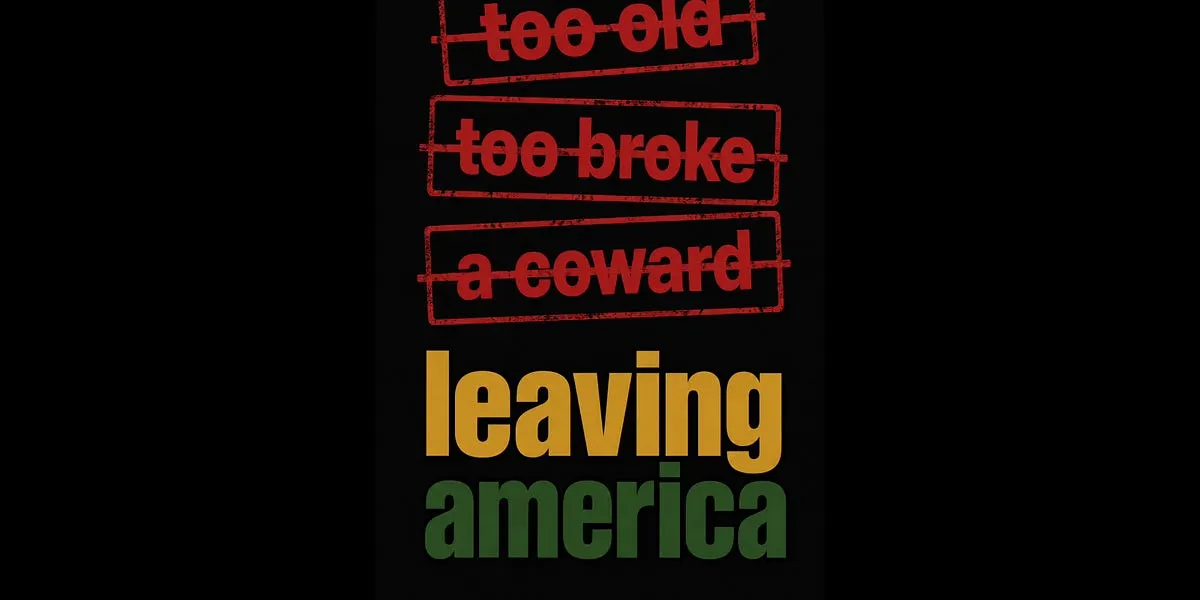
Now, 116 years since The Great Migration first began and 56 years after it ended, a similar migration is occurring, but this time no northern border to cross. They call it Blaxit, Blaxit Global, the Black Travel Movement, among many other names. Black people leaving the racial hostility and, in my case, both the racial and homophobia of the US to find a more peaceful and accepting life somewhere else in the world.
The Association of Americans Resident Overseas estimates that 5.5 million Americans are living abroad, and by inference, 655,000 of those are Black Americans. The social media space, YouTube, Facebook, WhatsApp is filled with Black expat groups and Black influencers displaying their lives in all corners of the world. And now my partner and I are joining the ranks of the growing Black expat community.
And the reasons for Black folks leaving are almost too many to list. We can start with the rising cost of living, from groceries to medical insurance, and the very real and present danger of not retiring with financial dignity. But then we land on much more sinister reasons for our departure. We too are seeking a higher quality of life away from the stress of police brutality, the microaggressions of Karens, Bubbas, and Chads in grocery stores, neighborhoods, and random racially driven road rage. Then there’s the macroaggression of racism: tearing down the Voting Rights Act, obliterating Black-majority voting congressional districts, removing Black people, Latinos, Asians, Women, and LGBT people from the historical narrative, both in public spaces and in the history books of this country. All of this is being done while simultaneously restoring monuments, statues, and names honoring un-American, un-patriotic traitors of the Civil War.
Get Elias Whitfield’s stories in your inbox
Join Medium for free to get updates from this writer.
And let’s not forget about the new reality of imprisoning women for having a miscarriage, or forcing them to risk actually dying by carrying a dead fetus to term. Or the fear of being arrested for simply driving a woman across state lines, or buying her a plane ticket to see a doctor, in order to reclaim her bodily autonomy or even something as basic as receiving birth control pills. And the plight of Black mothers is even worse. Black women are more than 3 times higher than White mothers to die while giving birth in the United States.
And from all that, here’s the result. According to November 2025 Gallup polling, 1 in 5 Americans want out. The Department of Homeland Security estimates 180,000 U.S. citizens emigrated in 2025 alone, the largest outbound citizen migration in decades. Passport renunciations, once a rounding error at 200 to 400 a year, are climbing toward 5,000 annually, with demand for renunciation appointments backed up past 30,000.
Our own Blaxit Global movement has scattered us everywhere. West Africa: Ghana, Rwanda, Senegal, especially Ghana, where the government’s Year of Return and Beyond the Return campaigns started the fervor. According to their Diaspora Affairs Office, at least 1,500 African Americans relocated between 2019 and 2023 alone. Southern Africa: South Africa, the only country on the entire continent where our gay rights have been enshrined in the constitution since 1996, and where same-sex marriage has been legal since 2006. Then there’s Asia and the Gulf: Thailand, the UAE. Latin America and the Caribbean: Mexico, Costa Rica, Panama, Colombia. Parts of Europe: Portugal, Spain, France. A single Facebook group, Blaxit Tribe, has more than 50,000 members trading notes on how to leave. That’s not a trend. That’s a network.
Black people are no longer chained to the inequities, the hostilities, the micro- and macroaggressions of a racist, homophobic America. Blaxit, Blaxit Global, the worldwide Great Migration of Black people, it’s already underway, whether the headlines have caught up or not.
We’ve seen this story before. We know what happens if we stay and wait for it to fix itself.
We built cities to great heights in America from nothing through our presence and our work ethic: Chicago’s South Side, Harlem, Detroit’s whole industrial spine. Imagine what we can build somewhere else with our high-valued US dollars, already sitting in our savings and investment accounts. But it’s our money driving the development this time around not just our physical bodies. The Black diaspora only knows how to thrive. It’s the one thing history hasn’t managed to beat, push, squeeze, or kill out of us.
Don’t be afraid of this new Great Migration. It isn’t North this time. It’s everywhere. And it’s been a long time coming, and the time is right now!
Elias Whitfield is a writer covering the Black diaspora, relocation, and life abroad, including his own move to South Africa. He is also the author of The Freedom in Leaving (TheFreedomInLeaving.com, Release E-book Oct. 20 + Print Copy: Nov. 10, 2026).
Originally published at https://eliaswhitfield.substack.com on July 23, 2026.