Musicians: Take Notes When You Practice!

If you don’t keep track of what you’re working on, you’re probably wasting valuable practice time.
You probably think you don’t need to take notes when you’re practicing, but you do. It doesn’t take long, and it can really help you improve faster and be less frustrated with your practicing.
A few great reasons why taking notes helps:
- You can get right back to what you were working on the last time you practiced, even if that was a couple of days or even a week ago.
- Notes help keep you pointing toward a goal consistently enough to achieve that goal.
- Notes let you track your progress. For example you can quickly see how long you’ve been working on a tune, a technique, an idea, and how far you’ve come.
- They help you find out what works and what doesn’t
- In your notebook, you can include your own ideas, your epiphanies, your attaboys. That can be a great reminder at some future time, maybe when you’re not feeling great about your playing.
- Writing things down actually helps you understand & remember them, even if you don’t go back and read it.
Put It into Practice
Pull out any notebook: lined, unlined, graph paper, music staff, whatever, in any size that you like.

I created this workbook that has music staff on one page and is blank on the facing page.


It’s available on my website.
Get Judy Minot’s stories in your inbox
Join Medium for free to get updates from this writer.
Make an entry every time you practice. You can include any details you want but I suggest you include at minimum, the date, your overall intention for the day, and the tunes/techniques you worked on. You can add things like how long, what element you focused on, what you did or didn’t do well at, or metronome markings.

You’re free to doodle, or add highlights, underlines, even stickers. You can write out snippets of musical notation or any visual representation of what you’re doing or want to do.

An app or a whiteboard may also work for you. Just find some way to keep notes on what you’re working on!

I’ve started using a small magnetic whiteboard and I’m a big fan. It allows me to keep sight of what I’m working on long-term, and gives me room to add inspiring ideas and memorabelia (as well has providing a handy place to hang a thermometer, camera remote, etc.). But I still take notes on paper, too. I hope you’ll give it a try.

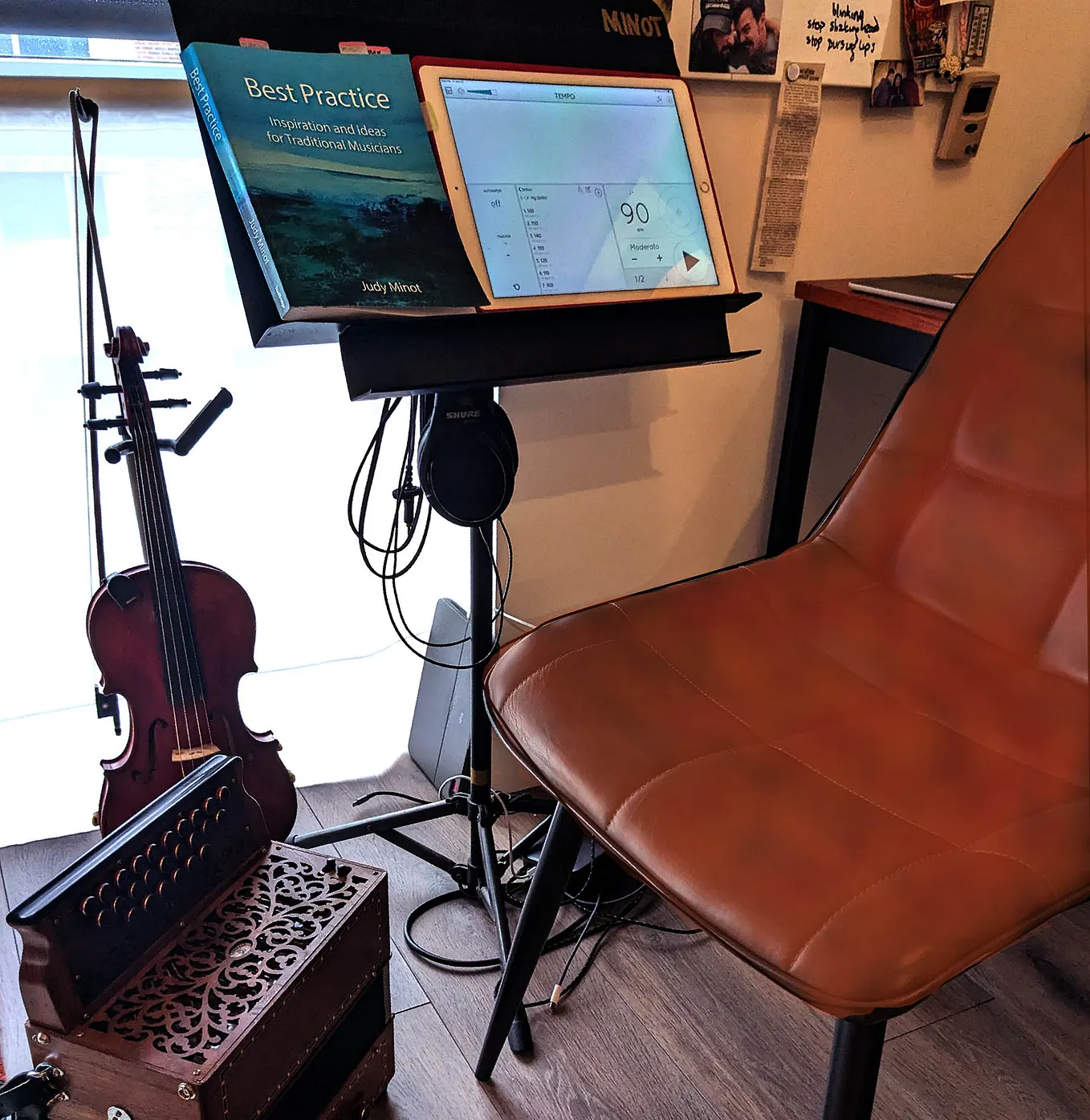
My book, Best Practice: Inspiration and Ideas for Traditional Musicians, is full of ideas to help you improve more quickly and play with more joy.
It’s written for any musician, playing any instrument, in any genre at any experience or skill level. Each chapter is a 1–3 minute read, giving you a practical piece of advice to help you today, right now.
Here are a few chapters in Best Practice where you’ll find more about taking notes
18— Taking Notes
100— Your Three Things
169— Continuous Growth
194— The Presentation Rule
196 — Goal Setting

Judy Minot is a musician, teacher, and the author of the book Best Practice: Inspiration and Ideas for Traditional Musicians.
Judy has played and practiced piano since she could reach the keys, training in classical playing until age 16. She now plays traditional music in various settings on a number of instruments, and gives workshops and classes on Best Practice ideas all over the world, both virtually and in person.
Judy spent her working life in broadcast television and digital marketing. She holds a 4th degree black belt in the martial art of Kokikai Aikido and is a certified yoga teacher.
- For more information visit: www.judyminot.com/bestpractice
- Subscribe to the mailing list of very occasional updates.
- Tiktok: @bestpractice41
- Facebook: https://www.facebook.com/bestpracticefortradmusicians/
- YouTube: https://www.youtube.com/@judyminot