Controlled Instability
A Trembling Bow, an Unshaken Conviction


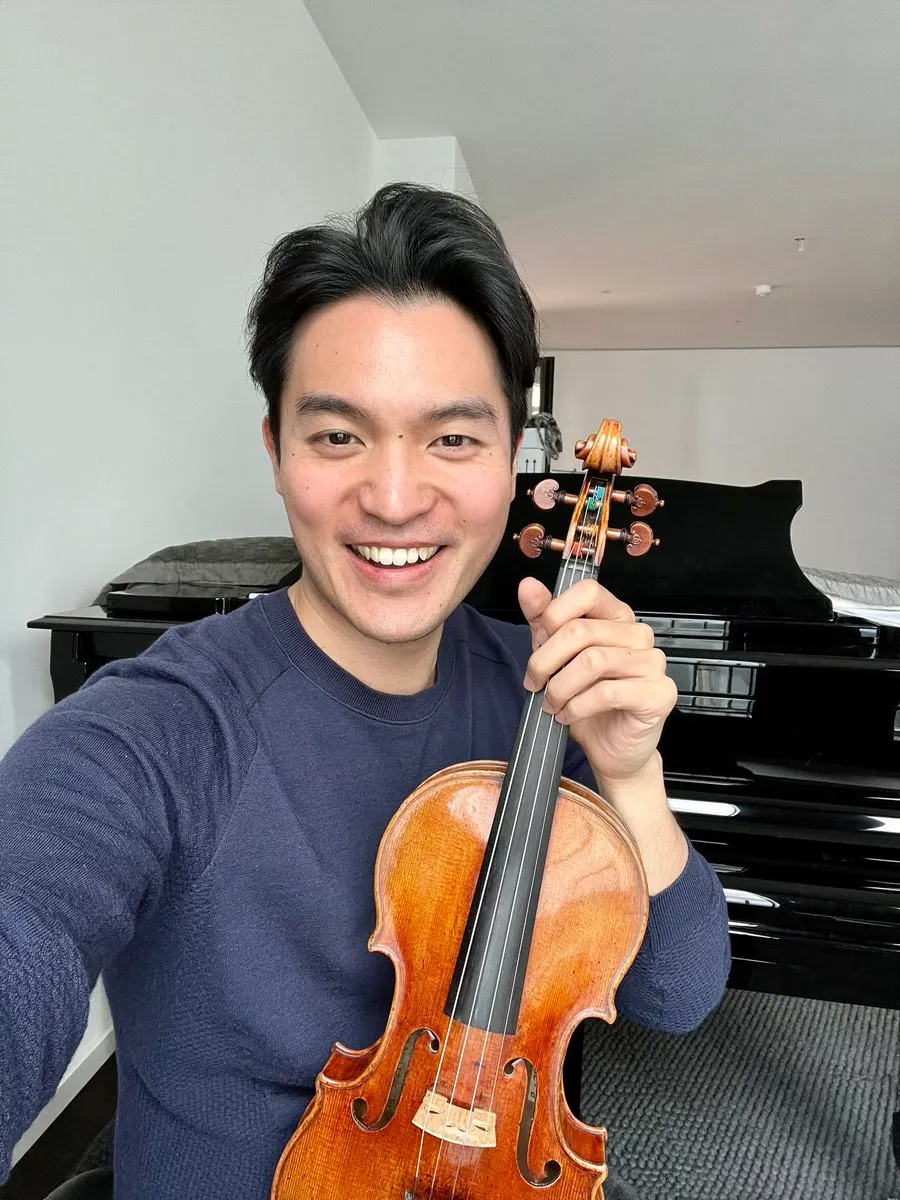
The World-renowned Violin Virtuoso Ray Chen has spent much of this season chasing a contradiction that most performers spend their careers trying to avoid: the idea that imperfection, carefully held, might be closer to truth than polish ever could be.

It is a strange thing to watch a musician of his stature deliberately court instability, and stranger still to hear how convincingly he argues for it. But spend enough time following his preparation this year, the late nights with an antique bow, the returns to scales he mastered decades ago, the quiet insistence on remembering rather than merely performing, and the argument stops sounding strange at all. It starts sounding inevitable.
It began, as these things often do, with a bow. Chen had been alternating between an early-1900s Hill and Sons and a newer Picatti, and what he found troubled him in the most productive way.
The old bow trembled slightly under his hand.
It resisted him, refused the kind of frictionless control that modern craftsmanship has spent a century perfecting. And in that resistance, something in the Sibelius Concerto’s bleaker passages started to breathe in a way the newer, more obedient bow simply couldn’t replicate.
There is a particular passage in the first movement, one of those long lyrical lines that asks a violinist to sound utterly alone, where Chen has said the old bow’s slight unsteadiness does something a flawless tone cannot: it sounds like a person, not an instrument.
“A sound that carries risk,” he has said, “can be more compelling than a perfectly refined one.”
It is not the kind of thing a violinist says lightly, and Chen does not say it lightly. He has built an entire philosophy of practice around it this year.
What makes the observation interesting is not the poetry of it, though there is plenty, but the discipline underneath.
Chen is careful to note that instability without foundation is simply chaos, and that the tremble he has come to prize is only useful because everything beneath it is unshakeable.

The bow does not create the vulnerability.
It reveals one that was already earned.
He describes, almost ruefully, six unbroken months earlier in his training spent on nothing but scales, a period he now credits with everything that followed.
“The problem is never the piece,” he says.
“It’s always the fundamentals.”
It is a humbling thing to hear from someone at his level, delivered without a trace of false modesty, and it is precisely why students and colleagues who have watched him work this year keep returning to the same word: honest.
That honesty extends past the instrument and into the body itself.
Chen speaks of a new bow not as a simple substitution but as a disruption that ripples through the entire physical system, unsettling the left hand, souring the intonation, breeding a kind of hesitance that has nothing to do with talent and everything to do with trust. His answer is characteristically unsentimental: lean in.
Meet the unfamiliar tool with more conviction, not less, and let the body recalibrate through confidence rather than caution. It is a small piece of advice with large implications, the kind of thing that separates musicians who merely survive change from those who metabolize it.
The same restless curiosity shows up in his relationship with strings, an area most soloists treat as settled once a preference is found.
Chen instead approaches sound as something to be actively designed rather than passively produced, testing how a set of Rondo Gold strings interacts with the particular voice of a Stradivarius, listening for the moment a tired instrument comes back to life. He speaks of the performer less as a player and more as an acoustic architect, someone responsible not just for notes but for the shape of the air around them.
Even pizzicato, so often treated as a footnote to the violinist’s real vocabulary, becomes under his attention a complete miniature of everything else he believes: the position of the pluck determining resonance, the angle determining color, the whole hand engaged rather than the fingertip alone.
Nothing in his current practice is left to accident, even the parts engineered to sound accidental.
Get YOON’s stories in your inbox
Join Medium for free to get updates from this writer.
There is something almost confessional in how Chen talks about the problems that persist despite all of this rigor.
Passages that refuse to settle.
Balance that fractures after an equipment change.
Intonation issues that vanish for weeks and then return, uninvited, like something feral.
He has a memorable phrase for it: these problems behave like a wild animal that keeps coming back.

Not something defeated once and forgotten, but something managed, watched, coexisted with.
It is a rare admission from a performer of his caliber, and it reframes the entire conversation.

Mastery, in Chen’s telling, is not the elimination of difficulty.
It is a permanent, attentive relationship with it.
That relationship depends, more than audiences usually realize, on memory, and memory is the one instrument no violinist can simply purchase or inherit.
Chen has spoken candidly about how much of what happens in a lesson or a rehearsal simply evaporates by the following week, no matter how sharp the insight felt in the moment.
It is a problem every serious musician quietly wrestles with and rarely admits to, this slow erosion of hard-won detail beneath the sheer volume of daily practice. His response has been almost engineering-minded in its simplicity: record it, structure it, return to it.
He has been using Tonic Notes to do exactly that, letting the platform capture and organize the granular texture of a session, the bow angle that finally worked, the pizzicato correction that clicked, the exact tempo where a passage stopped fighting him, so that nothing has to be relearned from scratch the way so much technical wisdom quietly is, lesson after lesson, year after year.

For a player whose entire current philosophy rests on remembering exactly which instability was useful and which was not, that kind of continuity has become less a convenience than a working necessity.
A violinist chasing controlled instability needs, more than most, a stable record of what instability actually taught him.
The tremor in the old bow means nothing if the lesson it produced disappears by Thursday.

Underneath all of it sits a question Chen returns to again and again, one that has less to do with technique than with reason for being.
He describes an early stage of his career defined by playing for himself, and a current one defined by the desire to transmit something outward, to move whatever is happening inside the sound toward another person entirely.
Purpose, he insists, is what sustains practice through its most tedious hours. Without it, even flawless technique curdles into something hollow. With it, even a trembling old bow becomes an instrument of connection rather than mere display.
What emerges from watching Chen this season is a portrait of a musician who has stopped chasing safety and started chasing precision within risk instead, a much harder and much rarer pursuit.
It is worth noting, quietly, how much of that shift has depended on infrastructure most audiences never see: the discipline of scales revisited long after they were supposedly mastered, the willingness to trust an instrument that refuses easy obedience, and a system patient enough to hold onto every hard-won detail long after the lesson has ended, so that the next practice session can begin exactly where the last one left its most valuable thread.

The bow, the strings, even the notes themselves, are simply the means by which that purpose finds its way to an audience.
The discipline that holds it all together, quiet and largely unseen, is what makes the risk worth taking at all.