INTO THE TRIANGLE

What Ray Chen’s Practice Sessions Reveal About Navigating Adversity Toward Mastery
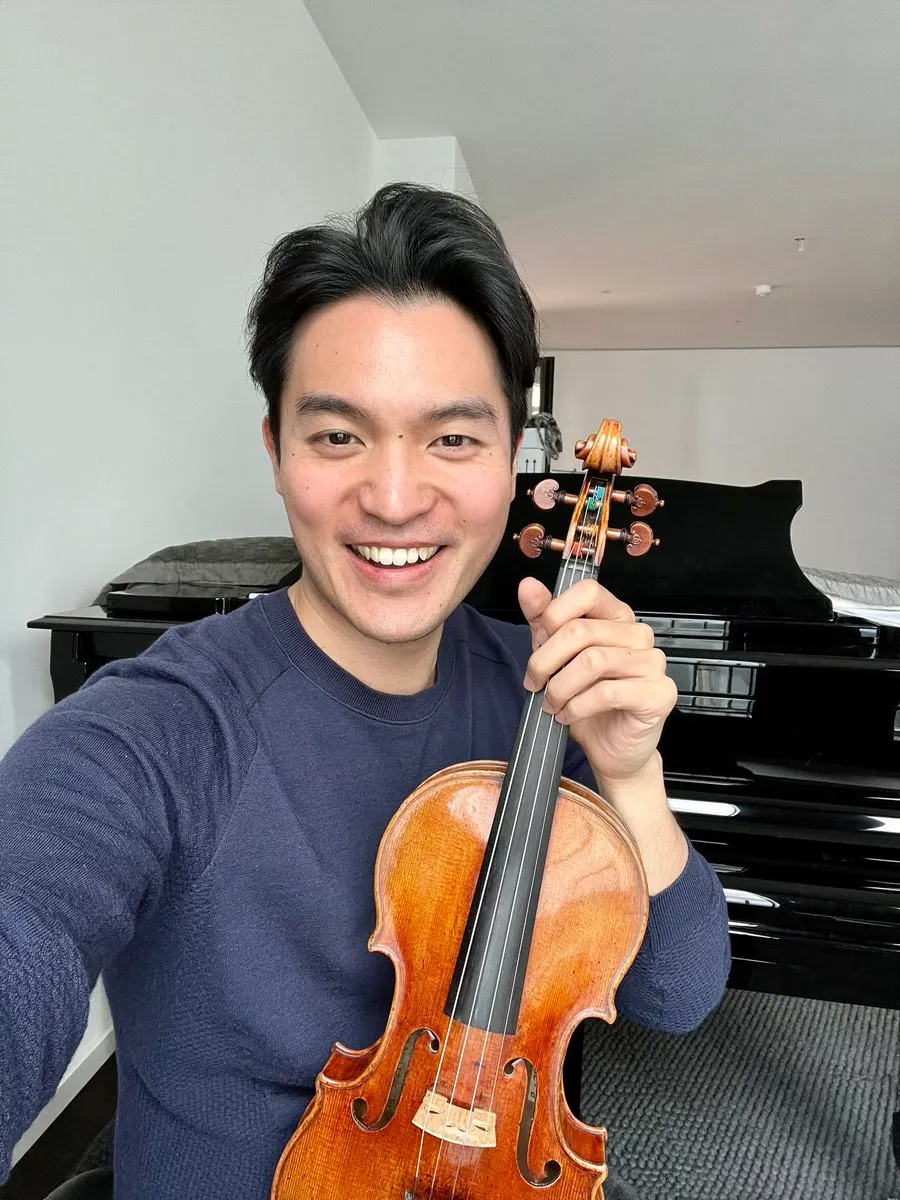
The world-renowned violin virtuoso Ray Chen walked into a practice session not long ago under conditions that were, by any reasonable standard, inauspicious.

His bow had just been rehaired with coarser brown hair than he ordinarily used, and the acoustic result was immediate: a high-frequency scratching sound that accompanied nearly every stroke, giving the tone a quality he himself compared, with characteristic good humor, to a very unhappy duck.
Most performers, confronted with equipment that squeaks and protests and refuses to cooperate, would quietly set it aside and reach for something more obliging. Chen did not. He leaned in.
What followed over the course of that session, documented through his live practice stream on the Tonic app, was not a rehearsal of comfort.
It was something rarer: a sustained encounter with difficulty, embraced on purpose, structured with rigor, and ultimately transformed into something that looked less like a struggle and more like a voyage into unmapped waters.
If you wanted a metaphor for what Chen was doing that day, you might think of the Bermuda Triangle, that fabled convergence of uncertainty, risk, and mystery.
The difference, of course, is that no one comes back from the Bermuda Triangle. Chen came back with a cleaner bow arm, a consolidated passage at 128 BPM, and a six-week roadmap toward a complete run-through of the Carmen Fantasy.
The Coarse Hair and the Principle Behind It
To understand why Chen’s response to the bow hair problem matters, it helps to know what bow hair actually does.
The hair grips the string through microscopic irregularities in its surface, enhanced by rosin, and the quality of that grip determines the character of the tone.
Coarser hair catches the string too aggressively.
The clean, singing cycle of bite and release breaks down.
Upper partials bleed in.
The player is forced to recalibrate arm weight, contact point, and bow speed with a precision that well-behaved equipment would never have demanded.
What Chen recognized, and what he articulated plainly to his viewers, is that this is exactly the point.
“If I can make this work, then any bow will work. This is harder, so I am going to make it work.”
The statement sounds almost offhand in delivery, but it encodes a principle that educational psychologists and sports scientists have spent decades studying under names like constraint-based learning and progressive overload.
When you raise the difficulty of a task beyond its ordinary demands, and then achieve the desired result anyway, the skill that emerges is more deeply embedded, more resilient under pressure, and more readily available when conditions return to normal.
The coarse bow hair was not a problem to be solved.
It was a training instrument.
This is what sports scientists call progressive overload, and what
Vygotsky’s educational psychology frames as the Zone of Proximal Development: the fertile ground just beyond the edge of current ability, where the task is neither trivial nor impossible, and where genuine growth lives.
Chen did not arrive at this zone by accident.
He set up camp there deliberately.
Entering Uncertain Waters: Exploration and Risk
There is a quality to the Bermuda Triangle that has always captivated the imagination, and it is not danger, exactly.
It is the combination of danger and mystery, the sense that you have entered a zone where the ordinary rules of navigation may no longer apply, where you must feel your way forward by instinct and observation rather than by the reassurance of familiar landmarks.
Chen’s practice session carried something of that quality.
The bow was unpredictable.
The tonal response shifted with each phrase.
He could not simply execute a pre-planned series of motor actions and expect the sound to behave; he had to listen acutely, adjust continuously, and remain alert to a range of variables that a well-functioning bow would have made invisible.
This is what exploratory learning theory describes as deliberate engagement with instability.
By accepting the coarse hair and its unpredictable tonal response, Chen transformed the session from a rehearsal of known solutions into a voyage of discovery, in which technical answers had to be uncovered rather than retrieved.
The instability was not incidental to the session’s value.
It was constitutive of it.
Performance psychology makes a distinction worth pausing on here. Risk, in the context of skill acquisition, is not a threat to be minimized.
It is a catalyst for growth.
When a performer accepts the discomfort of tonal imperfection and compounds it with the pressure of increasing tempo, each successful phrase becomes a demonstration that adversity can be converted into advancement.
The bow hair and the metronome together created what might be called a controlled stress environment: not the unmanageable chaos of a genuine crisis, but the productive friction of a challenge pitched precisely at the boundary of mastery.

The Metronome as Navigational Anchor
At a specific point in the session, Chen reached for the metronome.
The decision marked a shift in the nature of the work: from the exploratory management of the bow hair problem to the systematic construction of a passage at increasing tempos.
He began at 99 BPM, moved to 109, then to 117 or 118, and eventually reached 128, which he identified as the ceiling of his reliable control on that particular day.
Each increment was small enough to preserve the quality of what had already been achieved while raising the demands upon it.
Each stage consolidated accuracy before introducing new pressure.
Motor learning research has documented this method at length. When tempo increases too quickly, errors embed themselves into motor memory and become progressively harder to dislodge.
The incremental approach prevents that.
It keeps the neural pathways of correct execution intact while steadily strengthening them against greater demands.
What Chen was building was not just speed.
He was building rhythmic stability under pressure, the ability to maintain exact subdivisions as the margin for imprecision narrows and the physical and cognitive load intensifies.
But the metronome was doing something else as well, something more specific to the conditions of this particular session.
As Chen’s attention was necessarily distributed between managing the coarse bow hair and navigating the increasing tempo, the metronome held the rhythmic framework in place.
It served as what he himself described with precision: not a crutch but a scaffold.
Once the building stands on its own, the scaffold comes down.
In the context of turbulent seas, the metronome was a fixed navigational point, a lighthouse in the uncertainty, preserving the architecture of the phrase while the rest of the work demanded something closer to improvised seamanship.
The Compounded Challenge: Where Two Variables Converge
Get YOON’s stories in your inbox
Join Medium for free to get updates from this writer.
There is a concept in cognitive psychology called dual-task training, and the session Chen conducted that day was a near-perfect illustration of its application to instrumental practice.
The coarse bow hair demanded heightened concentration on tone production and contact point management.
The metronome’s tempo progression demanded heightened concentration on rhythmic precision and motor coordination.
To sustain quality under both pressures simultaneously required the kind of executive function that Cognitive Load theory associates with high-level performers: the capacity to distribute attention across competing demands without allowing either to collapse.
This is what makes the session more than a technically productive afternoon.
It is a demonstration of a governing philosophy, one that Chen articulated with characteristic directness: if the work can be accomplished under adverse conditions, it can be accomplished under any conditions.
Obstacles, in this framework, are not unfortunate interruptions of the real practice.
They are the practice.
The adversity does not delay the mastery; it builds it.
Emotional Honesty as a Dimension of Technique
One of the most instructive things about watching Chen practice is not the technique but the temperament.
He does not perform equanimity.
When the bow hair frustrated him, he said so, vividly and without embarrassment.
He acknowledged having momentarily forgotten how to set the Tonic app’s time signature, and handled the small navigation of that with complete ease. When a passage came off well despite the difficult bow, he praised himself aloud with what appeared to be genuine and unaffected pleasure.
Psychologists who study resilience in performance contexts call this stress inoculation: the controlled exposure to manageable stressors that builds psychological resistance against greater ones. But there is something more specific in what Chen does.
By naming his frustration and then moving forward without allowing it to arrest him, and by praising his successes specifically and immediately, he creates what reinforcement learning theory identifies as the most productive conditions for motor consolidation.
Immediate, specific positive feedback accelerates the embedding of correct patterns.
Chen has internalized this not as a technique but as a disposition, the kind of forward-looking emotional posture that treats each small victory as meaningful data and each setback as a navigational correction rather than a verdict.
This, too, is part of what the Bermuda Triangle of practice demands.
The mystery of that zone is not only technical.
It involves the management of one’s own inner weather, the capacity to remain oriented when the instruments are unreliable and the conditions are difficult.
Chen’s emotional intelligence in the face of equipment failure is not separate from his artistry. It is an expression of it.
Deliberate Practice and the Larger Picture
Anders Ericsson’s concept of deliberate practice has become so widely cited in the past two decades that it risks losing its specific meaning.
What Ericsson described was not practice that is effortful or long-lasting, but practice that is structured around targeted engagement with identified weaknesses, in which discomfort is not a side effect of improvement but its vehicle.
Chen’s session was a nearly textbook instance of this.
The bow hair isolated and amplified a specific vulnerability in his bow control.
The metronome isolated and systematically developed a specific technical bottleneck in the Carmen Fantasy. Neither challenge was allowed to remain vague or ambient.
Each was met directly, named, structured, and addressed.
The broader context of Chen’s practice life only deepens the picture.
Across sessions documented over recent months, he has been simultaneously preparing the Carmen Fantasy, the Mozart Violin Sonata K. 454, and the Grieg Violin Sonata №3, three works whose technical and expressive demands could hardly be more different from one another.
For the Carmen Fantasy, the governing challenge is the achievement of expressive freedom through total technical security: the somatic precision of the 0.2-second holding principle, the tactile anchor of the palm against the violin’s shoulder, the conviction that virtuosity is an instrument of seduction rather than a goal in itself.
For the Mozart, it is the preservation of classical purity through deliberate string and fingering choices, the refusal of convenient solutions that would darken the tone, the aspiration to sing like an opera singer in the most seamless and resonant sense.
For the Grieg, it is the negotiation of Norwegian folk freshness against the weight of German Romanticism, enacted primarily through the bow, and grounded in historical and biographical research that preceded the technical work.
In each case, the approach is the same: identify what the music requires, find the specific technical means of achieving it, and then practice those means under conditions that demand more than ordinary performance would.
The bread-baking analogy he uses for the first principle of his practice philosophy captures something essential here.
A piece of music, like dough, requires time to rise.
You learn the notes, then you set it aside, then you return, and what you find on your return is deeper than what you left. But the rising only works if the foundation was properly made, and the foundation is made in exactly the kind of session documented here: difficult, honest, methodical, and unsparing.
Final Coordinates
There are vessels that enter the Bermuda Triangle and do not return, and there are those that come back changed.
The ones that return, if the metaphor is to hold, are the ones whose navigators knew that uncertainty was not the enemy of the journey but its condition.
They carried fixed points with them, and they trusted those points when the instruments behaved strangely and the horizon gave no useful information.
Ray Chen’s practice session with the coarse bow hair and the metronome is a portrait of a navigator who understands this.
The uncertainty of the bow’s tonal response cultivated resilience.
The risk of tempo escalation acted as a catalyst for growth.
The metronome held the rhythmic architecture steady in turbulent conditions. And the mystery of the bow’s unpredictability, which could not simply be engineered away, became a source of motivation, compelling a level of listening and physical adjustment that a well-behaved bow would never have required.
What emerges from this session, and from the larger body of practice it belongs to, is a portrait of artistry understood not as the avoidance of difficulty but as the disciplined cultivation of the capacity to meet it.

The obstacles are not unfortunate features of the terrain.
They are the terrain. And the musician who learns to navigate them, honestly and with good humor and without the pretense of ideal conditions, is the musician who will still be making music when the conditions are anything but ideal.
Which, as any performer will confirm, is most of the time.
Chen committed at the end of that session to beginning earlier the next day. It was a small thing, but it was characteristic: forward-looking, self-accountable, already oriented toward the next crossing. The scaffold would come down eventually. The building was already rising.

This article draws on documented practice sessions and analysis for Master Ray Chen, covering work on the Carmen Fantasy, Mozart Violin Sonata K. 454, and Grieg Violin Sonata №3.