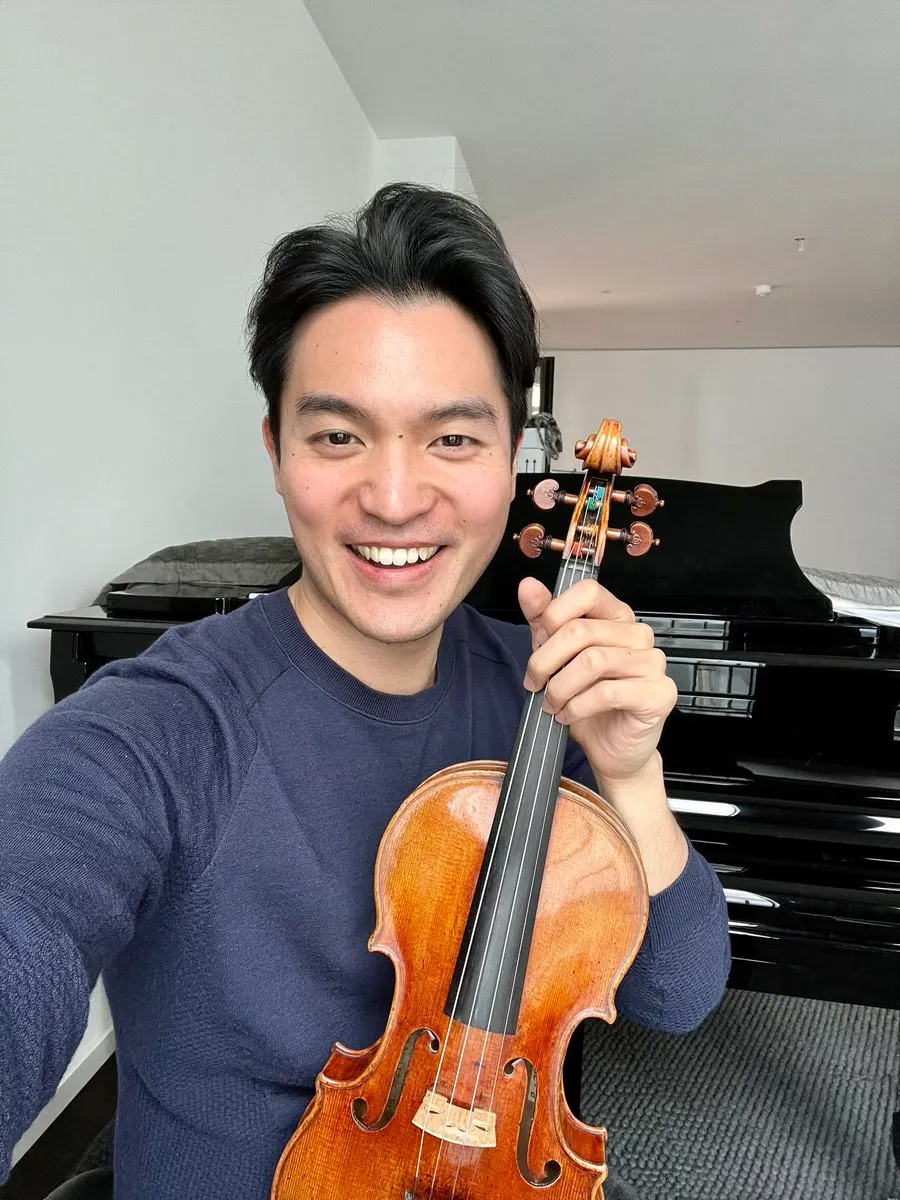
The Devil Must Cry: The Infernal Virtuosity of Ray Chen

To witness the World-renowned violin virtuoso Ray Chen at the height of his powers is to understand, with sudden and disquieting clarity, that virtuosity is not a gift conferred at birth but a covenant entered into daily with something vast, demanding, and not entirely of this world.

The legend of Giuseppe Tartini has survived three centuries not because it is plausible, but because it is necessary. In the year 1713, so the account endures, the Paduan composer dreamed that the Devil himself appeared at his bedside, seized the violin from his trembling hands, and proceeded to perform a sonata of such preternatural brilliance that Tartini awoke in a state of inexpressible agitation, seized his instrument, and attempted to transcribe what he had heard. The result was the Devil’s Trill Sonata. Tartini himself confessed that the work he committed to paper was, compared to what the nocturnal visitor had played, a thing of pitiful inadequacy.
One wonders, seated in the concert hall as the World-renowned violin virtuoso Ray Chen draws his bow across the strings of his 1727 Stradivarius, whether Tartini’s devil would find cause for similar complaint today.

I. The Campaign Begins
In the universe of the video game Devil May Cry the protagonist, a half-demon swordsman of incomprehensible aptitude, does not merely defeat his adversaries. He annihilates them with what the game’s designers call Style, a measurable quality ranked from the ignominious D to the transcendent S, accumulating through the sustained elegance of unbroken combination.
To falter, to be struck, to abandon the continuity of one’s assault, is to surrender the rank one has so laboriously cultivated.
The highest designation, awarded only at the apex of sustained, flawless, radiant execution, is reserved for the single English word the designers chose with curious precision: Stylish.
Ray Chen calls it something else. He calls it Aura Farming.
The term, borrowed with characteristic irreverence from the vocabulary of competitive gaming, describes a phenomenon that the classical tradition has always intuited but seldom managed to name with such disarming directness: the deliberate, disciplined cultivation of a performer’s commanding presence upon the stage, the construction of an energy field so potent and so persuasive that an audience ceases to listen and begins, almost involuntarily, to receive.
Aura is not born. It is farmed, hour by hour, in the practice room, through scales and etudes and the meticulous interrogation of one’s own inadequacies.
II. The Training Mode
Every action game worth the designation contains, somewhere within its architecture, a Training Mode: a space stripped of consequence, without adversaries or time constraints, where the fundamental mechanics of combat may be internalized to the point of instinct.
In Devil May Cry, no style rank accumulates in Training Mode. There is no audience, no judgment, no consequence. There is only the movement itself, repeated until it is no longer a sequence of conscious decisions but a single, indivisible act.
At the age of thirteen, Ray Chen spent six consecutive months practicing exclusively scales and etudes.
No repertoire.
No performance.
No audience.
He has spoken of this period as the crucible in which the technical substructure of his entire subsequent career was forged, and the metaphor is apt: the crucible is a vessel of extreme heat, not a pleasant environment, not one conducive to exhibition, but the only environment in which certain transformations can occur.
The fruit of that foundational discipline is audible in the precision of every positional shift, in the absolute stability of intonation in the upper registers of the D string, in the seamless tonal continuity of his slides.
These are not ornaments.
They are the silent infrastructure upon which every visible act of brilliance depends.
The Training Mode is never over.
Chen now warms up by performing the very works he intends to master, but at a tempo so profoundly reduced that the music dissolves into its constituent elements: every scale implicit, every technical challenge revealed, every intonation demand made visible by the unforgiving slowness of the approach.
He has observed, with characteristic self-awareness, that slow playing is in fact the greater challenge.
The stage performance is, in a sense, the easier half.
III. The Style Switch
Among the most coveted abilities in the later installments of Devil May Cry is the Style Switch: the capacity to transition instantaneously from one combat mode to another, from the
Trickster’s evasive fluidity to the Royal Guard’s unyielding defiance, without disrupting the continuity of one’s assault, without surrendering the rank one has accumulated.
The Style Switch is not a retreat from engagement.
It is an expansion of it.
The warrior who can switch at will possesses, in effect, not one weapon but all weapons simultaneously, and the selection of the appropriate instrument in the appropriate instant becomes itself an act of supreme artistry.
Chen calls the equivalent mechanism in violin playing the Color Change, and it is, if anything, a more demanding discipline than its digital counterpart.
The transition from one tonal world to another is achieved through a configuration of three physical variables, bow pressure, bow speed, and the contact point at which the hair engages the string, each adjustable in infinite gradation, each interdependent with the others, each capable of producing a fundamentally different character of sound.
The dense, earthbound weight of the Grieg Sonata’s leathery tone is produced by a perpendicular bow bearing with sustained pressure.
The luminous, weightless transparency that Mozart demands requires the same bow moving at greater velocity with diminished force.
The fierce, bridge-focused intensity of the Carmen Fantasie at its most combative is a product not of weight but of velocity, a clarification that runs counter to the instincts of most performers, who under the pressure of the fortissimo reach instinctively for force where only speed will serve.
But what distinguishes the Color Change from mere tonal variation is the vehicle through which it is enacted: the threshold.
Chen has articulated, with a directness that carries the weight of genuine conviction, that there are rests in music, but there are only rests when you are not playing.
Every silence, every caesura, every moment of apparent repose is not an absence but a portal, a charged interval across which the performer steps from one emotional world into another, and the Style Switch, the Color Change, the transformation of tonal identity, occurs precisely there, in that charged and generative silence.
In Devil May Cry, the Style Switch consumes a fraction of a second. In Chen’s playing, that fraction is known as the 0.2-Second Strategy.
IV. Frame-Perfect Input
Among those who study action games with genuine rigor, the concept of frame-perfect input represents the pinnacle of technical precision. The execution of a specific action within a window of opportunity so narrow as to be measured not in seconds but in the individual frames of the game’s rendered animation, sixteen milliseconds at sixty frames per second, an interval so brief as to be invisible to any perception except the one trained specifically to inhabit it.
The player who commands frame-perfect input does not react to the game.
The player anticipates it, perceiving structural opportunities that exist within the game’s logic but are invisible to the untrained eye.
The 0.2-Second Strategy is violin playing’s equivalent, and it rests upon an insight of comparable elegance. When the score calls for an open string, that string resonates without any engagement of the left hand.
The left hand, in that instant, is free.
The duration of that freedom is approximately one-fifth of a second.
What Chen discovered, or rather what he named and systematized, is that this interval, if inhabited with conscious deliberateness, transforms what appears to be a demanding positional leap into something altogether different: an arrival.
The hand migrates to its destination before the music demands it, and the passage that previously produced anxiety produces instead an almost uncanny sensation of ease.
The overwhelming majority of errors in rapid positional transitions arise not from any deficiency of physical speed but from a cognitive misapprehension: the performer believes no structural window for movement exists, when in truth the score has already provided one.
The 0.2-Second Strategy is, in Chen’s own formulation, the art of recognizing and inhabiting the space that the music itself has already offered.
Get YOON’s stories in your inbox
Join Medium for free to get updates from this writer.
It operates, as frame-perfect input operates, at the intersection of perception and preparation, where what appears to be reaction is in fact the enactment of a plan conceived well in advance of its execution.

V. The Ultimate Move
In Devil May Cry, the Devil Trigger is the game’s ultimate move: a state of transformation in which the protagonist’s latent supernatural power is unleashed, his capacities amplified beyond their ordinary parameters, the accumulated aura of sustained stylish combat finally discharged in a single act of overwhelming and annihilating brilliance.
It cannot be activated at will.
It must be earned through the sustained excellence that precedes it. And its deployment, to those who understand what they are witnessing, is not a surprise but an inevitability, the natural culmination of everything that has been building since the first encounter.
In Tartini’s Devil’s Trill Sonata, that moment is the cadenza. And crucially, it is not Tartini’s cadenza.
It is the one subsequently composed by Fritz Kreisler, the Viennese virtuoso who examined the original work and, with an audacity that is either supreme impertinence or supreme homage, wrote a cadenza of such staggering technical ambition that it transcends the composition it was designed to serve. Kreisler, in Chen’s formulation, one-upped the composer himself.
The passage preceding the cadenza is what Chen calls the Last Hurrah: the point at which aura cultivation reaches its absolute zenith, the moment at which the accumulated discipline of a lifetime is gathered and focused into a single, devastating act of virtuosic superabundance.
To hear Chen perform the Kreisler cadenza is to understand, with sudden and disquieting clarity, why Tartini believed his own work was inadequate by comparison with what the devil played.
The cadenza does not merely display technique. It displays the consequence of a life organized around the pursuit of something that most performers acknowledge as desirable and few achieve: not mere proficiency, not even mastery in its conventional sense, but the condition of having so thoroughly internalized the demands of the instrument that the instrument ceases to be an obstacle and becomes instead an extension of the will, of the imagination, of whatever it is in the human spirit that insists, in the face of all reasonable counsel, on transcendence.
VI. The Stage Progression
A Devil May Cry campaign is not a single encounter but a progression: a sequence of stages, each distinct in its environmental character, its adversarial demands, and its tonal atmosphere.
The virtuoso who performs Piazzolla’s Four Seasons of Buenos Aires navigates an analogous succession.
Each movement presents its own atmospheric demands, its own species of aura to be cultivated and ultimately projected outward.
Summer announces itself with the explosive technical brilliance of the first great peak, the combat zone entered at full engagement.
Autumn descends into lyrical depth and the delicate, plaintive textures of cricket-song, an elegiac aura of intimacy and autumnal gravity.
Winter, which Chen designates the most mysterious of the cycle, demands the cultivation of a ghostly, suspended, ethereal sonority, a tone that hovers at the boundary between the audible and the imagined, between the present and the irrecoverable.
These are not merely different movements.
They are different stages, different combat environments, each requiring a Style Switch of the most comprehensive kind: not a shift of technique but a transformation of being.
VII. Weapon Customization
No serious practitioner of Devil May Cry approaches the weapon customization screen with indifference.
The selection, modification, and calibration of one’s armaments is an act of strategic deliberation, each choice altering the character of the combat that follows in ways that are both measurable and aesthetically consequential.
The warrior who does not understand his weapons cannot understand himself.
Chen is, as he freely acknowledges, a complete nerd about sound, strings, and acoustic properties, and the confession is not a disclaimer but a declaration of priority.
Since the year 2009, he has maintained a meticulous string-change diary, a record of observations gathered across decades of performance on the world’s most demanding stages, a document that has actively shaped the development of Thomastik strings. At the time of a recent session, he was performing on prototype strings not yet available to the public, providing real-world refinement data to the manufacturer in exchange for the privilege of playing the future before it arrives.
The 1727 Stradivarius upon which he performs is, in its fundamental character, a dark instrument.
Chen has selected ebony pegs to introduce brightness, to restore tonal equilibrium, to prevent the darkness from collapsing into opacity.
The governing principle is one of balance: a dark instrument receives a brightening accessory; a bright instrument receives a darkening one.
The instrument’s voice is not a fixed quantity to be accepted but an argument to be joined, a conversation between the wood’s inherent character and the performer’s deliberate intervention, conducted through the most intimate imaginable means.
Every component of the instrument, from tailpiece to string to the accessory that holds the string in place, participates in the construction of the aura that will ultimately reach the audience.
The weapon must be worthy of the warrior who wields it.
VIII. The Campaign Never Ends
There is, in the Devil May Cry universe, a mode called Dante Must Die: the hardest difficulty setting, in which every adversary is at their most powerful, every mistake is most costly, and the margin between survival and defeat is at its narrowest.
It is not a mode for the casual player.
It is a mode for those who have mastered all the preceding difficulties and found them insufficient.


The European tour that Ray Chen is currently preparing to undertake is, in the terms we have established, a campaign conducted at that difficulty.
The Devil’s Trill Sonata with its supernatural narrative and its Kreisler cadenza. Piazzolla’s Four Seasons with its atmospheric breadth and expressive extremity.
A 1727 Stradivarius configured with the precision of a masterwork weapon.
A practice philosophy refined over decades into something approaching a science of artistic self-construction.
Each practice session as Training Mode.
Each tonal transformation as Style Switch. Each cadenza as
Devil Trigger, activated at the apex of accumulated aura, discharged in a single act of supreme and irreversible commitment.
Chen has described his philosophy of performance in terms that resist, with admirable stubbornness, the mystifications to which classical musicians are professionally susceptible.
Technique is a servant, never a sovereign.
Interpretation is neither pure emotion nor pure mechanics but the art of their fusion.
Aura is not a birthright. It is built, layer by layer, through devoted exploration, technical mastery, and an intimate understanding of every element of the instrument.
Tartini’s devil, according to the legend, played a sonata so magnificent that the best human approximation of it was, in Tartini’s own estimation, forever inadequate.
One suspects that what the devil actually possessed was not supernatural ability but rather the absolute freedom from self-doubt that comes from having completed the training that no mortal is ever quite willing to endure to its logical conclusion.
Ray Chen, who has spent decades willingly enduring precisely that training, has narrowed the gap considerably.
Whether he has closed it entirely is, perhaps, the question that keeps him returning to the practice room every morning, armed with his Stradivarius and his string-change diary and his 0.2-Second Strategy, farming aura in the patient and inexorable manner of a man who understands that the campaign never truly ends, only continues, stage by stage, toward the rank that awaits those with the discipline and the audacity to pursue it: Stylish.