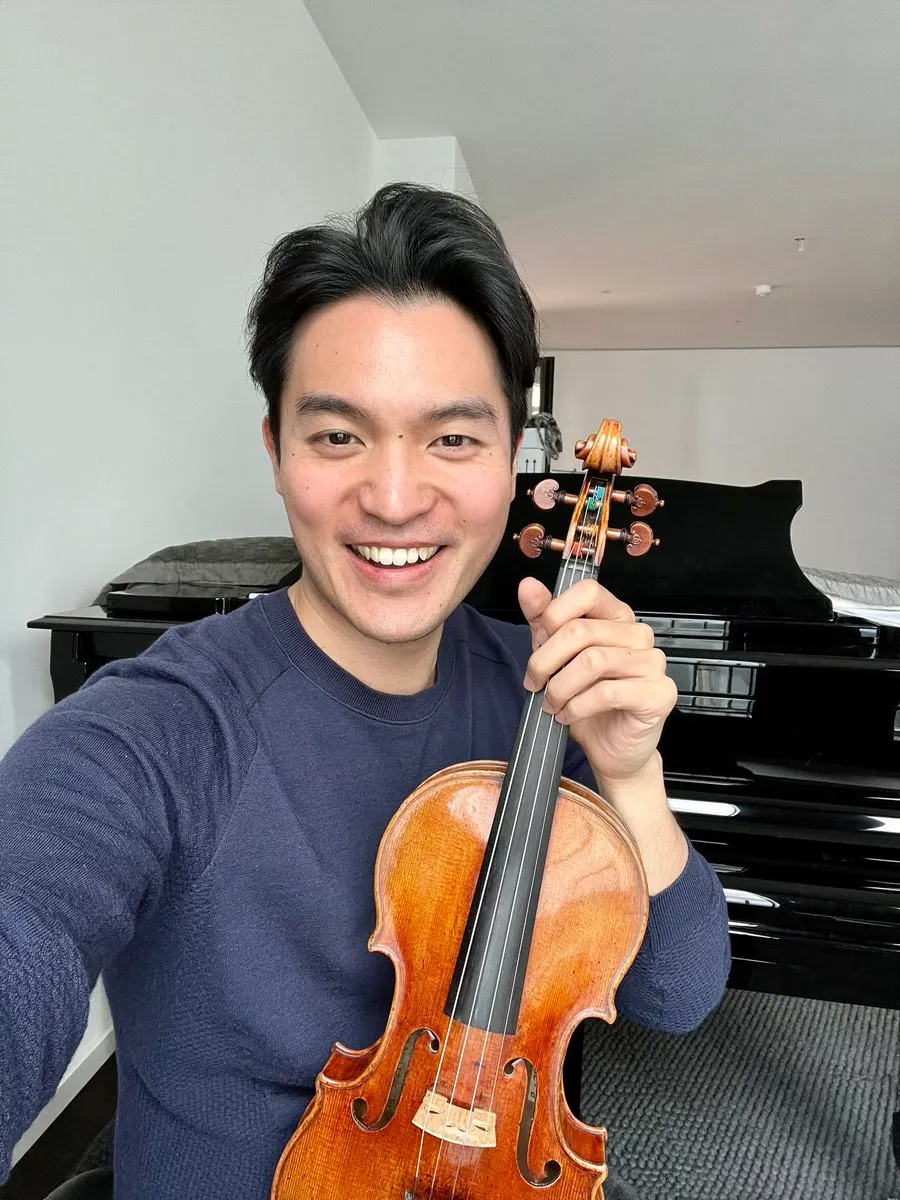
The Volatile Core

On Virtuoso Ray Chen, Temporal Mediation, and the Art of Controlled Instability

Most violinists polish. The Violin Virtuoso Ray Chen destabilizes.

This is not a criticism. It is, on reflection, the most precise description of what actually occurs when Chen enters the practice room.
The familiar narrative of violin mastery assumes a particular shape: repetition gives way to refinement, refinement to completion, completion to the performance itself. The arc moves in one direction. The destination is, eventually, a fixed object. But what the documentation of Chen’s preparation reveals is a process that refuses this arc entirely. There is no fixed object. There is no stable endpoint toward which the work is tending. There is, instead, something more volatile and considerably more interesting.
In the universe of Arcane, the Hextech Core is not a reliable power source. It is an unstable center in which multiple forces continuously reorganize without ever reaching resolution. It holds incompatible energies in a state of perpetual tension, productive precisely because it cannot settle. Applied to the practice of a string player, this is not the most obvious metaphor. But for Chen, it may be the only accurate one.

Excavation Before Performance
When Chen returns to a work he recorded years earlier, the first task is not interpretation. It is archaeology. Approaching the Arcane Suite, which he first recorded in 2019, he articulates the problem with unguarded candor: “I can’t remember. I’ve got to find my ways and fingers from back then.” The statement is disarming in its simplicity. For a performer at his level, memory is presumed to be a settled instrument. What this moment reveals, instead, is that memory is a site of ongoing excavation.
The fingerings, bowings, and structural modifications he introduced at the time of the original recording are not stored reliably in the body or the mind.
They must be recovered, often imperfectly, from annotated scores and prior recordings that function less like a reference library and more like dispatches from a former self. The gap between initial inspiration and present recall is not a failure of preparation. It is a constitutive feature of the practice. Past decisions must be reencountered before they can be either reinstated or surpassed.
This is the first of three movements that define Chen’s practice structure, and it corresponds precisely to the first stage of the Hextech model: excavation of the past. What has been deposited over years of prior engagement must be brought back to the surface before it can be examined, altered, or discarded. The past is not background. It is active material.
Reconstruction Under Pressure
When the archive yields nothing usable, Chen pivots without apparent hesitation. “You know what? I don’t need to find my old bowings and fingerings. I’ll make them up on the spot!” The exclamation point is part of the performance, but what follows it is not improvisation in the casual sense.
It is reconstruction: the generation of new technical solutions from first principles, in real time, under the conditions of an active session.
This capacity for on-the-fly reconstitution is not incidental to the practice. It is, arguably, its most characteristic feature. When a standard string crossing proves mechanically awkward in the Arcane Suite, Chen devises a solution involving the sustained D string in a manner that approximates a double stop, neutralizing the need for the crossing in its conventional form. He refers to this as a hack, with the lightness of tone that belongs to a performer who is comfortable operating inside the mechanics of a problem rather than circling it from a distance. The word is deliberately modest. The insight behind it is not.
The same inventive energy extends to the musical text itself. In I Promised You, where the original structure was designed to support on-screen dialogue rather than concert presentation, Chen identifies an opportunity to compose an original melodic line that preserves the emotional register of the scene while satisfying the architectural demands of a standalone performance.
This is no longer interpretation. It is, in the truest sense, co-authorship. The score is treated as a flexible system rather than a binding contract.
What the Hextech model identifies as instability, the conventional performance discourse tends to frame as error or incompletion. Chen reframes it as the condition of genuine artistry. Technical decisions are not inherited from prior sessions but actively reconstituted. No fingering is treated as settled until it has been tested against the demands of the present moment. The system is, by design, resistant to premature closure.
The Psychology of Controlled Instability
Perhaps the most analytically revealing episode in the documented sessions concerns a passage of such concentrated difficulty that it had brought the previous day’s practice to a full stop. Chen’s response is, by his own account, a form of self-gaslighting: a deliberate, sustained campaign of positive self-persuasion in which he repeats, with escalating conviction, that the passage is easy, that anyone could manage it, that even a child might find it trivial.
The artificiality of the exercise is fully acknowledged. Its effectiveness is also fully acknowledged. These two facts coexist without apparent contradiction.
What Chen is describing is not positive thinking in its popular and somewhat debased contemporary form. He is describing a precise psychological technique: the strategic reconfiguration of an emotional relationship to difficulty, executed not by denying the difficulty but by interrupting the feedback loop between perception and response. The passage does not become easier. The performer’s relationship to its difficulty is restructured. The distinction is the entire point.
This is the quality that the Hextech model identifies as the ability to operate within controlled instability. The system does not seek equilibrium. What might be described elsewhere as mastery appears here not as the achievement of stability but as the cultivation of a sufficiently robust tolerance for instability that the work can continue in its absence. A passage mastered in this sense is not a passage conquered. It is a passage held.
Temporal Mediation: Two Worlds Held Apart
Chen’s programming choices present a surface-level argument that is easy to make and not very interesting: a world-class classical violinist engages with video game and anime repertoire, demonstrating that these scores are compositionally worthy of serious attention. This argument is accurate. It is also insufficient.
The more precise observation is this: Chen does not bridge the classical and contemporary media worlds. He keeps them from collapsing into each other.
A program that places the Saint-Saëns Introduction and Rondo Capriccioso alongside the Arcane Suite and Tears of the Kingdom is not advancing a thesis of equivalence. It is constructing a performance space in which distinct temporal and cultural registers can coexist in full integrity, without reduction on either side.
The tension between them is not a problem to be resolved. It is the structural condition that makes the experience meaningful.
In Arcane’s symbolic geography, the divide between Piltover and the Undercity is not resolved by the narrative. It is sustained.
The drama does not emerge from reconciliation. It emerges from the ongoing pressure of two worlds in proximity, each maintaining its own logic, each shaped by the proximity of the other.
Chen’s programming follows a structurally identical principle.
Classical repertoire and contemporary media music do not merge into a single aesthetic language on his programs. They remain distinct, held in parallel, each altered by the presence of the other without surrendering its own character.
This is the function that might reasonably be designated temporal mediation. Chen does not perform music from different eras. He enables distinct temporal realities to coexist within a single performance arc, without flattening the historical and cultural distance between them.
The term is not promotional language. It is a description of an observable and repeatable structural feature of his artistic practice.
The Cadenza and the Question of Time
There is a moment in the documented Arcane Suite sessions that deserves particular attention. Chen plays back a prior recording of the cadenza and responds with genuine admiration before identifying himself as the performer and situating the recording within the unusual conditions of the pandemic period, when the suspension of his concert schedule had concentrated an extraordinary density of practice hours into a single passage. His response to this recognition is not nostalgia and not self-doubt. It is an affirmation: he is, he asserts without apology, a better violinist now than he was at the time of that recording.
The episode illuminates the temporal structure of Chen’s practice with unusual clarity.
The past recording is not a standard against which the present self is measured and found wanting.
Get YOON’s stories in your inbox
Join Medium for free to get updates from this writer.
It is one temporal layer coexisting with others: the self who produced that performance, the conditions that made it possible, the interpretation that was available to that version of the artist. The present self encounters all of this not as a fixed predecessor but as active material. What is retrieved from the archive is not authority but resource.
This is precisely what the Hextech model identifies as layered temporality. Multiple temporal strata coexist within the practice. Past interpretations are not replaced. They are reintroduced into a present that is already engaged in its own problem-solving, its own creative decision-making, its own ongoing reconfiguration of the work.
Time in this practice does not move forward in a linear sequence. It accumulates. What emerges on stage is not a reproduction of an earlier interpretation but a newly assembled configuration shaped by the full weight of everything that preceded it.
Shimmer and the Cost of the Quick Solution
In Arcane, Shimmer is a substance that produces immediate and spectacular results while destabilizing the system it augments. The parallel in musical practice is a familiar one: the solution that works in the moment but is not structurally sound, the technical fix that resolves the immediate problem without addressing the underlying condition that produced it.
Chen navigates this tension with characteristic self-awareness. After successfully executing a particularly demanding passage in the Arcane concerto sections, his response is not satisfaction but diagnosis: “I nailed it, but I feel very lucky that I nailed it. It’s literally like going to fall apart if I breathe on it.” The passage is correct but not yet stable. What is currently operating at the outer limit of available technique with no reserve of security is, in the Hextech vocabulary, a Shimmer solution. It illuminates without consolidating.
The distinction between a passage that can be reproduced once and a passage that can be reproduced reliably under the conditions of live performance is one that Chen returns to with notable consistency.
Speed and accuracy, he observes, are not the same thing. A passage mastered at reduced tempo and a passage mastered at performance tempo are achievements of a structurally different order. The neurological and physical requirements of the latter are not simply an intensified version of the former. They are distinct. The transition between them is itself a skill that must be practiced.
What the Practice Room Actually Contains
The practice room, in the conventional account of how great playing is made, is a site of refinement: a space in which the rough is made smooth, the uncertain made secure, the approximate made precise. This account is not entirely wrong. But it leaves out the most interesting part.
In Chen’s practice, the room is something closer to a laboratory on the verge of failure.
Fingerings change.
Bowings are revised.
Melodic structures may be altered.
Prior solutions are retrieved from personal archives and tested against the demands of the present, often found wanting, and replaced by new ones generated in real time. The work is not preserved. It is repeatedly decided. What endures across sessions is not a stable interpretation but the capacity to sustain this cycle of excavation, reconstruction, and reactivation without loss of coherence.
The performance that emerges from this process is not, therefore, the execution of a fixed interpretation.
It is the moment at which a volatile, continuously reconfiguring system becomes temporarily audible.
Like the Hextech Core, it does not resolve.
It holds its incompatible elements in suspension long enough to produce something that the audience, in the dark of the concert hall, experiences as singular, inevitable, and complete.
That sense of inevitability is the achievement.
It is also the illusion.
What preceded it was not refinement but something considerably more precarious: a controlled instability, held together by an artist who has built not a perfect technique but an extraordinary tolerance for the work of never quite arriving.

His artistry is not a performance system. It is a volatile core that holds incompatible times, memories, and sounds in suspension.
If the practice room is where instability is contained, the concert hall is where it is released.
In early May, that release will take place at Symphony Hall, as Ray Chen joins the Boston Pops under the direction of Keith Lockhart for a program titled Ray Chen: Epic Music from Anime, Film, and Games.
On paper, the premise is straightforward: classical virtuosity set alongside music drawn from anime, film, and video games, including selections from his 2024 album “Player 1 and the Emmy Award winning series “Arcane”.
In practice, however, the structure suggests something far less predictable.
What will appear on that stage is not a sequence of repertoire categories, but a system already set in motion.
Saint-Saëns will not simply precede Arcane, nor will cinematic and interactive scores function as contemporary contrast.
They will coexist, each carrying its own temporal weight, each refracted through the same volatile core of decision, memory, and reinvention.
By the time the first note is heard, the work will already have passed through cycles of excavation, reconstruction, and reactivation.
What the audience encounters is not the process itself, but its temporary stabilization, a moment in which instability holds just long enough to register as form.
There is, perhaps, a particular kind of anticipation that belongs to this kind of performance.
Not the expectation of perfection, nor even of interpretation in its traditional sense, but the awareness that what unfolds cannot be fully repeated, even by the performer himself.
Symphony Hall has long been associated with clarity, balance, and architectural precision of sound.
For two evenings in May, it will also serve as the site at which a different condition becomes audible: a controlled instability, sustained at scale, and shared in real time.


May 8, 2026 — May 9, 2026
“Arcane & Player 1” — Boston Pops Concert — Symphony Hall
Boston Pops
Ray Chen, violinist
Keith Lockhart, conductorPerforming classical showpieces and music from his critically acclaimed 2024 album Player 1 and Emmy Award Winning animationArcane
FRI, MAY 8, 2026, 7:30 PM
DETAILS & TICKETS
SAT, MAY 9, 2025, 7:30 PM
DETAILS & TICKETS