Assembled, Not Designed
Nonlinear narratives, fourth-wall collapses, and the loss of authorial control
Part 1 of 8: Why I Watch What I Watch
In the overview of this series, I laid out a framework for viewing screen media not as passive entertainment, but as built environments governed by spatial rules, systems of power, and structural mechanics. Part 1 of this 8-part series begins where traditional narrative scaffolding breaks down: stories built from reordered fragments, fractured timelines, and collapsed fourth walls.
A story told in strict chronological order asks for a specific kind of leap. It asks you to trust a single authorial hand, guiding events from origin to resolution according to a pre-engineered master plan.
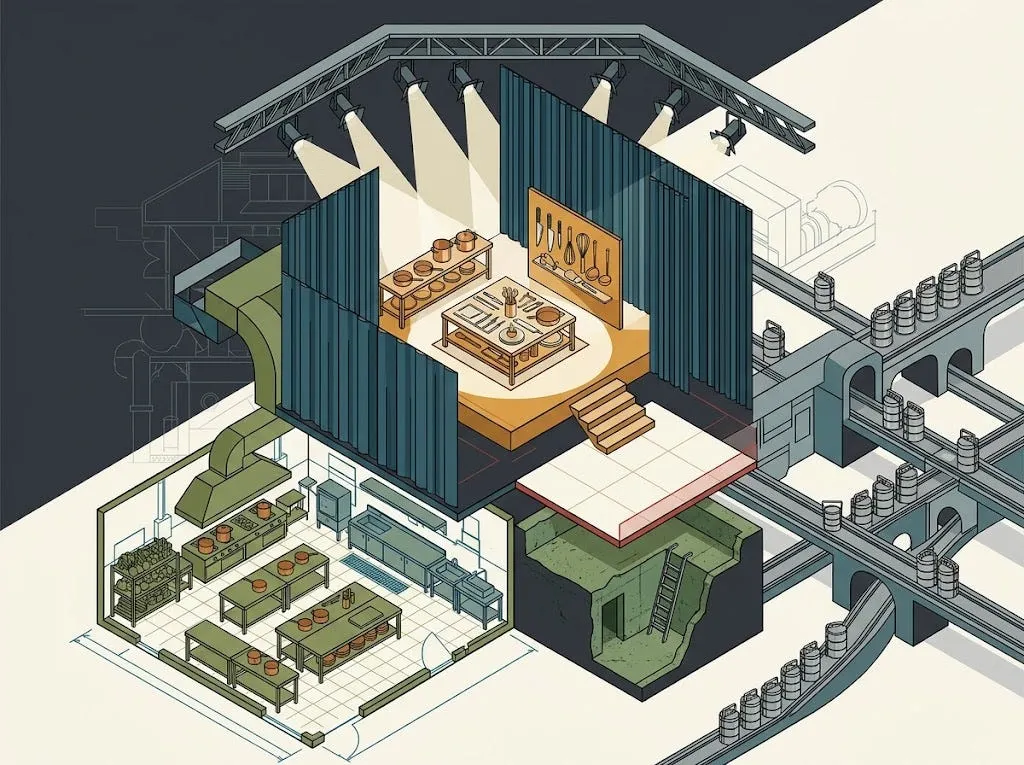
Six pieces of media I return to again and again refuse that trust. Over time, I have realized that this refusal is not a decorative quirk or a puzzle box mechanic meant to be solved and set aside. It is the core structural thesis of the work itself.In April 2016, while studying at the Städelschule Architecture Class in Frankfurt, I wrote a master’s thesis titled Violating Architecture: Staging an Assemblage of Intrusions in the Discipline. The paper was built around a real culinary experiment we staged at the academy’s annual Rundgang: a six-course dinner titled The Feast, featuring 8 Ingredients that our group of 8 studied, multi-level seating and an opera singer.
Poorly articulated back then, the central argument of that paper was that The Feast was not designed in the traditional architectural sense. It was assembled. It existed as a collection of heterogeneous, self-subsistent components with no fixed hierarchy: the sequence of the menu, the tent kitchen, the improvised movements of photographers whose shutter clicks defied the music, the overlapping roles of guests who were simultaneously the audience and the performance itself. Drawn from Manuel DeLanda’s reading of Deleuze and Guattari, assemblage theory posits that an entity is defined by relations of exteriority: its components can be unplugged from one whole and plugged into another without losing their identity. When a system is assembled rather than top-down designed, authorial control dissolves. The author is no longer an omnipotent director; they become an arranger of intrusions.
I did not have the formal vocabulary of autopoiesis or relations of exteriority when I first watched Run Lola Run, Memento, Pulp Fiction, or Synecdoche, New York, but the instinct was already there. I trust an assembled story because it reflects how memory, space, and identity actually operate. Dreams and dream recall operate that way as well: they do not make us nauseous because we intuitively recognize and accept their structure. Neuroscience shows that human memory does not work like a video recording; it is fundamentally constructive. Every time you recall a memory or reconstruct a dream, the hippocampus pulls stored, isolated fragments (sensory cues, spatial locations, emotions) and physically reassembles them on the fly into a coherent scene.

A Story Told Backward Is Still a Story
Memento gives you the resolution first and reconstructs causality backward from the wreckage, scene by scene. Leonard Shelby’s anterograde amnesia prevents him from constructing a continuous narrative arc. Instead, he relies on a fragile, localized archive: tattoos, scribbled Polaroids, and annotated receipts.
This structure is not a trick. It is an argument that narrative meaning is always assembled in retrospect from fragments that possessed no inherent linear order while they were being lived. Leonard’s tragedy is that his coding entities (his notes and visual system) are vulnerable to manipulation. By forcing the viewer into Leonard’s temporal blindness, Christopher Nolan demonstrates how easily the illusion of a master plan can be manufactured from arbitrary pieces.
Pulp Fiction and Reservoir Dogs execute a looser, more spatial version of this logic. Quentin Tarantino scrambles timelines into episodic modules. The narrative weight does not depend on chronological progression; it depends on how entering one module retrospectively alters your reading of every other module. In Reservoir Dogs, the heist itself (the central event) is entirely excised from the screen. We see only the pre-production planning and the post-performance fallout in the warehouse. The event is defined by its absences, its intrusions, and the bloody breakdown of a trust network.

A Reality Built Around You, Without Your Consent
David Fincher’s The Game pushes assemblage logic into the realm of spatial paranoia. An elaborate, scripted simulation is constructed around Nicholas Van Orton without his consent. Every street corner, every taxi driver, and every television broadcast becomes a staged component designed to elicit a specific psychological response.

The core tension of The Game mirrors the exact question I raised in my 2016 thesis regarding the boundaries between performance and audience: When an environment is staged, who counts as the spectator, and who is merely a component being moved into position for someone else’s benefit? Nicholas believes he is the protagonist navigating a real city. In reality, he is an unwitting actor inside an autopoietic, self-correcting set where every spatial boundary is rigged. The horror of the film lies in the complete loss of personal authorship over one’s immediate physical environment.
Breaking the Frame on Purpose
Phoebe Waller-Bridge’s Fleabag makes the mechanism of assemblage explicit through the fourth wall break. Fleabag uses her direct-to-camera soliloquies as an internal coping mechanism, a way of curating her own trauma for an imagined, sympathetic audience.
Get Kaushambi Mate’s stories in your inbox
Join Medium for free to get updates from this writer.
In Season Two, when the Priest notices her slipping away into these side-comments (”Where did you just go?”), the structural boundary collapses. The audience is no longer a passive container for her confession; we are exposed as a spatial intrusion inside her real-world interactions. The show punishes her for performing, revealing that her narrator persona was a defensive wall built to delay actual emotional exposure.

Arrested Development operates through extreme structural density rather than direct confrontation. Its narrative architecture relies on delayed payoff and hyper-referential continuity. A visual detail or throwaway line in Season One functions as an unexploded ordinance that only detonates three seasons later. The show refuses to deliver immediate, linear gratification. It is legible only in retrospect, requiring a viewer willing to hold dozens of disconnected fragments in mind until the full, absurd matrix locks into place.
The Harder Kind of Trust
A story told in a straight line asks you to sit back and trust the author’s blueprint. It reassures you that every turn was planned, every consequence calculated, and every loose end accounted for from the beginning.
An assembled story operates on a different, more demanding contract. By presenting reordered fragments, overlapping timelines, and permeable boundaries, it forces you to participate in the act of construction. It admits that the world is messy, that cause and effect are often assigned after the fact, and that order is something we impose on chaos rather than something we inherit.
That is not a failure of design. It is a recognition of how space, time, and memory actually function, and it earns a much harder, far more honest kind of trust.

Referenced Works in This Essay:
Films
- Run Lola Run (Lola rennt) (1998), directed by Tom Tykwer
- Memento (2000), directed by Christopher Nolan
- Pulp Fiction (1994), directed by Quentin Tarantino
- Reservoir Dogs (1992), directed by Quentin Tarantino
- Synecdoche, New York (2008), directed by Charlie Kaufman
- The Game (1997), directed by David Fincher
Television Series
- Fleabag (2016–2019), created by Phoebe Waller-Bridge
- Arrested Development (2003–2019), created by Mitchell Hurwitz
Originally published at https://kaushmb.substack.com on September 25, 2026.