Artist in Residence at a Hotel (Day 04)

Climbing Mt. Daimonji and the Aoi Festival (Residency Day 04)
I have to say that the texts about the hotel residency here are the ones that I translated from Japanese texts, which I wrote and posted on “note” in Japan a while ago. So, you may find some parts sound a bit off. Please forgive me about it. But here we are — this is Hotel Residence Day 04.
Following some advice I received during last night’s dinner gathering, I woke up at 5:30 a.m. again and, around 6:30 a.m., parked my car in the area near the foot of Mt. Daimonji, right where Ginkaku-ji Temple is located. I started walking toward the mountain trail beside the gates of Ginkaku-ji. Even at that early hour, I noticed a few visitors from overseas.
I thought there wouldn’t be many people on the mountain trail itself, but shortly after starting to walk, I passed someone descending from the mountain. Judging from his clothing, he seemed to be a local. He looked quite accustomed to the trail.
Though I was still near the base of the mountain, I was lucky enough to find a spot where spring water seemed to be flowing. Along the lower trails, small streams run beside the path, and although I couldn’t see them, I heard frogs croaking in various places. The croaks came from close to my feet, so I looked down and saw a secluded area where a large number of frog eggs had been laid.

A little further up the trail, I saw the same local-looking man coming down and decided to ask him whether the spring water I’d found earlier was safe to drink. He explained, “It’s probably a mix of spring water and rainwater that seeps down the slope. Some people say it might be contaminated by bacteria from animals and is not suitable for drinking, but I think it should be okay.”
I continued climbing stairs and slopes until I encountered a group of about ten people coming down. I wondered what time they must have started hiking. Doing some quick calculations, it seemed they must have begun before 6 a.m.
As I kept climbing, I passed one or two more people. After ascending a long flight of stairs, I finally reached an open area with a panoramic view of Kyoto city. Under the blue sky, I could see the mountains encircling the city in the distance — the Kyoto Basin. Right beneath my feet was the area where the giant bonfire forming the “大” (Dai) character gets lit during Obon season in the middle of August. The spots where the fires are set appeared to be marked by elongated brick-like structures arranged in points to form the shape of the character. The “大” character is so large that, standing right there, I couldn’t really perceive it as a recognizable letter.

Just as I arrived in that area, an elderly man appeared, slowly climbing up from a different route. He had the dignified air of someone who’s definitely a local. He passed in front of me, carefully advancing one step at a time. Meanwhile, a woman traveler from abroad was coming down from above. Everyone seemed to be enthusiastically enjoying their morning hike.
I followed the elderly man up the slope, and for some reason, it started feeling like a bit of a race between us. I would overtake him, then he would pass me again, and so on — though all at a very slow pace.
My strides were probably a bit faster, and I tended to choose steeper routes to make quicker progress, but then I’d slow down on the flat sections. On the other hand, the elderly man took smaller steps, chose gentler paths, and would briskly overtake me whenever the trail leveled out.
This back-and-forth continued for about 15 minutes until we finally reached what seemed to be almost the summit, where there was a large rock!

I wondered if it might be an Iwakura — a sacred rock — and observed it closely, taking photos with great interest. Because I was so absorbed in that, the elderly man ended up reaching the destination before me and, without my noticing, seemed to have already started his descent. LAUGHs!
Get Keijiro Suzuki’s stories in your inbox
Join Medium for free to get updates from this writer.
At the summit, a group of about three people were gathered, apparently having a morning tea party while enjoying the view of Kyoto city. There were many benches around, giving the impression that the spot sees a lot of visitors.
By this time, it was around 7:30 a.m., meaning it had taken me about 30 minutes to climb up. On my way down, I passed several more people heading up the trail. Altogether, I’d guess there were about twenty visitors on the mountain during the hour or so I spent there.
As I headed back, I collected some of the spring water I’d seen on my way up. It didn’t seem to have any particular name. But I felt that this nameless spring holds a certain mysterious presence in Kyoto, a city so steeped in history and stories.
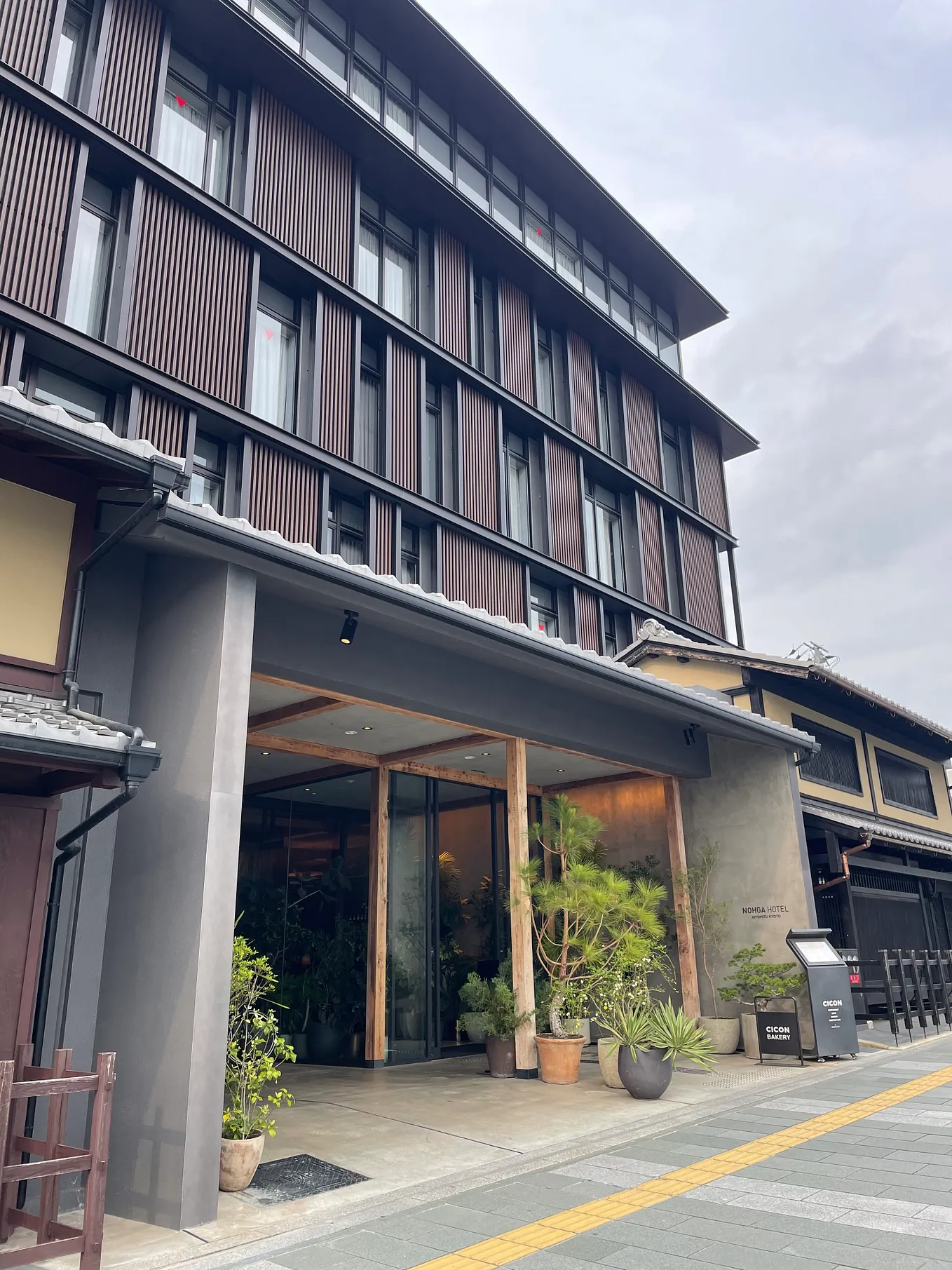
After descending the mountain, I returned to the hotel, did some laundry, had a meeting, and finished lunch before heading out again.
That morning, I’d been watching TV and learned that today was the day of the Aoi Matsuri festival. It’s a special day when a procession in ancient court costumes parades from Shimogamo Shrine to Kamigamo Shrine — a rare spectacle! Since I don’t know Kyoto very well, I thought I absolutely must see it, so I took the subway to Shimogamo Shrine.
By the time I reached the entrance of Shimogamo Shrine, it seemed the procession had just passed through. While catching glimpses of the crowd following it into the distance, I first wandered around the spacious grounds of the shrine. Near the Romon Gate of the main hall, I found signboards indicating the presence of Imperial family members, which made me feel I was attending quite a significant event. I paid my respects at the main shrine and then also prayed at the smaller shrine for my own zodiac sign, the Rooster (Tori), which was nearby.

Actually, visiting Shimogamo Shrine had been on my wish list for some time. I’d often heard its name but had never been there. Moreover, it had come up when I searched for springs on Google Maps.
After that, I headed to the Temizuya (purification pavilion) indicated on Google Maps to collect some spring water. Because of the Aoi Matsuri, the place was crowded, but I managed to wash my hands and fill my bottle. Reading the sign nearby, I learned that this water source is called “Mitarashi — Sanbonsugi,” and it explained, “This Mitarashi is a boat-shaped Iwakura linked to the legends of the shrine deity.” Unlike the other Iwakura rocks I’d seen, this one seemed more functional, designed to store water for practical use. Because of that, I found it a little hard to grasp its sacred uniqueness in the moment. Still, it’s certainly a very unusual and precious kind of Iwakura.

And so, this spring water marked the final goal of my spring water quest on this trip. I felt relieved to have completed it successfully!
Since I had obtained a map of the Aoi Matsuri procession route, I hurried off to try and catch up with the parade. The tail end of the procession was apparently still nearby, so I made my way in that direction. Before long, I caught up with the very end of the line and was completely absorbed, gazing in fascination at the participants dressed in ancient costumes.
Seeing only the tail end wasn’t enough for me, so I decided to try and make my way closer to the front. As crowds lined the streets, I alternated between walking along the Kamo River riverbank to avoid the throng and moving closer to the procession to observe it. I continued this until I reached Kamigamo Shrine. When I arrived, there was another massive crowd gathered there. Being such an important historical festival, many distinguished people were present, and security was tight. Obviously, I couldn’t enter the inner areas.

Altogether, I must have walked 7 to 8 kilometers, spending about two hours going back and forth.
Having climbed Mt. Daimonji and chased the Aoi Matsuri procession, I was thoroughly exhausted that day. That evening, I soaked in the hot spring at a Ryokan called Makoto no Yu. When I checked my phone for the day’s walking distance, it showed 23.3 km. It turned out to be the day I walked the most during my stay.
Thanks for reading, and until next time!