Artist in Residence at a Hotel (Day 05)

Silver, Gold, and Dragon Quest (Residency Day 05)
Here is my journal about Day 5 of my artist residency at a hotel. It covers Monday, May 12th to Sunday, May 18th, right after my Zen temple training, and this is the fifth day out of those seven. I actually wrote this first in Japanese on Tuesday, June 10th, so about a month and a half has already passed, and my memories are starting to fade.
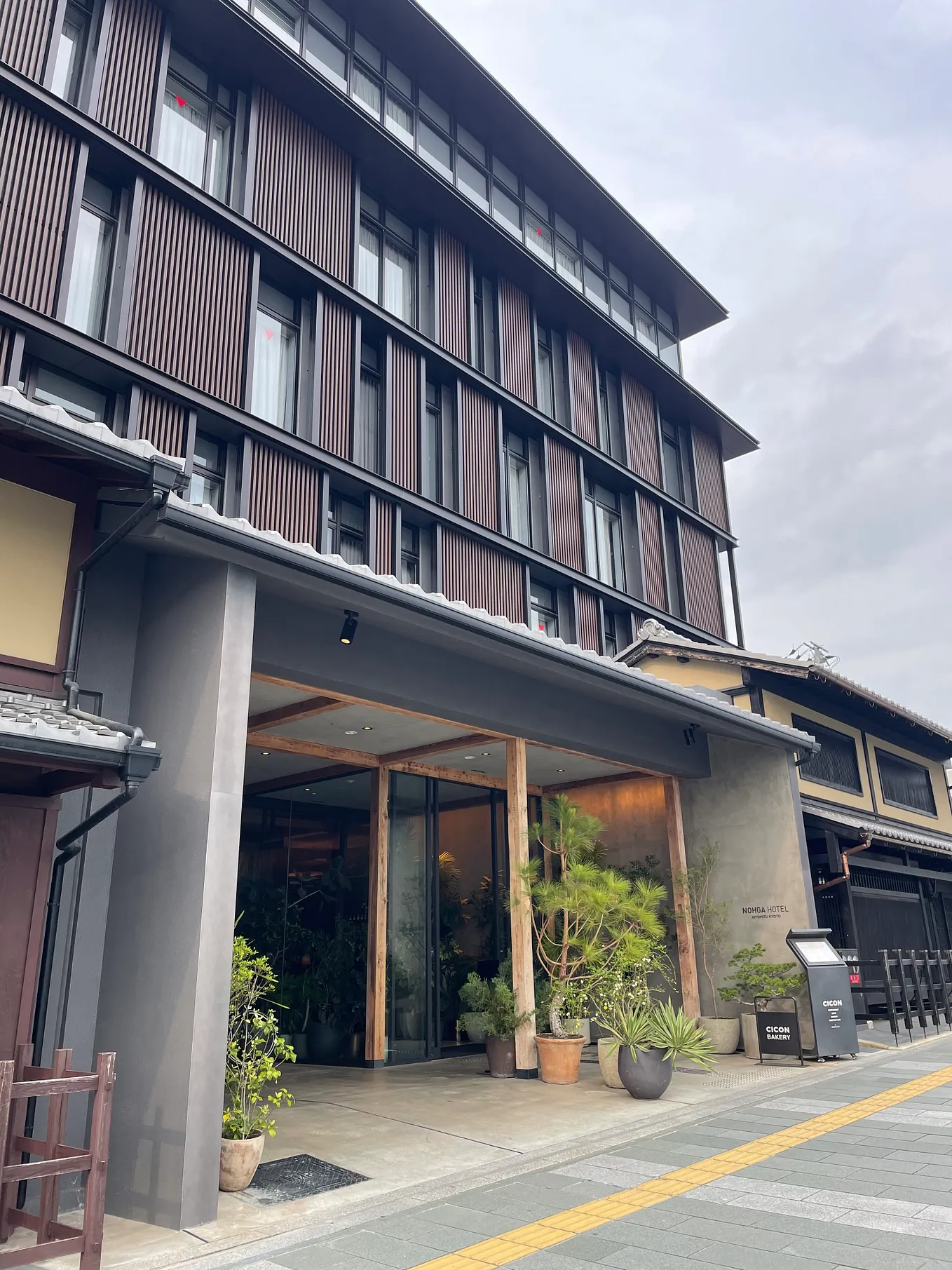
On this day, from around 8 AM, I joined a Zen meditation program hosted by Nohga Hotel Kiyomizu Kyoto. It was held in a softly lit, minimally designed meditation room located on the hotel’s basement floor, featuring elegant curves throughout the space.
This program was a collaboration with Ryosokuin, a sub-temple of Kenninji Temple of the Rinzai Zen sect, located nearby. The instructor, or a monk, from Ryosokuin was already at the front of the room, chatting with a guest who had arrived early. Soon after, about eight more hotel guests arrived, and I guessed they might have come from Africa.
The instructor provided explanations in both Japanese and English as we listened to the gentle sound of water flowing from a ceramic Suikinkutsu (a musical water feature) placed at the front of the room. We experienced Zen meditation, sitting upright and also lying on our backs with our eyes closed, focusing on our breath and the sound of the small bell. Although it was a short session of about 15 minutes, it was a completely different and refreshing experience compared to my recent Zen temple training.
The meditation room itself was truly stylish, and near the entrance, there was a preserved section of an old stone wall on display. When I asked one of the staff members about it, they explained that this area used to be part of the grounds of Rokuharamitsu-ji Temple, and historically, this neighborhood was thought to be a boundary between this world and the next. Hearing that reminded me of the story of Toribeno, which I had heard from an older man I met recently at Kiyomizu-dera temple. For me, as an artist drawn to the unseen, this story felt deeply meaningful. Later, I visited Rokuharamitsu-ji Temple, about a 7–8-minute walk from Nohga Hotel, and learned about Kuya Shonin, a prominent monk from the mid-Heian period, which was about 10th century, his life, his statue, and the extent of the temple’s grounds. Somehow, I could picture scenes from that era in my mind.
On this day, I planned to make the most of my time and visit as many places as possible over these few days. The only places requiring advance reservations were the Zen meditation program that morning and the Mirei Shigemori Garden Museum around 2 PM. Everything else I decided to visit spontaneously, depending on location and crowds.
My first destination was Ginkaku-ji Temple. Having climbed Mt. Daimonji the day before, I already had a good sense of the area and distance from the hotel. There were some crowds, but I managed to buy a ticket smoothly. As soon as I entered, Ginkaku-ji came into view. The white walls of the plaster and shoji screens contrasted beautifully with the dark brown tones of the pillars and roof, all harmonizing with the surrounding garden’s colors and serenity. In front of the pavilion was a minimalist and intriguing sand cone called Kogetsudai, and atop Ginkaku-ji’s roof stood a phoenix, making me feel as though I had stepped into the spiritual world of the past. Further into the garden, there was a spot called “Sengetsu-sen,” meaning “Spring cleansing the Moon,” evoking a sense of the mysteries of life and death. I imagined that for powerful figures and intellectuals of that era, life and death were so intertwined that existence and impermanence felt fleeting. The compact grounds seemed filled with such a unique perception of time and space.

Next, I headed to the grounds of the Kyoto Imperial Palace. As I mentioned earlier, an elderly man I met at Kiyomizu-dera temple who was a birdwatching enthusiast had told me that, from a Feng Shui perspective, the Imperial Palace was the best spot in Kyoto. Although I have no personal connection to the Imperial family, this place is crucial for understanding Japanese history. During the Meiji era, the Emperor moved from the Kyoto Imperial Palace to the Imperial Palace in Tokyo. Living in Yamaguchi, I often hear stories about the Meiji Restoration and Emperor Meiji, but I still struggle to fully understand them. Who exactly is the Emperor? What does Japan mean?
I arrived at the palace grounds around 11 AM but hadn’t researched specific spots to visit, so I felt a bit lost about where to go. I saw the Kyoto State Guest House and went in to ask one of the staff members some questions. He informed me that the Kyoto Imperial Palace itself was closed to visitors due to the Aoi Festival and wouldn’t reopen until Sunday, May 18th. Since the grounds are vast and I wanted to use my time efficiently, I quickly moved on to my next destination. As I was leaving the palace grounds, I decided to briefly visit Nashinoki Shrine and Gojoin Temple nearby, both of which I had encountered during my recent “spring water quest.” Both sites have sacred springs, and while I was at Nashinoki Shrine, I happened to notice a water bottle with a familiar logo near the spring. For a moment, I thought I might run into someone I knew, but the person who owned it was someone I’d never met before. However, after talking, I discovered we did share an indirect connection. It was such a strange coincidence.
My next stop was Yasaka Shrine. It’s relatively close to Nohga Hotel, but somehow, I hadn’t managed to visit it until then. There’s also a Yasaka Shrine in Yamaguchi City, where I live, and the Gion Festival is held there, so I’m quite familiar with the name. However, the original Gion Festival and Yasaka Shrine are, of course, in Kyoto, and it seems that Yamaguchi modeled its shrine and festival after them.
The vivid red, green, and yellow colors of the main gate at the original Yasaka Shrine gave it an air of festive elegance and good fortune. The grounds were bustling with many travelers. There was also sacred spring water there, which I wanted to add to my spring water quest, but unfortunately, I had already used up all my empty bottles, so I had to pass this time. Near the spring, there was a small fortune-telling tent with a rather solemn atmosphere. I peeked inside to see if I could quickly get my fortune read and to check the price and time. Although there were no customers at the moment, it seemed the reading would be quite thorough and time-consuming, so I decided not to go for it this time.

I had lunch at a restaurant in a nearby shopping arcade and spent some time until my reservation at the Mirei Shigemori Garden Museum. Since it opened at 2 PM, I made sure not to be late. When I arrived, there were already seven or eight people waiting by the gate. A few were international visitors, and gradually more people, both Japanese and foreign, joined us.
Get Keijiro Suzuki’s stories in your inbox
Join Medium for free to get updates from this writer.
When it was time, a guide welcomed us. It turned out he was actually Mirei Shigemori’s grandson and an artist himself. He calmly explained the gardens in both Japanese and English. The Karesansui (dry landscape) garden embodies Buddhist concepts of the afterlife and cosmic landscapes. The carefully placed rocks, the white gravel, and the lush moss in between evoked visions of mountains, seas, and forests, representing otherworldly scenes. The stones themselves were abstract in shape, allowing one’s own senses, knowledge, and memories to shape what one sees. Inside the building, there were also unique and innovative artworks. Since there’s a Karesansui garden by Mirei Shigemori at Joeiji Temple in Yamaguchi City as well, being able to hear directly from his grandson deepened my understanding significantly.

Next, I headed to Seimei Shrine, hoping to gain insights into invisible forces like fate, the soul, and the universe. Historically, the powers of Onmyoji (Yin-yang diviners) and fortune-telling have played crucial roles in Kyoto’s urban planning and politics, and these traditions continue to influence people today. While it’s rare in daily life to feel the direct impact of such mystical forces, I believe they do exist. There’s often a mysterious sense of timing and place — why this moment, why this place? I wondered if my encounter and conversation with the birdwatching man during my recent spring water quest had somehow led me to be here on this particular day. I’m captivated by the mystery of whether I chose this path or was guided to it — an invisible chain of cause and effect. Am I merely living out a script that was already written?
Within the shrine grounds and office, there were numerous images and statues of Abe no Seimei, along with pentagram symbols. Including my recent experiences with Zen, I began to feel that my own being was like an accumulation of all these invisible forces. Perhaps each person is an embodiment of such unseen energies. Are we living life, or is life living us — a miraculous world crafted by infinite cosmic mysteries? Maybe this is what Buddhism refers to as Myōhō, the mystic law?

By this point, it was around 3:30 PM, and I was hoping to visit Ryoanji Temple as well. On the way from Seimei Shrine toward Ryoanji temple, I decided to make a quick stop at Kinkakuji for a second visit. In one day, I managed to see both Ginkakuji and Kinkakuji!
Finally, I headed to my last destination of the day: Ryoanji Temple. It’s famous from art history textbooks and often comes up in conversations with international artists, but I’d never truly felt its presence for myself. Upon arriving and reading the explanations, I learned that Ryoanji belongs to the Myoshinji branch of the Rinzai Zen sect — the same sect my family’s temple belongs to — which made me feel a special connection.

Ryoanji’s Rock garden left a strong impression, especially because of its striking sense of emptiness and space. It’s there, yet it’s not; it’s absent, yet it’s present. The placement of the stones reminded me of the arrangement of stars in constellations — sometimes visible, sometimes invisible. It felt like a physical embodiment of the Hannya Haramita Shingyo in Japanese, or Prajnaparamita Hrdaya Sutra in Sanskrit. Many visitors sat quietly along the edge of the garden, seemingly contemplating questions and interpretations in introspective silence. It felt reminiscent of Ikkyu’s philosophical riddles, “Somo-san, seppa.”

You can’t truly grasp the spatial layout without seeing it in person, but facing the garden are three rooms with “Fusuma” sliding doors painted with powerful images of dragons. The force and presence of these mythical creatures were palpable. I thought that if one lived in an environment like this every day, immersed in such Buddhist training, the world one perceives would surely transform.

On my way out, I passed a Tsukubai (stone water basin) with an explanation beside it. The kanji characters for “吾唯足知” (ware tada taru koto o shiru) each contain the radical “口,” which is shared at the center of the basin, while the remaining parts of each character are arranged around it. The sign explained that “He who knows contentment is rich even in poverty; he who does not know contentment is poor even in wealth.” Water continuously flowed into and spilled out of the basin, symbolizing this teaching. It was fascinating to learn that these four kanji together mean “I am content with what I have.” Buddhist philosophy and the quest for truth transcends East and West, remaining a universal theme.
Leaving the building, I looped around the large pond at the center of the temple grounds to return to the entrance gate. Along the path were numerous impressive stones of various colors and shapes, placed in ways that felt intentional and harmonious. Each stone seemed to have a unique character and left as strong an impression on me as the stone garden, the dragon paintings, and the Tsukubai.

By then, I was thoroughly worn out from all the walking, so I decided to visit Saganoyu Onsen Tenzan-no-Yu in the Arashiyama area — a place recommended to me by Jojusan, the Zen monk I met during my temple training, who’s also a sauna enthusiast. When I arrived, I saw that the entrance area was decorated with numerous certificates and awards related to hot springs and saunas. After experiencing it myself, I could see why. It was an outstanding facility with excellent service. In the sauna, as I sat quietly and endured the heat, I truly felt my ego dissolve and my senses open up. I finally understood what Jojusan meant when he described it as “Sa-Zen” — Zen through the sauna! If you have time, I definitely recommend visiting.
After the onsen, I returned to my hotel and took a stroll around Miyagawacho, the nearby Geisha, or Maiko, district. The streets were quiet, with almost no one around, but the distinctive lanterns bearing matching family crests hung from the doorways, and the stillness carried a sense of depth belonging to the secret world of the Maiko.

It was a long day — thank you for joining me on the journey!