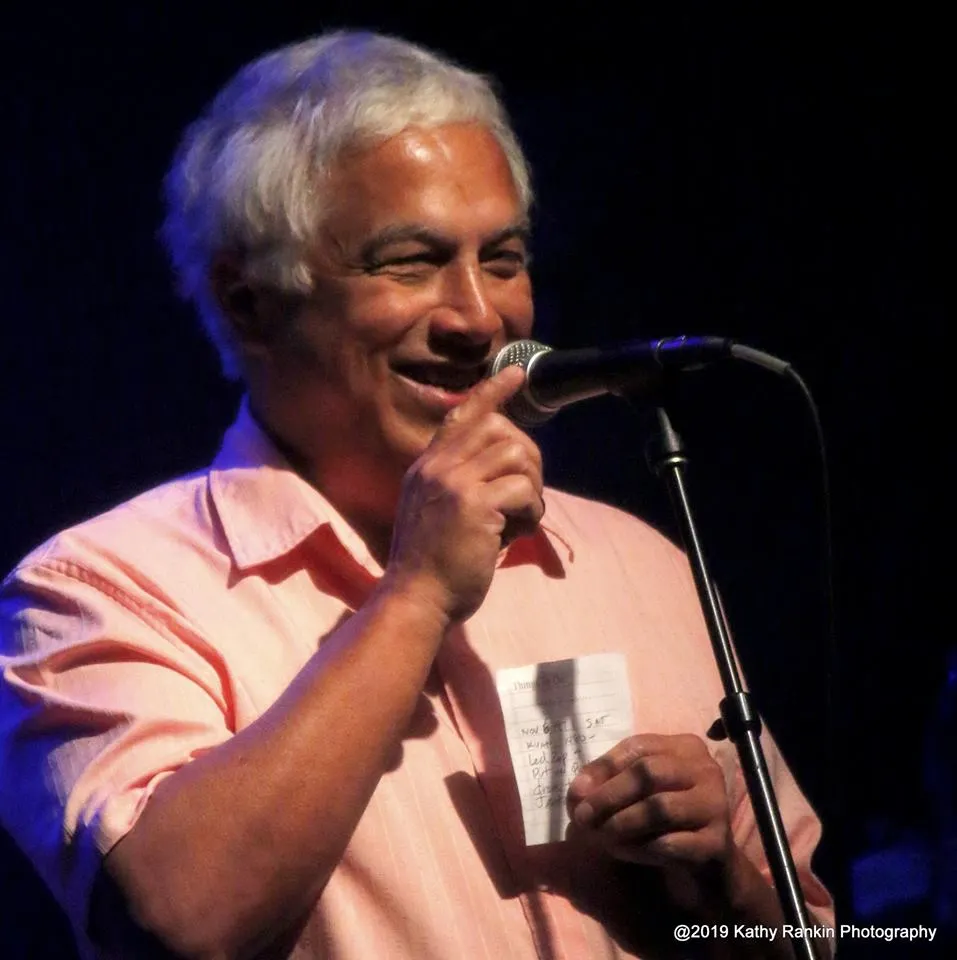
Michael Adelsheim — Wine Lover and World Class Music Aficionado
A Portland Paramount Experience
by Ken Thompson — June 2021
Michael Adelsheim acquired a passionate taste for music that grew and developed as the decades unfolded from an early age. He even picked up the guitar for a few years. Still, he didn’t entirely cultivate his desired expertise; perhaps due to unfair comparison to the musical geniuses he admired so emphatically. Undaunted, his love of music inspired his music career and a life filled with outstanding musical experiences.
Michael was born in Minneapolis and soon relocated to Chevy Chase, MD. After five years the Adelsheim’s made the fortunate decision to move out west to Portland, where he attended Lincoln High School. He spent his college years first at Reed and then graduating from Portland State.
Michael began his early career in the Portland music scene, working at the legendary and awesome Longhair Music record store. He managed to slip into playwright/director Eric Overmyer’s position after he left for Hollywood. Along the way, Michael served as Editor of Two Louies, one of Portland’s finest local music magazines.
(Another Longhair alumni is Mikal Gilmore, a stellar music journalist and Senior Contributing Editor for Rolling Stone Magazine.)
In 1971 his Brother David and his wife, Ginny, purchased land in the Chehalem Mountains in the Willamette Valley. They were pioneers, among the first to cultivate grapes and produce wine in the area. In 1978 the couple founded Adelsheim Vineyards, the first winery in the region. Michael joined them in 1983 as a marketing strategist, helping in their journey as they grew to become world-famous for outstanding Pinot Noirs.
The Adelsheim name is well-known, but its correct pronunciation is not. Its meaning is “Nobilities Home” from the German words Adels (rhymes with paddles) and Heim (rhymes with thyme).
These days, Michael uses his retirement years downsizing, weeding -out his substantial music collection down to the last few boxes of vinyl and CDs, and doing some volunteering. Generally, enjoying the good life, that he’s nurtured for himself.
1. Please name three of the best concerts you saw at the Paramount.
The original Steely Dan — Summer, 1972 (or maybe 1973) David Palmer sang about half the leads, and they ended their encore with a drum solo.
Bruce Springsteen & The E Street Band — Oct. 25, 1975. I sat in the 3rd row. Bruce opened solo on piano, singing “Thunder Road.” During his encore, he jumped up on the seat in front of me for a minute or so!
Gil Scott-Heron — 1978. Just so cool to see this guy do his proto-rapping and then go right into an amazingly taut and moody song such as “We Almost Lost Detroit.” Another highlight that I remember was the up-tempo “Hello Sunday! Hello Road!”
2. About those shows, what was most meaningful to you?
I guess I got ahead of myself above.
3. What’s your favorite story about the Paramount?
Perhaps the fact that Longhair Music was so close that many, many of the acts stopped by to shop and chat. I missed Joni Mitchell — damn! — but managed to catch Carlos Santana on his way out the door (I was carrying a couple of boxes of records, so we didn’t chat. He opened the door for me and said (and I quote), “grunt, grunt.” I felt he meant it kindly.)
4. Please share a couple of memories of the first concert you attended (anywhere)?
The first concert that I attended was by a commercial folk group named The Wayfarers (ala the Kingston Trio) in 1965. It was at a downtown club whose name I’ve forgotten that was at the corner 9th and Salmon (actually right next to where Longhair went in a few years later…most recently, South Park restaurant has occupied the space.) A friend of my parents had been enlisted to escort me there, and he knew enough to flag down a group member on their break, and so Sean Bonniwell sat down and chatted for a few minutes. (The next year, I was on a ski trip to Aspen, and a band named The Ragamuffins was playing in a bar — I wasn’t quite of age — and there Sean was rocking out! By that fall, the band was named The Music Machine and had their big hit, “Talk Talk”!
5. What are three of your favorite musical artists from Portland?
Since I spent a lot more time seeing local bands and singers, first at high school dances, then in coffee houses, then in psychedelic ballrooms, and then bars and clubs, than at the Paramount, I have so many memories. Here are three artists who I saw 50–100 times, in chronological order.
The Holy Modal Rounders/Les Clamtones — I first saw the Rounders around Halloween, 1972, in the Park Blocks across from PSU’s Smith Hall. Then the White Eagle, then when Euphoria opened, that gave me the chance to see them up to 4 nights each week! Things got even better sometime in late ’74 or’75 when Jeffrey Fredericks and Jill Gross showed up to form Les Clamtones. (For those who don’t know, the two bands were made up of the same musicians except the lead singers.)
Cathy Lunsford — An out-of-state folk duo hipped me to Cathy in early 1974, and lucky for car-less me, her main gig was at Claudia’s tavern just ten blocks from where I was living at the time. The first night I went, a friend I was with asked me what I thought. Not knowing Cathy was sitting right there, I said I wished she sang more originals. Cathy told me to come back another night, and she’d show me originals! Many were from a Polydor album she’d recorded before she moved to Portland, just wonderful! (And when Cathy played liquor joints, she’d break into a chorus from the Eagles’ “Tequila Sunrise” whenever I ordered one.)
Seafood Mama — The first time I ever went to Up The Down Staircase, I hit the jackpot. It was spring or summer of 1977, and the combination of Marv Ross’ multifaceted songs, Rindy Ross’ singing and sax playing, and the others checked many boxes for me. A few years later, when I was BucK Munger’s editor at (Portland Music Magazine) “Two Louies.”, I wrote a very positive cover story on them.
6. Name three favorite music artists from anywhere. What about them do you find inspiring?
Since I’ve always wished I had a good singing voice, that’s where my idolatry leans when it comes to music. For the way my musical tastes were molded, I believe I grew up at just about the perfect time, to the year, meaning that just as I was starting to try to understand what was going on out there in the world, popular music branched in that direction too. I could name three of the best-known singer-songwriters of my/our times, but that’s quite boring. Here are three others:
John Prine — At his best, John would use imagery that hovered in the vicinity of what he was on about, without nailing it down for us. He could be quite gnomic at times and then slide into downright silliness. And, the stuff he wrote perfectly fit his somewhat craggy voice. (I saw him two or three times at the Paramount.)
Graham Parker — Another great songwriter, mostly ranging from Dylanesque squall to uptown R’n’B. When I put together a mixtape of him for myself, I named it for one of his songs, “Passion Is No Ordinary Word.” Early on, there was a lot of swing to his sound, but he adapted quite well to the New Wave era. Some people thought he was nothing without his anger, but I’ve always thought he has been reaching for a kind of realistic joy. I also saw him two or three times at the Paramount.
Thea Gilmore — hailing from the British Midlands, Thea was a bit of a prodigy, starting her own label before she was 20. Punky before I came upon her music in the early part of this century, she showed as streetwise yet romantic, a storyteller who knew the value of punchy declarative songs. In truth, I don’t find her more recent work nearly as astounding, but there was a time when I flew to NYC to see her play a club (also to work a trade tasting, but….).
7. Adelsheim Vineyard is celebrating its 50th year in Oregon Winemaking. It must have been quite a ride. What are some of the critical factors and benchmarks that have contributed to its excellent success?
My brother David, who founded the winery with his then-wife Ginny, has always pointed to the ethos and practices of the founders of the Willamette Valley wine industry as a major contributor to how we all got on the (national) wine map in about 15 years. Though competitors, everyone was eager to share knowledge and even equipment for the betterment of all. Also, you could say that they lucked upon the right idea at the right time. Outside of Burgundy and Champagne, nobody else had succeeded with Pinot Noir, so this little scene became a cause that wine writers were thrilled to embrace and raise as high as they could. More than most, we realized that outreach would be critical, so even when everyone could sell their entire production instate, David hit the road (actually, the air), selling the region as well as our wines. In 1987, the industry started an annual event in McMinnville called the International Pinot Noir Celebration, bringing many of what we’d now call “influencers” to get to know our home turf. The wines weren’t bad either.
8. You worked on the Marketing side of the operation. What were some of the most exciting challenges and experiences Adelsheim has faced over the years?
Though I’m not so sure that the challenges facing a sales rep could be called exciting, the biggest challenge was to teach people in markets new to Willamette Valley wines not to assess wine quality on how “big” it is…that is to say that we aren’t trying to be like warm climate wines, but more like to cooler wine regions in Europe. And, of course, how to pass that idea on to their customers. On the experience side, I’d say that there were two times at trade tastings when our wines became the hit of the event. I’d look out across the room and see someone who had just been at my table walk up to someone else, chat a moment or two, and that new person would immediately make a beeline over, multiplied many times. This happened to me twice. The first was when we were releasing our 1983 vintage Pinot noir — this was the first famous vintage for Oregon around the country — and at the Portland tasting, it seemed that everybody had to taste. Very gratifying! The second time it happened was about 25 years later, in Baltimore, and the wine was much more obscure, our very dry 2008 Pinot Blanc. Pretty much sold out all of this wine that our distributor would be getting at one time.
9. How do you see the Oregon Wine industry evolving as the future unfolds? What do we have to look forward to?
Get Ken Thompson’s stories in your inbox
Join Medium for free to get updates from this writer.
This is probably the toughest question you’ve asked! Not only have I been out of the business for half a dozen years, there are a few “small” global issues that factor in. You know, the pandemic, global climate change, small stuff like that. The pandemic has been especially tough on cool-climate wineries (and wine regions) that rely more on restaurants since they pride themselves on food friendliness. So, regaining major sections of our state’s wine markets is a big one. And, of course, as our world heats up, it’ll tax the ingenuity of winegrowers looking to bring in grapes with fresh — rather than cooked — flavors. But as my brother David has quipped, we can move farther up the hill to plant new vineyards, and if it comes to it, actually go over the hill, to face north! So, I guess that I’m actually punting your real question, but I hope I’ve given a few hints at an answer
10. What are the three best wines ever to cross your lips?
Oddly enough, given my love for pop music, I’ve never been one to make “Top 10” lists (unlike Rob in “High Fidelity”). If I love a song, I say that it’s in my Top 1,000. The same goes for wine, I suppose, so here are three that I found to be great that I remember right now, in chronological order of when I drank them. On a different day, it easily could have been three entirely different wines. Social context has a lot to do with the experience of wine, at least to me.
Bouchard Pѐre & Fils 1976 Vigne de L’Enfant Jésus. A Premier Cru (Red), Burgundy, ordered in early 1986 at a Seattle restaurant where my future first wife and I celebrated her birthday while still in the dating stage. 1976 was a warmer year all over Europe, so the wine had more flesh on it than typical for Burgundy (which hints at the fact that I generally prefer Willamette Valley Pinot noirs over those of its mother region.)
Louis Roederer 1979 Cristal Brut. I drank this — one glass of it — celebrating a friend’s birthday in 1988 (or so); it is the Champagne I measure all others against. So creamy, it could be mistaken for a Blanc des Blanc. Long, long, long, long finish.
Taylor Fladgate 1948 Vintage Port. I drank this “birth year” wine not on my 50th birthday but soon afterward, with the friends who had gifted me of it. Tawny in color after all those years, so very smooth. I do not claim Port as an expertise, but this worked for me!
(And no, I didn’t cite any hometeam wines, I could have though)
11. Please tell us about three of the best wines that sell for under 20 dollars.
For red wines, I’m not going to speak of any specific wine, but for under $20, my go-to reds have long been Côtes du Rhône. Even though our last presidential administration jumped tariffs on most French, Spanish and German wines by 25%, I think there are still many that come in under $20. (And if you run across any Côtes-du-Ventoux, they’re a bit less expensive and quite similar). These have nice richness and a bit of complexity, yet still enough acidity to be relatively refreshing.
I often lean Italian for whites, and for some reason, Italy wasn’t included in the above-mentioned tariff hike. I generally skip the Pinot Grigios — although some are quite nice — and go for Pinot Biancos (sister grape of Pinot grigio, and for that matter, Pinot Nero), Verdicchio, and Soave. Portland has long had a great love for Italian wines of all sorts, so there are many fine choices available in these parts.
Of course, most Rosés come under your limit. I particularly love Pinot Noir versions, though Provence in Southern France is the established classic.
I will come up with one specific wine from that state to our south. In my life, I have bought cases of Bogle Vineyard’s California appellation Sauvignon Blanc. Nice balance, really clean finish, a tiny touch of sweetness, grapefruity & maybe passion fruit. The winery is much better known for its Zinfandels, but all their wines are fine.
12. Please name three books you think everyone should read.
I think I’m going to duck and dodge a bit because books that I think everyone should read would be along the lines of how to survive an earthquake. How about books that made a big impression on me?
“Trask,” by Oregon novelist Don Berry. A historical novel set on the Oregon Coast in 1948. The major plot point is that the title character, Elbridge Trask, has to undertake a dream quest to prove himself worthy of establishing a residence on the coast by successfully going through a sacred rite of the coastal Clatsop tribe. It’s been over 50 years since I read it, but it took me deep.
“Narratives Of The Empire,” by Gore Vidal. It’s a series of seven historical novels that Vidal wrote, published from 1973 to 2000, though not written in chronological order. Vidal makes a promise that anything his real-life characters say in public are actual quotes, but not what is said in private by these same people, or — of course — by the fictional ones. The separate books are “Burr,” “Lincoln,” “1876”, “Empire,” “Hollywood,” “Washington D.C.,” and “The Golden Age.” These are no hagiographies; the characters he builds out of these historical figures into seem honest depictions of real people.
“Standing Fast” by a novelist named Harvey Swados. This novel covers about a quarter of a century, from 1939 until the JFK assassination, following a multi-generational family of hard-left unionists as they try to make sense of the political shifts. Though probably long out of print, this novel seems to have held up nicely; I just read a positive review of it from 2006. For me, it lets me understand how these vast historical events would have been lived through by a politically committed family.
13. Name three songs you’d include on the soundtrack to your life.
I understand this question as asking me to come up with songs that I deeply love (so listened to a lot) AND relate to my lived life.
Ben E. King — This Magic Moment
Van Morrison — Astral Weeks
Ferron — Ain’t Life A Brook
14. Who are your heroes in real life?
I spent a few weeks trying to come up with some names, and sure, let’s call baseball player Jackie Robinson a hero. Folksinger Donovan would be up there because I believe that a hero is someone other people use for inspiration. Within a day of buying Donovan’s 2nd album, I started writing poems and lyrics, etc.
15. What are some things you like best about Portland?
My favorite thing about Portland is that it has enough of a population to offer cultural wonder on just about every level, from visual art to music, food, and drink, but isn’t so large that it feels oppressive. I have also loved the climate, but we’ll see how that goes.
16. If you were advising a new visitor to Portland on a few cool insider things to do, what would you tell them?
For several reasons, I’m so out of the loop that I have nothing meaningful to put here. For the last 15 years of work, I was on the road about one-third of a year all over the county. Plus, I have a bad-ish back, so I don’t roam around town as much as I did 40 years ago. (And, I lived in San Diego from 2012 to 2016.) I’m not saying that ignorance is bliss, but that it is what it is!
17. If you could take your ultimate trek or journey, where would you go?
A trip to both Germany and Scotland would mean going to the places both sides of my family lived back in the 19th century. I have been to Germany, though that trip was 30+ years ago. I don’t know any cousins there, so it would be fairly generalized. As for my mother’s side, I know where we came from, a town about as far north as one could go, and I am even in contact with one of my relatives on a frequent basis.
18. Please tell us something most people don’t know about you.
As a kid who loved baseball, I became so enamored by the concept of switch-hitting that not only did I learn how to do it well enough to have some success batting lefty in the slow pitch games I played in the parks, but I also taught myself to throw left-handed. Playing catch, I could get the ball to my partner, but pretty weakly. Oh well, not sure what someone could extrapolate about me from this.
19. What would you like the world to know about you?
That I’m someone who believes black and white are just different shades of grey.