Know your Shareholders’ Agreement (SHA) — 1 of 5

Indian startup founders, did you know you may be thrown out of your own entity if you take your shareholders’ agreement lightly?
Yes, you read it right. All your hard work and dedication may go in vain if you do not take proper legal advice while signing your shareholders’ agreement. The document is, therefore, of supreme importance and must be paid attention to while drafting and negotiating.
What is an SHA?
A shareholders’ agreement is an arrangement among the shareholders with respect to the operations of the company and the rights and obligations of the shareholders. It is a reflection of the commercial understanding amongst the parties, which needs to be recorded keeping in mind the regulatory requirements.
It is also critical that the Articles of Association (AOA) be aligned with the provisions of the shareholders’ agreement, as any inconsistency with the AOA is considered legally invalid.
Therefore, all provisions related to governance and management are typically copied in the AOA, while provisions related to commercial understandings, which are confidential in nature, are generally skipped.
Now that we have a little background on what an SHA is, let us move on to discuss various aspects of the management of the company and shareholders’ rights and obligations that must become part of your SHA in order to avoid any disputes in the future.
Board Seat
Have you given an investor two seats on a board of directors with a maximum of four members? Be ready for a deadlock!
The governance of a company is one major aspect that is dealt with in an SHA. The board of directors (Board) of a company is a significant part of its governance. The composition of the Board can make or break an organization, and yet it is one thing that, in my experience, is taken very lightly by the founders.
In order to have an effective Board, the founder needs to take care of the following in the SHA:
✅ Board seat for investor’s representative: Founders may consider offering an observer seat instead of a board seat to an investor who invests up to 10–15% in the company. This, however, depends on how well you negotiate and the policy of your investor.
✅ Maximum strength and composition: Make sure that all co-founders have a board seat, and depending upon the seats offered to an investor, determine the maximum strength that your Board will have. You might want to keep it low. Also, make sure only founders have the right to appoint or replace founder directors.
✅ Quorum: Make sure one founder director’s presence is required to make a quorum for a board meeting. It is not negotiable.
✅ Decision-making: By majority votes. Check your composition again here to ensure that founders remain in the majority. Also, make sure the Board delegated the power to take decisions related to day-to-day operations to the CEO, MD, or any other executive founder director, and a resolution was passed to this effect.
Get Khushboo Khatreja’s stories in your inbox
Join Medium for free to get updates from this writer.
✅ Reserved matters: Only such matters that affect the business at a higher level and have a tendency to impact the valuation are to be included as reserved matters in an SHA for investor(s). Keep this list very short. This is where deadlock comes into play! (Btw, “reserved matters” are those matters where a decision cannot be taken without explicit consent from the investor.)
Governance at shareholders’ level
“I have a majority shareholding in my company or startup, but I’m still unable to make certain decisions that are in the company’s best interest. Where did I go wrong?”
This is a common question I receive, and my answer is, “Well, this is what happens when you ignore basic provisions related to voting that investors generally propose in the SHA.”
In order to maintain control (not just majority shareholding), founders need to be careful while signing the SHA and ensure the following:
✅ The quorum of shareholders’ meetings requires the presence in person of one of the founders, and no business is transacted without a valid quorum throughout the meeting.
✅ The chairman of the meeting does not have a second vote in cases of equality.
✅ Voting is carried out by poll, not by a show of hands. In a poll vote, votes are calculated based on the number of shares (one vote per equity share) held by a member and not by reference to the number of physical attendees at the meeting.
This is where a majority shareholder (generally promoters or founders in the initial stages of fundraising) ensures the power of decision-making.
✅ All these provisions are reflected in the articles of association (AOA) of the company.
Now that you have a fair idea as to what your stand should be with regards to governance, let us dig deep into transfer restrictions, which are so crucial to understand. Why? Because your need for liquidity is dependent on it.
Transfer Restrictions
Do you remember the famous case of Tatas vs Mistry (one of the landmark judgments covering governance aspects in India)
One of the questions that the Apex Court had to decide was the applicability of one of the clauses in the AOA bestowing the powers on Tatasons to restrict members from freely transferring their shares as they had “right of first refusal” (ROFR).
It was a blow to the SP Group’s attempt to raise funds via the transfer of their share in Tata Sons and get itself out of a financial mess.
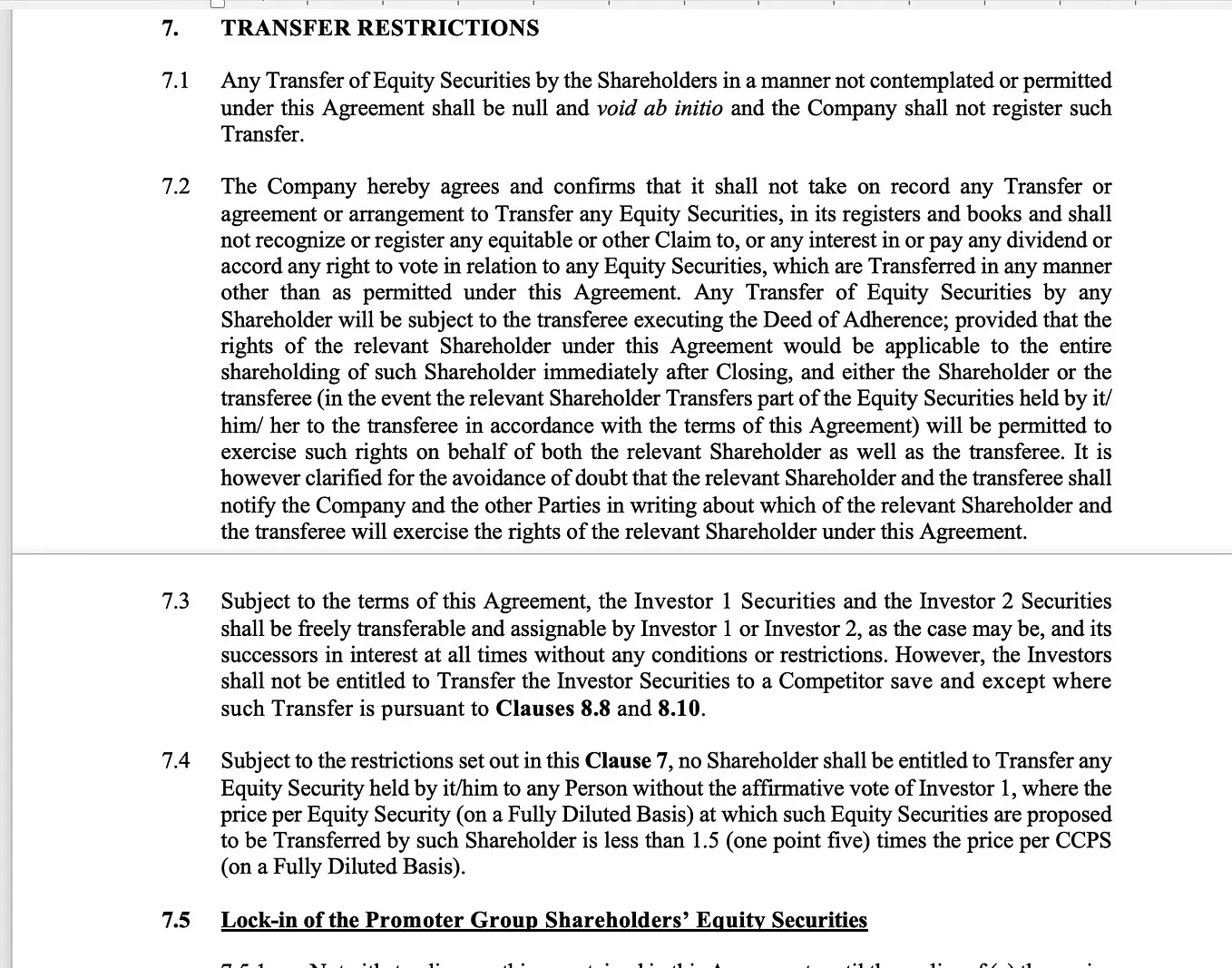
Transfer restrictions are very common in the SHA, as any third-party investor would want the promoters or founders to remain invested in the company, especially when it’s an early-stage start-up. These are fair restrictions unless they cross boundaries and do not let founders sell their stake, even in cases of personal exigencies.
Now, what are these restrictions, and what can founders do to not fall into this trap? One of these restrictions is the lock-in period.
Lock-in Period
Founders are prohibited by investors from transferring their shares in the company until they remain invested. This is a fair restriction that should be dealt with in a tactful manner. Founders must ask for an exception in cases of personal exigencies.
Further, why would founders agree to transfer restrictions if investors hold a minuscule shareholding? They must hold a minimum threshold of shareholding to enjoy this right. Isn’t it? Ask for a special rights period for the investors (it is going to save you, Trust me!)
Lock-in is just one of the transfer restrictions. Others are just as important and have to be understood properly to know their future impact. I will discuss the same in upcoming posts. Stay tuned, and happy reading!
Want to know more? Hit me up at khushbookhatreja23@gmail.com
Edited: Here is the link to the next post in this series: https://medium.com/@khushbookhatreja/know-your-shareholders-agreement-sha-2-of-5-eb38c1320ff1