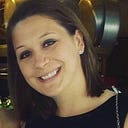
Making my smile

I stared at a black-and-white portrait of ripples in a puddle hung next to a TV much too large for the postage stamp of a hotel room. The TV off, I squinted and could see a thin layer of dust betraying the portrait’s intended purpose of creating a homey and comforting space. No one had paid any attention or care to it since it was hung, perhaps decades ago. Somehow simultaneously melodramatic and banal, the dusty mass-produced artwork left me unmoored.
I closed my eyes and focused on my mother’s voice radiating from the phone pressed to my ear. The faux hospitality dropped away as she recounted the most important advice either of us have ever received. Advice that set my life’s trajectory. Advice my parents had to do more than hear once — they had to live it every day. Advice from a pediatric craniofacial surgeon charged with repairing my cleft lip and palate — a genetic birth defect.
“He said ‘she is not sick, this is mechanical’. And I — at first — I didn't understand and was thinking ‘how could that be? you just told me she will need to have a dozen surgeries, maybe more, and special dental care…but then I realized…he was right, it made perfect sense. My fear was misplaced, this was fixable.”
“How old was I?” I asked. Having heard versions of this story my entire life, I learn a bit more each time as she volunteers more information, and I get more curious. An under-appreciated gift of adulthood is being able to discuss important events with your parents as equals.
“Umm two weeks maybe?”
The next morning I was scheduled to give a presentation to about eighty people — live and in person — no scripts, no notes, no screens. The presentation was about understanding the attitudes of today’s youth. And while nothing in that presentation I’d been rehearsing for weeks directly discussed entitlement, victimhood, or negative mindsets — those were themes I couldn’t shake from my consciousness. Themes I was pondering in a larger cultural context, not limited to youth. And I suppose part of the reason my mom and I found ourselves in the conversation we were in.
At six in the morning, my final rehearsal was not going well —brain synapses weren't connecting with my mouth, my jaw felt tight and slow, my thoughts like molasses — I was forgetting keywords, and even slurring the big ones. No amount of cramming, coffee or practicing at this point would help — I was banking on an adrenaline dump to ignite and connect the synapses with my voice. An adrenaline dump I hoped — and from experience knew — would come in about 3 hours when took the stage. I closed the laptop, put my notes away, and drowsily stumbled into the bathroom to finish getting ready.
The number of fluorescent lights in the small bathroom (only a curtain to distinguish where to shower) were as equally out of proportion as the TV in the other room, but made it incredibly easy to apply makeup. Every freckle on my face and every puckering curve of the scar on my lip looked lit from within.
The scar of course just residual evidence of my having been born with a cleft lip and palate — a genetic birth defect that is more disturbing to the observer than the haver. As an infant, a large gap in my upper lip penetrated my right nostril, gumline and roof of my mouth. The right side of my nose almost completely flat, and only red fleshy gum where supple baby skin is supposed to be. Alarming to look at is an understatement. Even when I look at my baby picture my first reaction is ‘Ouch! that poor thing.’ It looks painful. It looks irreparable. It looks permanent. It is hard to see past the disfigurement and your own reaction. It is hard to see the child, the innocence, the future young woman. It is hard to see the fact that the baby knows no different, unless they are told.

My mother, though, she did see a future. A future of teasing, ridicule, and rejection. A future of uncertainty punctuated by a dozen or more surgeries interrupting my childhood. The surgeon who dispensed that critical advice saw a different future. He saw something tangible, a solution that existed in the present and something easily repaired. Where my mom first saw untamable uncertainty, he saw a clear well-lit path forward.
Indeed, I had a total of fifteen surgeries in about as many years to repair both the function and cosmetic appearance of my lip, nose, palate, and teeth. As I applied my makeup and brushed beige powder over my now 33-year-old scar and asymmetric nose, I recalled memories of those surgeries, and pondered a well-traveled series of ‘what ifs’.
‘What if my parents treated me as sick kid?’
‘What if the surgeon never made that point to my mom?’
‘What if my parents didn't act on the advice?’
‘What if he never helped her realize the bigger danger was treating me like a victim?’
Get Maura Kolkmeyer’s stories in your inbox
Join Medium for free to get updates from this writer.
‘What if she let her fears shape my childhood?’
‘What if we acted like it wasn't fixable?’
I knew the answer. I sure as hell wouldn’t be about to give a speech in front of eighty people. I reflected on the rest of my conversation with my mom the night before.
“I know I have told you before, but the older I get the more grateful I am that you and Dad took that advice to heart — you never let me think of myself as less than, entitled, or damaged. Not projecting your fears and anxieties onto me is the greatest gift. Even though I know you must have felt them. When I think about what it would have been like if you…it terrifies me…”
I trailed off. Fear of those ‘what if’s’ swallowed my words.
“We made a conscious decision that this was going to be a ‘non-issue’. We’d get you the best care, love you through all the surgeries, but you were not to be treated differently because as the doc said ‘This is mechanical, she isn't sick’. It wasn't a lifelong diagnosis, it was a feature to repair…and we prayed the process would make you stronger.”
I reviewed my makeup in the mirror — like any woman I accepted the reflection with an ‘as-good-as-it-is-gonna-get’ shrug— but a familiar feeling welled in my chest. Gratitude. And a familiar thought ‘God I am lucky.’
I should speak with a lisp or worse a nasally stutter, people should be able to see evidence of the original mechanical failure on my face from across a room, and I probably should also have a severe learning disability. If you would have asked a passerby of that Kettering, Ohio nursery in 1991, ‘What do you think that baby will be when she grows up?’ I doubt they would have said ‘a business consultant who thinks, writes and talks for a living.’ But thanks to my surgeon who was willing to speak honestly to a scared mom, and to my loving parents who were willing to repeatedly hold back their anxieties, that is exactly what I am.
I do not become a confident, strong, resilient woman without my parents: encouraging me to play sports even when it meant getting kicked in the face with soccer balls, taking aunts, uncles and teachers aside when they saw them pitying me or giving me special treatment and saying ‘never again, she is not victim’. I do not become someone who seeks out challenges without my mom holding back her mama bear fury when I came home crying from preschool — not because I was being teased for my scar and crooked smile, her first thought — but because the boys wouldn't let me play block fort with them because I was a girl — not because I was a girl with an odd smile.
Imagine for a moment, if instead of letting my five-year-old self tell her about my reality through crocodile tears, she assumed I was being teased for my scar, and inserted that anxiety as my reality. Instead of asking ‘Sweetheart what is wrong?’ she said, ‘They are wrong to treat you differently because you look different, it isn't nice. I’ll talk to the teacher.’ I would have felt bad for two reasons instead of the one. I would have looked for discrimination everywhere, and my confidence and my adventurous spirit would have been crushed permanently. An anxiety I didn't know existed would have infected my reality and permanently altered my self-perception and expectations of others.
My life would have been a miserable series of expecting — and seeing — the worst in other people — both peers and authority figures. I would have found discrimination at every turn if I had been allowed to think of myself as less than or as a victim. I would have learned the terrible habit of entitlement — expecting more than I deserved and being constantly let down.
In fact, I was nothing but fortunate. Fortunate to have amazing parents, and quite literally the best care in the world (Cincinnati Children’s). Born at the right place, at the right time, to the right people. I won the cosmic and ovarian lottery. Nothing about that is worth crying over.
Believing I was a victim would have turned me into one — and trapped me in a special kind of hell. A study proves it. In the study, make-up artists added defects to people’s faces before they engaged in social interactions in a professional environment, but before participants were released the make-up artists made ‘touch-ups’ to the makeup. In reality, the ‘makeup touch-up’ removed the manufactured defect, but the participants still believed they were going into interactions with a facial defect. The participants reported higher rates of discrimination and anxiety even though what they thought was the catalyst of the discrimination didn't exist. The defect only existed in their minds.
How do you find joy if you see injustice at every turn?
What makes you smile if you are convinced both yourself and everything around you are irreversibly damaged?
My smile is made from skilled surgeon hands, loving parents who refused to let their anxieties be my reality, parents who encouraged me to find strength in and learn from adversity, gratitude for the sheer luck of it all, and the greatest gift of all — never being given the option of victimhood.