Before You Say Hello
We’ve been asking if THEY are out there. The better question is: will we recognize THEM when they appear?


There is a quiet assumption running beneath almost every conversation about non-human intelligence in congressional hearings, research papers, podcasts, and the corridors of UAP disclosure. The assumption is this: when contact happens, we will recognize it. That intelligence will arrive in a form the human mind already knows how to name.
It may be the most dangerous assumption we carry.
Even now, the question is moving from the cultural margins toward the center of public life. Today, on the steps of the U.S. Capitol, former intelligence officer David Grusch and members of Congress will publicly call on President Donald Trump to release additional classified UAP-related records and advance formal disclosure measures. What was once dismissed as fringe speculation is entering the language of institutions, governments, and state transparency.
And yet the deeper question has barely begun.
Not are they out there, but what are they. Not will they come, but whether the human mind can truly perceive an intelligence shaped by realities entirely unlike our own. That question is not philosophical luxury. It is preparation.
The Brain That Never Just Listens
Before we look outward, we need to understand something about the instrument we’ll be using to make contact: the human mind.
The neuroscientist Karl Friston has spent decades demonstrating something that overturns the intuitive picture of perception. The brain, he shows, does not passively receive the world. It predicts it. Every moment of conscious experience is the brain’s best guess about what is causing the signals to arrive at its sensory surfaces: a continuous, real-time model of reality, updated whenever the model fails. What we experience as seeing, hearing, and touching is not input. It is a hypothesis.
Immanuel Kant arrived at a structurally identical insight two centuries earlier, without the benefit of neuroscience: the mind does not read reality off the world like text off a page. It actively structures experience imposing frameworks of space, time, and causality that make the world legible at all. Remove those frameworks, and the world does not become more real. It becomes inaccessible.
Both Kant and Friston are pointing at the same underlying fact: perception is construction. We never encounter raw reality. We encounter a model.
The biologist Jakob von Uexküll called this the Umwelt — the species-specific perceptual world each organism inhabits. A tick, a bat, and a human being share the same physical environment but live in entirely different experiential worlds, each defined by what their sensory systems can detect and their nervous systems can process. There is no view from nowhere. Every act of knowing is situated knowing.
This matters enormously for contact. Because if we carry our Umwelt into a meeting with something that evolved or was designed, or emerged under entirely different conditions, we may not fail to communicate. We may fail to notice that there is something there to communicate with at all.
An Alien Already Lives Among Us
The clearest example of non-human intelligence may not lie among the stars, but in the oceans of Earth itself.
The octopus has approximately 500 million neurons comparable in number to a dog’s. But two-thirds of those neurons are not in the central brain. They are distributed throughout the arms. Each arm contains its own ganglia, its own processing centers, capable of acting semi-autonomously. Each sucker has chemical and mechanical receptors functioning as its own miniature processor. When an octopus reaches into a crevice in a rock, the central brain does not micromanage every movement. The arm thinks for itself tasting, sensing, deciding — and sends already-processed information upward.
This is not a lesser form of intelligence. It is a different architecture entirely. A distributed mind, without a single seat of consciousness, without a unified “self” in any sense we would recognize, and yet capable of extraordinary problem-solving, tool use, and what researchers carefully call “play.”
If on Earth, with a shared origin of life, such a radically different form of intelligence could evolve, what does this tell us about what we might encounter beyond it?
The octopus is not a curiosity. It is a warning. And a doorway.

A Map of Possible NHI Minds
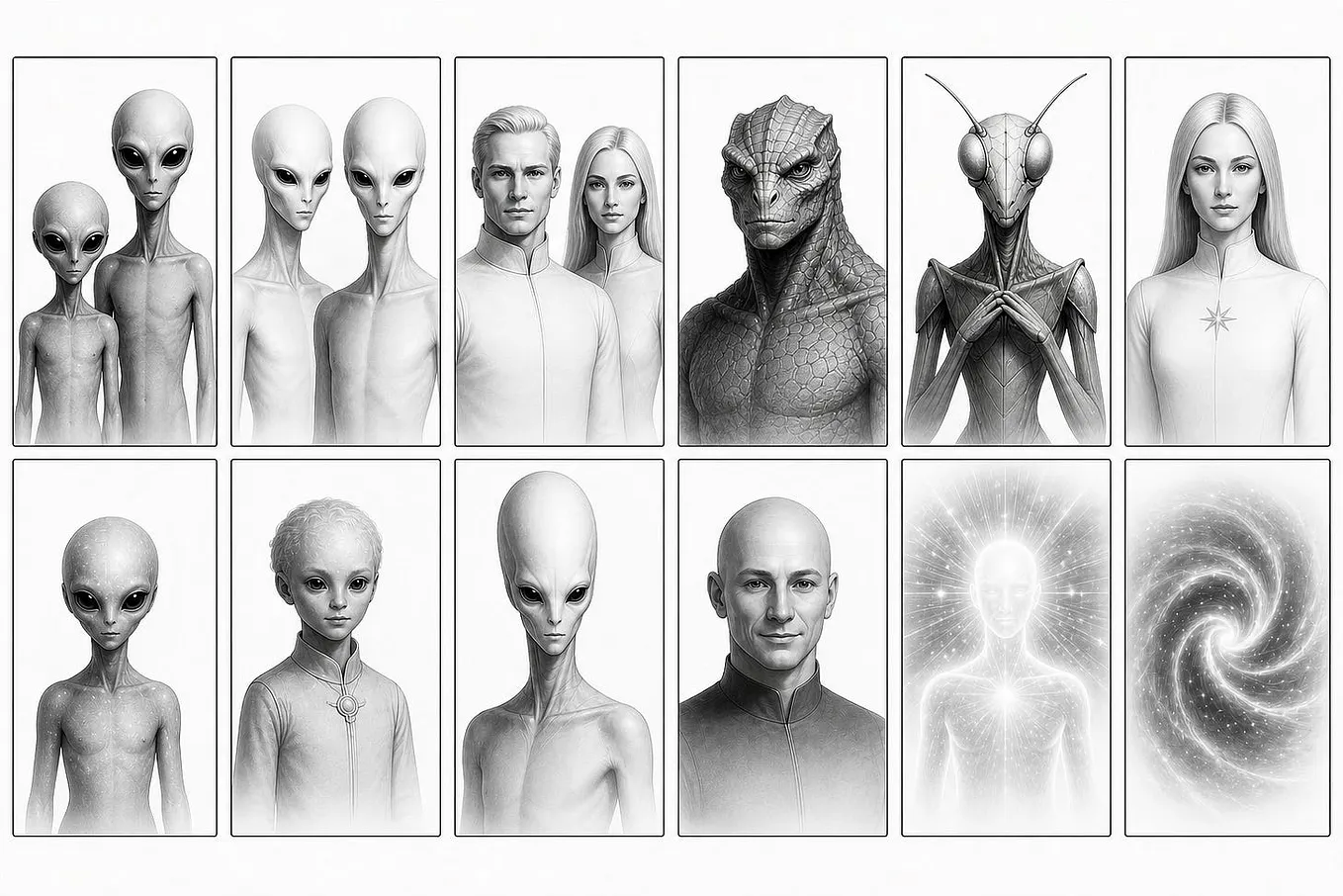
Cognition, it turns out, is not a single thing. It is a space — vast, mostly unexplored — of which human cognition occupies one small, particular region. Here are some of the territories that space contains.
Distributed cognition — the octopus architecture, scaled up. Imagine beings whose intelligence is spread across a body with no privileged center, where different parts may hold different opinions simultaneously, where what we would call “a decision” emerges from something closer to a vote among autonomous subsystems. How would such a being communicate? Not through a single spokesperson. Not through a consistent individual voice. The signals might seem contradictory, fragmented, multiple. We might mistake the internal complexity of one mind for a committee.
Collective cognition — many separate beings functioning as one consciousness. Research on honeybee swarms has revealed something remarkable: a colony choosing a new nesting site operates, mathematically, exactly like a single agent learning through reinforcement. The collective learns as one organism, even though no individual bee perceives the whole picture. Now scale this to a civilization. To communicate with a hive mind, you cannot address one unit. You must address the whole, and understand that the death of one unit carries no more significance than the loss of a single thought.
Get Thoughts Of The Rookie REMOTE VIEWER⭐️’s stories in your inbox
Join Medium for free to get updates from this writer.
Temporal cognition — thinking not bound to the linear flow of time. The Heptapods of Arrival were fiction, but the underlying concept is not. A being whose cognition operates across multiple time-states simultaneously experiencing past, present, and future as co-present rather than sequential would communicate in patterns that seem, to a linear mind, like confusion or prophecy. Answers might arrive before questions are completed. References to events that haven’t happened yet would not be predictions. They would simply be now, for that being.
Chemical cognition — thinking based not on electrical signals but on molecular gradients, pheromone patterns, biochemical reactions. The mycelial networks beneath forests what scientists have begun calling the “wood wide web” — process and transmit information across kilometers through chemical exchange. A decision in such a system might take days. A thought might span a continent. Such a mind would not experience “immediate” as a meaningful category. It would require patience on a scale that no human institution has ever practiced!
Quantum cognition — processing information in superposition, performing many calculations simultaneously, using entanglement as a form of coordination between distant parts of a system. Such a mind might give answers that seem paradoxical not because it is confused, but because the resolution it operates at is finer than binary. Yes and no might be, for such a being, a primitive and lossy interface with reality.
These are not science fiction scenarios. They are extrapolations from biology, physics, and mathematics that already exist on Earth, or that follow from known principles. The question is not whether such cognitions are possible. The question is whether we are prepared to encounter them….
The Frequency a Civilization Broadcasts
Without consciousness, the universe would unfold in silence: stars igniting, colliding, dying with no witness to know it happened. Life gives the cosmos the ability to observe itself.
The atoms in your body were forged inside dying stars. You are, quite literally, the universe becoming aware through human form.
And if other intelligences exist, then they too are the universe knowing itself through different structures of perception — different Umwelten, different cognitive worlds.
Every civilization carries a kind of signature shaped by its inner coherence or fragmentation, its relationship to power, fear, diversity, and cooperation. According to some models of exodiplomacy, contact is not initiated through simple technological discovery, but through resonance recognition: civilizations perceiving one another through the qualities they radiate.
A civilization organized around internal violence and domination may not be avoided out of superiority, but for the same reason a surgeon waits before operating on an unstable patient.
Researchers such as Jacques Vallée have long suggested that the phenomenon may not fit the simple model of extraterrestrial visitors arriving from distant planets. The intelligence behind many contact experiences appears stranger than that — operating through consciousness, symbolism, altered states, and dimensions of reality that intersect with human perception in ways we barely understand.
Whether these intelligences originate from other star systems, other layers of time, or other structures of reality entirely, the deeper question remains the same: contact may depend less on distance than on the evolution of consciousness itself.
In that sense, the future of humanity and the possibility of contact are not separate stories. They are the same transformation viewed from different sides!

Before You Say Hello
So: what is the practical shape of this preparation?
It begins not with technology, but with perception. With the deliberate expansion of what you are capable of recognizing as intelligence. The octopus is a starting point. So is the mycelial network. So is the bee colony learning as one organism. Every encounter with a radically non-human form of cognition on Earth is training not metaphorically, but literally for encounters beyond it.
It continues with patience. Not the social patience of waiting your turn, but something deeper: the willingness to sit with a signal you cannot immediately decode. To resist the reflex toward premature interpretation. To hold open the question what is this? long enough for an answer to form on its own terms.
It requires the development of what might be called cognitive humility. Not the false modesty of doubting everything you know, but the genuine recognition that your framework of reality is one framework among many possible frameworks. That what seems like confusion may be a different kind of order. That what seems like silence may be a different kind of speech.
And it asks, perhaps above all, that we take seriously the work of internal coherence. Not because spiritual development is a prerequisite for contact, but because a fragmented, fear-based, domination-organized mind is poorly equipped to process what it encounters at the edge of its known world. The quality of what we can receive depends on the quality of the instrument receiving it.
Karl Friston’s free energy principle holds that the brain continuously minimizes the gap between its predictions and reality. A mind that has expanded its predictions and that has made room, in its model of possible worlds, for intelligence that looks nothing like itself will experience less shock, less defensive closure, less misidentification when it encounters something genuinely new.
Reality does not interpret itself. We do. And how we do that work, how precisely, how openly, how honestly, determines what aspects of reality are available to us at all.
The conversation has moved. It is no longer only are they out there. It is becoming what are they, and what are we, and whether those two questions might turn out to be, at some depth we haven’t yet reached, the same question.
Before you say hello, know what you’re prepared to hear.
The answer may not arrive in words. It may not arrive in a form your current mind can immediately recognize as an answer at all. That is not a reason for fear. It is a reason for preparation. And preparation, real preparation — begins now.
For those who want to go deeper: Friston, Varela, von Uexküll, Teilhard de Chardin — each of them pointed here, from a different direction.