The Space That Loves You Back
Notes on a State I Have Met Among Galaxy-Builders, on the Water, and in a Room Full of Children

I keep meeting the same thing in places that have nothing to do with each other.

I. The Galaxy-Builders
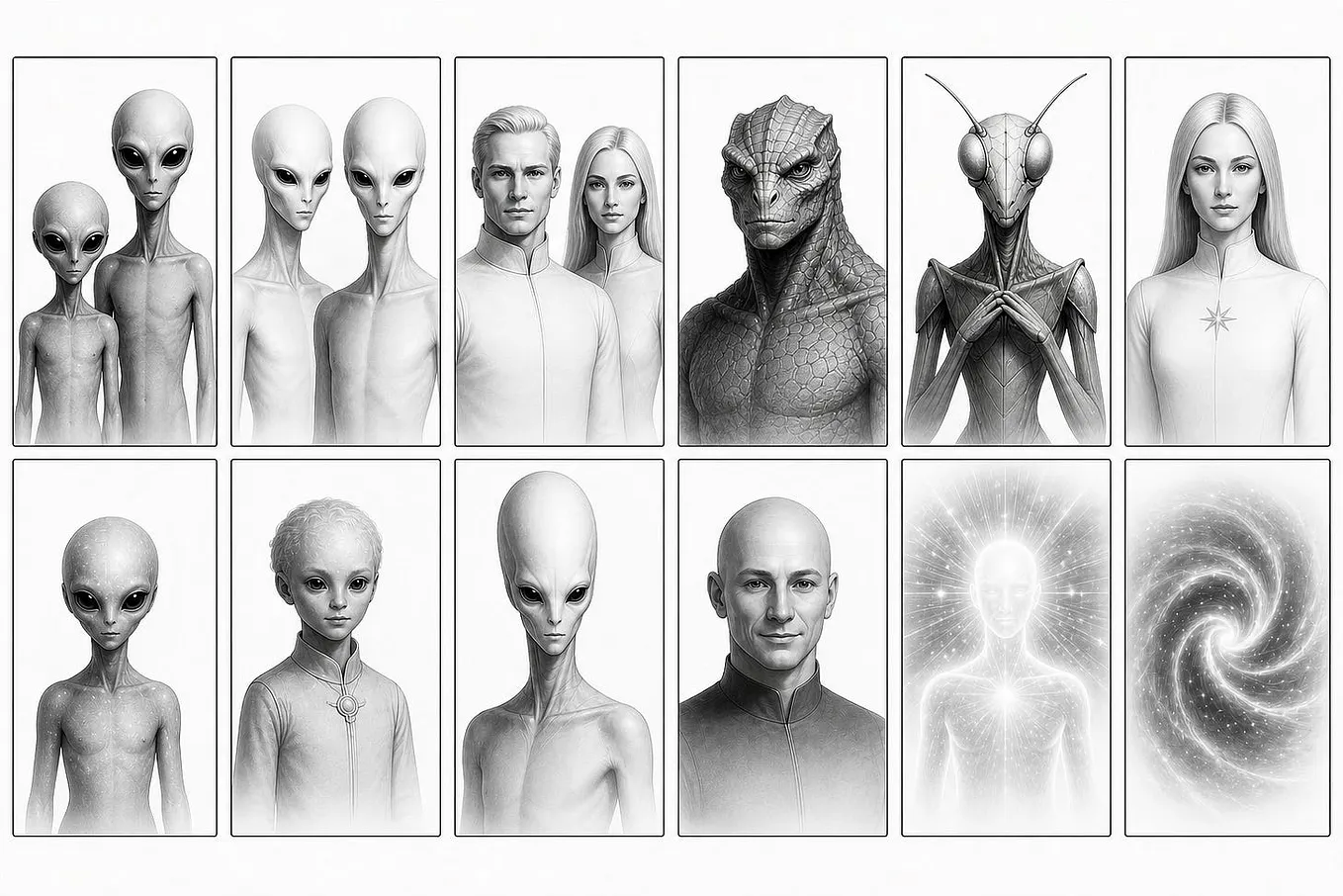
I first met ‘it’ not as an event but as a presence: ‘a group’ of impossibly tall, long-haired beings — builders of galaxies — appearing during a remote-viewing session. That’s how they chose for me to portrait themselves. They did nothing dramatic. They simply existed, accepted me as if I was a child not prepared to know the truth about them. Also the space around them carried the quality this essay is trying to describe. It wasn’t warmth directed toward me. It was a field I happened to be standing inside, the way you stand inside weather.
II. Over the Water, With the Keys of Enoch
I met ‘it’ again for only a few milliseconds, moving low over what felt like the surface of water, racing with love toward beings I couldn’t yet name, on a rescue, to help. Only afterward, researching what I had felt, did I recognize the symbol my mind had reached for in that moment: the so-called Keys of Enoch — not doctrine, but the closest container available for what was moving through me. The help wasn’t sentimental. It felt like moving through a medium already, by its very structure, on the side of every being it touched.
III. The Visitor from ‘Oumuamua
I encountered the same quality during contact with what I associated with ‘Oumuamua. Whatever that encounter ultimately was, it carried the identical signature: not affection directed at me, but a space that already possessed this quality before I entered it.
IV. A Room Full of Korean Children
And I meet ‘it’, smallest and most familiar, in a room full of Korean children who are not mine and do not speak my language, building towers out of blocks and singing karaoke off-key, in chaos that behaves, on contact, like a rocket launcher. Something lifts, and does not come back down the way it went up.
Four unrelated settings reveal the same recognition. The repeating pattern matters more than any single event, and it’s stronger evidence that this isn’t a projection draped over convenient moments. Something structural is showing up in radically different rooms.
Not a Feeling. A Place.
This was never an emotion moving from me toward something else. It was the discovery that I had stepped into a space already possessing the quality of loving me back — prior to my noticing it, prior to my deserving it. You do not create it. You enter it, or it arrives around you, the way weather doesn’t ask permission before it changes.
Across traditions, mystics borrowed the language of love because ordinary vocabulary could not reach this experience. Sufi poets reached for ishq, sliding between romantic longing and divine absorption. The bhakti traditions of India built entire theologies out of frankly erotic language — Krishna and the gopis — because only love-language carried enough heat to gesture at the real thing. John of the Cross wrote of the soul’s Dark Night in bridal, erotic imagery to describe something that had, by his own account, nothing to do with eroticism at all.
So when “love” fails you, you’re in good company. The failure is structural. Every one of these traditions was trying to name a place using words built only for relationships.
What the Contemplatives Circled
Trungpa, Dilgo Khyentse Rinpoche, Mingyur Rinpoche, and Christian mystics each pointed toward the same limitation: reality exceeds the capacity of ordinary consciousness and language. The encounter is not the problem. The container is.
Chögyam Trungpa, describing what he called an awakened heart, said that if you go looking for it — put your hand through your own ribcage searching for the thing you call your heart — you find nothing solid there. Only tenderness, unconditioned, without cause. Dilgo Khyentse Rinpoche described the compassionate radiance of the nature of mind as something that simply emanates, the way light emanates from something luminous — and reached, to describe it, for the image of the moon reflected in still water: vividly present, impossible to grasp. Yongey Mingyur Rinpoche said plainly that capturing the direct experience of the nature of mind in words is impossible, and that the closest approximation is that it is immeasurably peaceful, and, once stabilized through repeated contact, virtually unshakable.
Christian theology arrived at something structurally similar in the beatific vision — the direct, unmediated encounter with God, seen face to face. Aquinas and the tradition after him held that this vision is not survivable while alive in the body. It’s reserved for whatever comes after the body is no longer the instrument doing the perceiving. That’s the same architecture I keep running into: the encounter is real, the container isn’t rated for it, and something has to give.
Why the Body Can’t Hold It
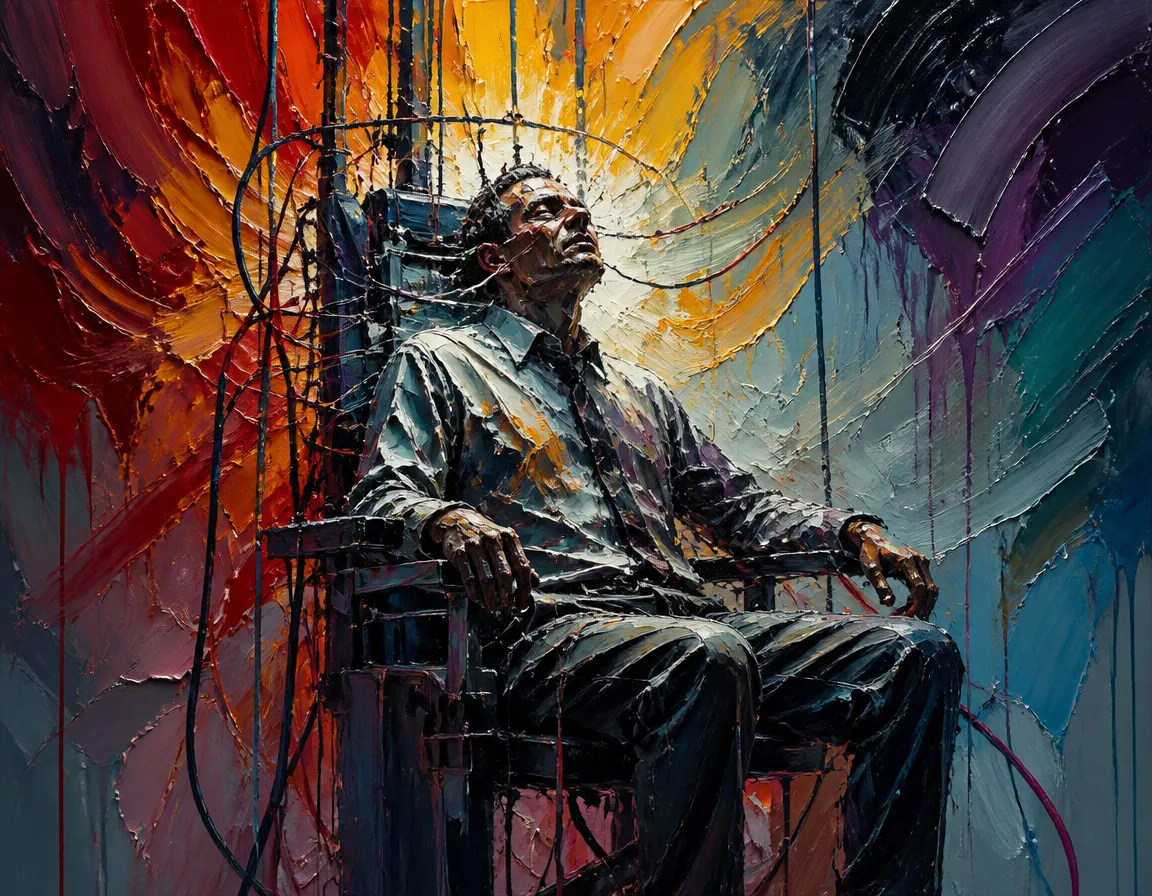
Perhaps the nervous system is a limiter, compressing reality into a survivable bandwidth — a narrow-gauge wire on a current several orders of magnitude too large for it. What I’m calling the space that loves you isn’t an altered state bolted onto baseline awareness. It’s what’s sitting underneath the compression the entire time. Moments of remote viewing, profound contact, or simple human presence loosen that compression, briefly.
Get Thoughts Of The Rookie REMOTE VIEWER⭐️’s stories in your inbox
Join Medium for free to get updates from this writer.
These openings do not merely reveal something hidden — they gradually transform the observer. Call the ordinary compressed rendering of reality the matrix, if the word still does useful work: not because anyone designed it, but because it behaves like one, mistaken by nearly everyone for the whole of what’s there. What gets through in these moments reorganizes the system rather than only overwhelming it — filtering out what was never true, and amplifying capacities that were always available underneath the compression. Every real touch of it changes the instrument doing the touching, leaving it more capable of receiving the next one.
Liberation as Recognition, Not Achievement
Freedom may not be something achieved but recognized. The dimensions we don’t yet understand, the timelessness ordinary perception can’t render, may simply be more of the same space, experienced without the filter that currently makes it look like empty distance instead of presence. Oneness is not a mystical reward; it is what remains when perception stops confusing the rendering for reality.
I offer this as testimony, not proof.
But it would explain why an encounter with builders of galaxies, a few borrowed seconds over water, contact with something that arrived from outside our solar system, and an ordinary evening with children who don’t speak my language, all register, underneath everything else that makes them different, as the same place.
A Human Echo
Barbara Fredrickson’s work on positivity resonance hints at something related, yet what I describe seems to precede relationship itself. It feels less like an emotion between people than an environment already present — the domesticated cousin of what I’m describing, real and measurable, but capped at human scale.
What I keep meeting is what’s left when you strip away even that.
The Room
I keep returning to one ordinary memory: a room full of children, voices out of tune, towers ready to fall. Nothing miraculous happened, yet something opened — not inside me, but around me. Everything else in this essay is an attempt to describe that opening as honestly as I can.
Sources & Further Reading
- Chögyam Trungpa, Shambhala: The Sacred Path of the Warrior (Shambhala Publications, 1984), the chapter “The Genuine Heart of Sadness.”
- Lion’s Roar excerpt: “The Tender Heart of the Warrior”
- Dilgo Khyentse Rinpoche, commentary on Padampa Sangye’s The Hundred Verses of Advice to the People of Tingri.
- Full commentary, Dharma Wheel
- Yongey Mingyur Rinpoche with Eric Swanson, The Joy of Living: Unlocking the Secret and Science of Happiness (Harmony Books/Random House, 2007), p. 249.
- Lion’s Roar excerpt: “Rest in the Sky of Natural Mind”
- Thomas Aquinas and the Christian doctrine of the beatific vision — the classical claim that the direct, unmediated vision of God is not survivable while still embodied.
- Beatific vision, Wikipedia
- Beatific Vision, New World Encyclopedia
- Barbara L. Fredrickson, Love 2.0: How Our Supreme Emotion Affects Everything We Feel, Think, Do, and Become (Hudson Street Press, 2013) — the concept of “positivity resonance.”
- Greater Good Science Center: “The Love Upgrade”
Note on the RV and contact material: the galaxy-builder, Keys of Enoch, and ‘Oumuamua-associated percepts referenced here are drawn from my own remote-viewing sessions and contact experiences, offered as first-person testimony rather than verified external fact. I’ve tried to keep description and interpretation separate throughout, in the spirit of researchers like Dean Radin and Jacques Vallée, whose work treats anomalous first-person experience as data worth taking seriously without overclaiming certainty about its ultimate nature.
#RemoteViewing #ConsciousnessStudies #Samadhi #Bodhicitta #NHI #UAP #Mysticism #NonDuality #TibetanBuddhism #BeatificVision #Contact #Spirituality #PhilosophyOfMind #Panpsychism #Awakening