You Decide What’s True in American Animals

It opens like this:
This is not based on a true story, this is a true story.
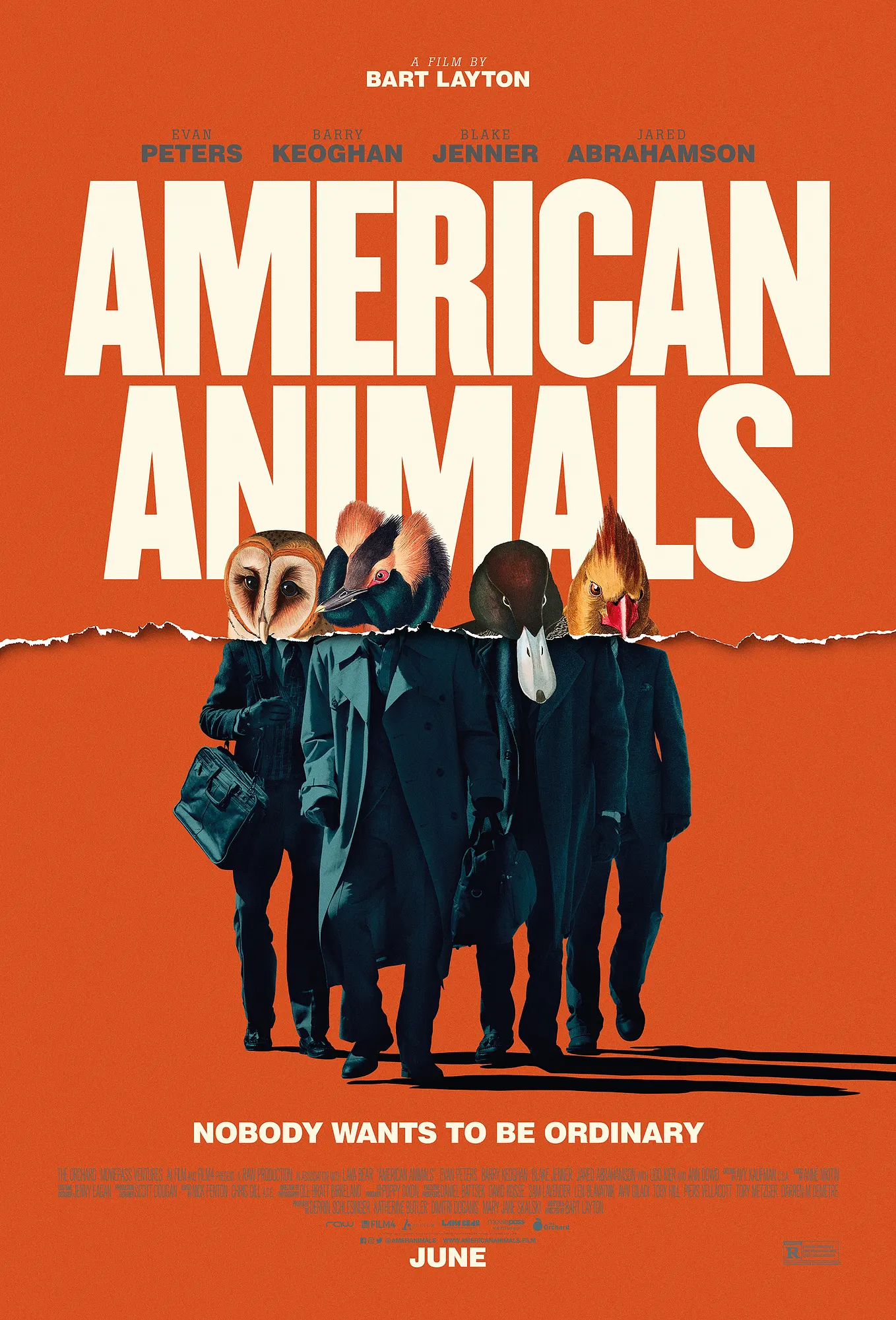
Director Bart Layton makes the aim of his film clear upfront: this is not a fictional movie. But it also isn’t a straight forward documentary like the rest of the director’s filmography. American Animals lies in-between. It would be incorrect to say American Animals breaks the fourth wall. Instead, it puts a frame around it, constantly reminding the audience that it’s there. It knows it’s a film but it transcends a single genre. American Animals pulls in the audience to view the dissection of a true story by having two formats of film-making to collide.
The film tells the true story about the audacious heist of four college students who try to steal valuable rare books from Transylvania University library. The movie alternates between the fictional/adaptive narrative and documentary talking heads from many of the people involved in the heist. This includes all four men and the librarian who was guarding the books. There are also interview style talking heads featuring parents and teachers but these people are portrayed by actors, despite being shot in the same format as the real subjects.
The two leading men who orchestrate the heist are guided by fantasy. They seek a reprieve from their boring middle class life. Art student Spencer craves the moment that would make him special and unlock his true artistic capabilities. His friend Warren lives a detached life, disillusioned with society itself and a disjointed home-life coupled with apathy toward college and his success as an athlete. Also in the heist is Eric, an outsider who’s become distant from his friends who dreams of joining the FBI. And successful Chas craves something away from his manicured life.
The plan begins, as all imagined things do, as a form of escape. As they watch heist films and follow the mysterious trail of a fence, the two are exhilarated by the adrenaline of doing something big. While they dream of money, it rarely comes up. It’s what comes at the end, but fantasy is never about the end.
For Layton, the difference between fantasy and reality is perspective. Layton’s direction and the editing follows the theme of the movie. The cuts between reality and the dramatic narrative are very precise and collide at unexpected moments. In one scene, dramatic Warren played by Evan Peters talks to the real Warren in a car at a gas station, questioning him about the accuracy of the story. Meanwhile, dramatic Spencer, played by Barry Keoghan, is in the gas station convenience store. The real Spencer and Warren disagree about where the first mention of the rare books began, and each person’s intentions. In a blink-and-you-miss-it shot, the real Spencer leaves the store in front of the dramatic Spencer. He lingers on the outside of his own narrative because it is being consumed by the fantasy of Warren’s perspective.

Layton wants to blur the fantasy and the reality but also makes their divisions clear. In the fantasy, scenes are clean and filled with cinematic composition. Colors and light are vibrant. The camera frames every shot perfectly. It looks exactly like they would imagine.
But if the fantasy is a perfectly manicured shot, then what is the reality? For Layton, reality comes from new perspectives. Every now and then, when the story drifts to one character’s perspective, the real versions of the character slip through. They correct elements of the movie, and the elements change along their words. A man’s scarf changes color before he changes into another person before he disappears all together. Each’s character’s truth is different. Layton uses the elements available to him through making a film because it is art. His artistic medium allows for backtracking and changing timelines and visuals.
A crucial element of American Animals lies in the subject matter itself: art. The film is about the theft of art and protagonist Spencer is an art student who craves to be a great artist. Spencer sees not just the numeric value of the works but becomes enamored with the paintings of the titular creatures. The first one he sees, a flamingo, ignites his desire for something more. In the critical moment when he wants to abandon the heist, the dramatic Spencer sees one in the middle of the road. As opposed to standard character growth, Spencer’s character grows through his view of art.

The first scene is Spencer being asked about himself with his portfolio lay before him and being unable to answer. He doesn’t believe he has a spark that makes him different. We see his drawings are incredibly realistic but he isn’t satisfied with his self portrait. He may be talented, but what is talent without something special?
Get Leila Jordan’s stories in your inbox
Join Medium for free to get updates from this writer.
But then there is the heist.
It doesn’t go according to plan. It’s tense, and long, and the music pounds in your stomach. The librarian is tasered and screams in pain. The camera work is no longer clean but shaky and uneven. Warren and Eric sweat and panic and stumble. Everyone is sick and disgusted with themselves. As the real Spencer states: once you’ve crossed the line, there’s never a point when you haven’t.
After the heist, there is a shot of each of the real men. They shrink inside themselves. They are no longer telling an exciting story. They are forced to sit with their actions, and we sit with them.
The four men deteriorate. They become detached and irritable and unable to cope with what they have done. They’ve hurt someone, and they don’t even have the money to show for it. After the heist, the fantasy comes to a complete halt. And while Layton’s clean shots return, they are colder. The silence is louder. The characters’ panic fills each frame.
The men and the audience know right away how this will end. By the time the FBI comes to each of their houses, a cinematic scene played out in slow motion with Leonard Cohen playing, it’s almost a relief. The fantasy had ended weeks ago, or for the audience, minutes ago. The stories need to collide with each other.
As Spencer is taken from his room, we see he had done a new self portrait. He drew his new face, hollowed and sickly with guilt and fear. He has transformed, he has had the experience that would make him a true artist, but the resulting art is a permanent reflection of the physical and mental toll it has taken on him. There is no great suffering, there is just suffering. The change of his self-concept is a microcosm of the film’s message about perspective itself. He doesn’t necessarily go through a change in character, but rather a change in how he views himself.

This is embodied best by a short interview with Betty Jean Gooch, the librarian who was incapacitated by the heist. For the whole movie we’ve seen the heist through the men’s eyes, with slight commentary from their fictional parents. But when Gooch speaks, she turns all their actions around. She says they are selfish, that they were horrible enough to be willing to hurt someone for excitement. We understand these men and we can’t hate them because we understand their naivety. But we hear Gooch the loudest, and she ultimately gets the final say. Her perspective had been missing the whole movie, but it is the most crucial to understanding all the events as a whole.
Once you’ve seen American Animals, it’s hard to stop thinking about it. It’s because the film does not leave you with the proper ending of a fictional film nor the fulfillment of hearing the true story in a documentary. All of the characters are still alive, still living with the consequences of that artistic fantasy. During the final shots we see them walk away from the camera, into the lives they now inhabit. Each of their careers is tied to the events of the film and the choices they made. They will always be existing past that line.
In the end, American Animals gives no right answer. Each person is left to process the events. But it tells us we latch onto perspective. It’s what everything we experience boils down to. The camera works shows us the beauty in fantasy and idyllic dreams of becoming something greater. It provides the same escapism that it did the main characters. But the characters live on in our own world because they are not fictional. They live their own views of the events, just as we live out Layton’s.
So what is the truth of American Animals? Was the heist a grand fantasy? A delusion of grandeur? A selfish act of violence? Each character, each subject, has their own conclusion. But Layton allows the audience to make a conclusion as well. American Animals gets its power through its lack of complete objectivity. Absolute truth may exist, but we may never know it. All we know are the subjective stories, each powered by an individual's private and public motivations.
On the way to the heist, dramatic Spencer looks out the window to see real Spencer standing on the street. The final shot of the movie reveals that street to be the one Spencer lives on now. He watches the street and sees the car going forward, about to do the event that will change his life. His perspective, just like ours, is looking out at that moment. He is no longer in the car but watching whenever he leaves his house. He haunts his own story.

We’ve heard all the perspectives Layton has curated. But we are left in that moment, when reality forever looms over the fantasy. The text on screen reveals that he is still an artist, specializing in pictures of birds like the ones that started the fantasy. His great fantasy has collided with his reality. He may not fully know who he is now, but it’s connected to what he’s done. The film ends and our ability to escape into the fantasy ends with it. All that is left is for each individual to process; to find their own truth among the differing stories. We, like Spencer, are in the after. And it’s where we will always be.