The Existential Threats of AI for Uber


This is the third of a three-part series of articles assessing Uber’s strategy, business outlook, and the growing risks threatening its future.
- Does Corporate Trustworthiness Matter?
What Costco’s $1.50 hot dog reveals
about the trust Uber is trading away
Released Sept. 30 - The Enshittification of Uber:
Higher Prices, Longer Waits, Lower Pay
The risks of heading down a familiar tech industry path
Released Oct. 7 - The Existential Threats of AI for Uber
Robotaxis and AI agents are coming
Released Oct. 14

AI is profoundly impacting every individual and business enterprise, and Uber is no exception. This post argues that AI poses more of an existential threat than an opportunity for Uber, as a result of the two foundational pillars of Uber’s strategy.
- Uber’s asset-light strategy leaves it particularly vulnerable to vertically integrated robotaxi companies that neither need nor want to use Uber’s market-maker platform.
- Uber’s R&D focus on perfecting exploitative pricing algorithms on both sides of the marketplace leaves it particularly vulnerable to AI agents that are better aligned to serve users’ interests, not Uber’s. If AI agents work as well as promised, they will stand between users and everything they buy, particularly threatening companies saddled with fraught relationships with their customers.
Let’s assess both of these threats in turn.
Disruptive robotaxi providers threaten Uber’s rideshare leadership
A decade ago, Uber co-founder Travis Kalanick presciently predicted that robotaxis would pose an existential threat to the company.
“It starts with understanding that the world is going to go self-driving and autonomous. So, what would happen if we weren’t a part of that future? Then the future passes us by basically, in a very expeditious and efficient way. If we are not tied for first, then the entity that’s in first will roll out a ride-sharing network that is far cheaper or far higher-quality than Uber’s, then Uber is no longer a thing.”
Kalanick was right in foretelling the transformative consequences of autonomous vehicles on the rideshare industry, if not the winner-take-all stakes, which led him to commit Uber to an aggressive and expensive R&D effort.
Four years after Kalanick’s dire 2016 warning, his successor abandoned Uber’s robotaxi R&D initiative. Dara Khosrowshahi undoubtedly saved billions of investment dollars in a race he believed Uber couldn’t win. But his decision didn’t mitigate the severe risk to Uber’s future profitability by ceding control of robotaxi technology to others.
To understand why, a good starting point is to recognize that today’s circumstances are vastly different from the market environment in which Uber created, explosively grew, and dominated the rideshare sector 15 years ago.
While Uber’s initial asset-light strategy enabled it to scale rapidly by brazenly ignoring local regulations, today’s robotaxi players face a grindingly long, expensive city-by-city certification process (often requiring multiple layers of government approval), followed by sizable investments in expensive, technologically sophisticated vehicles and supporting fleet management infrastructure. This results in a profoundly different growth trajectory than Uber’s initial race to global domination.
Nearly eight years after launching its first paying passenger trip, robotaxi industry leader Waymo has only been able to deliver about 30 million rides, about as many trips as Uber currently delivers in the U.S. every three days. Robotaxi providers are thus significantly supply-constrained, not demand-constrained.
What are the implications for Uber? Without its own autonomous vehicle technology, Uber’s pitch to robotaxi companies has been that it can speed their market penetration and improve vehicle utilization. But Waymo (and Tesla) is proving that it can achieve these objectives on its own. Moreover, demand generation is not the robotaxi industry’s most pressing problem; it’s scaling adequate supply to serve existing strong demand.
For example, in California, Waymo has scaled its robotaxi service at an average growth rate of 15% per month, surpassing the one million monthly trip threshold last year.

As it expands its robotaxi fleet to serve a growing market, Waymo is also improving operational efficiency and customer service. For example, Waymo’s vehicle utilization rate in California, measured by the percent of total robotaxi miles with paying passengers, has already reached 55–57%, roughly equivalent to Uber’s driver-based rideshare utilization rate nationwide. Moreover, the gap between Waymo and Uber’s price and wait time is rapidly closing, putting Waymo closer to the better/faster/cheaper trifecta that can fuel explosive growth.
Most Waymo customers already consider robotaxis to be superior to human-driven services. According to recent consumer sentiment polls conducted by Obi, 70% of Waymo riders prefer it to standard Uber or Lyft ridesharing, and 43% of respondents said they would be willing to pay up to $10 more per ride to take a driverless vehicle.
So Travis Kalanick was right: the question isn’t whether, but only how and how fast the robotaxi market will evolve. Three business models are vying for market supremacy in the U.S.¹
- Model 1: Vertically integrated robotaxi companies, led by Waymo and Tesla, who control the entire robotaxi technology stack, including demand generation, vehicle assignment, some or all manufacturing or AV retrofitting, and all fleet management services (in-house or contracted to third parties)
- Model 2: Partnership models where AV technology and automotive companies like Nuro/Wayve and Lucid/Rivian agree to exclusively distribute their services through Uber’s platform in return for a minority equity capital investment
- Model 3: A variant of the first two models, where robotaxi companies agree to use Uber (or Lyft’s) platform as an ancillary demand channel, similar to how airlines manage their own demand generation apps, as well as sell through online travel agency (OTA) channels like Expedia.
Regardless of how these competing business models play out, they all threaten Uber’s profitability in three ways.
- The first model directly reduces Uber’s share of the rideshare market by cutting it out of the robotaxi business entirely.
- The second and third models reduce Uber’s profit margins and commissions, as sophisticated robotaxi technology providers will demand better compensation than Uber’s current customer base of millions of riders and drivers with limited bargaining power. An example of this differential bargaining power is evident from Uber’s split with Waymo, after Uber claimed Waymo’s demands created “unsustainable economics” for the company.
- All three models are likely to lead to more efficient, lower-cost rideshare services over time, as technology and supporting infrastructure economies of scale take hold.
In short, compared to its current strong financial performance, Uber is likely to face the “triple whammy” of declining market share, lower margins, and lower prices in the post-robotaxi era.
Let’s take a closer look at each element of this dire business outlook.
Lower Rideshare Market Share
Uber is already seeing its market share decline in cities where it directly competes against Waymo:
- According to credit card tracking data from Earnest Analytics, Uber controlled 63% of San Francisco’s total rideshare spending at the end of 2023. One year later, just six months after Waymo launched its robotaxi service in San Francisco, Uber’s revenue market share within Waymo’s geofenced service area had dropped to under 55%, similar to Lyft’s demand contraction.
- Earnest Analytics also found that, on average, users spent $189 on Uber rides the quarter before their first Waymo purchase, a 7.2% increase over the prior year, but only $174 on the platform one year after their first Waymo ride, a 7.5% decrease. This finding corroborates earlier research from Earnest Analytics that found Waymo’s early adopters exhibited stronger loyalty to the new technology than customer loyalty to Uber.
- Corroborating these dynamics on the supply side, Gridwise’s driver data drawn from observations on more than 800 million U.S. rideshare trips found that driver rides per hour fell 5.3% year-on-year in cities with robotaxi service in Q4 2025 versus a 2.6% decline nationally, and hourly pay fell in robotaxi markets in LA (−3.7%), SF (−1.7%), and Phoenix (−0.4%) while rising 1.8% nationally.
Bottom line, in markets where head-to-head competition has already emerged, Waymo’s growing market penetration is already being felt by Uber and its drivers.² Rideshare market share wars will undoubtedly intensify as new entrants further challenge Uber’s historical dominance in more markets. Waymo already operates in 15 cities and is aggressively pursuing further expansion. If and when Tesla can pass safety certification hurdles, it has the ability to scale rapidly.
Lower Uber Profit Margins
The two pivotal strategies that enabled Uber to become a cash-generating machine over the past four years — its asset-light business model and discriminatory algorithmic pay policies — will be weakened in the post-robotaxi era, portending a decline in its profit margins.
To see why, let’s start with the centerpiece of Uber’s strategy, its asset-light business model. In practice, this has meant Uber neither owns nor bears responsibility for the costs associated with delivering ridesharing services: not the acquisition costs or accelerated depreciation of the vehicles it deploys, nor vehicle licensing and registration fees, baseline insurance coverage or taxes, nor the costs for fuel/electricity, maintenance, tire replacement and cleaning, or the adverse consequences of low vehicle utilization, which, in fact, currently helps Uber lower driver pay.
This approach puts Uber in an ideal position to exploit its fragmented supply base through algorithmic wage discrimination, which pits millions of drivers against each other in a race to the bottom for the lowest pay any driver will accept for each of the billions of rides Uber matches in the U.S. each year.
My analysis of millions of Uber trip offers over the past year across scores of U.S. cities shown below illustrates how effective Uber’s strategy has been in cutting rideshare labor costs, with the majority of driver pay rate offers from Uber well below $1 per mile, a threshold that many drivers consider the minimum to adequately cover their expenses.

Several prominent independent research institutions, including the MIT Center for Energy and Environmental Policy Research, Economic Policy Institute, and UC Berkeley Labor Center Study have evaluated rideshare economics and concluded that Uber drivers’ net earnings are frequently below state-mandated minimum employee wages, once vehicle depreciation, auto ownership and operating costs, and unpaid standby times are factored in.
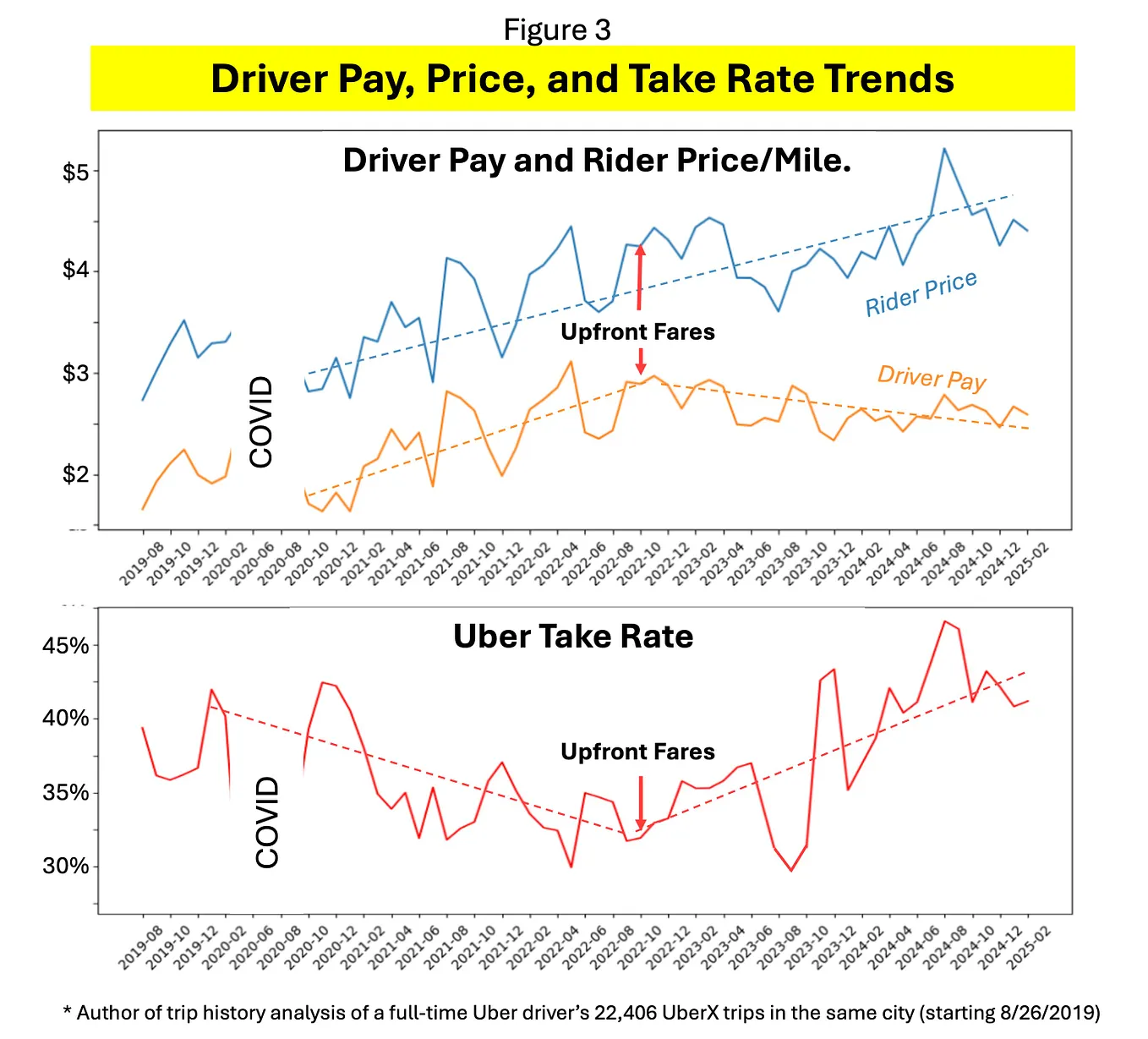
As previously noted in this report, Uber’s algorithmic pricing practices have also enabled Uber to raise rider prices. But even as accretive as rider price increases have been, my research has shown that Uber has gained even more profit leverage by selectively cutting driver pay than by raising rider prices.
In the post-robotaxi era, Uber will not have as much bargaining power over sophisticated, technology-rich AV companies as it does with drivers to set low pay rates for rideshare trips and all the supporting services that drivers currently provide. The breakdown of Uber’s earlier partnership with Waymo (and Tesla’s lack of interest in any partnership arrangement with Uber) suggests a substantial gap in Uber’s and robotaxi providers’ profit-split expectations.
As a result, Uber will have to pay more, one way or another, to secure robotaxi technology access: either accept lower commissions than it currently enjoys with drivers, and/or make significant equity investments and stage-gated vehicle purchase commitments in emerging robotaxi companies (as Uber already has with Nuro, Wayve, Lucid, and Rivian). For the foreseeable future, robotaxi trips will likely be considerably less profitable for Uber than the driver trips they replace.
Dara Khosrowshahi has seen these market dynamics play out before as CEO of online travel agency Expedia. OTAs like Expedia and Booking.com serve two distinctly different market segments: airlines and hotels. Airlines, a concentrated set of large brands, maintain their own demand-generation channels (consumer apps, corporate and loyalty programs) to handle most bookings and exert strong bargaining power over OTAs as an ancillary sales channel. In contrast, the hotel segment, outside a handful of national and global chains, is extremely fragmented, with hundreds of thousands of independent properties worldwide that can’t possibly match the marketing reach and demand generation OTAs provide. Market fragmentation is exactly what gives Booking.com and Expedia pricing power: hotels need OTAs’ demand-aggregation capability far more than airlines do.
Industry structure and bargaining power matter! OTAs typically only earn 1%-2% commissions on airline fares but can charge 15%-30% commissions on hotel bookings.
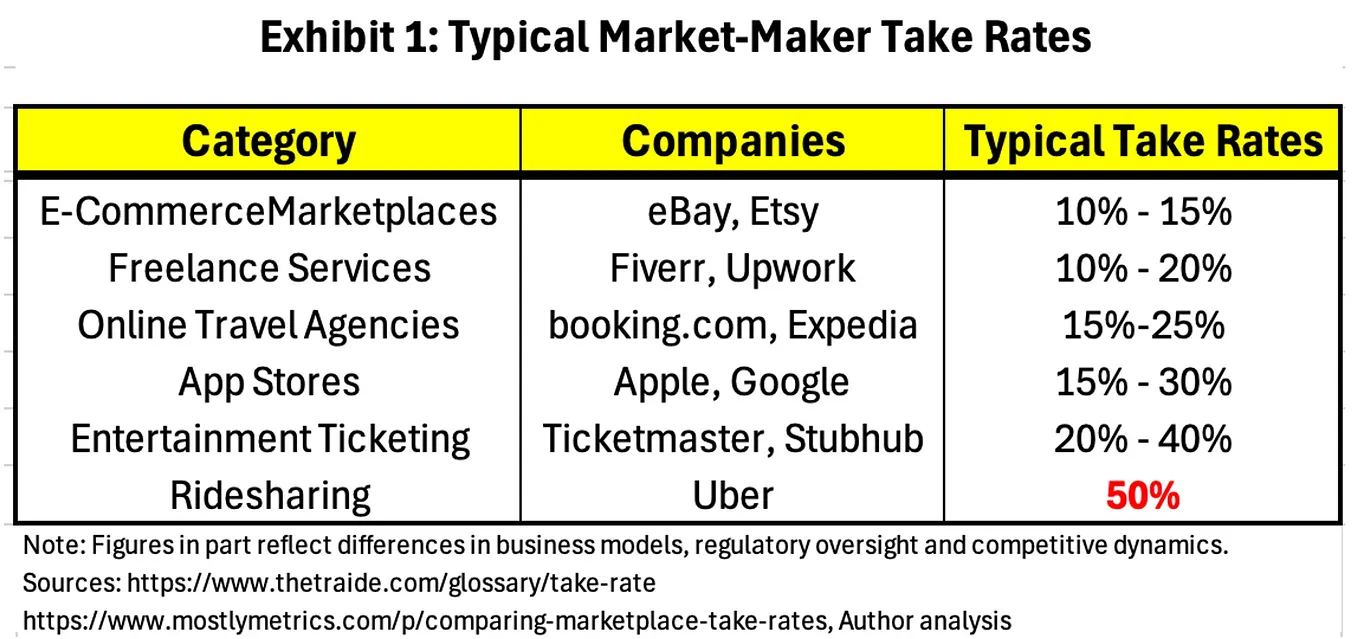
The same market dynamics apply to ridesharing for Uber’s two key segments: driver-based and robotaxi trips. Uber has never disclosed the commissions it earned to book Waymo rides in Atlanta and Austin, but it is fair to assume that Uber’s take rate on robotaxi fares in those cities is considerably less than the 50+ percent take rates it currently enjoys on its human-driven rideshare trips in most cities, where the majority of its driver pay offers are well under $1 per mile.
It is thus not surprising that the initial agreement allowing Uber to exclusively book Waymo’s robotaxi service in Atlanta and Austin unraveled. According to reporting in the Financial Times and Bloomberg, the relationship fractured under the weight of conflicting business goals. Uber privately characterized the partnership’s framework as handcuffed by “unsustainable financial terms” and “flawed economics.” Ultimately, the commercial friction proved insurmountable: Waymo’s revenue-share demands clashed directly with Uber’s outsized margin expectations, conditioned by years of experience under a different industry structure.
Going forward, a hybrid distribution model will likely emerge, where many robotaxi providers will maintain their own direct booking channel while allowing referral bookings through Uber’s app, if both sides can agree on a mutually acceptable commission rate — just as in the OTA sector. Zoox, a new robotaxi entrant, is planning a hybrid sales channel approach, as are Waymo and Lyft for current robotaxi service in Nashville.
Lower robotaxi prices
As with any major new technology or automotive product, heavy scale economies will come into play in the robotaxi sector, sharply reducing average vehicle costs. For example, the most common vehicle currently in Waymo’s robotaxi fleet is a Jaguar I-Pace, which, when retrofitted with supplemental sensors and onboard computers, is reputed to cost around $200,000 per vehicle. Waymo is also using lower-cost minivans (Ojai model) imported from China, but a 100+% tariff doubles their acquisition cost.
Get Len Sherman’s stories in your inbox
Join Medium for free to get updates from this writer.
Over time, as more domestic purpose-built robotaxis emerge, along with lower-cost sensors and AI technologies at scale, robotaxi costs are likely to decline by 50% -75% from current levels. This, combined with growing competition in the robotaxi space, is likely to yield far lower consumer prices for rideshare services than driver or driverless services today.
Implications for Uber
Uber thus faces the prospect of lower market shares, lower margins, and lower prices for its rideshare business. Uber has advanced two arguments to support its ability to succeed during and after the disruptive transition to a robotaxi future.
- By investing and partnering to gain access to, but not own, key capabilities — AV technology, vehicle manufacturing, and fleet management services — Uber can create its own robotaxi offering that will expand its business scope and addressable market more than enough to offset its market share and margin losses to more fully integrated robotaxi competitors like Waymo and Tesla.
- Uber will retain the unique competitive advantage of the largest combined network of human-driven vehicles and robotaxis, offering riders the most convenient “one-stop-shop” (Uber’s app) to the most rideshare options
Let’s stress test these two pillars of Uber’s robotaxi strategy.
1. Asset-light approach to building robotaxi capabilities
Uber abandoned its own development of autonomous vehicle technology six years ago and, to this day, is still hedging its bets by limiting its investments to minority, non-controlling, stage-gated stakes in several smaller AV and automotive industry players. By doing so, Uber is betting it can achieve market-share and margin leadership without owning the core assets or gating capabilities transforming the rideshare industry.
If true, that would certainly pencil out to attractive ROI for Uber, but the experience of companies that have achieved and sustained market leadership in other industries radically transformed by disruptive technology tells a different story. Netflix, Apple, Tesla, and Amazon all recognized the need to make big bets to own and sustain the shifting sources of competitive advantage during disruptive transformations.
Netflix
After launching its streaming business, Netflix initially acted solely as a distributor, licensing content or paying external studios to produce shows exclusively for them (e.g., House of Cards). However, Netflix has since aggressively invested in building its own extensive studio ecosystem to develop, produce, and exclusively distribute streaming video content. Netflix represents the rare case of a market-leading company that invested heavily to disrupt itself in the home entertainment business, first by launching a streaming service to obsolete its leading video rental business and then investing again to backward-integrate its movie production capabilities, strengthening its position as the video streaming leader.
Apple
To achieve and sustain industry-leading price realization and margins, Apple has invested heavily in building in-house capabilities to design proprietary chips, hardware, and software, as well as to own and operate a global network of company stores and service facilities. Deep integration across its entire value chain has been a defining principle of Apple’s product strategy, allowing its devices to consistently deliver best-in-class performance, energy efficiency, and superior customer satisfaction.
Tesla
Elon Musk had to build and own a wide range of core capabilities to launch and scale Tesla because neither the enabling technologies nor production infrastructure existed when his enterprise launched. Owning the assets and capabilities across Tesla’s entire technology stack and value chain — vehicles, batteries, powertrain, charging infrastructure, and sales and service facilities — gave Tesla a huge advantage in developing superior-performing products that paced the development of the global electric vehicle industry. It remains to be seen whether Tesla can fully deliver on its aspiration to deploy Level 5 robotaxi service and to engage Airbnb-like access to its 3 million customer-owned Teslas in the US, but there’s no question that the company’s vertical integration puts it in a unique position to scale rapidly if it overcomes technical hurdles.³
Amazon
Amazon offers a particularly relevant comparison to Uber on the value of vertical integration, given that Dara Khosrowshahi repeatedly pitched Uber as the “Amazon of transportation” in marketing its IPO.
On the surface, Amazon seems like an ideal aspirational role model for Uber. Both companies serve as intermediaries between millions of suppliers and hundreds of millions of buyers, both earn as much as 50+% commissions (aka take rates for Uber) from transactions on their platform, and it is certainly understandable that Uber would want to be considered as having the same potential as a company whose market cap recently peaked at over $3 trillion. But on closer inspection, Amazon and Uber have pursued profoundly different strategies that invalidate their comparability.
Amazon, in fact, embodies the antithesis of Uber’s asset-light philosophy, repeatedly demonstrating a willingness to invest heavily in R&D and capital expenditures to strengthen its core e-commerce mission and expand its business scope.
For example, in the 2010s, when it was about the same corporate age as Uber is today, Amazon re-architected its entire fulfillment operation, with massive investments in highly automated fulfillment centers, aircraft, truck fleets, data centers, and acquisitions of warehouse robotics companies.
As shown below, Amazon traded off a reduction in near-term profits (as measured by net income and free cash flow), for long-term profitable growth by reinvesting more than its growing cash from operations back into the business to strengthen and expand its capabilities, business scope, customer service, delivery speed and competitive advantage.
These investments have paid off. By 2025, Amazon delivered more than 13 billion items globally via same-day or next-day shipping — marking a third consecutive year of accelerated delivery speeds. In the U.S. alone, Prime members received over 8 billion same- or next-day deliveries (a 30% year-over-year increase). Data tracked by NielsenIQ has shown that Amazon’s average delivery time across all order types is less than half that of major rivals Walmart and Target.

In contrast, Uber shows little inclination to move away from its asset-light roots. Over the past four years, Uber has spent less than 1% of its revenues on capital expenditures, uniquely low in the tech industry. Uber’s R&D outlays are also well below tech industry norms. Since 2024, Uber has spent more on buying back its own stock than on R&D, signaling its priority for near-term shareholder returns over long-term product and service superiority. Moreover, Uber’s limited R&D spending has largely gone toward refining its proprietary pricing algorithms, which have aggravated riders with higher prices for degraded service, and enraged drivers with relentless downward pressure on pay rates.

Given the evidence in this report on Uber’s track record and reputation for untrustworthy corporate behavior, lack of transparency, and fraught stakeholder relationships, robotaxi providers should seriously consider whether and how to partner with Uber.
- Should Uber be given primary or exclusive control over managing customer relationships?
- Are robotaxi providers comfortable becoming just one of many interchangeable suppliers on Uber’s platform, given Uber’s track record of exploiting a fragmented supply base?
- Even if Uber can speed robotaxi market penetration, does reinforcing Uber’s dominant market-aggregator position limit suppliers’ long-term profit opportunity?
Under any circumstances, as robotaxi technology services proliferate, the days of Uber largely dictating the pace, structure, and terms of rideshare industry economics are likely over.
Agentic commerce platforms may give consumers more value, convenience, and trust than Uber
Uber will have one notable advantage over pure-play robotaxi providers: the largest combined network of human-driven vehicles and robotaxis, offering riders the most convenient “one-stop-shop” (Uber’s app) for the widest range of rideshare options.
But Uber’s app presents choices to consumers on the company’s terms. Uber decides what riders are charged for each service type. Uber decides which rideshare providers — human or AV — receive trip offers and at what fare. And Uber gets to determine its terms of service and customer support policies.
I’ve already raised the question of whether robotaxi providers should be comfortable ceding full ownership of rideshare customer relationships to Uber. But what about consumers? Is there a preferable alternative that gives consumers a better selection of ridesharing choices on their terms, not Uber’s?
Consider this scenario of how AI agents could disintermediate Uber’s position as the primary matchmaker for ridesharing services.
Wanda has a 10 a.m. meeting across town on a Tuesday. Her calendar shows the meeting, her phone knows her location, and her AI agent has observed that she typically expenses weekday rides to her corporate Amex, which it has encrypted in Wanda’s customer file.
The evening before, the agent sends a notification: “You have a 10 a.m. meeting tomorrow. Based on traffic patterns, you should leave your office by 9:15. Want me to have a ride ready?” Wanda taps yes. The next morning, the agent evaluates Uber, Lyft, and Waymo based on current wait times, fares, and Wanda’s historical preference for quiet rides (Waymo six of the last eight times). It surfaces a single recommendation. Wanda confirms and the agent books the trip, charging it to her corporate Amex.
Wanda did not need to open any app, compare prices, enter a destination, or select a payment method. The agent compressed the entire decision to two confirmations. This works because the customer’s intent is clear, the agent knows the customer’s behavioral preferences, and the optimization criteria on Wanda’s terms, not Uber’s, are quantifiable: wait time, cost, reliability, privacy, payment, and routing. Despite lots of help and added convenience, the consumer remains in control. The agent recommends; the human approves.
Later, the agent sends Wanda a follow-up message: “Two new rideshare providers have recently launched service in your city, Zoox and Tesla. Both are robotaxi services, which you’ve shown a preference for, and both are offering introductory discounted prices to attract new customers. I’ve received good reviews from customers of both services. Would you like me to enroll you on their platforms as an option for future rides?” Wanda confirms, musing that discounted fares would certainly be welcomed, given Uber’s recent price hikes.
Would Wanda (or you, for that matter) be willing to establish a relationship with such a helpful AI agent? In this scenario, the AI agent works on Wanda’s behalf and provides a high level of convenience and decision support. Her decision comes down to trust. Wanda trusts her agentic helper enough to share extensive details of her life — her calendar, personal contact list, credit card and banking information, account information with dozens of merchants, and her preferences, styles, likes and dislikes based on countless transactions and personal interactions.
Wanda likes that her agent is transparent about what information she is comfortable sharing and how the agent will use it for her benefit. And she also likes remaining in full control of what decisions her agent is or is not authorized to make without explicit consent.
As for Uber, Wanda lost trust in that company a long time ago (and polls confirm she’s not alone). She believes Uber also collects, stores, and analyzes an immense trove of information about her personal life, and lacks transparency about how it uses her data.
Wanda and her friends have often seen different rideshare prices for the same trip, and Uber’s explanations of why lack credibility. She’s also been dismayed by how high Uber’s prices frequently have become, particularly when drivers confide how low their compensation is.
Wanda isn’t averse to booking an Uber if her agent recommends one that best meets her needs for a specific trip. But she no longer wants to rely on Uber as the sole provider for her rideshare and delivery needs. Uber burned that bridge of trust a long time ago.
This scenario is just one example of a broader fight for control over who serves as the aggregator of consumer demand and the entry point for a broad range of e-commerce transactions and digitally ordered services. If AI agents work as well as promised, they will stand between consumers and virtually everything they buy.
Two caveats temper this techno-optimistic scenario that casts AI agents as the new gatekeepers to the World Wide Web. First, successful, technologically sophisticated e-commerce leaders will fight vigorously to prevent agents from disintermediating their apps, as if their lives depended on it… because they do. For example, Amazon recently blocked Meta’s Muse agent from querying or shopping on its site on behalf of customers, and Uber has erected security layers and API restrictions to block unapproved access for fear agents will reduce several sources of its profit:
- In-app advertising
- High-margin upsells and cross-promotions
- Proprietary loyalty and subscription programs
- Most importantly, booking opportunities redirected by agents to other vendors, after comparison shopping
The second caveat is whether AI agents can or will sustain the halo of trust they may currently enjoy among satisfied users. After all, early on, both Amazon and Uber enjoyed high customer/supplier satisfaction and perceived trustworthiness, before choosing to trade off stakeholder trust for profits.⁴ AI agents themselves may ultimately pursue the same gatekeeper rewards at the expense of their customers’ trust.
In any event, the threat of AI agents is real, and Uber finds itself in an uncomfortable position somewhere between a nagging threat and an existential crisis. Some companies like Expedia, Shopify, and Walmart have chosen to partner with Meta’s Muse to tap mutually beneficial and equitable shared benefits. These companies have chosen to build a bridge to the AI agentic future, while Amazon and Uber have built a wall.
Bottom line, AI agents put Uber in danger of losing its uniquely strong market pricing power, opacity, and asymmetric information advantages, as empowered customers increasingly access technology that serves their interests, not Uber’s.
The Road Ahead
The common thread underlying all the threats cited in this report reflects the consequences of Uber having enriched itself by willfully gaining, then squandering, the trust of its key stakeholders. By enshittifying its business, Uber opened the door for insurgents to attack its cash-generating machine, attracting riders and drivers eager to dump an exploitative market leader for a better deal. Like the rise and fall of many former market leaders profiled in this report whose shareholder primacy sowed the seeds of their decline, Uber unaccustomedly finds itself in a vulnerable position.
A company that walked away from developing its own proprietary AV technology, spends billions on stock buybacks but virtually nothing on capital expenditures, devotes most of its limited R&D spend to enshittify profit-maximizing algorithms that erode rider and driver trust, fires thousands of employees, and lobbies aggressively for city laws that would limit competitors from deploying fully tested and certified robotaxi technology, sounds more like a company in a defensive crouch than a company committed to going all-in to win a game-changing race to the robotaxi future.
The swagger and arrogance that long made Uber the modern-day corporate embodiment of Lily Tomlin’s Ernestine character, living by the mantra, “We don’t care. We don’t have to. We’re Uber,” will be sorely tested in the years ahead.
Author’s Note
As it has in the past, Uber will likely dismiss the findings in this report as flawed, misleading, and unrepresentative of its business. But consider this. A company handling billions of U.S. trips annually, whose pricing decisions materially affect the mobility and deliveries of tens of millions of Americans and the earnings of millions of drivers, steadfastly refuses to publish data on its U.S. trip counts, fares, driver pay, take rates, or algorithmic pricing practices on both sides of its marketplace. So, while Uber may criticize the accuracy of my fact-based best efforts to fill in the gaps, until the company is willing to disclose even the most basic summary of its U.S. financial and operational performance, my analyses will have to stand as the best available inferences.
Footnotes
¹ For clarity, this business model dichotomy is a simplified depiction in two respects. First, over time, both approaches are likely to evolve toward multi-channel demand-generation relationships. For example, although Waymo currently serves 9 of its 11 U.S. cities exclusively through its own booking app, it may over time choose to partner with Uber’s app as an ancillary channel. Similarly, players like Lucid and Rivian who currently have exclusive distribution relationships with Uber may seek to negotiate their own parallel distribution channel in the future. Second, while Tesla is currently the only provider that fully integrates its entire robotaxi services stack (including cleaning, charging, and maintenance), the other two business models currently rely on third-party providers for a variety of fleet management services.
²In keeping with Uber’s standard practice of disputing inconvenient truths about its business challenges, on the company’s Q2 2026 earnings call, Dara Khosrowshahi stated that Uber continues to maintain or grow its category position across major markets, despite localized robotaxi scaling efforts. Uber CFO Balaji Krishnamurthy then followed up with a data source that purported to show Uber’s SF market share has remained steady over the past six months. But as The Rideshare Guy blog correctly noted, Uber’s cited Yipit data has an important caveat. It only measures trips that start and end within Waymo’s operating domain, and that domain expanded substantially over the past year, first farther down the Peninsula in June 2025 and then to a 260+ square-mile Bay Area service area stretching from San Francisco to San Jose in November. That matters because every time Waymo expands, it moves into new territory where Uber is well established and Waymo is starting from scratch. So you would naturally expect Uber’s share within the newly expanded operating zone to increase and Waymo’s to fall, even if Waymo is still increasing its penetration of the Bay Area as a whole.
³ A Level 5 autonomous vehicle is completely responsible for all driving tasks under all conditions in all geographies. At this level, no human driver or human intervention is required, and the vehicle can navigate any roadway, environment, or weather condition in which a human driver could legally operate.
⁴ Amazon has attracted widespread criticism for running too many ads on its site, which, in fact, have become the biggest profit source in the company’s vast e-commerce business. Critics complain that Amazon gives more visible placement for products that pay the most for favored treatment, rather than represent the best value or fit to a customer’s search prompt. Last year Amazon sold $68 billion worth of ads, almost exactly double the $34 billion in profit that Amazon made from its e-commerce business; without ads Amazon’s retail business would run at a loss.