Of Places We’ve Been To: Travel stories from 19 provinces in the Philippines — (1) Bohol


There’s an “Add Yours” story circulating on Instagram which shows 30 provinces in the country. You identify which places you’ve been to and feel smug inside, while subtly humble-bragging to your friends and followers.
I was surprised that I’ve checked 19 out of 30 destinations. For someone who feels extreme FOMO and insecurity about the places she hasn’t been to but felt like she should have, this made me pause and actually evaluate the facts of my life. It’s reaching, I know. But as INFPs, we get into these depths and connect things too fast without even trying.
I’ve been downtrodden lately because an aspect of my life is currently at the low end of the valley. But not to be deterred, we try our best to fight self-pity as it creeps in the doors, windows, and crevices of daily living.
So let me get into these Philippine provinces and tell my story behind each of them. I’m not a travel junkie. I would be if my pocket and passport would allow it.
But these essays are my postcards, something to remind myself about the good things in my life — that I’m not a loser, and was blessed enough to visit these beautiful islands.
Each place holds a good (or bad) memory. But the mere fact that I was able to travel within my country, a country separated by land and water with 120–180 spoken languages, is something of a feat.
Bohol
Last July 2024, my partner and I were scheduled to visit Dimiao overnight before returning to Cebu. We spent the last four days of June in Dumaguete, fulfilling a promise and launching our three-book collection at Silliman University. On the first day of July, we took a two-hour OceanJet ride to Tagbilaran City.
Traveling Central Visayas requires boat rides that connect its major islands. There are no trains here, no inter-provincial bridges either, and the distance is too near for planes. Passenger buses are also ferried across islands.
This was new to my Luzon-bred brain. Sure, my family land-travels from Manila to Samar more times than I can remember. But the crossing from Matnog to Allen feels like an event. After 8–12 hours of driving through fields and mountains, there’s a huge sign that says “You are now leaving the island of Luzon” as you cross to Visayas on waters that flow to the Philippine Sea which then opens to the Pacific.
But the OceanJet, intra-Visayan island hopping is commonplace and a matter-of-fact. The same as riding a bus or a plane, except on water. It’s a sea-bus. I have never experienced our archipelagic reality more than anywhere else.
Here in the Visayas, I saw how my country was separated and connected by water. I heard the call of the horizon, the voices of my ancestors as they navigated the seas guided by stars, the Austronesian blood thick and pumping through my veins. I am Moana. Char.
From Tagbilaran City, we took a bus and traveled roughly 40 minutes to the Municipality of Dimiao.
Our purpose was to visit his Papa and to formally introduce me, the new girlfriend. That was the consensus requested by his mom and sister before we took things further.
A family history is at play here, and the female population of his family wants us to be sure that we (me in particular) know what we’re getting ourselves into.
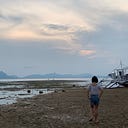
His father lives a simple life by the beach. It was full of rocks and pebbles (not sand) and looked like a mini-cove surrounded by mangroves. At low tide, you could walk 50 meters into the open sea in ankle-deep water.
It was also my partner’s first time visiting his father’s house— built during the pandemic. It was still unfinished, with a missing wall and exposed concrete blocks. On the way here, my partner told me to manage my expectations. But I am not alien to these things. I’ve been exposed to the simple and unglamorous all my life.
It reminded me so much of my Lolo’s house in rural Palawan, at a time when my parents would leave us for a month in the care of my grandparents.
There is something slow and uncomplicated in the provincial life. It reminded me of childhood, of a time when your days were filled with wonder and the earth was your playground. Visiting Dimiao felt like that.
On the bus, he inquired about my thoughts now that we were in Bohol. I said I can’t believe we’re here and that you’re actually taking me to meet your Papa. It was a huge step, even making a statement without saying it. We’re literally going out of our way to introduce me. I said I felt kilig.
My partner’s Papa and his partner welcomed us into their home. They were warm and generous, almost shy as they adjusted to my lack of Cebuano, forcing them to speak Tagalog, the imposing language of imperial Manila. I really should learn Cebuano soon, and fast. I’m getting there. Nakasabot na me, pero super gamay ra.
Get Ligaya Runes’s stories in your inbox
Join Medium for free to get updates from this writer.
Tall and bald, his Papa has a kind face with thin lips that stretches upward, giving him the look of a man with a permanent smile. My partner and his father share the same face shape, cheeks, nose, and eyes.
I always tell him that the older he grows, the more he looks like his Papa. It’s not bad since I also look terribly like my Mama. If he wants to see what I look like in my 60s, just refer to my mom.
That night, after his Papa made the best Adobong Bisaya that I’ve ever tasted (it was dry, almost fried in texture, but not oily and still glazed, I think he used patis/fish sauce instead of toyo/soy sauce), we changed into our sleeping clothes, and I suggested we walk by the shore to watch the stars.
It was dark, almost pitch black but for the tiny lights from near and distant neighbors and the bright light coming from the house, intruding on the stillness of the night. I guess it was there for security reasons.
The sea was calm. The sky was hazy and a little overcast. There were barely any stars. A bit disappointed, I turned around, intent to go back inside, when I saw one of the most magical sights I’ve ever seen in my life. No cap.
There, in the backyard, meters away from the beach, were two trees converging into one (or at least two trunks shooting out of the ground joining into one). I looked up, and it was filled with fireflies. Thousands upon thousands of Tinker Bells.
I gasped as my partner turned to see the cause of my surprise. Yeah, aghast was an understatement. Expletives were said, followed by ‘wows’ and ‘OMGs’ and ‘thank you Jesus.’
The fireflies were like stars floating in mid-air, like a Christmas tree lit with faint fairy lights. They were moving with such grace, as if they were dancing to slow and silent music only they could hear, to the ambient sound of cicadas and crickets and the gentle rocking of waves.
You feel small and in awe, grateful to witness a display of beauty from such elusive creatures. It also felt like a fragile secret, like you’d want to protect the tree and hide the Tinker Bells or leave them alone so they wouldn’t die.
The last time we saw fireflies, we were in a payag/hut by a beach in Siquijor. It was exactly a year ago. During a creative writing workshop at Silliman University that changed our lives. It was in that two-week workshop that my partner and I met and eventually fell in love.
That weekend in Siquijor was pivotal. It cemented the friendship formed among the eleven fellows we now call family. Most of our recent travels were spent with them. Those two fireflies by the beach felt like the magic of land and water had blessed us and our newfound fellowship as we shared the stories of our lives and the reasons we write.
A year later, here we were, doing family introductions and witnessing an abundance of fireflies in his Papa’s backyard. I do not know what premonition or symbolism this experience entailed. But I’m sure it was a good thing. The rarity, its timeliness and timelessness, also felt like a blessing.
I texted my writing mentor about the fireflies. She’s one of the best poets this country has ever produced and is also a native of Maribojoc, Bohol.
“We saw a tree by the beach that’s full of fireflies / what a way to meet Bohol / it’s soooo beautiful here,” I said.
“The fireflies welcomed you. Very auspicious sign,” She replied.
It was indeed. Another core memory in a year full of core memories.
The next morning, we said our goodbyes and took a jeep to Tagbilaran City. From there, we rode an airport bus to the gentrified, touristy Panglao Island 40 minutes away.
My partner fondly told me the story (for the nth time, by the way) of the summer he spent in Panglao doing survey for a marine research. He interviewed Chinese and Koreans who were afraid to go dark, and White people bathing in the sun until they were lobster red.
It was a fun summer job. And the beach is one of the best places to people-watch. My partner observed how retired Germans spent the mornings scuba diving, and the rest of the day lounging at bars with beer in one hand and an arm candy in another. Their unzipped wet suits exposing their pot bellies.
He also accounted which people group respected and cared for marine life, and which ones would step and stand on corals. My partner is a brilliant storyteller, and I could tell how much he enjoyed that summer.
We planned to chill and have lunch in Alona Beach before we took the late afternoon OceanJet back to Cebu. My man was a little worried about the short time we had. He would’ve preferred we stayed longer, maybe a night or two just to relax and recover.
We’d been on the road..err on water for days, and it’s started to take a toll on him. I knew he needed rest since he’d been taking care of me, knowing that this area of Visayas was his turf.
I really appreciate him. You can’t help but feel secure with a man who knows how to lead. We’ll be fine, I said. We’ll go back next time and stay longer. That was a promise.