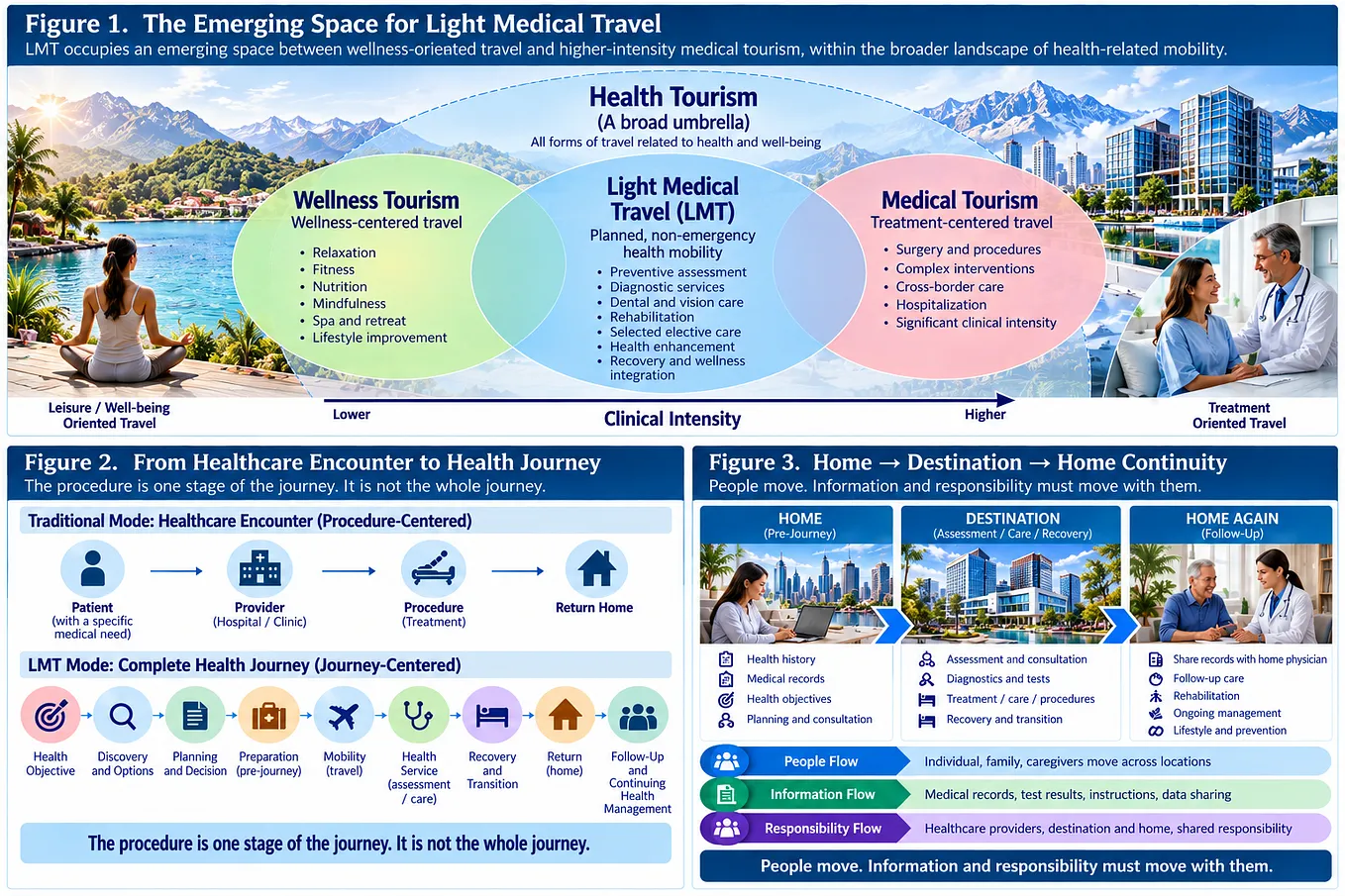
Defining Light Medical Travel

What It Is, What It Is Not, and Where Its Boundaries Should Be
Light Medical Travel Institute (LMTI)
Founding Paper №2 — Medium Edition | October 2026
People are increasingly traveling for health.
Some travel for surgery.
Some for wellness.
Others travel for preventive examinations, diagnostics, dental care, vision services, rehabilitation, recovery, healthy-aging assessments, or other planned health services.
But where do these journeys belong?
They are often more medically meaningful than a wellness vacation, yet less intensive than conventional medical tourism.
This is the space that Light Medical Travel (LMT) seeks to define.
In our first Founding Paper, Why the World Needs Light Medical Travel, we argued that changing relationships among health, mobility, technology and everyday life are creating a new form of planned health mobility.
The next question is more difficult:
What exactly is Light Medical Travel?
And equally important:
What is not Light Medical Travel?
A new category becomes useful only when its boundaries are clear enough to be understood, tested and applied.
A Working Definition of Light Medical Travel
The Light Medical Travel Institute proposes the following definition:
Light Medical Travel (LMT) is a journey-centered category of planned, non-emergency health mobility in which individuals travel beyond their ordinary healthcare environment to access preventive, diagnostic, restorative, rehabilitative, selected elective, maintenance or health-enhancement services, with the journey designed to remain appropriately compatible with mobility, recovery, safety and continuity of care.
Several words in this definition matter.
LMT is planned.
It is generally non-emergency.
It has a meaningful health objective.
It involves mobility beyond the individual’s ordinary healthcare environment.
And most importantly, it is journey-centered.
That last point changes how we think about health travel.
“Light” Does Not Mean Low Quality
The word Light can easily be misunderstood.
It does not mean:
low quality, trivial, cheap, non-medical, or risk-free.
Instead, “Light” refers primarily to the structure and intensity of the Health Journey.
A journey may involve genuine medical services while still remaining sufficiently planned and manageable to be compatible with mobility, recovery and continuity.
Quality should never be “light.”
Safety should never be “light.”
Professional responsibility should never be “light.”
The principle is:
HEALTH FIRST. MOBILITY SECOND.
Travel should serve health.
Health should not be compromised simply to make travel possible.
Seven Characteristics of Light Medical Travel
A Light Medical Travel journey can generally be understood through seven characteristics.
It is:
1. Planned — organized in advance rather than driven primarily by emergency.
2. Non-Emergency — not centered on unstable acute illness or immediate life-threatening conditions.
3. Health-Centered — organized around one or more meaningful health objectives.
4. Geographically Mobile — involving movement beyond the individual’s ordinary healthcare environment.
5. Journey-Compatible — the individual’s condition, health service and recovery requirements remain appropriately compatible with mobility.
6. Continuity-Aware — preparation, care, recovery and follow-up are considered across the journey.
7. Journey-Centered — the complete Health Journey, rather than the procedure alone, is the principal unit of analysis.
Together, these characteristics begin to distinguish LMT from neighboring forms of health-related travel.

Figure 1. The Anatomy of Light Medical Travel. Seven defining characteristics of the LMT category.
Source: Light Medical Travel Institute (LMTI), October 2026.
The LMT Boundary Model
Not every health-related trip should be called Light Medical Travel.
To make the category more useful, LMTI proposes three broad zones:
Core LMT
Potential Core LMT journeys may involve:
preventive health examinations,
screening and diagnostics,
dental care,
vision and eye health,
dermatology,
selected aesthetic medicine,
rehabilitation,
physical therapy,
pain management,
medically supervised recovery,
healthy-aging assessment,
preventive medicine,
personalized health management,
and selected traditional or integrative medicine.
But inclusion on this list does not automatically make a journey LMT.
The journey itself still matters.
LMT-Adjacent
Some activities sit near the boundary:
wellness retreats,
sleep programs,
nutrition,
fitness,
mindfulness,
stress reduction,
health education,
relationship and communication programs,
spa experiences,
and non-clinical longevity programs.
These may primarily belong to Wellness Tourism.
But they can become part of a broader LMT journey when integrated with a substantive health objective.
Outside the LMT Core
Other forms of healthcare generally fall outside the core:
emergency medicine,
trauma,
intensive care,
unstable acute illness,
emergency medical evacuation,
highly complex surgery requiring substantial hospitalization,
unpredictable prolonged inpatient care,
and situations in which travel is clinically contraindicated.
This does not make these services less important.
In many cases, they are far more medically serious.
They simply belong to a different form of health mobility.

Figure 2. The LMT Boundary Model. Core LMT, LMT-Adjacent and activities generally outside the LMT core.
Source: Light Medical Travel Institute (LMTI), October 2026.
The Journey Matters More Than the Procedure
This is one of the most important principles of the LMT framework:
Classification belongs to the journey — not the procedure alone.
Consider dental treatment.
One person may travel a short distance for a planned procedure under local anesthesia, recover predictably and have clear follow-up.
Another person may travel internationally for multiple procedures involving significant anesthesia, greater clinical complexity, extended recovery and uncertain follow-up.
The procedure may carry the same general name.
The journeys are very different.
The same is true for diagnostics, eye care, rehabilitation, dermatology, pain management and many other services.
Therefore, LMT classification should consider:
the patient’s condition,
clinical complexity,
intervention intensity,
anesthesia,
recovery requirements,
complication risk,
travel distance,
destination capability,
and follow-up.
The question is not simply:
“What procedure is being performed?”
The better question is:
“What Health Journey is required to achieve the health objective safely and effectively?”
Four Types of LMT Journey
To make the category more operational, LMTI proposes four broad journey structures.
LMT-1 — Preventive & Assessment
Journeys centered on prevention, screening, diagnostics, health assessment or health planning.
LMT-2 — Light Intervention
Journeys involving selected planned interventions where clinical and recovery requirements remain appropriately compatible with mobility.
LMT-3 — Recovery & Rehabilitation
Journeys centered on rehabilitation, physical therapy, functional restoration, pain rehabilitation or structured recovery.
LMT-4 — Integrated Health Journey
Journeys combining multiple components around a coherent health objective — for example:
Assessment + Diagnostics + Selected Care + Recovery + Health Education + Follow-Up
These four levels should not be understood as a quality ranking.
LMT-4 is not automatically “better” than LMT-1.
A more complex journey is not necessarily a better journey.
Different health objectives require different journey structures.

Figure 3. The LMT Journey Intensity Framework. Four journey structures from preventive assessment to integrated health journeys.
Source: Light Medical Travel Institute (LMTI), October 2026.
LMT Does Not Require an International Border
Light Medical Travel is not limited to international travel.
Get light medical travel’s stories in your inbox
Join Medium for free to get updates from this writer.
A journey may occur:
between countries,
between states or provinces,
between regions,
between cities,
or between an individual’s ordinary healthcare environment and a specialized health destination.
A New Yorker traveling to another country for a preventive health assessment may represent one form of LMT.
Someone traveling from one U.S. state to another for specialized rehabilitation may represent another.
A person traveling between cities within the same country for a structured health program may represent another.
The defining issue is not the passport.
It is meaningful health mobility.
A Health Journey Is Longer Than the Trip
Another important distinction is temporal.
A five-day trip does not necessarily mean a five-day Health Journey.
The journey may begin weeks earlier with:
health-objective recognition,
provider discovery,
medical-record preparation,
clinical consultation,
and travel planning.
It may continue after the traveler returns home through:
follow-up,
rehabilitation,
record transfer,
outcome monitoring,
and continuing health management.
Therefore:
The geographic trip and the Health Journey are not necessarily the same length.
This is one reason continuity matters so much.
Home → Destination → Home
Health travel is often imagined as:
Home → Destination
But a responsible LMT framework requires:
Home → Destination → Home
The individual eventually returns.
Health information must return.
Clinical recommendations must return.
Follow-up responsibility must be clear.
Three things therefore move through a Health Journey:
People
Information
Responsibility
People move physically.
Relevant health information must move appropriately.
And professional responsibility must remain sufficiently clear throughout the journey.
This makes continuity part of the structure of LMT — not merely an optional convenience.
Is This Light Medical Travel?
The boundary will not always be obvious.
For that reason, LMTI proposes a preliminary ten-question classification test.
Ask:
- Is there a meaningful health objective?
- Is the journey planned rather than emergency-driven?
- Is the individual clinically appropriate for travel?
- Does the person move beyond the ordinary healthcare environment?
- Does the journey involve a meaningful health service or integrated health objective?
- Is the clinical and recovery intensity compatible with mobility?
- Is appropriate recovery possible?
- Is follow-up reasonably available?
- Can relevant health information move appropriately?
- Are responsibilities sufficiently clear?
The result does not have to be a simplistic yes or no.
A journey may be classified as:
Potential Core LMT
LMT-Adjacent / Further Assessment Needed
or
Outside the LMT Core

Figure 4. Is This Light Medical Travel? A preliminary ten-question LMT classification framework.
Source: Light Medical Travel Institute (LMTI), October 2026.
Importantly:
This is a category-classification framework, not a medical clearance tool.
Clinical decisions belong to appropriately qualified healthcare professionals.
Why These Boundaries Matter
The purpose of defining LMT is not merely to create another travel label.
Boundaries matter because they make research possible.
Without them, we cannot reliably ask:
Which journeys belong in an LMT dataset?
Which destinations should be compared?
Which services should be measured?
What constitutes a successful Health Journey?
How should continuity be evaluated?
Where can AI reduce unnecessary friction?
What should a health destination actually be capable of providing?
Clearer boundaries also matter for individuals.
Not every low-cost medical service represents good value.
Not every popular destination is appropriate for every patient.
Not every procedure is compatible with travel.
And a successful procedure does not necessarily mean a successful Health Journey.
From Definition to Measurement
A new category becomes more useful when it moves from language toward observation.
The emerging LMT research architecture can therefore be understood as:
Light Medical Travel
↓
Health Journey
↓
Health Journey Performance
↓
Health Journey Enablement
↓
Measurement
↓
Destination Profiles
↓
Health Destination Intelligence
This is where the next phase of LMT research begins.
The challenge is no longer simply to say:
“Light Medical Travel exists.”
The challenge is to determine:
Can we define it clearly enough to observe it, classify it, measure it and test it?
A Living Category
Light Medical Travel is an emerging concept.
Its definitions should therefore be explicit — but not intellectually closed.
The framework will need to evolve through:
research,
field testing,
clinical input,
destination studies,
data collection,
and professional criticism.
Some boundaries may change.
Some proposed measures may fail.
Some classifications may need refinement.
That is not a weakness.
It is how a research field develops.
The objective should not be to protect the concept from criticism.
The objective should be to make it sufficiently clear that it can be tested.
What Light Medical Travel Is — and Is Not
Light Medical Travel is not a synonym for all Medical Tourism.
It is not another name for Wellness Tourism.
It is not simply inexpensive healthcare abroad.
It does not mean that a procedure is low-risk.
And it is not a recommendation that everyone should travel for healthcare.
Instead:
Light Medical Travel is a framework for understanding planned, non-emergency health mobility through the complete Health Journey.
Its central principles are simple:
Health before travel.
Journey before procedure classification.
Continuity before convenience.
Evidence before claims.
And above all:
HEALTH FIRST. MOBILITY SECOND.
Light Medical Travel Institute
The Light Medical Travel Institute (LMTI) is developing research, definitions, measurement frameworks and public knowledge for the emerging field of Light Medical Travel.
This article is part of the LMTI Founding Papers, an ongoing series examining the concepts, boundaries, measurement systems and future implications of planned health mobility.
Founding Paper №2 — Medium Edition
Defining Light Medical Travel
October 2026