On-Demand Transit Market Report — 2025 Recap


After storming from one record to the next year after year, the On-Demand Transit market began showing signs of cooling at the end of 2024. So how did 2025 perform, and what is the market’s trajectory going forward? Let’s find out.
On-Demand Transit World Map (all projects)

On-Demand Transit World Map (currently active projects only)
The Party is Over — Market Growth
Until now, the On-Demand Transit market consistently outperformed the previous year in terms of new project launches. 2025 was different. For the first time, fewer new projects came to market than in the previous two years.
With 375 new project launches globally, 2025 was not a bad year per se. However, with approximately 15% fewer new projects than in 2024, it clearly marks a turning point.

When examining the quarterly figures, we don’t see a sharp decline. However, each quarter of 2025 recorded fewer launches than the same quarters in the previous two years (as well as Q2–Q4 2022), resulting in a notably lower total for the year. Considering that Q4 2024 and Q1 2025 were outliers due to one-off effects in Japan and Canada, respectively, the turning point may have arguably occurred earlier than 2025.
Geographically, the busiest market region once again was North America, with close to 160 new project launches of which Canada accounted for an unusually high share of over 25%. Overall, 2025 was on par with 2024 in North America, although the aforementioned effect from Canada with a flurry of project launches in January 2025 in Nova Scotia should be kept in mind.
Asia ranked second, with more than 110 new project launches. Japan was once again the largest contributor, with over 75 new project launches. Compared to 2024, this represents a notably lower total. However, Japan’s Q4 2024 — when more than 50 new projects were launched in a single quarter — should not be considered the norm. South Korea also recorded a decline in new service launches but remained strong, with 30 new projects in 2025.
Meanwhile, Europe continued the downward trend observed over the previous three years, closing 2025 with approximately 100 new project launches.

While new project launches are an important gauge of the market’s trajectory, net market growth is arguably an even more telling indicator. Here, the aforementioned turning point becomes clearly visible.
With net market growth of roughly 215 services, 2025 fell back below levels last seen in 2022. All major market regions recorded a lower net growth compared to 2024 — except for Canada (driven solely by Nova Scotia) and Germany. Germany recovered somewhat from its sharp decline in 2024 but remains well below its peak years. As a result of 2025’s net additions, the total number of active projects globally now stands at around 1,700.

Reflecting on my 2024 Market Report, Germany appears to have been indeed ahead of the curve in terms of its market slump. This is ultimately not surprising, as most markets have followed a similar pattern: a heavy reliance on third-party funding for pilot projects, many of which are not renewed due to insufficient funding and/or underperformance. By my estimate, it will take approximately two more years for the market to be largely cleared of pilot programs. Only then will we gain a clearer sense of the true size of the steady-state market. Expect it to be smaller.

From a market segmentation perspective, 2025 unsurprisingly followed the pattern of previous years, with public transit (i.e., B2G) accounting for close to 90% of all new projects. Within that segment, rural demand-responsive transport services and local neighborhood on-demand bus services account for nearly 90% of projects, underscoring that on-demand transit is predominantly deployed in low-demand areas and/or during off-peak periods.
While I have discussed the implications of the market’s heavy dependence on the public sector in previous reports, it is worth noting that the B2B segment — primarily consisting of university campus and employee transport services and representing around 15% of active projects — experienced a proportionally larger decline in new service launches (-21% Y-o-Y). While the reasons for this development remain unclear, the overall economic climate — with companies tightening their belts — may have played a role.
Same old, same old — Solution Provider Market Update
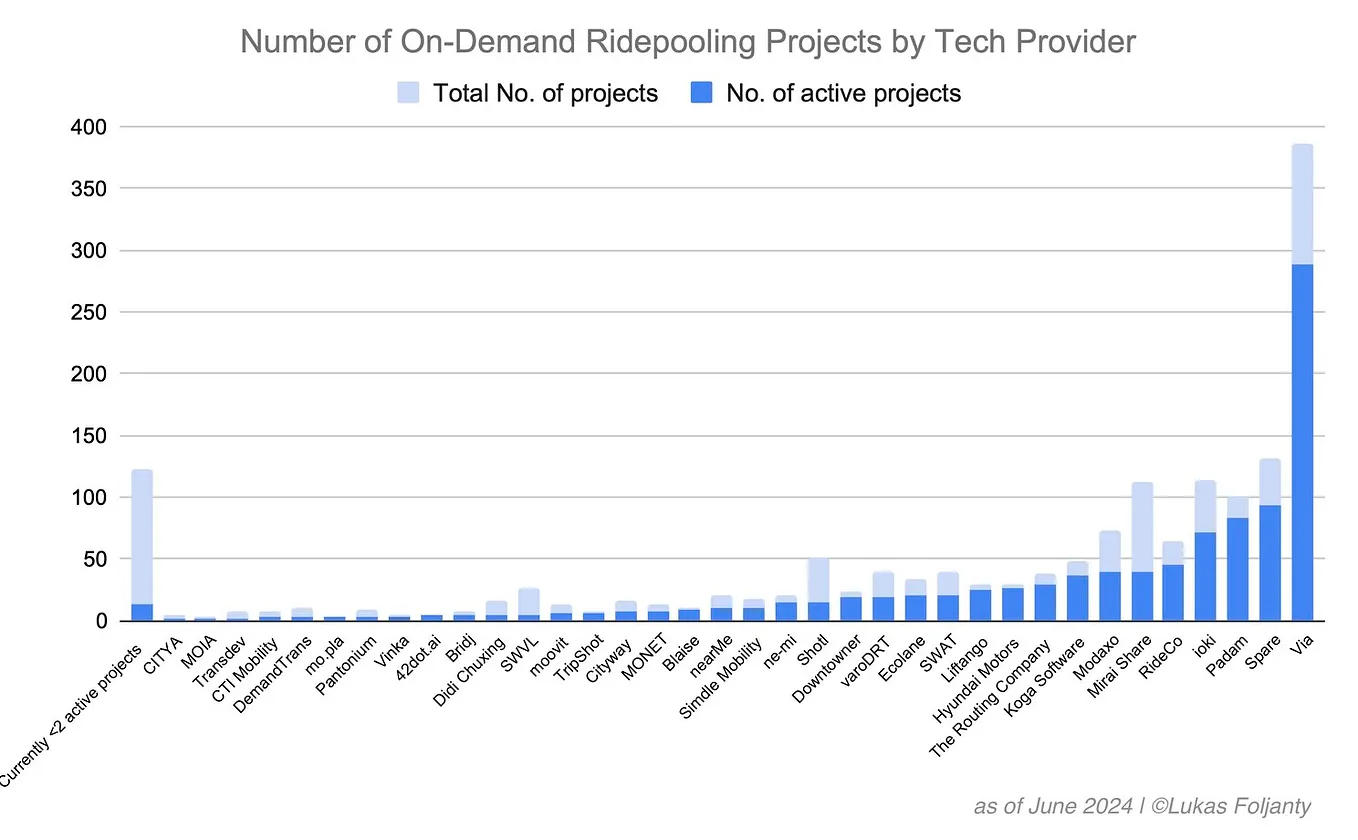
The on-demand transit solution provider market has been remarkably consistent over the years — and 2025 was no exception. With more than 500 projects launched to date, Via remains in a class of its own, followed by Spare, which currently occupies the Tier 2 category alone, alongside roughly 10–15 Tier 3 providers and approximately 30 companies with only a handful of deals each. This remains one of the sector’s enduring puzzles to me: despite structural challenges such as small deal sizes, high-maintenance clients, and resource-intensive sales cycles, more than 50 companies continue to compete in the market, with comparatively few exits over time, all things considered. This results in a highly commoditized product and, consequently, intense competition in public procurement processes, where a combination of low pricing and a high willingness to accommodate — sadly, often overly burdensome — requirements becomes the key to winning contracts. As a result, larger players are not necessarily at an advantage, as they must carefully consider product scalability and their own profitability.

Blaise recorded the largest jump in 2025, driven by its multi-tenant platform agreement in Nova Scotia, Canada, which led to over 30 service launches in the first quarter alone. However, I do not expect this growth trajectory to continue.
Among Asian providers, Mirai Share was once again the most active, followed by South Korea’s varoDRT, with both launching more than 20 new services. In Japan, Next Mobility Ltd.’s Spare-powered “Know Route” brand also contributed to market growth, as did near.me, each recording more than 10 new service launches in 2025.
In another notable development from Asia, a purpose-built vehicle (PBV) for on-demand transit services has been introduced in South Korea. The CV1 electric DRT shuttle, based on Hyundai’s ST1 platform, made its debut with four vehicles deployed in Seosan City’s varoDRT-powered on-demand neighborhood bus service in October. The CV1 not as fancy as MOIA’s PBVs, but use-case appropriate vehicles can boost user acceptance and operational efficiency.
As the largest player in this space, Via holds the biggest global market share at approximately 24%. This figure varies significantly by region, ranging from market dominance in some areas to barely noticeable presence in others. These dynamics have remained largely unchanged for some time, suggesting that solution providers are primarily consolidating their positions in home markets rather than pursuing international growth — except, perhaps, through opportunistic pilots, such as Hyundai’s first project outside South Korea in Gödöllő, Hungary (incidentally also the first ever new generation on-demand transit project in Hungary). And speaking of Central Europe, Czech startup CITYA is making notable progress in developing markets in countries that providers from Western Europe and North America have largely overlooked to date.

With regard to the average number of new service launches per quarter, Via — once again — outperformed the rest of the market by a significant margin. Spare is now firmly established as the market’s №2, with the past two years bringing it much closer to Via in terms of quarterly launches than in previous periods, averaging more than 10 per quarter over the past 5 years.
In terms of consistency, Mirai Share and Padam are worth highlighting, as — despite being in the Tier 3 bucket in this benchmark — they appear to be doing a very good job of keeping their pipelines full, presumably due to their strong position in their respective home markets. Meanwhile, ioki is feeling the cooling of its home market, Germany, and may begin to slip in this benchmark — unless its recent acquisition by HOLON (more on this below) enables it to unlock new growth markets.

While Via is the undisputed market leader in terms of the number of projects, the picture looks different when examining the largest fleets managed by each platform. In microtransit, Via has also been among the category leaders, with services such as “Berlkönig” in Berlin (now defunct), “Bubble” in Tel Aviv (also discontinued), and “Sprinti” in Germany. However, with the recent push into the paratransit segment, new leaders have emerged. RideCo, for example, has secured a 1,100-vehicle contract in New York City (more on this below), while the Spare-powered “The RIDE” program in Massachusetts operates a fleet of more than 700 vehicles. Via is not absent from the paratransit segment, operating services such as London’s Dial-a-Ride. However, so far its dominance in microtransit has not (yet) translated into an equally strong position in the paratransit market — a gap that could prove critical to its path to profitability, particularly following its public listing in September 2025.
DISCLAIMER: I am not a finance professional, and the following observations
regarding Via’s performance on the NYSE are based solely on my knowledge
of the on-demand transit market and represent my personal opinion.
They should not be interpreted as investment advice.
Via went public on the NYSE in September 2025, so it naturally earns a special spot in this report (as it always does, being the market leader). Priced at $46 per share, the IPO was based on the company’s valuation from its last funding round in 2023. Via raised $493 million through the offering, further extending its position as best-funded provider in the on-demand transit space.
In my last report, I speculated that Via might use some of the fresh capital from the IPO for M&A, which it did by acquiring competitor Downtowner. That move is a bit of a head-scratcher for me. With the acquisition, Via increased its client count in its core market (both geographically and in terms of business model), added revenue to its books and eliminated a competitor from the market. [Note: Since the acquisition of Downtowner was announced in December 2025, I have kept Via and Downtowner separate in my 2025 data and will consolidate them from 2026 onward.] However, even if one assumes that Downtowner was in a similar position to Citymapper when Via picked them up — i.e. close to bankruptcy — and therefore available at a low price, I struggle to see the strategic value. Unlike Citymapper, which added an attractive asset to Via’s “TransitTech” portfolio, Downtowner was a direct competitor, with an identical business model centered on turnkey demand-responsive transportation solutions for municipalities and public transit agencies. While Downtowner may appear easy to integrate into Via’s existing operations on paper, the experience of players like SWVL suggests otherwise. Post-merger integration should not be underestimated. Via must not only integrate Downtowner’s team into its culture and processes, but also maintain a separate tech stack, adding complexity and cost. In theory, Via could quickly replace Downtowner’s technology within existing contracts and implement its standard customer relationship processes across Downtowner’s services. In practice, however, public service contracts often include highly specific requirements that make switching technology far from straightforward — or even impossible. So even if Downtowner was available at a bargain price, why not wait until the company exited the market and then step in — a strategy that Via successfully applied in Germany, when CleverShuttle collapsed in 2023? Acquiring contracts through M&A — even at an attractive price — does not necessarily contribute to sustainable growth. Nor does it help Via break into new market segments or establish itself as a serious player in autonomous driving — moves that investors might value more highly.

Speaking of which, after six months of steady price declines, the IPO price appears to have been overly ambitious. While the majority of analysts remained confident following Via’s first ever quarterly earnings call in November — expecting the stock to outperform — sentiment seems to have shifted since. Price targets have been lowered, and the upcoming earnings call for Q4 2025 is now viewed by some analysts as a crucial moment for the company.
Get Lukas Foljanty’s stories in your inbox
Join Medium for free to get updates from this writer.
And some analysts are even more critical of Via’s business model and outlook. Bleecker Street Capital (BSC), which has taken a short position in the stock, argues that Via is essentially a glorified bus operator instead of the software company that it claims to be.
“VIA is a labor-intensive transit contractor masquerading as a software platform.”
– Bleecker Street Research, 2026
After reviewing more than 100 of Via’s public-sector contracts, the analysts conclude that the company’s revenue stems primarily from low-margin, labor-intensive transportation services, with only a small portion derived from software licenses. This analysis aligns with my own estimate, which suggests that SaaS fees typically account for 15–20% of total project budget, as well as with the observation that Via has been positioning itself aggressively as a turnkey operator of on-demand transit services in recent years.
Public market investors appear to value VIA as a software platform with recurring revenue, operating leverage, and long-term margin expansion potential. […] That assumption is difficult to reconcile with a business model where revenue durability depends on discretionary local budgets, temporary grant funding, and renegotiable service-hour commitments.
– Bleecker Street Research, 2026

From an investment perspective, whether a company is classified as a scalable software licensing business or a labor-intensive transportation service provider significantly influences its financial attractiveness — and, by extension, investor appetite for a stock like Via’s (which BSC values at $11.80). However, there is another risk inherent in a business model that relies so heavily on operating transportation services outside the core public transit offerings of most agencies: public funding. As I have outlined in the past two editions of this report, the On-Demand Transit market’s dependence of third-party funding is its Achilles’s Heel — a vulnerability that, as illustrated above, is already reflected in the market’s negative net growth.
“With excess funding sunsetting, a less supportive federal backdrop, and fiscal deficits increasingly common, many local governments are entering the budget justification phases of programs launched in prior years. Industry experts view microtransit as on the chopping block.”
– Bleecker Street Research, 2026
This, in turn, suggests that Via’s path forward must lie in expanding beyond demand-responsive transportation services — a strategy it is seeking to demonstrate through projects such as Sioux Falls where it was contracted to operate the city’s entire bus system across a mix of fixed-route, microtransit, and paratransit services, and where it also conducted the underlying network analysis. The open question, however, is whether public transit agencies are willing to trust a company like Via, with its own economic incentives and biases, to take over an entire public transit system. If that remains uncertain, the follow-up question is whether Via’s serviceable addressable market (SAM) is truly $82 billion, as declared in its SEC filing, or closer to my estimate (see chart above; reflects microtransit segment only) which is based on the reference-class forecasting methodology. However, regardless of the market’s size, addressing it ultimately rests on a core premise: the main pitch is that — whether for a microtransit deployment or an entire network such as in Sioux Falls — by utilizing software such as Via’s (or that of any competitor, since virtually all market participants advance this narrative), public transit agencies will realize efficiency gains that justify the investment in new technology. But is that actually the case?
You’ll (Never) Ride Alone — Project Characteristics
As discussed above, 90% of all on-demand transit projects cover some form of public transit use case, with 90% of that segment serving low-demand areas and/or off-peak hours. In line with these use cases, most services are operated with very small fleets of mini- to midibuses, and in some cases passenger cars. Of all new projects launched in 2025, 98% deployed fleets of fewer than 20 vehicles, and 88% fewer than five. Under current market conditions, larger fleets are found almost exclusively in paratransit services.

As I have emphasized in previous reports, productivity is not necessarily the primary objective of this type of public transit service, which is largely intended to provide baseline transportation for vulnerable populations. Nevertheless, when considering market risks from tightening municipal budgets or expiring grants, a question unavoidably asked is how a demand-responsive service performs and whether an alternative mode of operation might be better suited, at least from an economic perspective. And for many pilot programs, this can be the deciding factor in whether they are allowed to continue.
Examining the average number of passengers per vehicle revenue hour, the results paint a mixed picture at best.

For this analysis, I calculate the average number of passengers per vehicle revenue hour (PAX/VRH) using the most recent publicly available data from on-demand public transit services worldwide.
Average number of passengers per week ÷ service hours per week ×
(number of vehicles × 0.75) = passengers per vehicle revenue hour (PAX/VRH)
Based on 142 examined services across 22 countries, the market-average PAX/VRH is 2.19. Of these, around 11% perform exceptionally well, achieving over 4 PAX/VRH, although no new services have joined this tier since my last report. As noted previously, there is no clear pattern with respect to geography, use case, or the utilized technology, which suggests that effective service design — and, most likely, fare structures — is the key to strong performance.
Another 13% delivered solid productivity, with 3–4 PAX/VRH. The good news largely ends there, though. While 25% can be considered borderline acceptable with 2–3 PAX/VRH, over 50% of the examined on-demand transit services have fewer than 2 passengers per vehicle revenue hour. This also implies that another core value proposition of on-demand transit —namely pooling — is statistically rare.
I cannot stress enough that operating low-productivity on-demand transit services can be perfectly reasonable, as outcomes depend heavily on local context and policy objectives. And conversely, that high performing services don’t necessarily perform well economically.
“Demand-responsive services provide a solution for rural areas, but they are extremely expensive. In the case of the Sprinti, we are looking at an annual deficit of approximately 20 million euros. […] The guiding principle is that larger vehicles are more cost-efficient. Conversely, the fewer passengers per vehicle, the higher the level of subsidization. […] This results in costs per passenger ranging from 15 to 20 euros, which a region must carefully consider before deciding whether to provide subsidies.”
– Elke van Zadel, CEO Üstra Hanover, 2026 (source, translated from German)
Sprinti, Germany’s largest and one of the world’s largest on-demand transit services in terms of fleet size — and firmly in the 3–4 PAX/VRH range — will likewise need to withstand scrutiny and demonstrate a compelling value proposition to maintain political support amid fiscal constraints.
Consequently, some solution providers are focusing on replacing legacy software for call-a-bus–type services, which — despite tiny fleets and low performance figures — have a firmly established role in the public transit network as a baseline transportation service. However, this approach often comes with a departure from fully flexible service designs, where vehicles roam freely within a geofenced area and are available for instantaneous booking. Instead, more rigid designs — with semi-fixed routes or mandatory pre-booking — are making a comeback. Welcome back, demand-responsive transport of old! I like your new app.
Innovation, where art thou? — Emerging Trends
Once cutting-edge technology, on-demand transit technology has stalled in terms of innovation. A lot of what’s hailed as new, innovative features has in reality been around for years, such as real-time traffic data for vehicle routing, intermodal transfers between on-demand and fixed-route service, or caregiver apps for student transport. Naturally, AI had to be part of the narrative in 2025. However, new features such as AI-powered voicebots for call centers or AI-automated eligibility management still feel somewhat peripheral, with limited impact on the core functionality of the platforms, all the while machine-learning-based demand prediction has been part of routing algorithms of advanced systems for years.
In the United States, the push into the paratransit segment requires on-demand technology providers to adapt their platforms to meet the specific requirements of this type of service. RideCo, for example, will need to invest significantly to comply with the MTA’s requirements under its recently awarded major contract to provide dispatching technology for New York City’s paratransit system, which operates up to 1,100 vehicles. A system of this scale requires highly specialized software, making it de facto a fundamentally different solution from typical on-demand microtransit technology — and likely from smaller-scale paratransit systems as well. RideCo will be heavily engaged in implementing the platform, which will most likely limit its ability to pursue innovation on the microtransit side at the same time. The open question to me, however, is how much of this effort represents genuine innovation — and how much replicates functionalities that legacy paratransit software providers have offered for years. It also raises the question of how well such purpose-built software can scale beyond its original deployment. The $72 million contract volume may prove less attractive if it requires RideCo to maintain a dedicated team for what might effectively be an isolated product branch. Then again, a $72 million SaaS deal in the microtransit segment is unheard of. If the required product adaptations prove scalable, this contract could become a launching pad for RideCo and solidify its position as a leader in next-generation paratransit technology.
This leaves autonomous driving as the sector’s primary long-term bet, although it is arguably not the on-demand transit technology providers that are in the driver’s seat of this trend as they are primarily adopting technologies developed by others. In this context, Volkswagen’s MOIA has partnered with Oslo’s PTA, Ruter, on the ongoing EU co-funded ULTIMA R&D project to deploy a number of its ID.Buzz AD vehicles. Arguably, the partnership reinforces MOIA’s B2G positioning more than it advances Ruter’s capabilities, as Ruter already has experience with the Mobileye SDS stack that MOIA also relies on. As one of Europe’s most forward-looking PTAs, Ruter seems aware of this and has already begun consulting the AV solutions market regarding a potential large-scale deployment. That said, Ruter will likely benefit from replacing the NIO SUVs with the more use-case-appropriate ID.Buzz minivans, as well as upgrading from the dated Moovit DRT technology to MOIA’s best-in-class digital platform. The pilot program will deploy six MOIA-powered vehicles starting in June 2026.
Meanwhile, MOIA quietly reduced the number of service hours for its driver-based B2C ridepooling service in Hamburg, Germany, by 25% and has also stopped publishing KPIs for the operation — a development that, as I previously anticipated, may signal that the service is nearing its end.
While autonomous public transit pilots like the one in Oslo are valuable for a range of reasons, they remain far removed in terms of scale from developments in the robotaxi space. As a result, the risk that autonomous driving could compete with and potentially cannibalize public transit may materialize sooner than some anticipate. Meanwhile, German national railway company Deutsche Bahn published a study which shows that deploying one million autonomous on-demand buses through German public transit agencies could reduce national car traffic by 11% while cutting waiting times for public transport riders by 50%. While this study was intended to make a case for large, publicly funded R&D pilot regions with 100+ vehicles in Germany (an approach also advocated by private players such as MOIA), the current policy reality differs markedly. The German Federal Ministry of Research, Technology and Space has instead introduced a grant scheme capped at €5 million per project, aligning more closely with smaller-scale initiatives already underway such as the Ruter/MOIA pilot in Norway.
Somewhat counterintuitively in light of that study, Deutsche Bahn sold its on-demand technology venture, ioki to German Tier 1 supplier Benteler’s corporate startup HOLON. With this transaction, Deutsche Bahn effectively abandons its strategy of positioning itself as a turnkey provider of on-demand services — including autonomous offerings — while HOLON, conversely, moves closer to that role by adding ioki’s technology and experience to its portfolio. Given that HOLON’s primary objective is to bring its autonomous people mover into series production — and that it seems to be hedging its bet on the U.S. market — it will be interesting to observe how this development will impact ioki’s previous SaaS business model and its geographic focus on Western Europe. Considering that on-demand transit technology has become increasingly commoditized, HOLON could instead have formed consortia with a technology provider for each deployment. The acquisition of ioki and the subsequent positioning of HOLON as a full-service turnkey provider may signal that the company is shaping its investor narrative — whether in preparation for an IPO or to attract third-party investors. It is difficult to imagine Benteler having the resources and patience to self-fund HOLON until its autonomous minibuses are ready to be commercialized.
And as for Deutsche Bahn, after off-loading CleverShuttle and ioki, it is returning to what it has traditionally been: an public transit operating company that may — or may not — run on-demand bus services, depending on the regional concessions it holds. Given that on-demand transit technology has increasingly become commoditized, this repositioning appears reasonable. At the same time, however, the German on-demand transit market is losing one of its strongest champions as a result, with a car supplier unlikely to fill those shoes.
Conclusions
With 180 service launches by midyear, 2025 initially appeared poised to defy my earlier expectation of a market downturn and instead continue the trajectory of previous years. It did not. Rather, 2025 became a turning point, with fewer new projects launched than in 2024 and negative net growth overall.
While many pilot projects are still ongoing, the broader trend is clear: deliver compelling proof points that real-time, optimized demand-responsive services outperform less flexible designs in terms of efficiency and user experience — or risk being discontinued.
This highlights one of the central dilemmas of the on-demand transit market. A truly superior user experience — beyond a well-designed booking app — requires broad geographic coverage, short waiting times (i.e., sufficient vehicle supply), and extended service hours. Yet these features often conflict with the long-standing efficiency narrative of the sector. Balancing both objectives out might ultimately serve neither.
Pilot programs are designed to test, iterate, and learn. The on-demand transit sector has benefited massively from the public transit industry’s ambition to attract more riders — and from the funding allocated to support that goal. However, the economic climate has shifted, and “green” policy agendas are facing rollbacks in several countries, most prominently in the United States, where the current administration is scaling back climate targets and showing little support for policies aimed at shifting riders from private cars to public transit.
For the pilot-heavy on-demand transit market, tightening third-party funding and constrained municipal budgets imply far more rigorous scrutiny of existing programs. As a result, a growing number of services are being downsized or discontinued — either entirely or through a reversion to fixed-route operations, which can be observed in places like the UK. I expect net market growth to continue declining over the next two years, before the sector begins to reveal the contours of a steady-state market. That market will likely be materially smaller than it is today.
Which means that the overcrowded solution provider market is going to face challenging times. The drop height is naturally much higher for the large players, which, in my view, would be well advised to expand beyond the demand-responsive transportation market. As I have previously discussed, autonomous driving may prove to be a double-edged sword for the industry. On the one hand, it appears to be the only compelling long-term vision beyond the replacement of legacy DRT software. On the other hand, current momentum is clearly in the robotaxi segment, which poses a tangible risk of cannibalizing bus services in high-demand areas while leaving the structurally unprofitable segments to publicly funded operators.
The broader task for the public transit sector, therefore, seems to be to build sufficient political support for regulatory guardrails that ensure autonomous mobility services are implemented in a way that creates value for society as a whole — not primarily for the AV operators. Even if that objective is achieved, today’s on-demand transit solution providers will still need to articulate a clear and defensible role within that ecosystem. Perhaps Via will offer a glimpse into how that might look in their upcoming earnings call?
About this Report
Hi, my name is Lukas and I have been writing this series of reports on the state and outlook of the On-Demand Transit market since 2020. I would like to provide some background and context so that you know how to read this article:
- Between 2017 and 2024, I was working at a range of On-Demand Ridepooling solution providers (check out my LinkedIn profile if you are interested in which ones). I started this series of articles in response to the lack of data on this new market. It has always been a private project and was never part of my work at any of the On-Demand tech providers.
- The market is not so new anymore, but it prides me that my dataset, which is the basis for my reports, is still the most comprehensive source. This is to no small parts thanks to the On-Demand Transit community which has been extremely supportive by providing data and feedback.
- Nevertheless, all findings shared in the article should always be understood as informed indications, not hard facts. I invest many (many) hours before writing each edition of this report for updating my extensive dataset and try to be as diligent as I can. But there will be gaps and errors. If you notice either, please drop me a note!
- I try my very best to keep this report vendor-neutral. That will not stop me from expressing opinions about the state of the market or market participants (sometimes possibly provocative). However, should you ever have the impression that I am not being fair in how I present my findings, I appreciate if you send me a message and let me know.
- Possible deviations of facts and figures to previous articles of mine are most likely caused by retroactive additions to the dataset, which have been made possible in part by feedback and support from the On-Demand Ridepooling community. I appreciate the overwhelmingly positive and open response to my articles!
- The Google world map gets updated in the background, so it might show services which are not yet reflected in the analysis of this article.
- I use following terms synonymously: On-Demand Ridepooling, On-Demand Transit, On-Demand Transport, Microtransit, DDRT.
- The views expressed in this article are my own. They do not purport to reflect the opinions or views of my current employer.