What Could Be the Harm in Going Back To the 2000s?

One hobby I have that both my closet and wallet suffer from is shopping. My favorite feeling is getting to finally wear an outfit that showcases a brand-new clothing item. The sense of accomplishment that comes with finding the perfect fall sweater, knowing it will be both comfortable and flattering, is incredibly rewarding. My interest in shopping has been passed down from my mom to both my sister and me. As we’ve grown up, we have developed similar styles — a result of me being the younger sister wanting every piece of clothing my sister had when I started shopping. For my sister and me, shopping can get quite competitive, almost a game where the person who finds the best pieces wins, and the loser comes home with subpar clothes, or even nothing. Our most competitive matches are in the thrift store. We swiftly sift through racks of hung-up clothes, trying to find something unique, maybe even a throwback. Often, it’s like finding a needle in a haystack, but the hay is hundreds of extra-large t-shirts that say phrases such as “Susan’s 50 and Fabulous Birthday!” I’m still waiting for the day that I find someone left behind a pile of vintage clothes from the 2000s: low-rise jeans, baby tees, sparkly tank tops, and denim skirts, which people record themselves finding on TikTok daily.
Social media has brought fashion trends from the 2000s, also known as Y2K style, back to life about twenty years later. As seen in the comeback of claw clips and scrunchies from the 80s, trends are always coming, going, and circulating back again. But I am left wondering why the Y2K style was chosen by the masses as the next fashion fixation? Why is there a common style that people are being drawn to when social media can expose us to hundreds of different styles daily?

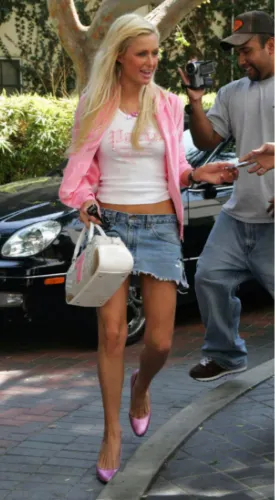
To understand why, we must acknowledge what was occurring during the 2000s. The start of this decade was the millennium, promising new beginnings and a successful future for people all over the world. Americans held optimism about the future, which was incorporated into women’s fashion. This time also sparked a new digital age where hybrid cars, iPods, GPS, and camera phones were launched. Mirroring this digital age, clothing became more playful and futuristic, as it incorporated highly saturated colors, textured materials, and high-tech applications. In 1999, Givenchy’s fall line strayed far from its previous classy and chic styles. Alexander McQueen designed clothing for Givenchy, consisting of PVC fabric, metal textures, and high-saturated LED lights in what was described as “android couture”. Beyond high-end fashion couture having an influence on trends in the 2000s, celebrities in the media impacted fashion trends as well. Paris Hilton, Brittney Spears, and Jennifer Lopez are examples of personalities who were idolized for their daring and eye-catching style. They broke fashion barriers that were set previously in the century by appearing on stage, and being photographed in low-waisted jeans and crop tops showing their midriff, big glamorous bags and bangles hung on their arms, and hot pink jumpsuits.


Besides the fun that comes with fashion, as it is a creative outlet for many, the resurgence of Y2K fashion indicates Americans' craving for nostalgia. If technology and fashion have advanced since then, why would Americans be looking for ties to take them back to the past? Although the 2000s came with their own uncertainties and turbulence, people today may view it as a simpler time and seek a connection to it. What’s interesting is that Gen Z is the generation that is most strongly continuing and spreading Y2K style once again. While members of Gen Z were either not alive or too young to have a strong sense of the world around them, they can still find comfort in the nostalgia of the 2000s. For Gen Z, nostalgia is a potential escape from the fast-paced technological world that we live in now. Today, Gen Z faces intense uncertainty about the future because of various factors like war, political unrest, economic instability, and climate change. As social media consumers, we are constantly bombarded with stressful news and information that is circulated on the internet. That’s where lightness comes in, in this case through the form of fashion. People just want to find something positive that can remind them of a less stressful time, like the 2000s.
Get Madalynjones’s stories in your inbox
Join Medium for free to get updates from this writer.
While the resurgence of Y2K style can be a positive source for people to destress and escape reality, negative messages are being spread to society because of the clothes that are coming back in style. I have seen body positivity posts and movements heavily advertised on social media, but the resurgence of Y2K style, which includes clothes that are more restrictive and less likely to flatter all body types, makes me think that the movement may be dying out.
The 2000s consisted of exceedingly unrealistic beauty standards. Women felt the pressure to be extremely skinny to be perceived as, and feel beautiful. Unhealthy eating habits, like anorexia and eating disorders, were glorified. Many celebrities in the media played a role in heightening unrealistic beauty standards, promoting audacious phrases such as “Nothing tastes as good as skinny feels,” which was said by fashion model Kate Moss. In the 2000s, a size six was considered plus size, and people thought nothing of fat-phobic and body dysmorphic jokes. The term “heroine chic” can be applied to many of the models and celebrities idolized for their thin bodies and dark eye bag appearances. Individuals like Kate Moss and Lindsey Lohan were often photographed while likely being high on drugs. Although they looked disheveled and tired, the largest factor women took away was their weight, or lack thereof.

Knowing the problematic history of beauty standards during the 2000s, it worries me that history may repeat itself, just like fashion trends have. Our society has evolved and learned to become very inclusive, as we see most stores carrying plus sizes, and there are many different body types depicted on the runway. But there are hints that the inclusivity we see now is regressing.
The resurgence of the Y2K style also has detrimental environmental consequences. As new fashion trends continue to form, it becomes harder for retailers to keep up. The fast fashion industry seems to be the only one that can stay on pace, as it pumps out unsustainable clothing at a rapid rate. Stores like Zara, Shein, and H&M sell clothes at remarkably low prices so people continue buying them. The environment is not a priority of the fashion industry as 10% of total carbon emissions are produced by it yearly, and 85% of leftover textiles are sent to the dumb every year. The fast fashion industry consumes vast amounts of water and energy, and uses microplastics that are not easily biodegradable. The ongoing cycle of overproduction harms the environment and continues to encourage detrimental fashion practices. If trends like Y2K fashion continue to develop, the fast fashion industry will only grow larger and have a worse effect on the world with time.
An alternative to depending on fast fashion may be shopping (like my sister and I) at thrift or consignment stores, to find pieces from the 2000s. It is apparent that there has been an increase in second-hand clothing sales, and that second-hand apparel sales increased 14% from 2023 to 2024, and will continue to increase 9% annually for the next four years. Buying second-hand clothing is beneficial for consumers, so they can save money, and it is a better form of shopping for the environment.
It is noticeable that what started as a distraction from frustrating and worrisome events in today’s world is also causing more issues to surface. Y2K fashion today is a statement, infiltrating society with nostalgic memories of a simpler time, and simultaneously, the horrors of the exclusivity of women’s fashion. Hopefully, people will continue to turn to sustainable fashion alternatives and focus more on what it is they are supporting when they buy clothes, rather than only worrying about the price.