The two things that have impressed me most from Xabi Alonso’s pressers


First things first: An ode to Carlos Ancelotti. I was not always his fan and was skeptical of his hiring. But two Champions League titles, two La Liga titles, one Copa del Rey and a bunch of other domestic and European super cup titles fully justify the club’s decision to bring him back. And he did unleash Vinicius Junior on European football. The last decade has been the most productive in the club’s recent history and he was a huge part of that. But both the club and Ancelotti made the correct decision to mutually part ways.
Xabi Alonso is in for him in what was one of the most poorly kept secret. I would have liked the club to do some scouting and consider other options before arriving at Ancelotti’s replacement but that is not how the club does its business (no one should forget how Ancelotti himself got the job in 2021). And let’s face it, they would most likely have arrived at the same decision. Alonso just makes a lot of sense.
Ok, with that out of the way, let me discuss two things that have impressed me most about Alonso thus far. Neither of these two things necessarily involves what I have noticed on the pitch at the ongoing Club World Cup — maybe that will come later. Instead, they are from Alonso’s press conferences since he first took training. Given that he tends to do what he preaches on tactical matters, I have taken notice.
1. Space management
One of my many pet peeves about Real Madrid under Ancelotti was how terrible the team was in managing space, both with and (especially) without the ball.
Two seasons ago, deploying the 4–4–2 and diamond systems meant we usually had eight players to defend the ball, with Rodrygo also being very hardworking. That helped us defend better without having to press high, but opponents still found it relatively easy to move the ball into our half. Switching to 4–3–3 (a system I advocated) last season made everything worse because Mbappe and Vinicius could neither press high or know where to position themselves out of possession, sometimes almost hugging each other, and Ancelotti could never figure out how to solve this. While going from a 4–4–2 to a 4–3–3 meant one less body in the middle, the easy solution would be to institute a high press — think the current PSG side. Ancelotti of course has never been pro- high press, and he failed to coach a compact structure to minimize spaces between the players.
Enter Alonso.
In at least two separate pressers, Alonso has discussed extensively about the need to manage the space between the players as a means of maintaining control, even deploying a drone during training sessions to monitor this.
The advantages of doing this without the ball are obvious. But it is also important to manage space between players and their positioning relative to teammates when we have the ball. That is how you avoid the “give the ball to Vini and let him dribble 5 players to create a chance” strategy of the last few seasons, an approach that had its success but was unsustainable in the long-term. Giving the ball to your best players to make instinctive plays in attack is not wrong in itself, but managing distance between the players means none of them is isolated when in possession of the ball and allows the team to form triangles all over the pitch.
Get Gboyega’s stories in your inbox
Join Medium for free to get updates from this writer.
2. Player profiling
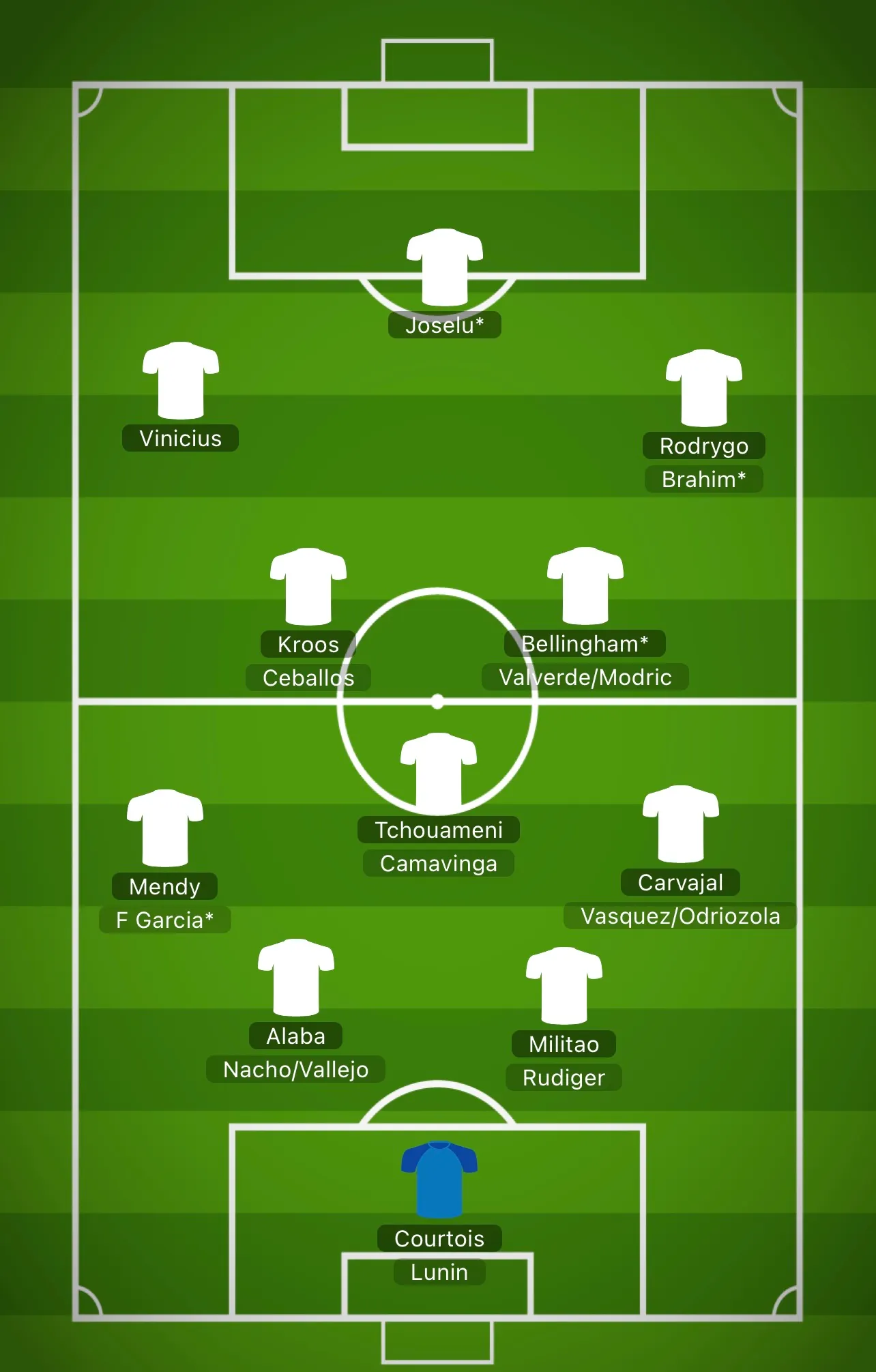
In the 2013/14 season, Ancelotti famously moved Angel di Maria centrally, with two advantages. One, it allowed us play Gareth Bale, who just joined as a galactico signing, on the right side of our attack. Two, it gave us a two-way presence in midfield: a player who could do a lot of running in midfield but could also create chances. The result was devastating in the Champions League. But during his second stint, I was sometimes frustrated with Ancelotti’s vision on each player’s role vis-à-vis their profile. When you have all-time greats like Kroos and Modric in your midfield, this problem is easy to overcome. But Kroos’ retirement last summer left a big hole that Ancelotti never addressed, either by asking the club to sign a direct replacement for Kroos or by deploying one of the two players (Ceballos and Bellingham) with profiles to perform that role, even if not as effective as Kroos did. Instead, Ancelotti declared very early in preseason that Valverde was going to take over the Kroos’ pace-setting role.
How much of that was because Kroos declared Valverde the successor to his №8 shirt (by the way, a very silly thing for Kroos to do and something that the club must ensure is never repeated!), no one knows. But playing Valverde in that role was never going to work. And it did not work.
Again, enter Alonso:
Through the first three games at the CWC, Ancelotti has been searching for a way to set tempo using the options he has. He has deployed Gulër deeper than Ancelotti in a bid to try get someone who could knit the midfield together in possession with short passes, but Gulër’s physical limitation makes me doubt how permanent that would be.
Bellingham is another option — he played as a central midfielder at Dortmund and, given time on the training ground, Alonso could further develop that side of his game. Getting him to do less inefficient running is already a win.
We have also been linked heavily with Angelo Stiller, although I am not very convinced by him — the eye test doesn’t back the data. I do not know how Alonso intends to solve this long-term, but it is clear he recognizes that profile as a necessity. That is good enough for now.
Those are the two things I have been tracking. The game against Juventus and (hopefully) the subsequent ones in the competition should offer further insight on how the team is shaping up. But the early signs are encouraging.