Civil Society: The Layer Between People and the State

In the modern world, we often imagine society as consisting of two broad categories of actors: on one side, the government and the market (corporations), and on the other, the individual. But this picture overlooks an important sphere that exists between them: civil society.
What is a Civil Society?
Civil society is the sphere of voluntary collective activity that exists between the individual/family and large institutions such as the government and the market to pursue common interests, values, or causes, such as:
- Religious organizations and mosques
- Charities and NGOs
- Labor unions and professional associations
- Educational and cultural organizations
- Community groups and social movements
- Independent media and advocacy organizations

Civil society allows individuals to act collectively, serve their communities, influence public policy, and hold governments and corporations accountable. It can also protect people from social isolation and prevent too much power from becoming concentrated in the state or market.
Ideology of Civil Society
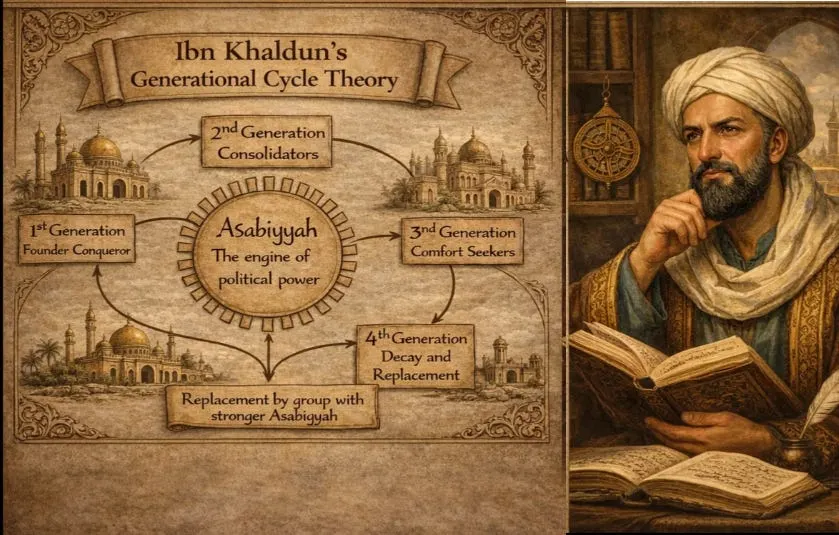
The modern understanding of civil society was greatly shaped by Alexis de Tocqueville. The concept itself existed long before Tocqueville and can be found in the works of Aristotle, Cicero, al-Farabi, Ibn Rushd, Ibn Khaldun, Shah Waliullah, Hegel, and many others. It was further developed by later thinkers such as Marx and Gramsci.
In the modern Muslim world, ideas and practices related to civil society can be found in the work of Muhammad Abduh, Jamal al-Din al-Afghani, Sir Syed Ahmad Khan, Maulana Maududi, Allama Iqbal, and Dr. Israr Ahmad, particularly in their emphasis on education, social reform, public engagement, and organized collective action.
Alexis de Tocqueville saw civil society as essential to the health of democracy. In Democracy in America, he emphasized the importance of voluntary associations (i.e. religious groups, civic organizations, local bodies, and other forms of collective organization) as places where citizens learn cooperation, trust, deliberation, and self-government. He feared that democratic individualism could leave people socially isolated and increasingly dependent on a powerful centralized state. Civil society, in his view, helps prevent this by giving citizens independent institutions through which they can organize, pursue common goals, and protect political liberty.
Antonio Gramsci offered a very different interpretation. He viewed civil society not simply as a sphere of freedom, but as an important arena in which power and social consent are produced. Institutions such as schools, churches, media, cultural organizations, and associations help shape the ideas and values through which a ruling order gains legitimacy. For Gramsci, political control therefore depends not only on coercion by the state but also on hegemony within civil society. This makes civil society both a site where dominant ideas are reproduced and a space where alternative movements can organize and challenge them.
Why Does it Matter?
Civil society is important because it creates a layer of organized social life between the individual and the state. Through charities, religious institutions, professional associations, unions, neighborhood groups, educational organizations, and other voluntary bodies, people learn to cooperate, build trust, solve shared problems, and pursue common goals. These institutions generate what sociologists often call social capital: networks of relationships, habits of reciprocity, and a sense of mutual responsibility (Check previous MINE post on this topic).
A society with strong civil institutions is therefore not simply a collection of isolated individuals but it has a dense web of relationships through which people can support one another and act collectively.
Get Muslim Intellectual Network for Empowerment (MINE)’s stories in your inbox
Join Medium for free to get updates from this writer.
A society may have a strong government without having a strong society. The state may successfully build roads, universities, hospitals, and bureaucracies while citizens remain poorly organized outside government structures. Civil society is important because it helps prevent too much power from becoming concentrated in either the state or the market, particularly in large corporations. Independent institutions can represent public interests, criticize authority, preserve cultural and religious traditions, provide services, and create alternative sources of leadership and knowledge. They can also serve as training grounds for civic participation by teaching people how to organize, deliberate, compromise, and take responsibility beyond their private lives. However, strengthening civil society is not antithetical to a strong state. A healthy society needs both a capable government that provides essential services and independent institutions through which citizens can cooperate, solve common problems, and hold power accountable. If every major social function depends on the government or large corporations, society itself can become weak. Civil society gives communities the capacity to act from below rather than waiting for solutions to come entirely from above.
As Daron Acemoglu and James A. Robinson argue in The Narrow Corridor, successful societies exhibit a kind of Red Queen effect, in which both the state and society grow in strength while continually keeping each other in check. Civil societies play a key role in strengthening a nation while preventing the state from becoming despotic by maintaining a dynamic balance between state and society. This differs sharply from many premodern political orders, where authority was conceived largely as flowing downward from monarch or ruler to subject.

Civil Societies and Muslim World
Historically, Muslim societies relied on a wide range of institutions outside the direct machinery of the state to organize social life and provide essential services. These institutions played a very important role during the colonial era, providing services to local populations, preserving religious and social institutions, and, in many cases, helping organize resistance to colonial rule.
Waqf endowments funded mosques, madrasas, hospitals, charitable activities, and other public needs, while ulema networks, guilds, merchant associations, extended families, and neighborhood communities helped regulate social relations, transmit knowledge, provide welfare, and organize collective responsibilities. The important point is that many functions now associated with centralized government were often carried out through decentralized religious, social, and economic institutions. This created a social sphere in which communities possessed considerable capacity to organize and sustain themselves without depending entirely on the state.
A number of modern Muslim thinkers promoted ideas similar to those associated with civil society, even if they did not always use that exact term. Rifa’a Rafi’ al-Tahtawi, Jamal al-Din al-Afghani and Muhammad Abduh emphasized public education, reform, journalism, and social organization as means of strengthening Muslim societies outside the direct machinery of the state. Allama Iqbal focused on rebuilding the moral and intellectual vitality of the Muslim community, while Abul A’la Maududi stressed organized social movements and institutions capable of shaping public life per Islamic principles. Malik Bennabi is especially relevant in this context because he argued that civilization depends not merely on individuals or governments, but on the quality of social relations, institutions, and collective organization. Together, these thinkers point toward a recurring concern: Muslim renewal requires not only better rulers or stronger states, but also stronger, more capable social institutions.
Alongside these are contemporary thinkers such as Timur Kuran, who question whether the rigidity of certain traditional institutions impeded adaptation to changing economic and social conditions. His critique raises many legitimate concerns, although it may overstate the extent to which Islamic law itself contributed to Muslim economic decline, as opposed to the ways in which legal and institutional arrangements developed and were applied in particular Muslim societies.
Future of Civil Societies
The future of civil society will depend on its ability to remain independent, adaptive, and relevant in an age increasingly shaped by powerful states, large corporations, digital platforms, and fragmented communities. Traditional institutions such as religious organizations, charities, professional associations, local groups, and independent media will continue to matter, but new forms of civic organization will also emerge through digital networks and transnational communities. The central challenge will be to preserve spaces where citizens can organize, deliberate, build trust, and pursue common goals without being captured by governments, corporations, wealthy interests, or ideological factions. A healthy future will therefore require not only a capable state, but also a strong and plural civil society able to innovate, hold power accountable, and create durable institutions from below.
Future of Civil Societies in Muslim World
For centuries, rulers and political thinkers in many parts of the Muslim world invoked sayings such as “the Sultan is the shade of Allah on earth” to reinforce unconditional obedience to political authority and limiting the role of civil society. Although the authenticity and interpretation of this hadith have been debated, such ideas were used to strengthen the legitimacy of centralized rule and discourage opposition to rulers.
The political sphere plays an important role in shaping the direction of a country, while civil society helps keep the state responsive and accountable. The future of Muslim civil society will therefore depend partly on how effectively Muslim institutions can navigate the political domain while maintaining their independence. It will also depend on whether Muslim communities can build strong, professionally run institutions that operate between the individual and the state. Mosques, educational organizations, charities, research centers, professional associations, media platforms, civic groups, and intellectual networks can all play a larger role in developing leadership, producing knowledge, solving problems, and representing community interests.
Another challenge is to move beyond short-term activism and personality-driven organizations toward durable institutions with clear governance, financial independence, accountability, and long-term capacity. A stronger Muslim civil society would not require a weaker state; rather, it would create a healthier balance in which capable public institutions are complemented by an equally capable society able to organize, deliberate, innovate, and hold power accountable.
The Pessimism of Frankfurt School
The Frankfurt School offered a more critical understanding of civil society. Theodor Adorno and Max Horkheimer argued that institutions outside the state are not necessarily independent or liberating, because mass media, consumer culture, and the culture industry can shape public opinion and manufacture social conformity. Jürgen Habermas, a second-generation Frankfurt School thinker, was more hopeful about civil society. He emphasized the public sphere as a space where citizens could discuss common concerns, form public opinion, organize collectively, and influence political decisions. Coffeehouses, along with salons, clubs, and the press, were important examples because they created spaces outside direct state control where people could exchange ideas and participate in public life.
A Hope for Change
When the establishment is too powerful, elites dominate public institutions, media organizations are captured by vested interests, and new ideas struggle to find a public platform, civil society can play a crucial role in creating space for reform. It can also help defend positive change when governments or elites become too dominant. At the same time, civil society is not automatically virtuous; wealthy interests, political groups, and powerful institutions can also influence or capture it.
Edward Said argued that political society can reach into civil society and “saturate” institutions such as universities, media, and cultural organizations with concerns tied to political power. Giving the example of imperial interests, Said writes:
[Political societies] impart to their civil societies a sense of urgency, a direct political infusion as it were” when imperial interests are involved.
Even with these limitations, durable social change is often more likely to emerge through organized civil society than through isolated individuals acting alone.