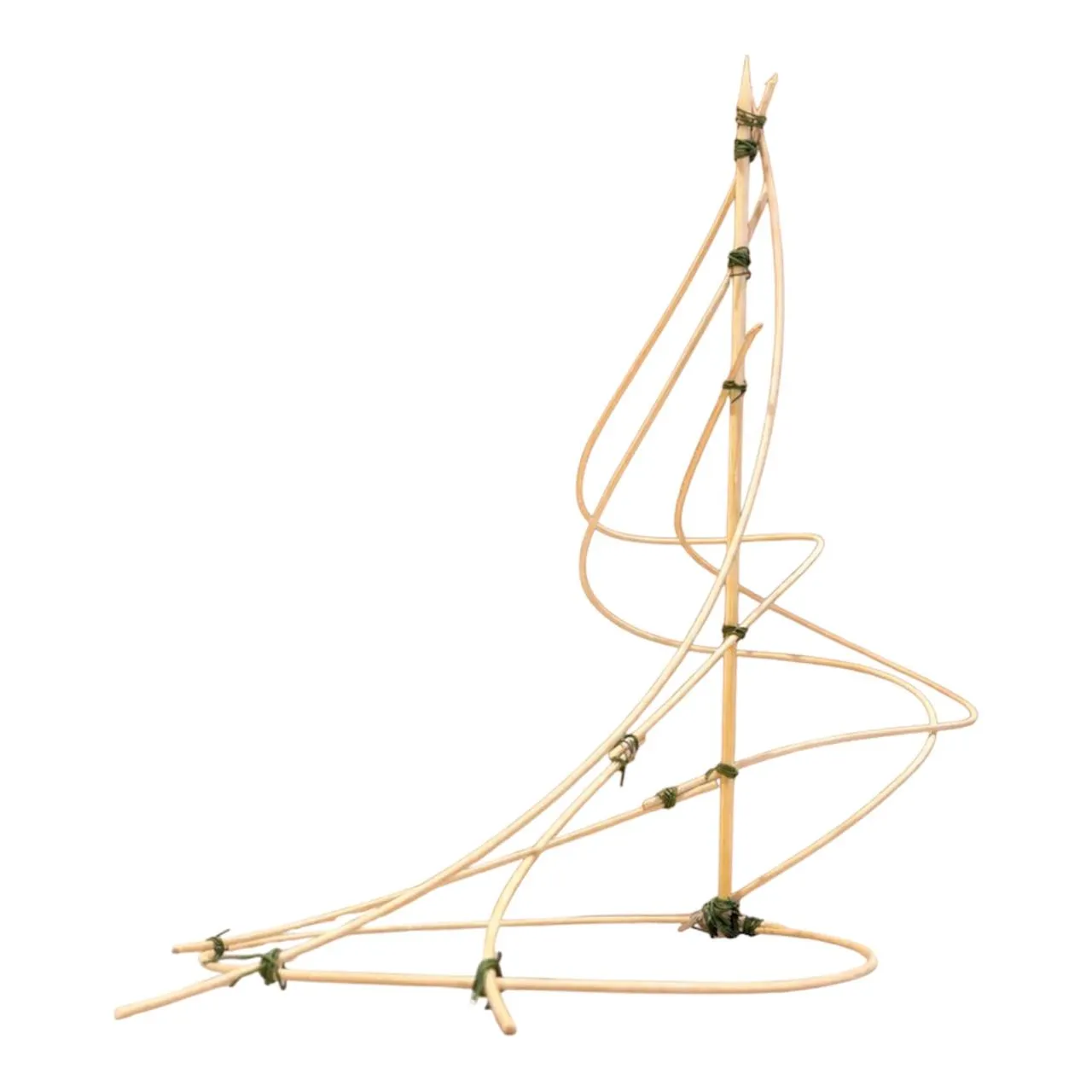
When Materials Start Moving
Four Months of Experimentation, Failure, Learning and Computational Design

It’s been four months.
Four months since I started working on one of my project studio projects, and what a journey it has been! You might remember how I started my computational design journey. This semester, however, I found myself exploring something entirely different.
I was working with a pretty cool teammate …..hannnn …….who came up with an idea that gradually started evolving throughout the semester.
We wanted to explore a material that could change its shape when exposed to moisture, curl or shrink in response to it, and gradually return towards its original shape once the moisture evaporated. Essentially, we wanted to develop a material system that could undergo this transformation repeatedly.
But there was one thing we weren’t entirely sure about. What exactly was this behaviour called? Did something like this already exist? What was the science behind it?
That’s when we came across the term Hygromorphic Materials.
To put it simply, hygromorphic materials respond to changes in environmental humidity or moisture by absorbing or releasing water. This exchange causes the material to swell or shrink, resulting in physical movements such as bending, curling, twisting or opening and closing.
Think about a pine cone. Have you ever noticed how its scales open and close depending on the surrounding moisture conditions? That’s a natural example of hygromorphic behaviour.
And that’s where our curiosity began.
What initially started as an attempt to understand a material’s ability to change shape slowly turned into an exploration of how we could control that movement, make it reversible and eventually translate it into an architectural application. Honestly, hearing all these terms for the first time was a little overwhelming. But slowly, what initially sounded complicated became one of the most interesting things I had ever worked on.
Eventually, it became my project.
It All Started With Experiments.
The entire semester was about exploring materials, understanding their behaviour and figuring out how we could fabricate something that would actually work. We explored different materials, experimented with different combinations and questioned almost everything.
We started with cotton, coconut coir, rice husk, rice paper and several other materials. We even tried extracting absorbent material from diapers!Yes, you read that right. Diapers!
Funny, isn’t it? But that’s what experimentation looked like for us. You never really know which material might give you the response you’re looking for.Every experiment gave us a different observation, a different possibility and sometimes, absolutely nothing.
I remember how frustrating it was when things didn’t work. There were days when I would genuinely get sad because an experiment had failed, especially when we had spent so much time working on it.
But there was something interesting about working with my teammate.
Every time something failed, I would start worrying about whether we were even going in the right direction. He, on the other hand, was always the person who believed that things would eventually work out.He trusted the process. And I think that was one of the first things I learnt from him:
Always trust your process, even when you don’t see the results immediately. Don’t wait for someone else to believe in what you’re doing. Learn to believe in it yourself.
When Failure Becomes Part of the Process.
This wasn’t a project where we could simply refer to an existing methodology, follow a few steps and expect the desired result.
A lot of what we were doing was experimental. We were trying to understand material properties, moisture absorption, shrinkage, curling behaviour and the relationship between different material combinations.Of course, there were concerns. We had several discussions with faculty members, and sometimes we were asked to reconsider certain directions.
But my teammate was someone who remained confident about the idea. He was willing to explore, experiment and give the process more time.There was another lesson I picked up from him:
It’s okay to fail, but don’t lose hope in the process.
There was something else about working with him that I found quite interesting.Sometimes, I genuinely used to wonder, What kind of crazy mind does this person have?
Every single day, he would come up with something new. One day, it was rice paper. The next day, maybe mesh. Then some other material, some new combination or an entirely different way of approaching the same problem.
Just when I thought we had explored enough possibilities, he would come up with another idea.
And the interesting part? He never seemed to run out of them. He never stopped questioning, thinking or experimenting. Even when something didn’t work, his mind was already somewhere else, exploring what we could try next.
Sometimes I would be confused, sometimes overwhelmed, and sometimes I would just wonder where all these ideas were coming from!
But looking back, I think that was one of the most interesting things I learnt from him: never stop thinking, never stop questioning and never let one failed experiment become the end of your curiosity.
Because sometimes, the next idea might be the one that changes everything.
and after all this we finally got something to work on . We eventually started working with laminated jute, cartridge paper and other paper-based substrates.Now, have you ever imagined a jute sheet, the kind of material we generally associate with carrying goods, actually responding to mist and changing its shape?
Neither had I!
ok let me ask other thing also ………………..
Have you ever thought about what veneer does? We generally associate veneer with interior applications, where thin sheets of wood are used as a decorative finish on furniture, panels and other surfaces.But have you ever wondered how a veneer sheet responds when water is sprayed onto it?
Honestly, neither had we! talking about me tohh i really didnt had idea .
We started experimenting with veneer, observing how it reacted to moisture and how its shape changed when exposed to water. What made this particularly interesting was that the response wasn’t just about the material curling. The pattern we introduced onto the sheet started influencing the way it curved.
Different patterns produced different curvature behaviours on the same substrate.
A flat veneer sheet could transform into something quite different depending on the pattern applied to it. Seeing those variations physically, and understanding that we could influence the resulting curvature through pattern geometry, felt like a real achievement.
It was one of those moments when an experiment finally started making sense.
The same curiosity continued with laminated jute and cartridge paper. We began comparing how different substrates responded, how quickly they changed shape, how much curvature they achieved and how they behaved as they dried.
Some materials worked, some didn’t, and some gave us unexpected results.
Get Nandy’s stories in your inbox
Join Medium for free to get updates from this writer.
But every experiment added something to our understanding.
But that’s exactly what made the process exciting.After numerous experiments, we finally started getting the responses we were looking for. Some materials worked, some didn’t, and some gave us unexpected results.
Laminated jute and cartridge paper became particularly interesting for us. We discovered that the substrate itself played a major role in determining how the sheet would respond. Different substrates produced different curling angles, response times and ranges of movement. And then came another interesting discovery: the pattern.
Understanding the Language of Curvature.
Imagine having a flat sheet.You draw a particular pattern on it using the biomaterial we developed. Once it get dry , it starts responding.It curls.But here’s the interesting part: it doesn’t curl randomly.The direction and geometry of the pattern influence the direction and nature of the curvature.A diagonal pattern produces a different curling behaviour from a linear pattern. Radial and converging patterns create entirely different responses.Similarly, changing the substrate or the thickness of the applied material influences the degree of curvature.
This was one of our major findings.
We realised that two things were particularly important:
- Material controls the degree of curvature.
- Pattern controls the direction and nature of curvature.
Essentially, we were developing a relationship between material behaviour, pattern geometry and the resulting form. Experimentally, this was fascinating.But translating these observations into computational logic? Well, that was an entirely different story!
From Physical Experiments to Computational Logic.
This was probably one of the most challenging parts of the semester. We had observations, physical samples, different patterns and a whole lot of data. But how do we convert all of this into a computational system?How do we make a computer understand what we had been observing physically?
How do we make a computer understand what we had been observing physically?
How do we translate the relationship between material, pattern and curvature into a script?
This is where things became complicated.We had to understand how to decode our experimental findings, identify the parameters influencing curvature and eventually translate those relationships into computational logic.
And somewhere in the middle of all this, another journey began.
The person who initially wasn’t very familiar with computational software started working with it extensively.Yes, that was me!I was learning, exploring, making mistakes, figuring out the software and trying to understand how everything connected.
There were moments when even getting a simple thing to work felt like an achievement.I remember starting with almost no confidence in my software skills, but gradually finding myself spending hours understanding the interface, figuring out the logic and trying to make things work.
I gave my 100% to this part of the process, even when I wasn’t entirely sure what I was doing.With a lot of trial and error, discussions and guidance, we gradually started translating our physical experiments into computational definitions.What initially existed only as physical observations was slowly becoming something we could digitally manipulate.
We were no longer just observing curvature. We were beginning to understand how to control that movement.And that was a huge moment for us.
But What Are We Actually Going to Make?
Initially, our goal was quite straightforward: understand the material, decode its behaviour and develop the computational script. But my teammate had something else in mind. He wanted to take the research further and explore an actual architectural application.
And there I was again, thinking, Bro, is this even possible?
But that was another thing I learnt from him.
He never immediately said no to an idea. Instead, he would try to understand how we could make it happen. He made me realise that sometimes the biggest limitation is not the problem itself but how we approach it. Never say no to an idea without first exploring its possibilities. Learn to ask how it can be done rather than immediately deciding that it cannot be done.
And so, we started developing our application.
We explored different patterns, developed prototypes, documented their behaviour digitally and experimented with different configurations.There were countless iterations, failed attempts, confusing results and, of course, a few moments of frustration and crying!
But eventually, we started developing a system that could respond to incident solar radiation through controlled mist application.The idea was to develop a hygromorphic secondary facade skin.The panels would respond to moisture, changing their curvature and consequently altering their shading behaviour. By controlling the mist application, we could influence the material’s response and explore how the facade could adapt to changing environmental conditions.
As the material dried, it would move towards its original configuration, making the response potentially repeatable.What began as a simple material experiment was slowly turning into an architectural application.And seeing that connection happen was probably the most satisfying part of the entire project.
More Than Just a Project.
Looking back, I think this semester taught me much more than material exploration or computational design.
It taught me how to work with uncertainty.
It taught me that not every experiment needs to succeed to be valuable. Sometimes, understanding why something doesn’t work is just as important as discovering what does.
It taught me to approach problems differently, to be patient with the process and, most importantly, to stop doubting every single step.
I also got the opportunity to work with someone who thinks differently from me. Someone who could look at a problem and imagine possibilities that I probably wouldn’t have considered.
And I think that’s the beauty of working with people who have different ways of thinking. You don’t just learn about the project; you learn how to think.
To my teammate, thank you for trusting the idea even when I was busy doubting it. Thank you for constantly reminding me that things are possible if we are willing to figure them out.
And somewhere between all those experiments, failed samples, computational scripts, material tests and endless discussions, I discovered something about myself too.
The person who started this semester without knowing much about the material or the software ended up spending hours understanding both, experimenting with them and giving her best to the process.
Was I always confident? Absolutely not.
Did everything work the first time? Definitely not.
Did I sometimes feel like giving up? Of course.
But I showed up, learnt, experimented and kept trying.
And perhaps that’s what I am taking away from these four months.
Not every project teaches you something new about architecture. Some projects teach you something new about yourself.
This one did both.