A Brief History of Curiosity

For most of human history, curiosity was something you had to hide. Now it is something you have to protect.

by Nathan Chappell
I spent an afternoon recently at the Picasso Museum in Barcelona, and the room where I ended up sitting on a bench for the better part of an hour was not the one with his most famous work. It was the room of paintings he made as a teenager.
Picasso’s father, José Ruiz y Blasco, was a painter and a drawing instructor, and he began teaching Pablo as a small child, so the earliest canvases on the wall are the work of a boy who had been handed the rules of European painting the way other children are handed a catechism. He learned them completely. By his mid-teens he was producing academic pictures, among them a canvas called Science and Charity that he painted at fifteen and that earned an honorable mention at a national exhibition in Madrid, which could have hung without apology beside the work of men three times his age, and you walk from room to room watching him do exactly what he had been taught and do it better than the people who taught him. Then, somewhere in his twenties, the pictures begin to change, so gradually that you can only see it by stepping back several years at a time. Faces start to flatten. Perspective bends, subtly at first, as if Pablo was testing how much weight the old rules would bear. For a stretch of years you can see both worlds on the same canvas, the classical training and the new way of seeing, negotiating over the same square of linen, and the negotiation is visibly unresolved.
There is a story, probably polished in the retelling, that when friends complained his 1906 portrait of Gertrude Stein did not look like her, Picasso answered that it would, and he did not mean that he planned to repaint it. He meant that he had seen something true about her that nobody else could see yet, and that their eyes would have to catch up to the canvas rather than the canvas to their eyes; Stein herself later wrote that of every image ever made of her, it was the only one that was always her. By the time he finished Les Demoiselles d’Avignon the following year, the negotiation was over, not because the old rules had vanished from his work but because they had stopped being the point.
The genius is what everyone notices first in those rooms, and it is worth the hour, but it is not what I came home with, because I will never paint like Picasso and I will almost certainly have to do what he did next. What he did next was a sequence, and the sequence is the part worth understanding. Before Pablo could find his own style had to master the inherited rules before he could see past them, and then he had to live for several years inside an uncomfortable in-between where the work was neither one thing nor the other, and where a reasonable observer might have concluded that a prodigy had simply lost his touch. That in-between is where most of us are living right now, personally and as a sector, carrying tools built for one way of seeing into a world that increasingly rewards another, and I have come to believe that what separates the people who make it through from the people who stall has very little to do with talent, budget, or technical skill. It has to do with whether they protect the oldest instinct they have.
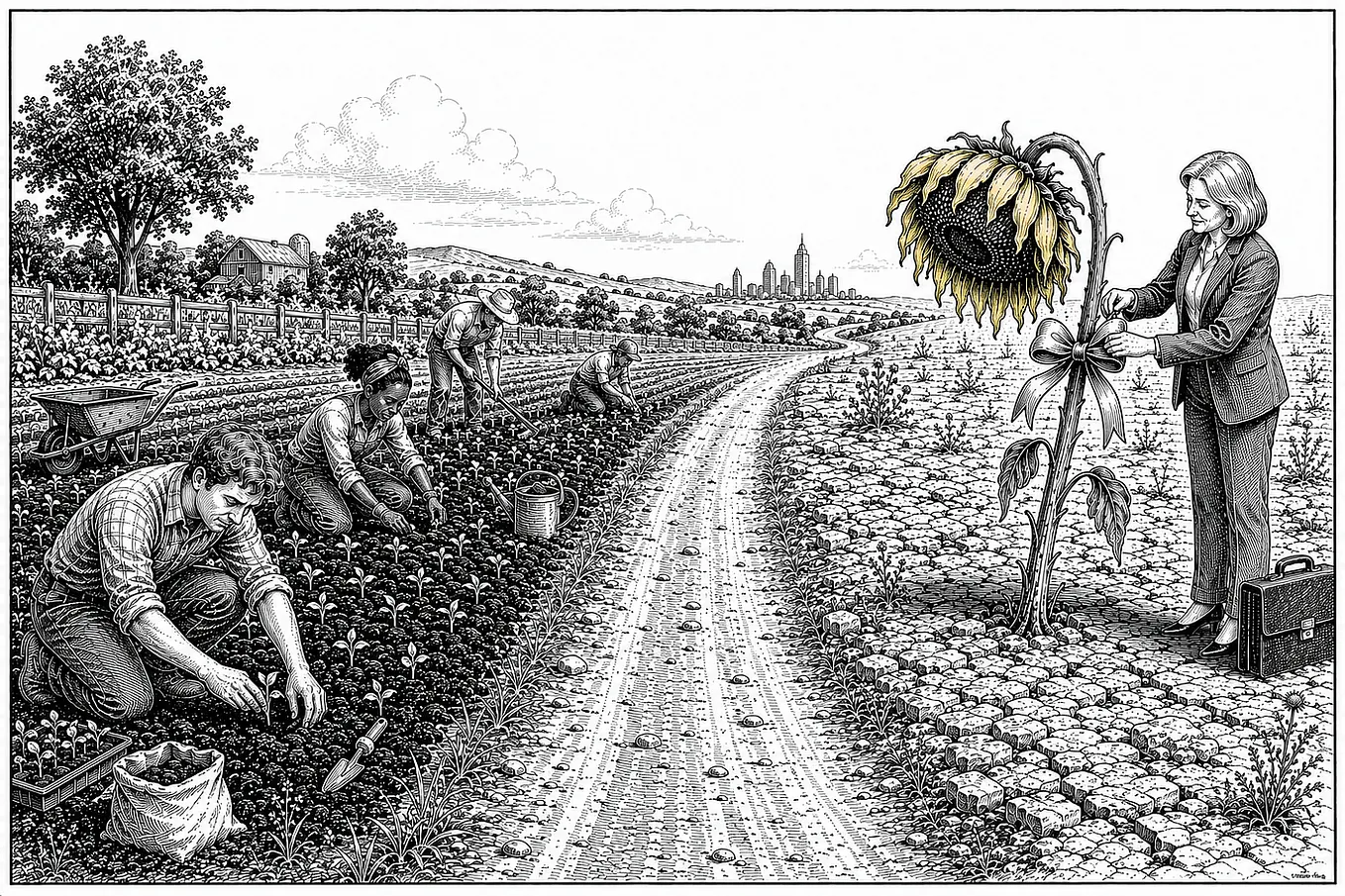
We are told that intelligence is being democratized, and for once the slogan is roughly true. The thing that used to separate the expert from everyone else, which was access to knowledge and the speed with which it could be processed, now sits in your pocket, and in a few billion others, and improves measurably every few months. There will still be winners and losers as the digital divide widens into a chasm, but the line will not run where most people expect it to. It will not separate the technical from the non-technical, or organizations with large technology budgets from organizations without them. It will separate the people who keep asking what else and what if from the people who have settled, often without noticing, for what is.
When answers are abundant, our ability to question becomes the scarce resource.
That sounds like the kind of thing one says at a conference, and I have said it at conferences, but I have come to think it understates the problem, because it implies that questioning is a skill you could pick up if you decided to. The history of curiosity suggests something less comfortable: that the capacity to question is not something we acquire so much as something we are born with and spend a lifetime defending, and that every age has built its own machinery for taking it away.
That history begins before the written word. Long before anyone had written down a word, someone crawled deep into a limestone cave in what is now southern France, far past the reach of daylight, carrying fire, and painted lions and horses and rhinoceros across the walls with a confidence that still unsettles the people who study them. Nobody required this, and it fed no one. It was the act of a mind that wanted to know what the inside of the dark looked like, and then wanted to put something there that had not existed before, and in that single act you can already see the two capacities that would carry our species from the cave to the cathedral and the laboratory: curiosity, which is the urge to go and look, and imagination, which is the urge to make what you saw into something new. Both were fully formed before we had agriculture, cities, or a written word, which means that everything we later built, including every institution that would try to govern them, was built by them.
The governing started almost immediately. It is striking how many of the founding stories of the West are warnings about the desire to know. Eve reaches for the one fruit that promises knowledge, and the consequence is exile. Pandora opens the one container she was told to leave shut, and it is worth noting that it was a jar, not a box; a sixteenth-century translator gave us the box, which is its own small lesson about how stories drift from their sources when nobody is curious enough to check. Prometheus steals fire for humanity and is chained to a rock for it. Icarus is told precisely how high to fly and flies higher anyway. In Athens, in 399 BC, a stonemason’s son who had spent his life asking questions in the marketplace was put to death by a jury of his neighbors, officially for corrupting the youth and failing to honor the gods, and in practice for making the people in power feel the ground move beneath their certainties. Plutarch, the Greek biographer, wrote an entire essay five centuries later prescribing cures for the busybody’s appetite to know what did not concern him. Augustine, in the Confessions, filed curiosity under the lust of the eyes, a disease of the soul, and admitted that he could be pulled out of prayer by the sight of a dog chasing a hare or a lizard catching flies. Bernard of Clairvaux, the twelfth-century abbot who was perhaps the most influential churchman of his age, made curiosity the first step on the staircase of pride.
It is easy to shrug this off, and I would rather not, because the people who warned against curiosity understood something true about it that the posters in our classrooms have forgotten.
A society built on inherited answers cannot afford too many questions, and the men who tried to tame curiosity were not wrong that it destabilizes whatever it touches. They were wrong only about whether that was bad.
Meanwhile, curiosity kept producing the leaps. To see why that matters, it helps to remember what curiosity looked like before it had anywhere to live. Today it has universities and laboratories and research budgets, a line in every job description and a poster in every classroom, and it is easy to forget that for nearly all of human history it had none of that. It had no profession, no funding, and no protection. It lived in individuals, usually one at a time, who looked at something everyone around them had agreed not to look at, and the leaps it produced came in spite of their age rather than because of it. The same Plato who recorded the execution of Socrates also recorded the first joke about curiosity and the first defense of it in a single anecdote: Thales of Miletus, the man usually credited with beginning Western science, was so absorbed in studying the stars that he fell into a well, and a servant girl laughed at a man who wanted to know what was in the heavens but could not see what was at his feet. Thales is also the man who, according to Herodotus, predicted an eclipse, which is to say that the laughter and the leap came from the same source. A century and a half after Socrates drank the hemlock, a librarian at Alexandria named Eratosthenes read that at noon on the summer solstice the sun shone straight down a well in southern Egypt and cast no shadow at all, wondered why the sun cast a shadow in Alexandria on the same day, and from that single itch of a question, one measured angle, and one surveyed distance, calculated the circumference of the earth to within a few percent of the figure we use today. Nearly two thousand years after that, in 1543, a Polish canon named Copernicus received the first printed copy of the book that moved the earth out of the center of the universe and, by legend, died within hours of holding it, having waited most of his life to publish for fear of exactly the reception Galileo would get ninety years later.
Across all of these stories, curiosity is rarely permitted and reliably produces the leap anyway, and that pattern held until the seventeenth century, when something changed that had not changed since the cave: curiosity acquired institutions of its own. The Royal Society was founded in London in 1660 under the motto Nullius in verba, which translates roughly as take nobody’s word for it, and five years later one of its members, Robert Hooke, published a book of engravings made through a microscope, including a flea drawn across a fold-out page at the size of a house cat. Samuel Pepys, the great diarist of the age, recorded that he sat up until two in the morning reading it and called it the most ingenious book he had ever read in his life. For the first time, a grown man staying up all night over a flea was not a sinner, a busybody, or a fool who had fallen into a well; he was a gentleman of the modern age. Hobbes had already called curiosity a lust of the mind whose pleasure outlasted any pleasure of the body, Kant would shortly tell Europe to dare to know, and a trial that had run for three thousand years ended in acquittal. By the time Einstein wrote to a friend that he had no special talent, only passionate curiosity, the verdict had traveled all the way from sin to virtue to classroom poster.
In the twentieth century, curiosity stopped being merely praised and started being measured, and the measurements were not flattering. William James, in 1899, had already distinguished the sensory curiosity we share with every animal, the kind that turns the head toward a sudden noise, from the scientific curiosity that is bothered by a gap in what it knows. In the 1950s the psychologist Daniel Berlyne gave that distinction its working vocabulary, separating diversive curiosity, the restless appetite for stimulation that relieves boredom, from specific curiosity, the directed appetite to close a particular gap in understanding, and he noticed that the two are provoked by different things and satisfied in different ways. A few decades later, the behavioral economist George Loewenstein described specific curiosity as the discomfort of an information gap, the itch between what you know and what you suspect you could know, and the neuroscience that followed located that itch in the brain’s reward circuitry: when people are curious about a question, the same dopamine pathways that anticipate food and money fire before the answer arrives, and the hippocampus enters a state in which it remembers not only the answer but whatever else happens to be nearby. Curiosity, it turns out, is less a feeling than a physiological state that primes the brain to learn.
The same century that located curiosity in the brain also measured what happens to it in school. The developmental psychologist Susan Engel, who spent years sitting in classrooms and counting, found that children arrive at kindergarten asking questions at a rate that exhausts every adult in the room, and that the rate collapses within a few years of formal schooling, so that by the upper elementary grades a classroom can go two hours without a single question anyone would call curious. The school did not set out to do this, any more than Augustine set out to make his congregation incurious. Schooling rewards the right answer, the workplace rewards certainty, and the feed, which we are coming to, rewards the impulse, so that an instinct once governed by taboo and theology is now governed by something gentler and far more effective, which is the repeated experience of being rewarded for not asking.
Get Nathan Chappell’s stories in your inbox
Join Medium for free to get updates from this writer.
And then, in the last twenty years, the taming found a method that no previous age had access to. The attention economy does not forbid curiosity. It feeds it, in portions calibrated never to satisfy. Herbert Simon, who would win the Nobel Prize in economics and who was also one of the founding figures of artificial intelligence, warned in 1971 that a wealth of information would create a poverty of attention, and the engineers who built the feeds a generation later did not so much ignore his warning as industrialize it. Daniel Berlyne’s old distinction, between the restless kind of curiosity and the directed kind, explains how. The feed is a nearly perfect engine for diversive curiosity, the appetite for something new, and a nearly perfect starvation diet for specific curiosity, the appetite to follow one question to its end. Every headline written to be clicked, every video that begins playing before you asked for it, every red badge on an icon is an engineered information gap, and the engineering is precise: the gap opens, the reward system fires in anticipation, and the gap is closed just enough to open another one.
A question that is fully answered ends a session. A question that is perpetually almost answered does not.
The neuroscientist Jaak Panksepp spent a career showing that the mammalian brain has a dedicated seeking system, running on dopamine, that rewards the pursuit of a thing far more than the having of it, and the feed is pursuit with the having removed. By one widely cited estimate, the average person now encounters several thousand algorithmic decisions a day and scrolls something like three hundred feet of screen, roughly the height of the Statue of Liberty, every single day, and almost none of that distance is designed to answer a question you started with. It is designed to replace your question with a smaller one, and then another, and then another, until the hour is gone and you cannot remember what you came to find out.
Augustine was worried about one lizard. We carry a billion of them in our pockets, and every one of them catches flies on demand.
The old enemy of curiosity was prohibition. The new one is saturation, and saturation is harder to notice, because from the inside it feels exactly like being curious.
Tamed wonder is easier to monetize than the wild kind, for reasons that have nothing to do with malice. Wild curiosity is unpredictable: it follows a question off the platform, into a library or a conversation or a long walk, and it has the commercially inconvenient habit of finishing, of arriving at an answer and stopping. Nothing about that behavior can be measured in engagement minutes or sold to an advertiser. Tamed curiosity, by contrast, is a flow that can be metered. It stays where it is fed, it never finishes because it is never quite satisfied, and it converts the oldest instinct we have into the most reliable revenue stream of the century. Nobody sat in a room and decided to domesticate human wonder. The incentives simply pointed that way, and an instinct that had survived Augustine and the Inquisition turned out to be defenseless against a slot machine that fits in the palm of a hand.
This is why I tell audiences that curiosity is not something you need to acquire. You were born with it, as fully formed as the person who painted the lions at Chauvet, and the work of your adult life is not to learn it but to protect it from a world that has gotten extraordinarily good at taming it. In our respective work around AI transformation, Meena Das and I often describe that protective work as four connected capacities, and we’ve have come to think of them as a sequence rather than a list. Curiosity is the spark, the willingness to go and look. Imagination is what you do with what you find, the willingness to picture an answer that does not yet exist. Adaptability is the harder discipline of letting go of the rules you worked so hard to master once they stop serving you, which is the discipline Picasso practiced in those uncomfortable years between the academic pictures and the Demoiselles. And capacity is the one almost everyone skips: the room, in your calendar and your attention and your nervous system, to actually do any of the other three. The feed does not attack the first three directly. It consumes the fourth, and the fourth is where the other three live.
I see the cost of that in my own sector every week. In research we conducted at Virtuous, in collaboration with Fundraising.AI, across 346 nonprofit organizations, ninety-two percent reported using AI in some form, and seven percent said it was meaningfully advancing their mission. The gap between those two numbers is not a technology gap, and it is not an intelligence gap, because the intelligence is now the cheap part. It is a blend-period gap. It is organizations holding the new tools in the old grip, painting the new way of seeing onto the old canvas, and mistaking the awkwardness of the in-between for evidence that the tools do not work. The tool you are judging today is the worst version of it you will ever use, and most people are still judging it against what they learned to expect from software, which is to say against the rules, rather than against what it is becoming.
Which brings the history to its present fork. Every previous leap in this story was made by one person, or a handful, against the incentives of their age, because knowledge was scarce and the means of pursuing it were scarcer still. That is no longer true. For the first time, the answer to nearly any specific question a curious person can form is available, instantly, to anyone who forms it, which should make this the greatest moment for specific curiosity in the history of the species.
But the same technology can just as easily become the most refined engine for diversive curiosity ever built, a bottomless generator of pleasant novelty that never requires anyone to finish a thought, and which of those two things it becomes in your life is not a property of the technology. It is a property of how you spend your hours.
AI is not being done to you. Much of the conversation around this technology treats people as weather vanes, as if the only remaining choice were which way to point, but you decide how you spend your time every day, and you always have. The people I know who are thriving in this moment share a habit that surprises almost everyone I describe it to: they spend about an hour a day on AI, and half of that hour involves no technology at all.
The first thirty minutes are spent alone, away from screens, doing nothing that could reasonably be called productive, which might mean looking up, noticing clouds, walking without a podcast, or skipping rocks if there is water nearby. My mother used to meet me at the door after school with a single question, what is something that you noticed about the world today, a
nd I was not allowed to get comfortable until I had a passing answer, and I learned decades later that my grandfather, a geologist, had asked her the same thing when she was a girl. Three generations of being required to look at the world before you were allowed to come inside. I resented it at the time, and I now think it is the most durable advantage I have in the AI era, because it installed, before I was old enough to refuse it, the one habit that every taming mechanism in this history has depended on us not having: the habit of going and looking before anyone asks.
The second thirty minutes are for pushing the machine past where you are comfortable. Not asking it to optimize your inbox or summarize the thing you already read, but asking it the question you have been avoiding, handing it the problem you assumed was yours alone to carry, and staying in the conversation past the point where it gets strange. I tell people that if they have not gone through all the stages of grief with their AI, they have not pushed it far enough. If you have not laughed at it, argued with it, slammed the laptop shut in frustration, and then come back with a mental reset, you are playing it safe, and safe is the one strategy the exponential curve does not reward.
Then you go back to dreaming, because the screen is where you test the idea and almost never where you find it.
It is seldom that your greatest epiphany arrives while in front of a screen.
Picasso did not stop painting classically because he ran out of skill, and he did not arrive at the Demoiselles in a single afternoon of inspiration either. He stopped because he had been looking at the world long enough to see something the inherited rules could not hold, and then he spent years of deliberate, unglamorous work teaching his hand to paint what his eye had found, canvas after canvas, through a stretch when the results satisfied almost no one, including, at times, the painter. The brilliance we know him for was not an epiphany. It was conviction, practiced daily, and a willingness to keep pushing past the point where the old rules would have let him stop. The uncomfortable years in between, when the old rules and the new way of seeing were negotiating on the same canvas, were not a failure but what the shift looked like from the inside, while it was still happening. I think the sector is in those years now, and I think most of us are there individually, carrying old frameworks and new tools into the same room and unsure which to trust.
The oldest thing about you is the part that wants to crawl into the dark cave with a torch and see what is there, and every incentive you will meet today is designed to offer you a substitute for that: a glowing screen that feels like exploring, costs you nothing, and has no back wall, so you can keep going forever without ever arriving anywhere. Protecting the real thing does not require a retreat or a sabbatical. It can start with one friend. Pick someone you trust and agree to text each other, every day, one thing you noticed about the world that you had previously taken for granted. It does not need to be profound; the way the light hits the building across the street at four in the afternoon will do, or a sound in your own neighborhood you had somehow never heard before. What matters is the daily commitment to each other, because that is how noticing becomes muscle memory, and muscle memory is how my mother’s question survived three generations of children who would rather have gone straight inside. Look up. Experience Awe. And tonight, before you let yourself get comfortable, answer the question my mother asked at the door: what is something you noticed about the world today?
Nathan Chappell, MBA, MNA, CFRE, AIGP is Chief AI Officer at Virtuous Software and co-author of Nonprofit AI, The Generosity Crisis and N1 Philanthropy. He writes about responsible innovation, the future of generosity, and the power of radical connection in the age of AI.