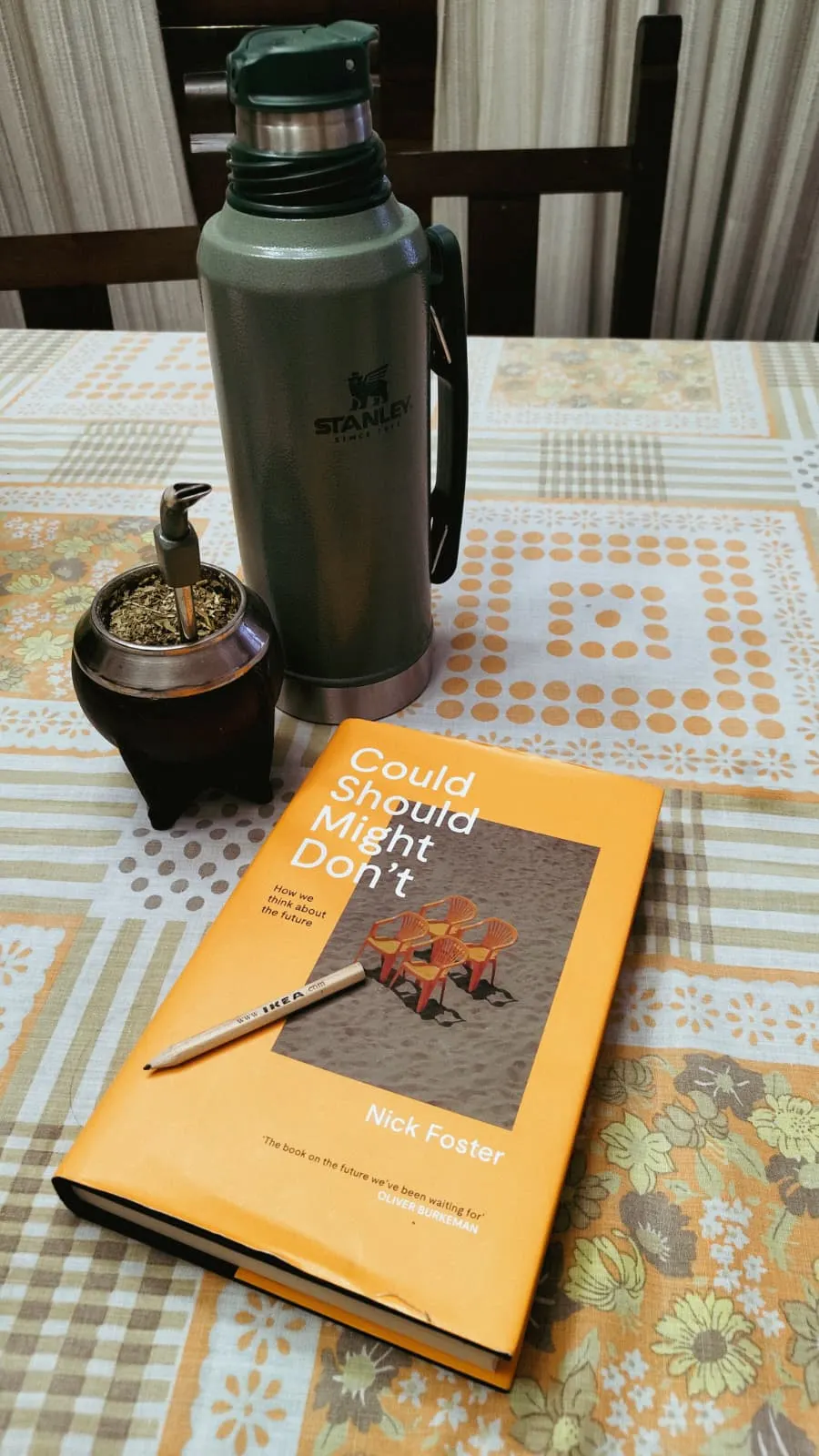
Could, Should, Might, Don’t: A Practitioner’s Reading
Part 4: Might

In the early 2000s, Foster was briefly involved in a project for the British Army. The study was called Future Integrated Soldier Technology (which, intentionally or otherwise, forms the acronym FIST). Top floor of a huge bureaucratic building in Whitehall, the smell of stale tobacco, carpets worn down by decades of vacuuming, three men in full dress uniform. A big project, with a big budget, about the future of the real soldiers of a real army.
The leading officer leaned forward and cut to the chase:
“It’s simple, really. We want our soldiers to feel like RoboCop.”
The officer had decades of military experience and direct responsibility for his troops' future. And yet, when it came to describing that future, his imagination reached only as far as a pulpy 1987 movie.
Foster’s question comes down to a single word: why? The entire Might chapter is an attempt to answer it. And the answer has a specific name:
“What this actually represents is a crisis of imagination, which might be significantly more damaging than we think.”
The litany
Each chapter opens with its litany in italics. Could’s closes with a demographic accusation: they are overwhelmingly male. Should’s, with a note of authority: they trust the dotted line. Might’s closes differently:
They can be indecisive, uncertain, and apprehensive.
The other two litanies pointed outward. This one is an inward confession. Might is the only mindset whose litany acknowledges its own cost, and it’s from this place that Foster writes. It’s also where I write from. I’ll come back to this.
The machinery
Scenario planning wasn’t born in a consulting firm. Foster first illustrates it in its domestic version: organizing a kid’s birthday party. You book the bouncy castle, but you prepare a backup plan in case it rains. Some kids have dietary restrictions, and someone will probably cry. This kind of strategic thinking, Foster notes, “underpins how we all approach the future and influences us in ways we rarely notice.”
Then the industrial version. Von Neumann puts algebra to competition, and game theory is born. RAND turns it into Cold War doctrine. And Herman Kahn (the man who inspired Kubrick’s Dr. Strangelove) takes it to its final form:
“This analytical mindset also encouraged Kahn to reduce every outcome — no matter how horrific — to a percentage, duration, or dollar amount.”
Every outcome, however unfavorable, expressed as a percentage. If you read Part 3, this will sound familiar: it’s numeric fiction in a military context. Foster himself closes the circle a few pages later, stating that the scenarios of Kahn, RAND, Wack, and Shell were hugely influential but were, in essence, “exquisitely crafted pieces of numeric fiction.”
The civilian turn arrives with Pierre Wack at Shell: four scenarios in 1971, with each player’s interests shifting depending on the case, and the tool replacing the forecast across the entire group by 1973. Advocates say Shell “predicted” that year’s oil crisis. Foster says that’s not the point:
“Scenario planning isn’t really about prediction at all — it’s about plurality.”
And here lies the irony that structures the whole subchapter, so subtle it almost slips past: the opening epigraph, “It is impossible to forecast the future, and it is foolish to try to do so,” belongs to Wack himself. The creator of corporate scenario planning opens the chapter with a warning against forecasting. Foster doesn’t underline the point. He lets the reader discover it alone.
The heart in the cone
On page 183 sits the diagram anyone working in futures has drawn a thousand times: Joseph Voros’s futures cone. The axis of the present, the probable cone, the plausible one wider, the possible one wider still. The exact opposite of an X on a map or a single dotted line.
In my copy, next to the diagram, there’s a heart drawn in pencil.
I drew it without thinking. And the pages that follow, I underlined almost completely; they’re the ones Foster uses to list the craft’s failures. That the diagrammatic, jargon-filled work feels systematic, but “Might Futurism relies on a significant amount of intuition and gut-feel.” That within organizations, these approaches are “initially welcomed, then tolerated, before exasperation ultimately sets in.” And the sharpest one, marked with a bracket and an exclamation point:
“Strategic foresight work is often sold as a neatly bound consulting package, with a beginning, a middle, and an end. In truth, it’s almost all middle.”
Almost all middle. No clean ending, no deliverable that closes the question. In Part 1, I mentioned that I’ve worked on projects where the speculative output received applause during the presentation and was archived the next day. That archiving wasn’t disinterest. It was the cycle Foster describes, seen from the inside: welcomed, tolerated, exasperating.
The heart and the list of failures live on the same pages. That’s the exact register of the chapter, and I suspect of anyone who does this work seriously. Love for the tool alongside clarity about its limits. Foster defends its value this way: think of it “more like insurance than advice”, scenarios as “props to point at and to argue around”, and the principle I underlined so I could steal it: “it’s the process of doing the thinking that matters, not necessarily the outcomes.”
The bottleneck
If the machinery is good and the value is real, where’s the crisis?
Get Nicolás Bronzina’s stories in your inbox
Join Medium for free to get updates from this writer.
Foster goes looking for it in the brain. In 2001, Marcus Raichle’s team discovered the default mode network; within it are two subnetworks: one that generates scenarios and one that evaluates them. The hippocampus plays a role in generating new ideas. And when you ask someone to imagine the future, the same regions light up as when you ask them about the past. The conclusion I marked with a bracket:
“Scientists are beginning to believe that the function of our memory is not to act as a factual storage facility for past events, but to help us to shape our ideas about the future.”
Memory as an organ of the future. What you haven’t lived, you can’t imagine well. Foster illustrates it with David Copperfield: we can’t conceive of a Harley appearing out of thin air because we’ve never seen it happen; the experienced illusionist, who knows the tells of the trade, can.
And then the confession. Foster, at this point in the book, turns around and looks at himself:
“So far in this book we’ve taken a largely Western, technocratic swing at the future, which is undoubtedly a reflection of my own personal experiences and perspectives.”
Futurists have typically been white, male, and financially privileged, with technocratic or philosophical backgrounds. And the easy way out — “let’s do empathy, let’s do ethnography” — Foster knows better than anyone: he joined Nokia in 2009, when the company was dispatching ethnographic teams to 140 countries. His verdict, after decades of observation sessions, workshops, and interviews:
“Real empathy is incredibly difficult. […] I’ve rarely seen anyone do it well.”
The scenario machinery doesn’t fail on method. The bottleneck is who operates it, and from where.
Where you read from
Here Foster writes the paragraph that, for me, justifies the chapter. Participatory futures, Afrocentric, feminist, postcolonial, postcapitalist futures (still dismissed by many audiences as a fringe activity) don’t interest him as a gesture:
“Taking these other perspectives into consideration serves to actively expand the cone of uncertainty. […] When I talk about exploring the future with more rigour, this is one of the things that I mean.”
Expanding the cone. Not decorative inclusivity: rigor. More perspectives produce more scenarios, shift the conversation’s starting point, and reframe its possible endings.
And among the limits of imagination he lists, there’s one that names me directly: time. The cone’s straight axis presupposes Western linear time. But “many Latin American, African, and Middle Eastern cultures view time through a polychronic lens.” For Mandarin speakers, the past sits above and the future below. For the Yupno of Papua New Guinea, the future is uphill.

I think about futures in two cities and in two times. I was born and lived in Buenos Aires, where planning coexists with the certainty that the scenario will flip on you, where nobody mistakes the dotted line for a contract, because we’ve seen too many dotted lines break. I work in Madrid, inside structures that do sign the paper. My projects (I wrote about them in Part 2) don’t start with a technology: they start with someone specific in a specific situation. This very series is written twice, in Rioplatense Spanish and in English, because I understood long ago that the language you think in changes the future you can think.
None of that is decorative biography. It’s exactly the material Foster says expands the cone. Reading Might from here comes with an unfair advantage: the plurality the chapter prescribes, some of us have by birth.
Trapped in our stories
There’s still the other half of the crisis: not just who imagines, but what with. Foster shows that each decade adopts its dominant technology as language. In the 20s everything was radio. In the 50s, atomic (from ovens to flasks). Then digital, then connected, then the cloud. Today, every startup brands itself as AI, generative, intelligent, “complete with purple sparkles.”
And then the scene anyone who has worked near technology recognizes instantly. Foster has sat in hundreds of meetings about emerging technologies, and the pattern repeats: while the talk is technical, engineers demand empirical evidence for every opinion. But when the conversation turns to what products we might make, those same people reach for a science fiction archetype. A device from Star Trek. An idea from Asimov. Yet another flying car.
Science fiction, Foster insists (admitting that a billion people are about to batter his door down), has entertainment as its primary function. Its technologies are conduits for the narrative. Props. In Hitchcock’s term: MacGuffins. Translating them directly into real products is clumsy malapropism. And using them as a stand-in for your own thinking is the final symptom:
“Maybe we’re getting trapped in our stories?”
Coda: the negative mandate
The last page of the chapter is completely underlined in my copy. Good scenario work, Foster says, demands imagination, information we don’t always have, and tolerance for other people’s decisions diverting everything in radical and illogical ways. But it demands something more, and it’s what almost nobody can stomach: if the work is done right, the conversation must veer toward where we don’t want to look.
“the conversation will veer away from what we feel is preferable or ideal into a territory of negative outcomes, failure, unfortunate consequence, or terrible disaster.”
That avoided, actively ignored territory is a vital and increasingly present practice. It has a name of its own, and it’s the fourth and final mindset of the quartet.
Don’t, soon.
The book is available at couldshouldmightdont.com
Nicolás Bronzina is an AI-Enhanced Futures Designer. He builds prototypes and design fiction artifacts that turn research into decisions organizations can act on. He is Managing Partner at BPP Analytics & Design, co-founder of Heated Studio, and designed and teaches the Emerging Technologies course for UDIT Madrid’s Online Master’s in UX Design. He documents his practice at Otros Futuros. Based between Buenos Aires and Madrid.
If you’re interested in running a design fiction workshop, collaborating on speculative projects, or just talking about climate adaptation and the future mundane, more at nicolasbronzina.com.