One Earth and the Cost of Division

The Universe From the Eyes of a 13-Year-Old

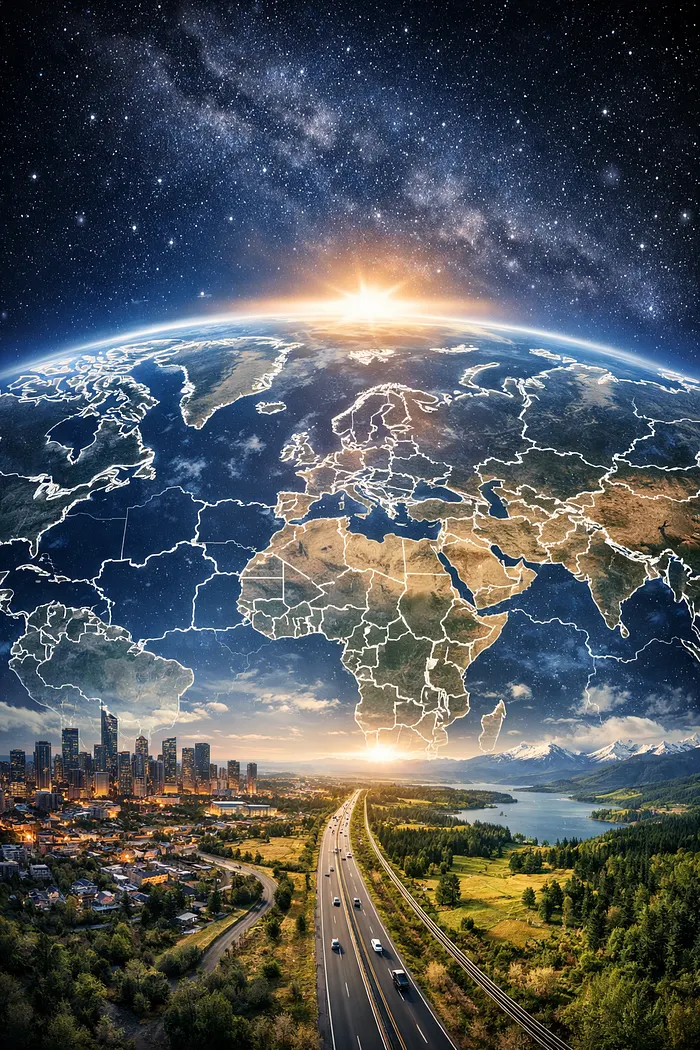
From space, Earth has no borders.
There are no lines separating countries, no labels for nations, no “you are now entering” signs floating above the atmosphere. Just land, water, clouds, and a thin layer of air doing an incredible amount of work for free. Every border we care so deeply about exists only on maps, and in human heads, which are historically unreliable places to store important information.
Politics begins the moment we decide to divide that shared planet.
Countries started as a way to organize people and keep them safe, which is reasonable. Humans like groups. Groups like structure. The structure eventually gets a flag. The problem is that once borders exist, they don’t stay boring. They turn into identities. And once identity gets involved, logic tends to quietly leave the room.
History follows a familiar pattern. Lines are drawn. Teams form. Someone declares that this side is “us,” and therefore automatically better. The other side becomes “them,” which is much more convenient than admitting they’re also people. From there, things escalate quickly and usually end badly.
Get Revilo Doos’s stories in your inbox
Join Medium for free to get updates from this writer.
Wars don’t kill ideas. They kill people. People who had plans for the weekend. People who did not wake up expecting to become a footnote. Most of them didn’t choose the conflict. They were just born on the wrong side of a line that did not exist a few centuries ago.
Nature, for the record, finds all of this extremely confusing.
Biology doesn’t recognize nationalities. Viruses do not stop at borders to check passports. Climate change doesn’t care who started it first. Physics treats every human exactly the same way, which is both comforting and slightly rude. The planet is one interconnected system, and systems tend to malfunction when their parts spend all their time arguing.
This is where politics becomes dangerous: when division is treated as permanent and cooperation is treated as optional, like a software update you keep postponing until everything crashes.
Humans often act as if conflict is inevitable, as though war is a built-in feature of the universe. It isn’t. Gravity is inevitable. Entropy is inevitable. Humans choosing to draw increasingly sharp lines between themselves is a habit, not a law of nature.
In fact, most of human progress exists because we did cooperate. Cities, medicine, science, satellites. None of these were built by one person shouting loudly at everyone else. They were built by large groups agreeing, at least temporarily, to work together instead of throwing things.
Politics, at its best, should reduce suffering and help billions of people share one planet without breaking it. At its worst, it amplifies fear, rewards division, and convinces ordinary people to see enemies where there are mostly just other humans trying to live.
We live on one Earth. One atmosphere. One biosphere. One extremely fragile system that does not reset between conflicts. No matter how many borders we draw, everything still happens on the same rock.
If humanity has a future, it won’t come from pretending we live on separate worlds.
It will come from acting like we noticed we don’t.