Learning with Teeth: Evaluation as Democratic Practice
Keynote speech delivered at the bi-annual conference of the European Evaluation Society “Evaluation for Vibrant Democracies”, Lille, 28–30 October 2026


Introduction
Evaluation is usually described as a way to improve programmes, policies and organisations. The question that concerns me here is narrower and more demanding: how do we organise collective learning that can also question power, and that has consequences for action? Evaluation practice has become accomplished at organising collective learning. It is less accomplished at ensuring that what is learned can question power and bears on action. The argument of this essay is that the gap is not primarily a matter of better methods or more honest reporting, but of institutional design: learning acquires “teeth” only when the conditions under which people can speak, disagree and demand a response are deliberately secured.
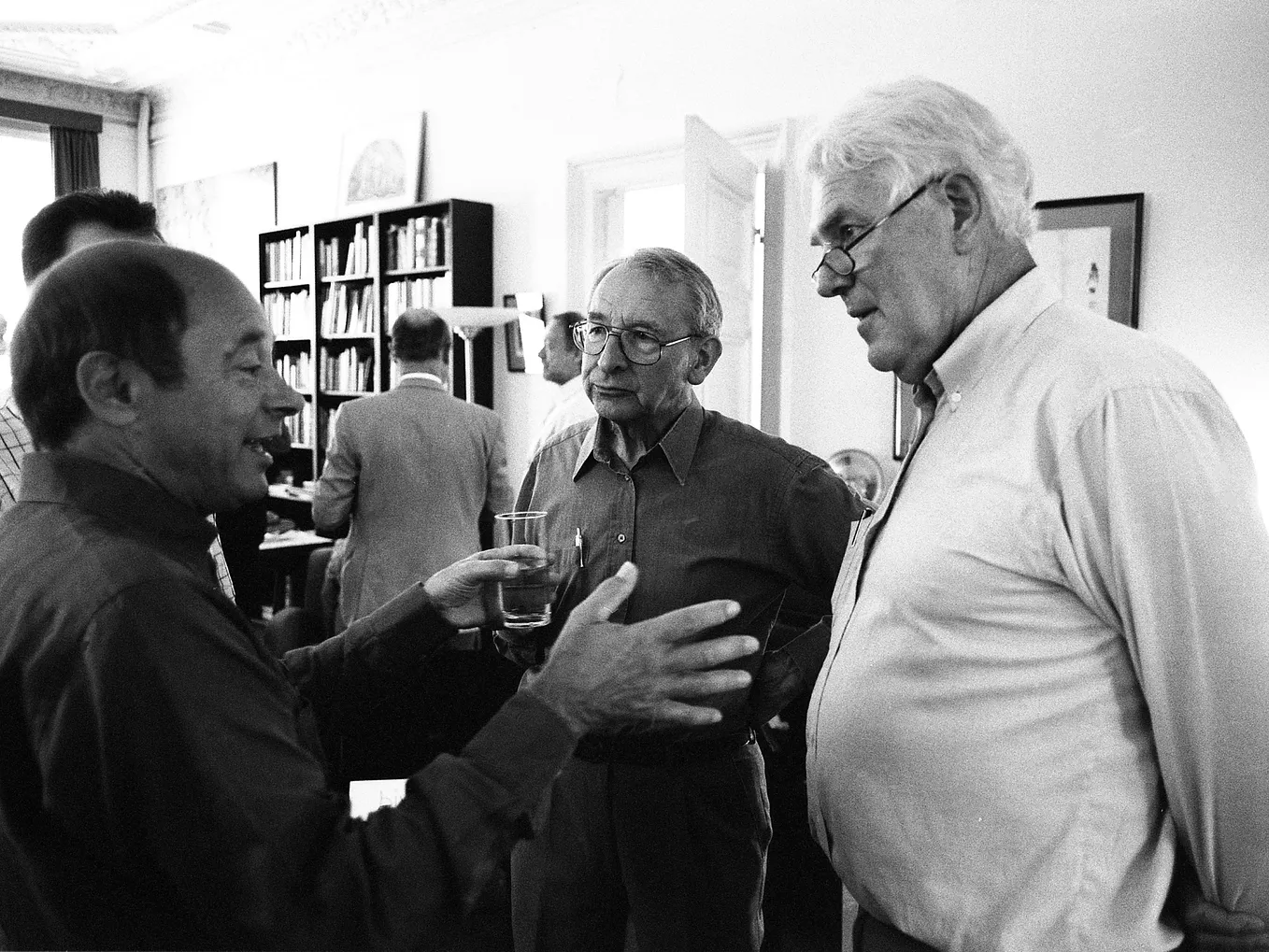
I develop the argument in four steps. First, I draw on the work of the Belgian systems practitioner Luc Hoebeke to frame evaluation as part of a broader project of collective learning (Luc sadly passed away on 28 September 2026 at the blessed age of 84). Second, I use John Dewey’s account of democracy as shared inquiry to establish a functional correspondence between evaluation and democratic practice. Third, I specify three conditions — composition, dissensus and answerability — that such practice requires if it is to be able to question power. Fourth, I use Stafford Beer’s Viable System Model to locate where in an organisation these conditions can be functionally embedded, and I propose that evaluators claim a mandate to contribute to what the model calls the identity function.
A theory of societal change from Luc Hoebeke
My point of departure is the work of Luc Hoebeke, a Belgian systems practitioner who is not widely known but who is, in my view, one of the most original figures in the systems tradition. Hoebeke published sparingly, and much of his later life was devoted to supporting reading groups in the exploration of sacred text in the tradition of Kabbalah rather than to writing. His main written legacy is the 1994 book Making Work Systems Better, a title that already indicates its relevance to evaluators (originally published by Wiley it is now available for free in a pdf version). I owe most of what I know about systems practice to him, and I take his thinking as a starting point here, respectfully but also critically.
Hoebeke expressed his guiding vision as follows (in a 1999 paper, originally in Dutch):
“I would like to conjure a 10-billion people society, where every inhabitant of this planet is part of a number of small-scale decision groups, and that from these groups — which naturally exemplify opposing interests and which naturally consist of imperfect individuals — emerges a social texture that, stumblingly, learns to deal with the dilemmas that belong to our species, with questions about life and death, good and evil, love and hate, give and take, me and the other. And, despite the multitudes involved, I would like to imagine that the desperate belief in the gift of life offers a sufficient condition to achieve a certain degree of coherence, in much the same way that each of us shows some degree of coherence despite our innumerable neurons.”
Read as a practical programme, this is a theory of change. The key term is learning: groups that deliberately work through foundational dilemmas together, and out of that work a social texture emerges. The vision guided Hoebeke’s own organisational experiments, and it has guided mine. It is also, I have come to think, incomplete.
The incompleteness is empirical rather than logical. Careful inquiry and mutual understanding do not guarantee change. Anyone who has worked on wicked problems over the past decades will recognise the pattern: the inquiries were diligent, the workshops were constructive, the reports on wicked problems accumulated … and the polycrisis continued to deepen. A theory of change that runs entirely through conversation underestimates the role of power. It tells us how people can learn together, but not how what they learn comes to bear on those who hold authority. That is the problem this essay addresses: how do we give learning teeth?
The evaluative learning cycle
Let’s begin with a description of what happens when evaluation works well. People can speak honestly, including about uncomfortable experiences. Relevant and reliable information becomes available. That information receives a response and informs action. People can see what happens as a result. Seeing consequences builds trust, and trust makes further honest speech possible.

Honest speech, reliable information, response and follow-through, trust, and back to honest speech: this is a reinforcing feedback loop. It describes the productive case, but the loop also runs in reverse. Where information is met with silence, trust erodes. People hold back. The collective loses access to relevant knowledge precisely where it is most needed. Evaluation practice, in my experience, consists largely of working on the conditions that keep this loop turning in the right direction, and of diagnosing why it has begun to turn in the other.
The isomorphism with democratic practice
The learning cycle has a political counterpart. John Dewey understood democracy not primarily as a set of procedures but as a way of living together in which people jointly inquire into their circumstances and revise their actions in the light of experience. On this understanding, the purposes and values that guide collective action remain themselves open to question. Democracy is, from this point of view, not a set of values or institutions but an organised way of asking whether what the collective is doing is still worth doing.
Here lies a functional isomorphism. Evaluation, understood as a learning process, and democratic practice, understood as Deweyan inquiry, can enact the same dynamics: honest testimony, collective sense-making, revision of action, and openness about purposes. This is why evaluation understood as a learning process has democratic potential, and why it makes sense to speak not only of evaluation for democracy (evaluation that supports democratic institutions) but of evaluation as democratic practice.
The isomorphism alone is not enough. Two further elements are needed before the potential acquires teeth: a specific belief about people, and a specific set of conditions about power.
Faith in human capacities
Dewey’s own formulation is precise. In his 1939 lecture “Creative Democracy: The Task Before Us” he wrote:
Democracy is a way of life controlled by a working faith in the possibilities of human nature. That belief is without basis and significance save as it means faith in the potentialities of human nature as that nature is exhibited in every human being irrespective of race, color, sex, birth and family, of material or cultural wealth. This faith may be enacted in statutes, but it is only on paper unless it is put in force in the attitudes which human beings display to one another in all the incidents and relations of daily life.
Two things about this passage matter here. First, the faith it names is not an empirical bet. It is a presupposition, a commitment. Isabelle Stengers makes a similar point: we do not know what people are capable of and we should honour that ignorance. The commitment is made precisely where knowledge runs out.
Second, the bet translates into a practical task for evaluation: creating the conditions where the full scope of human capabilities becomes discernible, in which people can contribute, inquire and learn is not a preamble to evaluation; it is part of the work.
Three conditions for questioning power
The learning cycle itself is politically neutral. A closed circle of power can also learn effectively, and often does; the problem is that it learns only from and for itself. For the learning cycle to acquire the capacity to question power, three conditions must hold.
Get Philippe Vandenbroeck’s stories in your inbox
Join Medium for free to get updates from this writer.
Composition. Those who sustain the learning collective and those who bear its consequences must both be able to help shape the inquiry. This includes people who are not present: absent parties require representation, and the claims made on their behalf must themselves remain open to scrutiny within the process. Composition is the answer to the question of who is in the room.
Dissensus. Joint inquiry does not require consensus. Differences in experience, interest and judgment have a legitimate place inside the process, and refusal, protest and resistance outside it remain possible. This condition protects the inquiry from the pressure to converge that afflicts many participatory settings, where the fact of being together in a room becomes an implicit argument for agreement. Here it is apposite to point to agonistic conceptions of democracy as foregrounded by Chantal Mouffe and Pierre Rosanvallon.
Answerability. Those with the authority to act must respond to what is brought forward, explain their choices, and account for what follows. Without this, honest speech produces information and information produces nothing. Answerability is what converts a learning process from a mirror into a lever. I see this as aligned with a deliberative conception of democracy.
Together, these three conditions widen the scope of what the inquiry can reach. Once composition, dissensus and answerability are secured, the collective’s purposes, its boundaries and the distribution of benefits and burdens become legitimate subjects of inquiry in their own right. The question shifts from “are we doing things right?” to “are we doing the right things, for whom, and at whose expense?”
Functional embedding: the Viable System Model
The remaining question is organisational. Where in an organisation can such a practice live? The question concerns organisational function rather than organisational form: the issue is not whether the practice is housed in a dedicated unit, but what the practice is allowed to question.
Stafford Beer’s Viable System Model (VSM) offers a grammar for this distinction. The model describes any viable organisation in terms of interdependent functions: operations that produce value (System 1), coordination among them (System 2), management of the present (System 3, with its audit channel 3*), modelling of the future environment (System 4), and the function that maintains the identity of the whole and arbitrates between present and future (System 5).

Evaluation, in practice, most often occupies a specific position in this diagram: 3*, a functional extension of management that keeps track of operational reality. In that position, evaluation audits historical performance for the benefit of those with managerial authority. It can ask whether the machine is running as intended; it is not mandated to ask whether the machine should exist, or whom it serves. There is real value in this contribution, and I do not dispute it. But the position carries a structural risk of capture and domestication: an evaluation function that reports only to management will, over time, learn to report what management can hear.
The opportunity lies elsewhere in the model, in System 5.
The Identity Function
In Beer’s model, System 5 maintains the balance between current functioning and future adaptation, in relation to the identity and orientation of the whole. A collective comes into being, and changes, in relation to others; the identity function is where that relation is worked out.
It was Hoebeke’s contribution to point out the mundane nature of this function. System 5 is often described in abstract terms as the ‘policy system’ (suggesting that it is the locus in which highest authority is invested) but in practice it exists as an ongoing conversation: the same honest talk that drives the learning cycle. Representatives of different constituencies speak and listen to one another, without pressure to agree and without the obligation to reach collective decisions. Four features of this conversational identity function deserve emphasis.
First, its questions concern value systems. Who are we here for? Who benefits from our actions? Who bears the costs? Which consequences can we justify, and what obligations follow from that? Moral dilemmas and possible accommodations between conflicting claims are explored here, not resolved once and for all.
Second, the process constitutes a social subject. The collective’s identity takes shape through how it relates to these questions and to the process itself. This is self-constitution in relation to those the collective affects inside and outside of the organisatio. It is neither a mission statement fixed at the founding moment nor a brand maintained by communications staff.
Third, composition and dissensus are secured within it. People from inside and outside the collective bring experiences and claims that can change its understanding of itself. The identity function is, by construction, the one place in the organisation where the boundary between inside and outside is itself on the table.
Fourth, the function is not executive, so answerability must be institutionally secured. This is the paradox at the centre of the proposal. System 5 does not decide; execution lies with Systems 3 and 1. A conversation that aspires to consequence therefore requires arrangements around it: a mandate to examine purposes and consequences, identifiable and responsible addressees, response deadlines, follow-up on commitments, and a route for escalation when no response is forthcoming. The consequences of the conversation must return to the conversation.
Beyond these four features, there is a strategic observation to make. The territory of the identity function is uncontested in a double sense. It is uncontested by LLMs. The work is discursive through and through: it is constituted by people speaking honestly, listening, and being answered by those with authority. Nothing essential in this process can be delegated to a machine because the point of the process is that particular people are present to one another. The territory is also uncontested by other professions. Very few people in or around organisations understand that the identity function needs deliberate cultivation at all, and fewer still claim it as their work. This double uncontestedness is at once an advantage and a disadvantage. The mandate must be claimed where it is not given, and the value of the work must be demonstrated rather than assumed. The advantages are just as real. The territory is open, at a moment when other parts of evaluation practice feel increasingly precarious. And, crucially, the function does not presuppose new structures: it can grow out of practices and arrangements that already exist. The key lies in the mandate and the surrounding arrangements, not in exotic technique or elaborate new structures. That is where the teeth are: answerability no longer depends, each time, on the goodwill of those with the authority to act.
The proposal in a nutshell
The argument can now be stated compactly.
Commit to a practice of creating the enabling conditions for honest speech and cultivating trust. Espouse a foundational disposition of trust in human capacities, in the sense Dewey gave it: a working faith that is put into force in daily practice, not a sentiment on paper. Anchor the inquiry in the three conditions of composition, dissensus and answerability. Embed the process functionally as the inquiring collective’s identity function, with the institutional arrangements that secure response.
This is a basic structure, not a blueprint, and it is deliberately formulated at the level of function rather than form. Different collectives will implement it differently. What the structure provides is a standard against which those implementations can be assessed: does honest speech occur, is it compositionally inclusive, is disagreement legitimate, and does it reliably provoke a response that returns to the inquiry?
For the evaluation profession, the proposal implies a widened mandate: from evaluation for democracy to evaluation as democratic practice. Evaluators should claim a role in the identity function of the collectives they work with to enable those who bear the consequences to help question and shape the collective’s purposes, boundaries and obligations. Evaluators do not determine that identity but they help make the encounter possible.
Conclusion
I have argued that the familiar learning cycle of evaluation — honest speech, reliable information, response, trust — is isomorphic with Deweyan democratic inquiry, and that it acquires teeth only under three conditions: composition, dissensus and answerability. The Viable System Model shows where such a practice belongs: not in the audit channel of management, where evaluation is at risk of domestication, but in the identity function, where the collective’s purposes and obligations are legitimately at stake.
The vision I began with, Hoebeke’s image of a society of small decision groups stumblingly learning to deal with the dilemmas of our species, describes the inner life of such practice well. What it does not describe, and what remains to be built, is the institutional casing that makes the stumbling consequential. Learning without teeth has been tried for decades, and the results are visible. The task before evaluation, as Dewey said of the task before democracy, is to put the working faith into force in the relations of daily life, including, and perhaps first of all, in the relations between those who act and those who bear the consequences of what is acted upon.
I thank the organisers of the conference for the invitation to deliver this keynote speech.