The War the West Is Still Helping to Fuel

Made in the West, fired at Ukraine. Four years of teardowns tell one story: Russia cannot build the missiles and drones it fires at Ukraine without components from American, European and Asian companies.

Kyiv, September 2026: a capital under sustained bombardment
The last several weeks have been among the worst for Kyiv since the full-scale invasion began. The pattern is day-and-night bombardment aimed at breaking the city’s endurance ahead of winter.
The immediate wave (Sept 24–29). Russia has struck Kyiv both day and night for consecutive days. On September 27, a strike on the Stolichny wholesale food market on the city’s edge killed two and injured several more, with eyewitness footage showing bodies and vehicles ablaze in the parking lot. On September 28, downtown Kyiv was hit — one killed, over 20 injured, and a building of the National Academy of Sciences set on fire. Overnight into September 29, missiles and drones hit several districts — Solomianskyi, Pecherskyi, Holosiivskyi — sparking fires at an educational institution and residential buildings.
The scale. President Zelensky said that in a single recent week Russia launched more than 2,200 attack drones, around 1,650 aerial bombs, and 38 missiles, many of them ballistic — nearly 4,000 munitions in seven days. September opened the same way: an attack on September 1 killed at least 12 in Kyiv and the surrounding region.
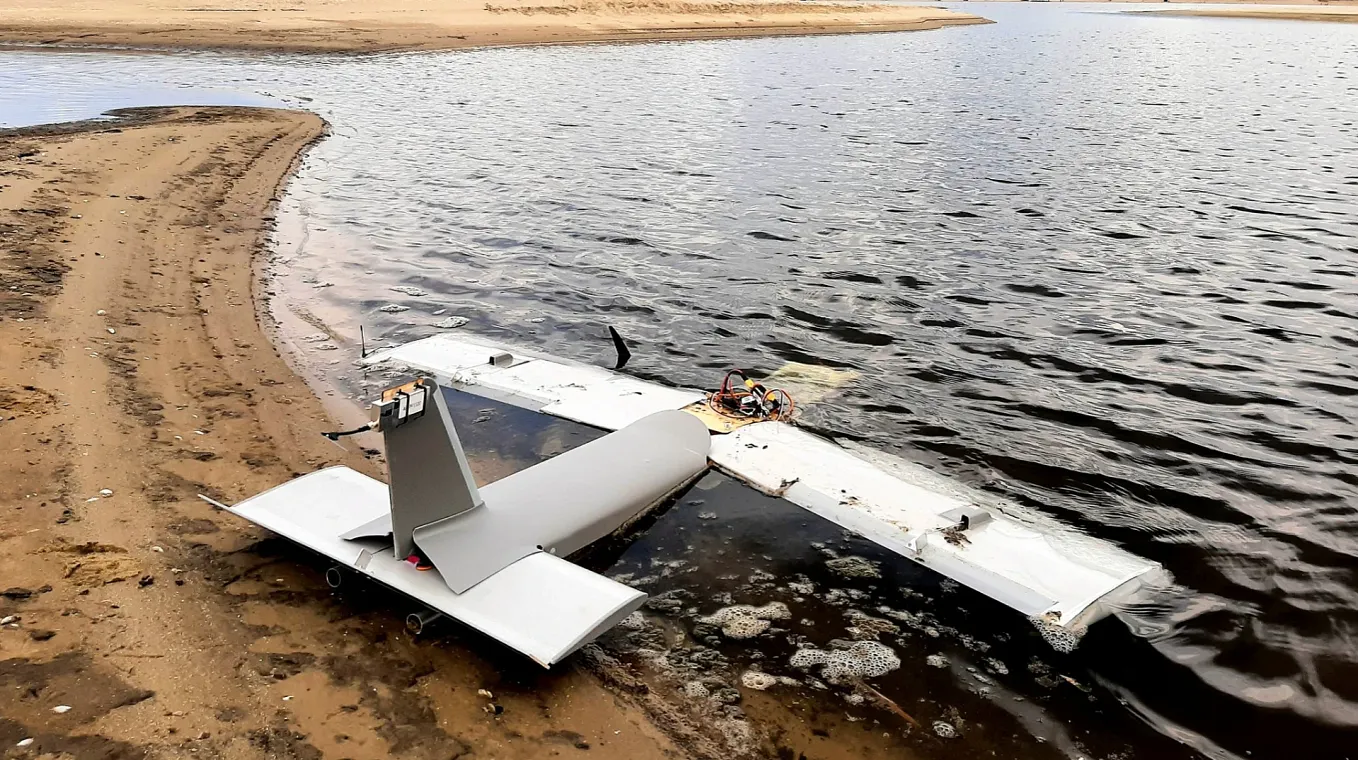
The new and dangerous element. Russia is now using jet-powered drones that fly too fast and too high for Ukraine’s ground-based air defenses to shoot down. That is the Geran-3/Geran-5 generation — precisely the drones the recent teardowns found packed with Texas Instruments, Infineon and STMicroelectronics parts. The escalating threat to Kyiv is being delivered by weapons that Russia cannot build without foreign components. Your thesis isn’t abstract; it’s landing on the city around you.
The strategic intent. The bombardment is timed to the approach of winter, reviving the strategy of previous years — hitting the power grid to deny civilians heating and running water. EU defense ministers were meeting in Ireland this month specifically over Ukraine’s air-defense shortages, which is the mirror image of the component story: Ukraine short on interceptors while Russia’s supply of foreign-enabled drones holds up.
Built on Western Chips: Inside Russia’s Sanctions-Busting Drone Supply Chain
What’s inside them
Teardown investigations of downed Geran-2/Shahed drones find that hundreds of components are foreign-made, with only a few dozen genuinely Russian-origin parts. The critical items, among them microchips, digital signal processors, voltage converters, receivers, transistors, diodes, resistors, clock generators, inductors, antennas, anti-jamming CRPA modules, and even sensors like ams-OSRAM rotary encoders or Infineon transistors, mostly trace back to US, European (German, Austrian), Japanese, and Taiwanese manufacturers. Around 20 European companies alone supply over 100 identified parts.
How Russia still gets them despite sanctions
- Re-routing through third countries: China, Hong Kong, Turkey, and Central Asian states act as pass-through points, since only about 60 countries actually enforce the sanctions regime.
- Chinese-made subassemblies (engines, servo drives) that themselves embed Western-made chips, so a single “Chinese” part can smuggle in US/EU-origin electronics.
- Shell/intermediary trading firms in non-sanctioning jurisdictions that ignore manufacturer export restrictions — at least 672 shipments of sanctioned European components reached Russia this way between January 2024 and March 2025 alone.
- China separately continues direct component supply to both Russia and Iran despite US sanctions, per Wall Street Journal reporting.
Could Russia go it alone?
No investigation found evidence Russia can substitute these parts domestically at scale but quite the opposite: reporting explicitly states Russia “does not produce all the elements” needed, and the current production rate (reportedly around 3,000 drones/month) depends on a continuous flow of imported electronics. If that supply were genuinely severed, not just sanctioned on paper, but actually enforced across China, Hong Kong, Turkey, and Central Asia, Russia’s drone output would very likely fall sharply, since its domestic semiconductor and precision-electronics base isn’t capable of replacing this volume and sophistication of parts. The core vulnerability isn’t Russian manufacturing capacity, it’s sanctions enforcement and third-country transshipment.
Sources:
- Russian Geran-2 Drones Almost Entirely Assembled from Western Components — Militarnyi
- Investigation: How Russian drones exploit European technologies to strike Ukraine, and beyond — Kyiv Independent
- Exclusive: American, European microchips found in Russia’s latest missile-like drone — Kyiv Independent
- China continues supplying Shahed drone components to Russia and Iran despite US sanctions — WSJ, via Ukrainska Pravda
- German Parts Inside Russian Geran Drones Expose A Sanctions Evasion Problem — DroneXL
Foreign Components in Russian Missiles & Drones: A Reference Bibliography (2022–2026)
The finding is consistent across every serious investigation since February 2022: Russia cannot build its precision weapons without imported microelectronics. The dominant source is US companies (roughly two-thirds of components in most teardowns), followed by parts from Japan, Taiwan, Switzerland, Germany, the Netherlands, South Korea, the UK, and China. Critically, newly manufactured parts — dated 2024 and 2025 — keep appearing, proving live sanctions evasion, mostly routed through China and Hong Kong.
The foundational forensic reports
RUSI — “Silicon Lifeline” (August 2022) :the report that set the template. With Reuters, RUSI dismantled 27 Russian systems and found at least 450 unique microelectronic components from companies in the US, Europe and East Asia; of the 450, 318 appeared to be made by US companies, with others from Japan, Taiwan, Switzerland, the Netherlands, Germany, China, South Korea, the UK and Austria. Analog Devices and Texas Instruments alone equaled nearly a quarter of all Western components.
→ rusi.org — Silicon Lifeline: Western Electronics at the Heart of Russia’s War Machine rusimilitarnyi
Conflict Armament Research (November 2022): traced Iranian Shahed components. Parts came from 70 manufacturers in 13 countries; 82% were made by US-based companies. swissinfo
Euromaidan Press (November 2022): early Shahed-136 teardown with Ukrainian intelligence and NAKO: almost every part was of American or European origin, with the engine the only domestically produced component. euromaidanpress
KSE Institute / Yermak-McFaul Working Group (June 2023): the trade-flow forensic benchmark, analyzing 1,057 imported components in Russian military equipment, with production concentrated in China, Malaysia, Vietnam and South Korea. Later expanded to almost 2,800 foreign components and more than 250 named manufacturers. ksebusiness-humanrights
The named companies
The recurring names across every report, useful for any accountability piece:
- US: Analog Devices, Texas Instruments, Intel, AMD/Xilinx, Microchip, Micron, Marvell, Maxim, ON Semiconductor, Fairchild, Bel Fuse
- Europe: STMicroelectronics (Swiss/Geneva), u-blox (Swiss), Infineon (German), Bosch, Würth Elektronik, TDK, Pierburg/Rheinmetall (German), NXP
- Asia: Renesas, Fujitsu, Murata, Kyocera, Panasonic, Mitsubishi Electric (Japan); Samsung, LG (South Korea)
US Senate Permanent Subcommittee report (September 10, 2024) — official Congressional confirmation, focused on Analog Devices, Intel, TI and AMD, whose parts kept appearing in Kh-101 cruise missiles.
→ hsgac.senate.gov — The U.S. Technology Fueling Russia’s War in Ukraine
The European supply-chain angle
OCCRP — “Made in the EU, Dropped on Kyiv” (Feb 2026) — the key European investigation. Over 100 components from ~20 European firms across eight countries; trade data showed 672 shipments of sanctioned European-made components sent to Russia between January 2024 and March 2025 by 178 companies, mostly in China and Hong Kong. Note the important fairness point the reporters stress: there was no evidence the European manufacturers themselves violated sanctions or exported directly to Russia — the diversion happens through third countries. kyivpostoccrp
Get Phil Jeudy’s stories in your inbox
Join Medium for free to get updates from this writer.
Kyiv Independent — “How Russian drones exploit European technologies” (2026) — traces Geran-2 components, noting some parts were produced in 2024 and 2025, after sanctions. kyivindependent
Euronews / Deutsche Welle (April 2026) — the German focus: 137 German-made components documented by HUR, with Infineon accounting for 58 of them, mostly transistors used in UAVs. Bosch fuel pumps and spark plugs also identified. united24media
Center for Information Resilience / CFHK — the financial scale: more than €190 million worth of European components reached Russia via Hong Kong in the first two years after the invasion. brusselssignal
Ukraine’s live database: the single most useful ongoing resource
GUR/HUR “War & Sanctions” portal — Ukrainian military intelligence’s public, continuously updated forensic database with 3D models and full component lists. As of March 2, 2026, it tracked 5,534 components across 190 weapon units. This is where you’d go for any specific weapon system (Geran-2/3/5, Kh-101, Lancet, Orlan, Banderol, Shahed MS001).
→ war-sanctions.gur.gov.ua dronexl
The 2025–2026 escalation
President Zelensky, October 2025: after mass attacks, he cited over 100,000 foreign-made parts in the drones of a single overnight attack, including British microcomputers, Swiss microcontrollers, and German switching connectors. isans
CEPA (2025): Geran-5 teardown found US chips from Texas Instruments, CTS Corporation and Monolithic Power Systems, plus a German Infineon component. Estimates that roughly 70% of Western-branded parts are genuine, produced legally for global markets — the rest grey-market or counterfeit. cepacepa
UNITED24 (2026): the “newly manufactured” smoking gun: STM32 chips from STMicroelectronics in Geran-2 drones, the most recent manufactured in July 2025 — months before hitting the battlefield. united24media
The new terror for Ukrainians: the Geran family
What has changed with previous versions of Iranian drones
- Jet propulsion. Russia now fields turbojet variants — Geran-3, Geran-4, Geran-5, and the S8000 Banderol, that fly 300–650 km/h instead of the ~180 km/h of the classic propeller Shahed/Geran-2. That’s fast enough to compress the time between air-raid alert and impact to just minutes, making interception much harder.
- Higher altitude, longer range. The Geran-4 can operate at up to ~5,000m and reach ~960 km; the Geran-5 reaches ~1,000 km.
- Bigger, more varied warheads. Original models carried a ~50 kg (110 lb) warhead. Newer configurations carry 50–90 kg payloads (Geran-4/5), and some are now fitted with stacked dual-warhead setups reaching roughly 100 kg combined. The Banderol jet drone carries the heaviest payload yet, around 150 kg.
- Harder to jam/shoot down. Anti-jamming antenna arrays (Chinese-made CRPA systems), AI-assisted and infrared/thermal guidance, and mesh-radio links letting an operator retarget the drone mid-flight in real time.
- Decoys and secondary munitions. Cheap Gerbera decoy drones are launched alongside real strike drones to overwhelm air defense and deplete interceptors; some strike variants now also carry R-60 air-to-air missiles (to shoot down Ukrainian interceptor drones/aircraft) or PTM-3 anti-tank mines as secondary munitions.
Destructive capability per hit
- A standard Shahed/Geran-2 warhead (~50 kg) is generally enough to destroy a single apartment and damage the surrounding building/nearby structures.
- The newer, heavier-payload jet drones (like the Banderol with its ~150 kg warhead) can destroy an entire house or take out multiple apartments in a single hit — a substantial step up in lethality against residential buildings.
Sources:
- Shahed-136 and Geran: Specs, Production, Jet Variants
- From Shahed to Geran: How Russia Continues to Reinvent the One-Way Attack Drone | CSIS
- Jet-Powered Shaheds and Banderols: Why Russia’s New Drones Are Harder to Stop — UNITED24 Media
- Russia Increases Lethality of Shahed-Based Drones With Twin 50 kg Warhead Configuration — Army Recognition
- Ukrainian Defense Intelligence: Russians Significantly Modernized Shahed and Gerbera Drones — Militarnyi
Skyshield? An illusion from the West, and in the meantime Ukrainians are dying every day
According to the UN Human Rights Monitoring Mission in Ukraine (OHCHR), as of their February 2026 “Four Years On” fact sheet, verified civilian casualties since the start of the full-scale invasion on 24 February 2022 stand at:
- 15,172 civilians killed
- 41,378 civilians injured
OHCHR is explicit that these are verified minimums — the actual toll is likely considerably higher, since many reports (especially from the early chaotic weeks of the invasion and from areas under Russian occupation or active fighting where investigators can’t access) couldn’t be confirmed.
Sources:
- KEY FACTS AND FINDINGS — February 2026 (OHCHR fact sheet, PDF)
- Protection of Civilians in Armed Conflict — February 2026
Conclusion: the hypocrisy standing over Ukraine
Strip away the diplomatic language and what remains is stark: the same nations sanctioning Russia, arming Ukraine, and issuing statements of solidarity are also, through their own components, sustaining the machinery that kills Ukrainian civilians. Texas Instruments, Infineon, STMicroelectronics, Analog Devices… these aren’t obscure grey-market suppliers, they’re flagship Western firms, and their chips, some manufactured as recently as mid-2025, are found inside the drones that hit a food market, a science academy, an apartment block in Kyiv within the same week. The West did not intend this. But intent stops mattering once the pattern repeats for four years running, through eight rounds of sanctions, through hundreds of millions of euros in diverted parts, and through a body count that keeps climbing. A government can call itself an ally and still be, functionally, a supplier, not by any single decision, but by the sum of enforcement gaps it has tolerated.
That is the hypocrisy, and Ukrainians are the ones paying for it twice over: once as the target of the weapon, and again as the audience for the reassurance that “everything possible” is being done to stop it. Everything possible has demonstrably not been done. Only about 60 countries enforce the sanctions regime at all; China and Hong Kong remain open conduits regardless of what Washington or Brussels legislate; and even the manufacturers named in these reports are, in most cases, not accused of wrongdoing — meaning the failure sits not in the boardrooms but in the customs posts, the shell companies, and the political will to actually chase the transshipment networks rather than issue another press release about them.
And this is precisely why sanctions, as currently enforced, will not stop the war. They were never a battlefield weapon: they are a long-run pressure tool, and Russia has spent four years building the exact infrastructure to defeat that pressure: third-country intermediaries, Chinese subassemblies that launder Western chips, and a tolerance among roughly two-thirds of the world’s states for looking away. Sanctions can raise Russia’s costs, force it toward less sophisticated substitutes, and slow the sophistication curve at the margins, the CEPA finding that some share of components are now grey-market or counterfeit is real evidence of friction. But friction is not denial. Production has reportedly held near 3,000 drones a month; Zelensky’s own tally of over 100,000 foreign parts in a single night’s attack shows a supply chain that is strained, not broken. Sanctions were written to be enforced by willing governments against willing exporters. They say nothing to a Hong Kong trading company with no exposure to Western courts, and they cannot, by themselves, reach into a decision made in Beijing to keep the pipeline open.
So the honest assessment is this: Ukraine is being asked to hold a winter of drone and missile bombardment on the promise that economic pressure will eventually change Russian calculus, while the tools of that bombardment continue arriving built, in significant part, from the sanctioning countries’ own industrial base. Until enforcement, not new sanctions lists, but actual interdiction of the China/Hong Kong/Turkey/Central Asia transshipment routes, closes that gap, the war does not run out of parts. It runs on them.