SUPERDENSE CODING

LETS EXPLORE SUPERDENSE CODING!!
Superdense coding is a quantum communication protocol that allows a sender to send two classical bits of information to another user by only utilizing one qubit.First proposed by Charles Bennett and Stephen Wiesner in 1992 and experimentally actualized four years later, in 1996.
Superdense Coding and Quantum Teleportation are closely related, there is a key difference between them. Quantum teleportation is a process by which a user can transmit one qubit using two classical bits whereas Superdense Coding is a process by which a user can transmit two classical bits using one qubit. Basically, Superdense Coding can be thought of as the flipped version of Quantum Teleportation.
Brief idea
In superdense coding, Alice and Bob are the two people used to explain how quantum communication works.

- Alice = sender
- Bob = receiver
The special thing is that Alice can send 2 classical bits of information by sending only 1 qubit, but this works only because Alice and Bob already share an entangled pair.

They share a special entangled state called a Bell State:

Think of this like two magically connected particles — no matter how far apart they are, their states are linked.
ENCODING CLASSICAL BIT INTO QUBITS
Alice wants to send 2 classical bits to Bob:
00,01,10, or11
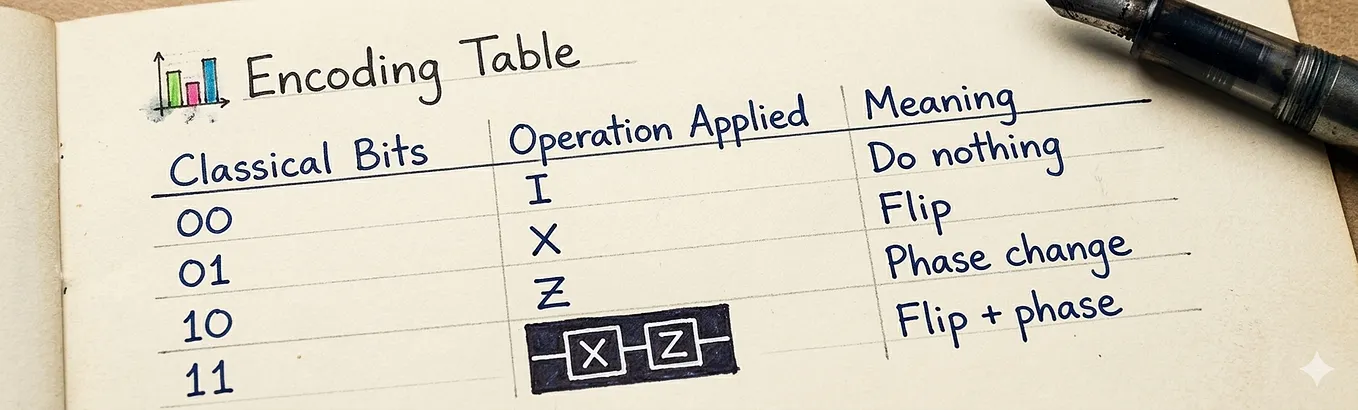
Instead of sending 2 bits, she uses quantum operations (gates) on her qubit.
Encoding Table

Each operation transforms the shared entangled state into a different Bell state. So Alice encodes 2 bits of information into 1 qubit by choosing the right gate.
Then she sends that single qubit to Bob.

Circuit Implementation (Step-by-Step)
Now let’s see the work behind the circuit

Step 1: Create Entanglement
Start with two qubits in state |00⟩
- Apply Hadamard (H) on first qubit
- Apply CNOT
This creates:
∣Φ+⟩
Step 2: Alice Encodes Message
Depending on the message:
- Apply I, X, Z, or XZ
Step 3: Alice Sends Qubit
Alice sends her qubit to Bob through a quantum channel.
Step 4: Bob Decodes
Bob now has both qubits.
He applies:
- CNOT
- Hadamard (H)
Then measures both qubits.
Final Output
Bob gets:

Message successfully received!
Coding it in Qiskit
Now that we have a foundational undertsanding about Superdense Coding, we can utilize Qiskit, an open-source software development kit for working with quantum computers, to test it out. You can access their official tutorial here.
1. Import the neccessary packages
from qiskit import QuantumCircuit
Get Piyush Kumar Mishra’s stories in your inbox
Join Medium for free to get updates from this writer.
from qiskit import IBMQ, Aer, transpile, assemble
from qiskit.visualization import plot_histogram
2. Create the entangled qubit pair by applying an H-gate followed by a CNOT in a 2 qubit circuit

3. Encode message with appropriate gates

4. Decode message by applying a CNOT followed by a H-gate

visual representation of the quantum circuit:

Communication in Superdense Coding
Superdense coding combines:
1. Quantum Communication
- Alice sends 1 qubit
2. Classical Information
- Encodes 2 classical bits
3. Pre-shared Entanglement
- The real secret sauce!
Flow of Communication
- Alice & Bob share entangled qubits
- Alice encodes message using quantum gates
- Alice sends 1 qubit
- Bob performs joint measurement
- Bob recovers 2 classical bits
Advantage Over Classical Communication
Here’s why superdense coding is powerful:
1. Higher Information Density
- Classical: 2 bits → need 2 bits
- Quantum: 2 bits → only 1 qubit
Double efficiency!
2. Faster Communication Potential
Less data sent → faster transmission (in ideal conditions)
3. Foundation for Quantum Networks
Used in:
- Quantum internet
- Quantum cryptography
- Secure communication
4. Breaks Classical Limits
Classically impossible → Quantum makes it possible
Limitations (Reality Check)
- Requires pre-shared entanglement
- Sensitive to noise and decoherence
- Needs advanced quantum hardware
References (for deeper learning)
- Quantum Computation and Quantum Information
- IBM Quantum (Qiskit tutorials)
- Quantum Information Theory
- Research papers on Bell states and entanglement