Psychosomatic Processing: An interview with Rhizocorp
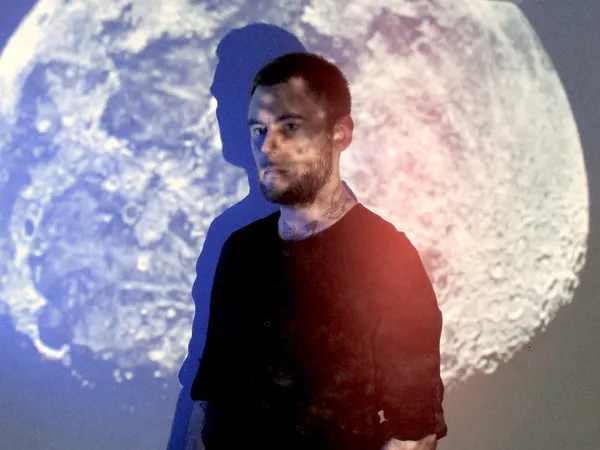
Jim “Rhizocorp” Osman’s music is awash with literary and cultural influences. The result is a unique mix of post-punk and dub that filters through a gauze of improvisatory DIYness in a really thrilling way. In anticipation of his Plymouth show on June 13th [tickets here!], I chatted to Jim about his interests, his multimedia work, and how this all informs his music.

How did you get into music and what led you towards performing experimental dubwave as Rhizocorp?
My dad used to play a lot of music in the car when I was growing up. Mostly Motown compilations, some Northern Soul, lots of two-tone, Johnny Cash and Rammstein. When me and my twin brother were between the ages of five and six, we knew most of the Rammstein lyrics. I had an MP3 player in primary school and it was a lot of going on LimeWire and downloading stuff, mostly my dad’s recommendations, which were primarily ’80s new wave. My favourites were The Cure and New Order. I remember my dad saying, “You might love New Order now, but when you’re older, Joy Division will be your favourite band,” which is absolutely the case.

Joy Division were important in terms of all the references to literature and philosophy. I think the ’80s post-punk scene has rubbed off on me primarily because so many of them came from visual arts backgrounds and applied deconstructed approaches, whether it’s William Burroughs-style cut-up collage or agit-prop storytelling.
Alongside music I’m an academic researcher, writer, and creative technologist specialising in speculative fiction (a fancy word for SF and fantasy) and media archaeology. I have an MA in opera directing and an obsession with baroque and early music, 1920s German modernism, as well as Slavonic classical music, so I jump over the French and Italian Romantic stuff; it’s not my scene. It’s the space between experimentalism and folk art that really fascinates me. What is now considered dance music is essentially folk music to me, and is fundamentally about psychosomatic processing.
I always wanted to be in a band and I tried a few in my teenage years, but it never totally worked out, probably because I was living in York. I was in a band with two Northern Irish guys in Leeds, more post-rock/math rock, called Man Fantastic and The Hand of God, named after an “ethical drug dealer” who bypassed the sectarian divide. I’d like to say rest in peace to bass player Stuart Doonan.
I also formed a band in London; we are still going, slowly. I was always searching for this sound in my teenage years. I had a very strong instinct for something that was both dance music and post-punk. The gig that changed my life was seeing Nisennenmondai, who remain the best band I have ever seen live; the show felt like 15 minutes and opened the Kosmische music floodgates.
A few years later having moved from my hometown of Leeds to London, not so much by choice courtesy of my family swapping their council house with someone else’s, I eventually formed this band called Spirit Data and the idea was that we’d have a very krauty approach where the bass guitar lines are repeated over and over in that signature avant-funk/no-wave disco sound. Teodora Kosanovic is a great bass player because she has a garage-rock, The Fall-style foundational approach but loves just playing the same riff over and over.
I basically started off in that band with vocals and FX, very alien and heavily effected, and a metal box with a spring on top and contact mics inside. I then started acquiring little analogue boxes that can make dub-siren-style one-shot SF sounds that I drown in delay and reverb.
Then eventually I got an SP-404MKII sampler. I found techniques where someone was using the SP-404MKII to emulate a dub mix and I thought, “Hmm, I can use this approach with post-punk and industrial no-wave weirdness.” So that’s how it came to be. The project was originally called Soborgnost.
Liminal spaces, cyberpunk, and science fiction all seem to be part of the Rhizocorp world. Did you have an interest in these things before the music? Or is it more a case of you having a particular sound in your head that you want to get out, and that these are simply the best words to describe the results?
Absolutely. I conceptualise my MA in opera directing like you might a fine art foundation. I am obsessed with folklore and mythology — not to confuse the two. Digital folklore is the early web: the webrings of GeoCities, the stories we tell about ourselves. The capitalist, algorithm-driven, soulless big web I consider the digital mythology, written by the winners. Something that influenced me from folklore theory; The tension between and interplay of the dynamic vs the conservative, which is a creative tension.
‘The cathedral and the bazaar’ — there is an interplay between the two, but I have a huge preference for folk art, the intangible, and the messages of resistance that are the weeds that grow through the concrete, emerging as a hideous Triffid, devouring the upper classes in the South of England, specifically Westminster; the Eye of Sauron, as it were.
And the name, Sobornost, is the Russian Orthodox concept of spiritual interconnectedness amongst followers of the faith, so I slapped a Latin G in the middle to bring the ‘Borg’ in there and make it about the spiritual interconnectedness of cyborgs. I since changed the name to Rhizocorp, taken from Matthew E. Gladden’s book Megacorp: From Cyber-Dystopia to Technoeconomic Reality, the Rhizocorp being the “technologically post-humanised megacorp”, “unmanageably large”. Everything I do is very DIY-inspired, RPG zines, experimental retro web design, etc. So the Rhizocorp umbrella is my dry sense of humour. My genre is post-cyberpunk magic realism.
In some ways my music is an exploration of my heritage, but not in an obvious way. My dad was born in Sudan, but his mother is from Nelson in Lancashire. She was an English teacher in Khartoum in the late 1950s and even shook hands with Haile Selassie I (she said he was very polite and very short). My mother is from Leeds, from a Jamaican family.
I was very influenced by Devon Rexi, who I interviewed for The Quietus, and their use of broken Farsi as a “language of the in-between worlds”, where estrangement from the language of origin becomes a creative space for worldbuilding. I’m inspired when I notice this Xenofeminism in music and art.
So whilst the work isn’t quite about identity in any obvious way, within the Rhizocorp tapestry are depictions from nightmares of Nubian Pendle witches.
With the themes above, it feels important to acknowledge the celebratory and unifying aspects of Rhizocorp’s music and live shows. How important is it, do you think, to have a sense of optimism in music and art?
Get Plymouth Experimental Sounds’s stories in your inbox
Join Medium for free to get updates from this writer.
I think ultimately it’s a hauntological music, which is about the repressed past coming back to haunt us -think Stone Tape Theory. Whether that’s German krautrock musicians processing what their parents did, or dub reggae as a medicine to release the trauma of slavery and banish negative energy.
So whilst the message is inherently about strengthening and centring the underdog, it’s also ultimately about working with the shadow and dealing with the horror of life in a way that can alchemise it into something. But you don’t achieve that by ignoring negativity.
I think this is also my autism. I’ve never been able to mask or code-switch. The Fool not only as neurodiverse/disabled, but as the one who, in the medieval court, speaks truth to power.
Improvisation is a big part of the live Rhizocorp experience. Is it a big part of the recording process too? Is there much of a gameplan when it comes to recording, or is it more about capturing yourself live in the studio, selecting the best bits, and creating a release from that?
Yes, it’s a dub mix, so as a rule I always have a post-punk bass guitar riff at the forefront of every track. Me and my producer, Jordan Parry, listen to a bunch of inspirational music and often take samples from things.
I’ll start with a bassline and send it to musician friends, telling them what the key and tempo is, and sometimes not even showing them what the song will sound like — just giving them the key and tempo without showing them anything else.
As me and Jordan are producing the album now, we take the stems and put them onto a desk in the studio and do a dub mix. We imagine the project might develop so that Jordan is playing the stems live with a dub mixer on stage. I still do my FX and vocals, but can focus more on the cinematic and performance elements, influenced by the performative and storytelling aspects of Gazelle Twin, for example.
When it comes to playing live, then, is this a largely improvisatory affair? What do you hope to get across to the audience when you’re playing for people?
I work with motifs, allegories and analogies. They’re offered as a gesture, so whilst they may come from a very specific space in my mind, I hope someone else may perceive the archetype(s) on their own terms.
To bring back Stone Tape Theory, the idea that ghosts and apparitions are memories stored in the stone of a building… I use a lot of electromagnetic frequency in my work. I also wear a Shungite pendant that supposedly blocks EMF. Some paranormal investigators believe that ghosts manipulate EMF and radio frequencies.
The sonic fiction (à la Kodwo Eshun) I’m playing with is that when I am playing with the EMF touch plates, I’m making contact with the energy and history of a location. I think there’s also something particularly British, post-punk and Northern about that if you think about all the references to M.R. James and Arthur Machen, and British folk-horror traditions in the lyrics of The Fall.
If I’m playing an old industrial venue in Sheffield, I like to imagine I’m literally sampling the memory of the building
Anything else you want to mention/shout out?
I’m designing a course on how to make and design solo RPGs (roleplaying games), which will be in person in London, so if you’re interested in that, please drop me a line.
I’ll also be doing more stuff with 8-bit microcomputers and interactive fiction, after my graphic text adventure game was exhibited at Coven LDN’s Arcade, a fantasy and SF-themed interactive exhibition at Hypha Studios in London.
The album is going to have an accompanying RPG that I’m publishing, so watch this space. If anyone is interested in being part of the playtest, send me a message on Instagram. And if you’re a fellow retro games and TTRPG obsessive and have an idea for a collaboration, please don’t hesitate to get in touch!
My album artwork is being designed by a great artist in Italy who goes by the alias Fat Gomez — check out his work. And many thanks to Italian DJ Brutta Botta who, under his publishing arm Strane Dizione, commissioned and printed the artwork.
I’d also like to say a huge thanks to Cabaret Voltaire for having me open for them in Sheffield — the best day of my life so far.
Also, many thanks to key influences including Bourbonese Qualk, J.G. Ballard, Philip K. Dick, the text adventures of Infocom, and the TTRPG writing of Robin D. Laws.
Rhizocorp performs at Images, Plymouth on Saturday 13th June. For tickets and more information, visit: seetickets.com