Back to Bed


I
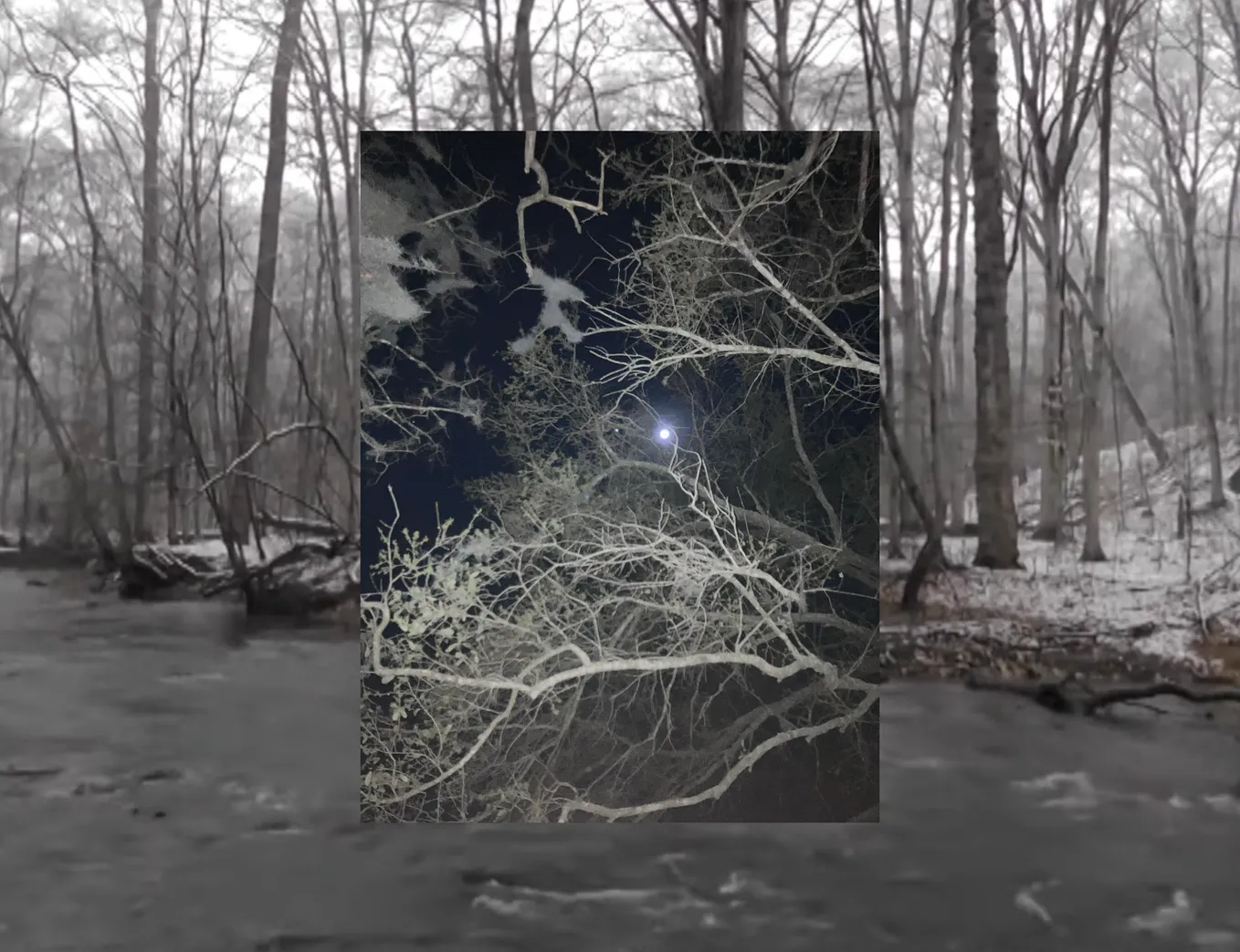
Where I watched from the balcony, on the top floor, the sun was up and over the city but in the distance gray clouds still clung to the snowcapped mountain ridges, giving the otherwise blue day a silver sheen. Lingering patches of snow marked the still-frozen areas of earth at the end of winter. Between the city blocks of aging apartments with their silver, corrugated roofs, bluish on the side shaded from the sun, some of them rusted, the still dormant branches of the trees jutted up like so many skeleton hands toward the blue sky. Among these ran various electrical wires. From where I was seated, two electrical wires that seemed to be precariously connected to the building somewhere over my head, above my hotel room on the roof, descended, forming a large V that divided the view up into three distinct sections. If one were to lean over the balcony, looking down along these wires, they connected to other rooftops, but where exactly it could not be discerned; rather, they just kind of faded into the distance though they were only affixed across the way. Sunlight obliquely struck the brick side of a building down to the left of where I was seated; a ways down the street the silver dome of the university building distinguished itself among the rooftops.
I finished a single shot of espresso. I wore my black Ray-ban Wayfarers as I basked in the morning light of a late winter day. Soon, all these trees would burst into spring. I had a book on the table beside me but I didn’t read. Another tome by Krasznahorkai. I merely finished the espresso (great for a morning surge of dopamine, my therapist had told me) and stared placidly into the sky.
Fifteen minutes later, I was down on the street. I ducked into the cafe next to the hotel and got another coffee, then opened up a newspaper that was left on the bar along the window.
Walking along the uneven cobblestone streets with the paper under my arm, I now was down among those skeletal trunks whose branches fanned upward toward the sun, but at this time of day, the street was still in the shadows, the dark edifices of 19th-century apartment buildings that were still occupied, uneven yet solid, with ground floors put to commercial use that their original architects could have never dreamed of.
I took a taxi down to the old city. I watched the city rush by, art nouveau buildings mixed in with Soviet Modernism. I got out by the river and walked up the winding cobblestone streets into the Old City, with its Art Nouveau houses piled on top of one another, with beautiful multi-colored wooden balconies, here a detail of preserved stained-glass windows over a stone wall innervated with dormant vines, there a wooden spiral staircase, damaged but still in use, behind which the spout descends next to some potted plants; it, too, is covered in vines. Here, a broken-down stairwell with patterns in the Islamic style, and there, some floor tiles of Villeroy and Boch.
I descended a brick staircase next to the bath houses into the ancient aqueduct, leading to a wide tunnel. An ancient canal ran beside the walkway and disappeared into a duct beside the tunnel. You could see from the road above in the square the various strata, from Soviet through Persian occupation to these Roman ruins down below or whatever they were, with echoes of Khwarezmian domination and Mongol destruction underneath and adjacent to the hustle and bustle of cars and pedestrians, showing that the living city was itself an excavation site. The canal contained only a small stream of water at this time of year that meandered through patches of green grass and piles of stones and pebbles, rubble on the muddy mounds. Vines climbed the series of brick archways that lined the far wall on the opposite side of the stream. Above, I saw the anachronistic, eclectic architecture, and below, the open-air aquifer system with its trickle of water, crumbling brick edifices, and stairway to nowhere topped with moss.
Pausing before the dark tunnel, an ancient brick archway into which a well-trodden boardwalk vanished, I felt a current of air flow out of it with the smell of earth. Ah, the beautiful, shambolic mess that was the city, the chaos of life, and many cultures stacked on top of each other! I wondered how the old city would be on the last day of summer, but here it was just the end of winter. What was I thinking?
I climbed back up the stairs and walked through the medina-like cobblestone streets, uphill through the old city, seeing the castle on the hillside, and felt the wind cut through me by the dazzling river at the end of winter and bare trees. I decided that I would try to pull an all-nighter and I’d make it to the show.
Inside the club, there was an atrium, a gathering hall. This club was literally underground in a sub-basement, a former bunker? One could hear the bass thundering through the heavy concrete walls, resounding around them and ricocheting off them through the doorways. The ceiling was low and naked pipes ran across it, white pipes that coursed across the ceiling and turned at right angles like the rectilinear gold filigree of microchips, or perhaps like a colorful ribbon cable, or rather the digital image of one that has been datamoshed and smeared at right angles. In any event there was heavy condensation on white pipes, which, as I mentioned, were not far above the clubgoers’ heads where they congregated in this kind of antechamber away from the dance floors. And it was brightly lit, but this was just the top level of various tiers to the room; that is, the room itself had a top level that was very close to the ceiling and the pipes, perhaps uncomfortably so, and then it dropped off to a lower level, and then another, like gigantic steps or drop-offs. There were a couple doors on the highest level that led to the dance floors; on the lowest level was the exit. More uncomfortably, perhaps all the concrete floors were covered in cream-colored carpeting. It was very warm in the club in the otherwise bitterly cold late winter season.
I recalled the sweating pipes covered in condensation, the tiers of the floor, and the cream-colored carpeting. In this scene, I stalked in a long beige trenchcoat, black turtle neck and dark, John Lennon style glasses. I had made up my mind to stay out at the club until the break of dawn, to be in the midst of the youth culture; I imagined dawn would be fringing the sky along the river, revealing those skeletal tree branches, just as I exited.
But after downing a Jagermeister with black currant juice, it was only not just five p.m. yet, and I decided to go back to bed.
But I awoke to find myself having slept. I must have slept early, maybe shortly after I returned from that underground establishment, must’ve fallen asleep before the sunset or was it just setting even, woke up in the bedclothes with my head facing the windows and the hall light on in the hotel room. It was otherwise dark, and there must have been the glittering lights of the city out beyond the window, and I woke up sobbing to myself because I missed her so, believe me I tell you I miss you so; the hall light was left on.
I roused myself where I lay beneath the warm comforter and sheets, and as my head swung up, I saw the dark outlines of the series of picture windows that ran along the wall looking out over the bay, dark now except for motes of orange streetlights along the coastal highway and then beyond the orange and white lights of a few boats sailing in the night.
The head of the bed was right at the base of these windows, with plenty of bookshelf space that ran beneath them, acting as a headboard. The room itself was wide enough, with a closet space along the wall to the right of the bed and one more picture window perpendicular to the rest, giving perspective in the daytime on the mountains and the sea and the city below. The hallway was to the left of the closets, and the light was still on. This is where the illumination spread out from into the room — a single electric lightbulb that was out of sight, illuminating the room with a slightly sunny, yellowish electric light. It presented itself as an invitation to oblivion. Like the hotel room scene in Hiroshima, Mon Amour, a solitary soul frozen under the incandescent light against the hotel room wall after a night of aimless wandering, the door left open, waiting for someone who would never enter, face to face with herself in the mirror of a midnight bathroom.
Across from the foot of the bed was another room separated by half-wall with a few rectangular spaces demarcated by beams or sections of drywall. The other room was recessed in darkness.
And as I reared my head up from the bed, sobbing deeply, chest heaving, I gradually swung my gaze around, past the line of dark picture windows, past the closet with its dark mirror, past the entry hallway from which the light spilled forth, around the half-wall and the black emptiness of its partitioned space, and into the shadows in the left-hand corner of the room and not all at once my sobbing turned into screams and I began to shriek.
II
“Oh, sorry I’m late. This is the dream analysis group, yes?”
I stood in the doorframe of the meeting space, which had cream-colored walls with boiserie and a full wall of mirrors.
All eyes were on me. The teacher merely smiled.
“You may take your seat.”
There were only six or seven people, and the chairs were set up in a semicircle. The teacher sat with her back to the mirror. Warm white woven blankets and circular white cushions were available to attendees. I padded one as I took my place in one of the chairs, smiling faintly.
An unremarkable pillar stood in the center of the room to my right. Near the far wall, on the other side of this pillar, was a standing crystal chandelier with six white bulbs meant to resemble candles. Half of them were out, but where the lamp’s image appeared in the mirror, it gave the impression of being fully illuminated because there appeared to be as many bulbs lit as usual, even though this wasn’t true. The lamp and its image seemed to be bisected into distinct spaces by the dark pillar that obscured one corner. The overall impression of the space was weird, with its half-illuminated crystal chandelier standing on the floor and its mirrored wall in keeping with the French baroque theme. Otherwise, the room was lit by a warm, off-white glow from the fixtures above. The carpeting and lighting made it feel like a mixed-use room, a conference space at an upscale hotel.
“Thank you all for coming today. For those of you who are new, this is our regular meeting of the dreaming group. If you answered this call, you are interested in sleep therapy. Maybe you have been having difficulty sleeping due to work pressures and the stress of daily life. Many people report difficulty sleeping due to life pressure. Did you know, for instance, that over half of parents today report feeling overwhelmed all the time? What are some reasons you have come to the group?”
One of the attendees raised her hand. “I lie awake at night sometimes with racing thoughts.”
“This is common,” replied the organizer. “What are they thoughts about?”
“Work-related and personal life. I lie there thinking, Oh my God, how will I get all this done? When will I find the time? What am I going to do?”
“Exactly,” said the organizer. And at that moment, I noticed that behind her was a large gong. Why was there a large gong in the room?
“In this class, we will walk together through guided meditation and healing, incorporating active suggestion and sound. You will achieve a sense of tranquility and calm, and you may even sleep and dream.”
I raised my hand.
“Yes?” she said.
“Hello. I am a writer. Science writing. A freelance journalist. I write about space and technology. I’m visiting the country for a story about dark matter. I also teach at a university. I saw your group advertised on the app. I understand work stress, deadlines, and insomnia.”
“And is that why you have come today?”
“Well, yes and no.” I paused momentarily, readjusted myself in the chair, and clasped my hands. “I’ve been having fitful sleep for a while, and it’s probably the job. But I used to be able to remember my dreams, and it’s become harder and harder recently. I don’t know if it’s job stress, or just that I’m getting older, or what. I wondered if there was a way to recall the dreams or if you could help me to analyze what I remember?”
“You are always welcome to keep a journal of your experiences after our guided sessions.”
“Is this more of a sleep therapy group? You said it was the dreaming group. I thought it was a group where we analyzed our dreams?”
“Well, not exactly.”
“Okay, well, what is it then?”
“I dream for you.”
III
Tangled in the sheets, beneath the layers, I tossed and turned vaguely, half aware, half awake, able to see and yet with eyes closed: she attempted to pull the covers from off me, from over me, but I was still asleep, and yet I could see my world of dimly illuminated white sheets, with their contours of folds, light, and shadows playing in the folds, a world cocooned and insulated from the truth.
In truth, what I felt, besides the fear — terror of seeing the impossible — was the expansion of the interstices between the joints of my body, as if feeling the space within my body expanding, every vertebrae and joint, every joint in my wrist and ankle, stretching, and breathing, the feeling of finally taking a deep breath, and feeling the breath move into the extremities of my body, expanding the joints, of sleep, falling into a torpor, restful sleep, pushing the chemicals out from my brain and replenishing, but afraid to allow it to go too far, to feel too refreshed, too free — freed from my physical form and see through the swimming light of watery space, some release from my body from my form, letting go.
Get Pure Villainy’s stories in your inbox
Join Medium for free to get updates from this writer.
Thus, I tangled with her there beneath the sheets, eyes closed but still seeing, and grappled with her hand where it sought to pull back the covers, the blanket, the bedsheet, parrying it off, tossing first right, then left to deflect her efforts, and she would relent.
She tried to pull them off me, from over me, to see me, pulling them to a point above my outstretched hand, but I was not ready to see her.
“I can’t help but feel that in my right foot, in particular, this joint cracking (like cracking a knuckle) is connected to loosening and gradual extension of the right ankle, which is connected to other things like low back pain.
“My feet are okay. They don’t hurt; I’m just surprised that this joint is popping or cracking as if I were to crack my knuckles or toe joints. I take it to mean that there is an expanded space around the joint, and I attribute this to the exercise routines in yoga, activities like walking and running, and some pressure at work being relieved.”
“That’s good,” she said.
We sat at a cafe around the corner from the meeting space. I asked the teacher after the class if we could talk some more because it turned out to be interesting, although I didn’t remember anything because we mainly slept. And I had vague dreams that I don’t remember. But, after all, her promise at the beginning of the session was that she would dream for us.
I had tried to go out to the club and failed. It was a couple days later, and I saw the class advertised on the fitness app , and since I was in a free trial so I thought what the heck. I had been having trouble sleeping.
“Please go on,” she said.
“I’m saying that through yoga, I believe it is possible to expand the space around a joint, e.g., by strengthening and stretching my right foot it may gradually help to alleviate tightness in my right hip.”
“Well, we are trained to think about strength as tensing up as much as possible,” she interjected.
“I’ve noticed that the real progress seems to come in yoga when I release and relax, but it’s counterintuitive. At the same time, sometimes I will see women I practice with regularly who just stick a position and exhibit a range of motion that is beyond my understanding.
Often, now that we are in summer term and things are more relaxed, the stress of classes has mostly abated. When I awaken lately (and this is often facilitated by the morning after therapeutic yoga or perhaps a run), I can feel the joints cracking between the metatarsals and phalanges that extend from my big toes, I think, between the proximal phalanx and the sesamoid bones, from the act of lying on my stomach and rolling the insteps inward, in a liminal state of dozing.
Ah, yes, the first metatarsophalangeal joints.
The hermit card was the last card I pulled from my deck four years ago before leaving for Europe. I know this because it’s still out of the deck, lying on my bookcase back home in America. It’s my Crowley Thoth deck. The Hermit is Atu IX. From what I can vaguely recall from the shadow tarot circle in Portland, the major arcana has two phases, and the Hermit is toward the end of the first cycle. But the memory is fuzzy.
Sure, psychotherapy can lead to lying awake at night because it can stir up all kinds of things, heightening anxiety. But that is also for me to deal with — no guarantee that sessions won’t bring up something. I do, however, appreciate your concern. A typical bad night perhaps includes lying awake and can’t get comfortable between 6 AM and 8 AM. Back and forth to the toilet. Grueling. Juliette snoozing. Congestion, racing thoughts, back pain… But also kind of laughing.
I’ve learned to take rest where I can get it. So maybe if there are sleepless hours, how I am learning to deal with this is through just laying there. I don’t believe in getting up and being productive or reading: I can never get anything meaningful done when I’m tired.
So I lay there, rest, manipulate my joints, my back and neck, my proximal phallanges…
Waiting for the right moment to get back at God.
The healing starts when I set proper boundaries and follow a regular sleep/wake cycle.
“Well, I’m a science writer,” I said. “I write about space and astronomy and physics and stuff like that. Black holes, dark matter, all that good stuff.”
I stirred my coffee. It was a bright morning, still cold, but spring was in the air. I would leave the next day back for home.
“They took a picture of a black hole a few years ago for the first time,” she said. “It’s something, don’t you think?”
“How do you take a picture of nothing?”
“Exactly,” she said. “Ex nihilo nihil fit style conjecture.”
I laughed. “I thought, I’ll believe it when I see it, and then they really did it.”
“It’s almost counterintuitive, taking a picture of an absence.”
“I’ve made mistakes. I flew to Siberia to interview a reclusive researcher but then couldn’t get a hold of him. They also say that dark matter may be making up the majority of matter in our universe, something we can’t see that doesn’t even interact with light, but it emits gamma rays sometimes.”
“Five percent,” she said. “They say that only five percent of the universe is made up of visible matter and light. There’s a theory that it’s a relic from shortly after the Big Bang when another universe made up of dark matter separated from ours, so hypothetically, if we’re searching for dark matter, there’s an astronomer made of dark matter in the universe of dark matter, observing us right now.”
“Did I mention I almost got hit by a car while I was running yesterday evening?”
“Oh? Are you alright? How did it happen?”
“I like to listen to music, and I am alright, though he came close enough that I cried out in the street from shock if you can believe it.”
“You have to be careful. People drive like crazy around here and especially at night it might not be well lit.”
“Mmm hmm. Well, it was well-lit, and normally this is not a problem. I’m careful, though I do listen to music too loud. I was in the crosswalk. And I made sure no one was coming from the right. But you know, the turn off just before the crosswalk is a bit of a jackknife, and so since I hadn’t thought to look left, and the cars turn out fast, and I suppose, he must have been distracted, a taxi…”
“I see. A bad set of circumstances.”
“But you know, after that, I was shaken up, and I ran past some people coming up the hill, and I was fairly sure I was far past them, and I looked back and I could have sworn they were still behind me. Odd, I thought, but then I looked back again and no one was there.”
“It could have been a tree.”
“Yes, I suppose.”
The healer laughed and it was a tinselly laugh, almost metalic like wind chimes, perhaps slightly derisive, but mainly amused. Then she looked down at the table and shook her head, smiling fondly to herself, fingers holding the stem of her wineglass. She had opted for red wine.
Then she looked at me and smiled.
“Who do you think it was?” she asked.
My mouth slightly open, lower lip beginning to tremble, eyes starting to well up, I was at a loss for words.
“Whatever it was, that was long ago, and far away. That energy is at its end; it can’t follow here.
“Thank you for coming to our group,” she said, standing and pushing in her chair to excuse herself. “Thank you for sharing.”
Back at the hotel, I saw the black bay with the few tiny lights of sailboats, stuck pixels in a vast, black jumbo TV, as I thought of our conversation earlier that day, after the group therapy.
Beyond the few points of light, the lost horizon.
Sept./Oct. 2024