In The Shade of A Shadow

IN WHICH “LIFE IS UNFAIR” IS TRACED BACKWARD TO ITS PAGAN ROOTS AND FORWARD TO ITS CONSEQUENCES IN THE SHADOW, PASSING THROUGH GNOSTICISM, AUGUSTINE, JUNG, AND THE PARADOX OF FAITH
Introduction
Why do religious people become atheists? Why is arguing with them usually pointless? Is “Life is unfair” a philosophical proposition or merely a cry of pain? What is the difference between God and mystery? Why does the denial of evil strengthen evil? Why are puritanical religious movements psychologically similar to obsessive-compulsive disorders? Why do followers remain loyal to failed prophecies? And what, finally, does faith actually demand of a human being?
This essay begins with reactive atheism and the problem of evil, not as questions of philosophy but as expressions of suffering. From there it traces a common psychological and spiritual pattern linking paganism, Gnosticism, scientific naturalism, and contemporary unbelief. Through the Book of Job, Augustine, Jung, the Qur’an, cognitive dissonance theory, and the phenomenon of the Shadow, it examines the relation between good and evil, faith and unbelief, certainty and doubt, orthodoxy and fanaticism. The argument culminates in an exploration of the Fall, initiation, suffering, and the paradox of faith itself: that man must confront evil rather than deny it, integrate the shadow rather than project it, and perform even God’s share of the work while attributing the action to God. Ultimately, this is an essay about the meaning of suffering, the psychology of belief, and the necessity of confronting non-being if being is to possess meaning at all.

In The Shade of a Shadow
When one has spent an entire life under a childish conception of God, then for an outwardly very religious person to become an atheist and the like is a natural occurrence; that there should be no sign of it would be surprising, not the opposite. That is: a man says, I used to pray, I used to fast, but now my trust has been shaken; such attitudes do not astonish me in the least. For example, when a nonreligious or a sinner turns toward religion, we rejoice, but we do not think that the reverse is equally natural. Where God serves as a justification for weakness, such a thing is inevitable. For example, a person knows and believes that anything can happen to anyone at any time; if, in a period of ease and happiness, the problem of evil were placed before him, he would present the whole doctrine that this world is a trial and so on, but when it happens to him, he says:
Life is unfair!
The implications of this expression are without number. That is, life was once “fair,” and only now has the feeling of its being “unfair” arisen. When our Mr. Neo-atheist was religious and saw the suffering of all those around him, he would tell us that the world is a test, be patient, and so forth, but when it happened to him, when he tasted the bitterness of life, when the shell of responsibility exploded, suddenly the injustice of life came to mind.
A certain Western, perhaps English, theologian lost his beloved granddaughter in an accident. Someone asked him what he now thought of God’s mercy. To this he replied in his characteristic British accent:
“I have spent my whole life seeing, every day, how many such little girls perish, but now that it has happened to my granddaughter, should I lose hope in God?” ¹
Thus every person who suddenly becomes indifferent toward God because of some great tragedy, sorrow, or mental turmoil already knew, before that particular event or moment, that far worse things regularly happen to people; life is unfair, he already knew it, hee knew what had happened at Karbala ², he claimed to accept that God is powerful over all things, but as the necessary consequence of that belief, when the time came to endure the blow of fate himself, the question began to arise: why did this happen to me? But when you were watching all this happen around you, and accepted the possibility that you too might become the target of the arrow of destiny, why did this question not arise then?
The first two are interrogative sentences and the third an exclamation, but neither are genuine questions, nor a search for facts, nor a statement of reality.
All of them are a cry of pain and anger: this should not have happened to me, God should have treated me differently in return for my religiosity, my worship, but the miracle I expected did not happen, so fine, I am angry, I do not believe. And some of our simple-minded ideological gentlemen begin debating such people; I would submit that questions of this sort from agnostics and the like are exclamations of astonishment, lamentations and cries, not serious subjects raised for the sake of knowledge. Thus when a question wrapped in such emotion, rather affective, covered in the cloak of words, comes before you, one example of a response is this:
“This world is a trial.” ³
But it is the questioner himself who is truly under trial. Your answer is insufficient either to help him digest that calamity or to cure the narcissism that desires special treatment. The person is in dukkha ⁴. And explanations of this kind make the problem worse. To address them, the one questioned must stand with great firmness upon an exceptionally high moral plane, that is: upon that perfection of being where, having embraced non-being, one accepts that the questioner’s pain, his affliction, is truly of such a kind that faith itself may tremble. Without validating existential crises and the human condition, without feeling them on the emotional level, every rational, intellectual, and scholarly answer is mere babble, because the nature of the question is emotional.
But what happens instead is that God’s knight-errants leap into the field against some atheist, in a situation where that atheist has come bearing the banner of rebellion against a God whom he once believed in, regarding the religious party as God’s army commander, thus if he wins, he feels a certain satisfaction and, finding no answer to his question, considers himself victorious and if he discovers that an answer to his question does exist, then instead of approaching it with humility, he will confront it with the same aggression, because the problem is not the answer to his question; the problem is not that he seeks truth and wants an answer, nay, the problem arises precisely when an answer appears that, in his estimation, could genuinely be a possible answer to his question, he takes it as an attack upon his hollow interrogative existence and sets out with even greater intensity to reject that God whom, according to him, does not even exist.
Because his skeptical attitude and atheistic creed have themselves become his identity, that is, he is like those chicks newly emerged from the egg who are nothing but the beak; the difference is that, unlike them, he wishes always to remain hungry so that he may forever preserve a justification for denying the existence of his mother, the source of his being. And the pleasure of glib rhetoric and disputation creates an addiction that repeatedly compels him to preach his suffering, the pain of the immature child within him, and to defend it, that is, the pain God has given him, he wishes to return to God, indirectly, by defeating God’s knight-errant. ⁵
And if, on the other side, our divine herald armed with the contingency argument wins, then the threat to the believers’ faith is removed, a feeling of victory is born, and even if the atheist loses, he consoles himself by seeing himself as a defeated yet still valiant warrior in the war against God, thus both sides enjoy the delight of victory, while a sensitive human being receives a justification for continuing to avert his eyes from the suffering necessary to produce the courage required to wrestle with the problems that confront him every day.
Let us consider this sentence once more:
Life is unfair.
That is, life has become such a burden that its pain itself is the axis and center of consciousness; that it is unfair. The meaning of this is that life, this world itself, is everything; it alone is the standard, to it alone belongs permanence, and it alone is worthy that, taking it as the touchstone, one decide whether to believe in God or not believe in God, that is, this world itself becomes a god beyond God, and the verdict concerning unbelief and faith will be sought only from this newly fashioned god (we are subsuming under this even the denial of the implications of faith, even if they relate only to action). In exactly the same way, when ancient man cast his gaze upon the phenomena of nature, overwhelmed by its beauty, its loftiness, its majesty and splendor that dazzled his eyes, he took that very mysteriousness and hiddenness (mystery) to be the divine. In the same way, the Gnostics ⁶, seeing the negative aspect of this awe, declared this material world to be the creation or manifestation of the anti-God, the demiurge Yaldabaoth ⁷, and regarded liberation from this vulgar reality through esoteric gnosis ⁸ as the purpose of life. On one side the universe is an emanation of God, on the other side, of Satan. But the matter is one and the same; the center of all striving is still nature itself, the only difference is that one takes it to be God and, singing its praises, wishes to be absorbed into that unity itself, while another takes it to be Iblis and, reviling it, wishes to be freed from that satanic multiplicity. The locus of both is one and the same; one group is expending all its energy in going toward it or bringing it to itself, while the opposing party, with the same intensity, is attempting to drive it away or go away from it and, not wishing to do so, is nevertheless proving it to be the center of its life.
This is shirk ⁹ (i.e., associating partners with God, the greatest sin in Islam). The condition of scientific naturalism is the same whose most adherents regard the universe itself as the standing and self-sufficient thing-in-itself, taking it as its own creator, and man and his world as its emanation. One group among them wishes, like the Gnostics, to conquer it, to free itself from its constraints, and through its inverted efforts has invented the atomic bomb, sex-reassignment surgery, and the like, ‘filling land and sea with its corruption and mischief’ ³¹ and leaving the earth unfit for habitation. And another, less harmful, group of these same naturalists, seeing divine attributes and consciousness within the universe itself, exhorts men to respect it, preserve it in purity, humble themselves before it.
Now if you reflect, the atheist or agnostic who has fallen into reaction is also a naturalist of precisely this kind, one who has only now attained a Gnostic gnosis that Life Is Unfair, and through revelation there has appeared to him, with regard to the problem of evil, the same thing that appeared to his ancient predecessors: that this world is the creation of a tyrannical god, Yaldabaoth, therefore salvation lies only in walking the path of its denial. That is, the world’s misery or comfort becomes the measure according to which God is affirmed or denied, therefore this is equivalent to fashioning a god beyond God. Can that for whose sake God may be abandoned be anything less than God?
Thus the atheist’s locus remains the same. Before, the world was below and God above; now it is the reverse.
Life is unfair.
I am not calling this utterance explicit shirk here, particularly when a Muslim says it, but it is certainly a reflection of a particular mentality, of being affected by the world and taking it as the criterion of honor and humiliation, of falling into deception and doubt, against which the Qur’an has warned.
But the contention of the Abrahamic religion is that mystery is not God ¹⁰; rather, it is a manifestation of God’s presence, the majesty of nature is a sign of the Majestic God, not God Himself. God is that which lies beyond this locus, that which, while amplifying and displaying the unfairness of the world, while showing oppression and injustice, nevertheless demands that He be acknowledged, he shows oppression, and when a man, expressing anger, raises a question, He silences him by showing him Himself, and wishes this paradox to be accepted: life is unfair, but despite this, I, the Creator of life, am not unfair; that is God. If you pass by a man writhing on the edge of death whom you could save, but despite possessing power and means you do not save him, then you yourself are his killer, yet before God such things happen every day and He remains silent; the prophets knew this as well, yet they remained silent before the majesty of God. They knew that God is indeed mysterious, but this mystery is not God; God may remain silent whenever He wishes, He may speak whenever He wishes, no question or objection can be raised against God; He is beyond human and mental categories. The entire Book of Job raises this question by placing Job’s suffering before us: why do bad things happen precisely to good people? In other words:
Why Is Life Unfair?
To this God answered with the thunder of a storm:
“Where were you when I laid the foundations of the earth?” ¹¹
That is: look upon this entire universe and then look upon yourself; am I answerable to you? Look upon this darkness stretching across light-years and the islands of light floating within it, have you discovered their secret? Has this mystery been opened to you and have all riddles become clear, such that concerning only one remaining matter you question Me? Did this enigma trouble you even when you saw a hunter snatch away an innocent sparrow and its chicks, all beak, perish from hunger and thirst? Only now, when your granddaughter has died, have you understood that life is unfair, or asked why evil happens to the righteous?
That is, when, in the depths of suffering, you cast your gaze upon the universe and question it, in reply there will come only silence and an awareness of your own cosmic insignificance, therefore, the one whose diety is mystery has an impersonal object of worship as well, and from it no answer can be expected, frrom this arises pessimism. Consequently, in whatever doctrine or philosophy the universe and its hiddenness are granted fundamental importance, its end will be pessimism and its remedy will be declared to be asceticism. But the conception of God presented in the Abrahamic religions is of a deity beyond theology, beyond language and discourse, beyond mystery, beyond the beyond. He is free from our categories of good and evil. The ancient pagan, crushed beneath the sublimity of nature, could never, like the Preacher, son of David, say:
“Vanity of vanities, says the Preacher, vanity of vanities; all is vanity.” ¹²
When knowledge of the true God beyond mystery is attained, man humbles himself before God in place of that mystery, only then does the vanity and futility of the world become clear, only then can he say:
“All is vanity.”
But for the pagan, for the one upon whom it has only now been disclosed that life is unfair or that the world is a trial, this is impossible. The pagan and the materialist are alike in this: neither can turn his gaze away from the world, but it is the Qur’an that tells us:
“Every soul shall taste death, and you shall be paid your full reward only on the Day of Resurrection. Then whoever is saved from the Fire and admitted into Paradise has indeed succeeded. And the life of this world is nothing but the enjoyment of delusion.” ¹³
And:
“Know that the life of this world is only play, amusement, adornment, mutual boasting among yourselves, and competition in wealth and children. It is like rain whose growth pleases the farmers; then it dries up and you see it turn yellow; then it becomes scattered debris. And in the Hereafter there is severe punishment and forgiveness from Allah and His pleasure. And the life of this world is nothing but the provision of delusion.” ¹⁴
Thus man’s gaze rises from mystery and calls upon its Creator, when he accepts the reality that has been disclosed by Him, when he internalizes it, he no longer requires the depths and layers of that sentence which we have repeated so many times above:
Life is unfair.
Now after this elaboration, our purpose is to complete the matter with which we began.
In our view, Christianity, at least in the form of Saint Augustine’s doctrine of privatio boni ¹⁵, is not correct. What is meant here is that evil in its own reality is nothing; it is merely the absence of good, just as darkness is not a thing but only the absence of light, it is not a concrete thing but something relative, and possesses various degrees. In the same way that cold is not a thing, it is merely the lack of heat, thus water from a tap feels cold in summer and warm in winter relative to the temperature of our bodies, otherwise there exists no thing called coldness, it is only the degrees of the diminution or absence of heat,even an extremely cold frozen object is not, scientifically speaking, devoid of heat, this is called entropy.
Thus within Christianity evil and darkness possess no existence of their own. They are only the result of distance from the supreme Good and Light; we are not discussing the metaphysical aspect of this doctrine here, rather, what concerns us is the sort of consequences produced by such a view, or by its opposite.The necessary consequence of denying the existence of evil is that one must go on filling the void with goodness and go on lighting lamps in the darkness; evil will disappear of itself. Yet despite the Gospel’s extraordinarily comprehensive teachings on forgiveness and forbearance, this doctrine culminated in the Crusades, the mutual hostility of Christian sects, and ultimately the World Wars: the very thing whose existence was denied became dominant.
The same problem lies at the heart of all self-help literature.
James Allen writes in As a Man Thinketh ¹⁶:
“The aphorism, ‘As a man thinketh in his heart so is he,’ not only embraces the whole of a man’s being, but is so comprehensive as to reach out to every condition and circumstance of his life. A man is literally what he thinks, his character being the complete sum of all his thoughts.” ¹⁷
According to him, the individual consciousness and ego-complex are the whole of human existence and there is nothing beyond them. And the whole of the human mind is in reality his conscious thoughts and ideas. It is like a driver who may turn the vehicle wherever he wishes i.e.,when I say “I,” this is the whole of my selfhood, the ocean of the unconscious is nothing, the irrational drives of nature are unreal and insignificant, while the reason generated by them is the true reality. This is the spirit of today’s so-called motivational culture and the lifeless mentality of “positive thinking”, even scholars such as Maulana Wahiduddin ¹⁸ fell prey to it, so that a great portion of their literature was sacrificed to the hairsplitting of the depths of this superficiality and even went so far as to say that the heart is nothing but an instrument for pumping blood and presented himself as an advocate of a self-fashioned “brain-based spirituality.”
When a man denies that there are forces within him beyond his control which may influence him, one example of the result is the religious man who claims piety yet becomes afflicted in the act of the People of Lot ¹⁹ i.e., when one speaks only of God, looks only toward the light, converses with the heavens while discoursing continually upon goodness, then within the earth of his own being the seed of evil is planted, from it many dragons emerge and, becoming demons, drag him into some pit and he ‘falls from the heavens only to become caught in a date-palm’. It is this very thing that Jung described through the archetype of the Shadow, and he made clear that for every person the bringing of his unconscious shadow into consciousness is a moral problem. And Jung insists that evil, the shadow, possesses existence just as light does, or at least that without acknowledging its existence it is impossible to protect oneself from its incendiary effects.
Thus when motivational speakers say, “You can do anything,” “You can achieve whatever you desire,” and so forth, and someone actually succeeds in doing so, he comes to be crushed beneath the weight of his own toxic positivity, the result appears in the form of various mental and physical illnesses, thus in this context depression is produced not by negativity but by its absence, namely positivity; it means that you are moving continuously in one direction and there is no one to stop you, you are conquering success after success, passing through one triumph after another, while its opposing force, negativity, is accumulating within you in the form of the Shadow, sometimes through dreams, sometimes through depression, anxiety, and the like, it continues attempting to warn you but when you do not listen, it explodes with a single detonation and, like an atomic bomb, reduces the entire structure of the personality to rubble through moral or clinical illness, i.e., pneumatopathology.
For example, there is a table resting upon the ground, the force with which it presses upon the earth is positivity,b ut the earth exerts an equal force upon it; that is negativity; in the same way, whatever a human being consciously does, an opposing energy is also accumulated I.e., the sum-total of this energy becomes a daimon ²⁰, a demon of one’s own. You cannot eliminate negativity, if you do not give it a place within consciousness, it will remain in the unconscious and plunge you into addiction; anger will arise without cause, envy will emerge, laziness, greed, difficulty in making decisions and continual procrastination, anxiety, depression, obsessive thoughts will come into being, religious and ideological violence will appear, certain people and groups will become objects of aversion and irritation, and this anger will not be harming them; it will be harming you. You will continue projecting, saying that circumstances are terrible, that a certain person’s intentions are impure, that another envies you, that someone is plotting to deceive you, and all the while you will be acting under the dynamics of the unconscious. Consequently the attention will never turn toward asking: what defect is there within me that all of nature appears to stand against me?
And here I repeat once more that this occurs not because positivity is too little, but because it is too much, in order to balance it, an equal negativity has been compelled to arise.
Thus on the same page of As a Man Thinketh the author writes:
“In purity of thought, joy follows him As his own shadow-sure.” ¹⁷
That is:
شب کو مے خوب سی پی، صبح کو توبہ کر لی
رند کے رند رہے، ہاتھ سے جنت نہ گئیAt night he drank wine, deep and freely; in the morning repented. Yet the libertine remained a libertine, and still, paradise did not slip from his hand. ²¹
That is, merely set right the petty calculating, clerical mind of addition and subtraction, and even your shadow will become your companion. Thus we have seen the consequences of denying the existence of evil. It is better, then, that we acknowledge its existence.
The Qur’an says:
“And if some good befalls them, they say: this is from Allah. But if some evil befalls them, they say: this is from you. Say: all of it is from Allah.” ²²
And:
“By the soul and He who fashioned it, then inspired it with its wickedness and its piety.” ²³
Thus it becomes clear that both good and evil are from Allah.
If, then, we free ourselves from privatio boni and from the sermons of many of our contemporary preachers, we shall find that the greatest evil appears within the righteous themselves. For example, what is the opposite of faith? Unbelief. And what is the opposite of tawḥīd? Shirk.
Thus in this context, merely adopting faith consciously will not abolish unbelief, nor will adopting tawḥīd eliminate the polytheistic impulses within, because shirk is by no means merely the absence of tawḥīd, nor is unbelief merely the absence of faith. Therefore within every believer there will be found an unbeliever in the form of his unconscious shadow.
Get Qamar Asghar’s stories in your inbox
Join Medium for free to get updates from this writer.
Now for a Muslim monotheist to admit that within him there are also exist shirk and other gods is worse than death, for this is the one sin whose forgiveness is denied even before God. Thus the expression of this negativity emerges unconsciously in the form of an intensely certain, superficial religiosity and violence in which one clings to a highly geometric, architectonic list of doctrines, protects it, fights for it, becomes prepared to kill or be killed for it, at one moment he raises the banner of the Finality of Prophethood and the Honor of the Messenger ﷺ, at another the Defense of the Companions, calling this attitude an honor for faith, he piles up arguments from reason, knowledge, scripture in its defense, and our knight-errant receives from his co-religionists the title of conqueror, he becomes a manifestation of the Collective Shadow.The slightest deviation from his architectonic list produces uncertainty within him, from this arises the fear that a breach may appear in the circle he has constructed for himself — it is precisely like the circle of the obsessive-compulsive patient, the moment he touches something with his bare hands, the integrity of that circle is threatened, thus he washes his hands with soap a hundred times a day and if he does not do so, he remains afflicted with severe anxiety that he cannot endure, in order to dispel it he learns to repeat certain behaviors so that he may escape panic attacks and preserve his circle and fortress — thus, denying this uncertainty and the fear generated by it, he begins excluding from the circle everything, every person, every doctrine, that stands against his intellectual structure. That means, in debate he wraps the Other in the unbelief within himself, he is fighting against the fear of being himself an unbeliever, a polytheist, a weak believer, he is washing his hands with soap a hundred times a day.
What is actually occurring is this: within our brains there exist warning centers responsible for identifying threats. Let us first name them so that discussion becomes easier:
- Posterior Medial Frontal Cortex (pMFC)
- Dorsolateral Prefrontal Cortex (DLPFC)
- Dorsal Anterior Cingulate Cortex (dACC)
Thus there exists within the brain a center called the pMFC, two especially relevant components of which are the DLPFC and the dACC. Let us think of the former as an eye, a third eye, which constantly monitors threats, when it detects danger, it also prepares the means by which you may protect yourself from it and remember that your intellectual structure is tied to your bodily structure, therefore it too is defended in much the same manner.
To understand this, let us travel for a moment into antiquity. You are a member of a tribe engaged in conflict with neighboring tribes, you have a supreme god, a national deity, who is at war with the deity of your enemies; in those times the individual could not maintain an existence separate from the collective, separation from one’s tribe was therefore an existential danger, to combat this danger the brain developed a mechanism, one whose expression remains within us to this day through these structures. Now imagine that a member of a hostile tribe arrives and begins preaching his religion, or presents a doctrine contrary to your tribal creed, what may result from this? Uncertainty, weakening of absolute faith, separation from the tribe, hostility from one’s own people, the wrath of one’s god: death!
Thus the pMFC will present every such foreign or alien person through the lens of fear, the dACC immediately becomes active, identifying possible dangers, warning against the threats arising from uncertainty: heresy, tribal hostility, eventual death, portraying every such individual, deity, doctrine, and people as an intruder, a pathogen capable of challenging your certainty and placing it in danger, consequently it signals the DLPFC, producing a form of mental tension and disharmony known as cognitive dissonance an in order to remove this discomfort, you either struggle against the external threat or begin collecting arguments in defense of your religion, tribe, or god, because you fear separation from your tribe, that is, from the center of your life- an existential danger confronts you.You then feel relief by becoming more firmly rooted in your previous belief and by triumphing over the opponent, you imagine that you have saved your religion, in other words — yourself — from fear, from the possibility of unbelief and shirk already present within you, from betrayal of your god and community, from Hell — from death. Thus whenever a person hears a doctrine for the first time, feels threatened by it, then dismisses it and clings more firmly to his previous belief, or even advances one step further and begins actively defending that belief, this is an example of cognitive dissonance and of attempts to escape it. The defense of the Companions, the defense of the Ahl al-Bayt, debates with atheists, refutations of unbelief and heresy are often examples of this phenomenon.
(The neurological claims here are, to some extent, speculative.) ²⁴
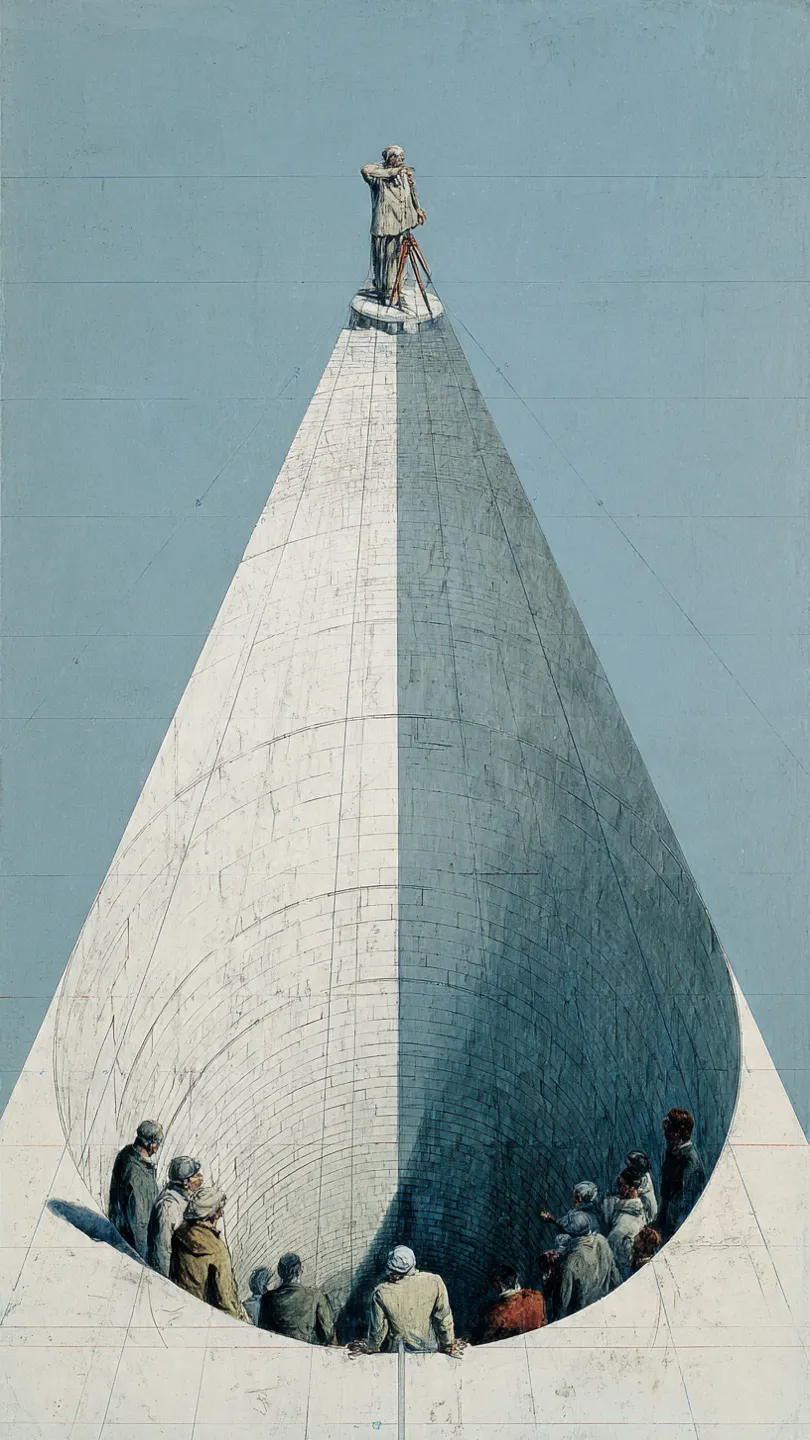
Consider the Athenians: they are a people, Zeus is their god, Together they inhabit a circle, and above them rises a conical triangle — Mount Olympus — where their deity stands guard over them. Below is the nation, above is Zeus and whatever lies outside that circle is therefore the enemy.
Research has suggested that if these regions of the brain are temporarily disrupted through Repetitive Transcranial Magnetic Stimulation (rTMS), belief in God weakens, but simultaneously racial and national prejudice decline, threat-detection becomes less pronounced, and greater flexibility and acceptance emerge toward strangers and unfamiliar people. Common observation tells us that prejudice is found most intensely among extremists, whether they are the religious ones or those who have made nation and country into gods.
And the pMFC, together with its two components, forms part of the Cortico-Striato-Thalamo-Cortical Loop (CSTC), disruption of which is associated with obsessive-compulsive disorder (OCD) and related conditions. Perhaps you can now see the resemblance between the psychology of rigidly puritanical religious and nationalist groups and the psychology of disorders arising from dysfunction in this circuitry (though these observations are, to some extent, speculative) and if, while reading this, some other sect, political party, or ideological opponent has come to mind as an example of the phenomenon, then you have not yet escaped projection, and this essay has been written in vain.
It is also because of this loop that we wish to expel those who think differently from ourselves from our circle. One might place Freud’s superego in this same pMFC, and it may also be regarded as the seat of Nietzsche’s herd morality. It is this mechanism that binds a man to the other members of his tribe through the thread of solidarity, protecting him from danger through feelings of guilt and remorse, perhaps this is why the gravest sins are often those that threaten the community as a whole, and why the voice of conscience condemns them most severely, both for the individual and for the collective. It should be remembered that we are not speaking here about the ontic status of sin, psychology, not theology, is under discussion, otherwise we shall fall into the error of confusing mystery with the mysterious.
As an example, I should like to mention the Christian denomination known as the Seventh-day Adventists. Their leader, William Miller, predicted that Christ would return on 22 October 1844, people even sold their homes. Naturally, what happened was what was bound to happen: there was no return. This event is known as The Great Disappointment. Logically speaking, the movement should have collapsed on that very day, yet you may be surprised to learn that it still has more than twenty million adherents. Whenever the prophecy failed and Christ did not return, accepting that fact in its entirety would have meant admitting that a lifetime of devotion had been wasted, that one’s existence had been sacrificed to a falsehood, and that the communal bond created by the belief-which served as a source of life for every member of the sect-would disintegrate, each individual would be forced to reconstruct his life from the beginning. To escape the pain of acknowledging this truth, the Great Disappointment produced cognitive dissonance, in order to compensate for it, the leaders of the movement declared that Christ’s return had indeed occurred, but in a heavenly or spiritual sense, thus the movement survived and continues to this day.
Something similar may be found in the Gospels:
“Truly I say unto you, there are some standing here who shall not taste death until they see the Son of Man coming in his kingdom.” ²⁵
“Truly I say unto you, this generation shall not pass away until all these things take place.” ²⁶
“Then we who are alive and remain shall be caught up together with them in the clouds to meet the Lord in the air; and so shall we ever be with the Lord.” ²⁷
That is, the picture emerging from the pre-70 CE Gospel traditions appears to be that Christ’s return was expected before the passing of the present generation, young people would witness it before reaching old age. Even in the letters of Saint Paul, which predate the Gospels, the same impression is present. The end of the world appears to have been expected within their own lifetimes, as the above quotes indicates. But contrary to expectation, instead of the return of Christ came the destruction of Jerusalem at the hands of the Roman Titus. It is possible that, as a consequence of cognitive dissonance, the Second Coming came to be understood metaphorically or was given a spiritual interpretation. For example, in the Gospel of John, written decades after the fall of Jerusalem and often called the “spiritual Gospel,” we read:
“Woman, believe me, the hour is coming when neither on this mountain nor in Jerusalem will you worship the Father… The true worshippers shall worship the Father in spirit and in truth.” ²⁸
Here worship has been thoroughly spiritualized that the Temple of Solomon had been destroyed, therefore it was no longer necessary and worship no longer depended upon the Law but would be performed “in spirit,” because the center of the Law had vanished, and no one had witnessed Christ’s return thus the event may have been deferred until the end of time. We are not claiming with certainty that religious beliefs are the product of cognitive dissonance, this is merely one possible interpretation, other explanations and theological readings have been offered by Christian and Muslim scholars and as we have already made clear, our concern here is with the psychological dimension of these phenomena. Nevertheless, it should now be apparent why followers of political and religious leaders often refuse to abandon them even after their falsehoods have become evident.
Thus when a person adopts atheism, what is often occurring is an assault from the shadow hidden within him, from a negativity that had been absent from his conscious life. Just as one side of a scale rises to compensate for the excessive weight of the other, so in such a psychological condition the energy of the reaction opposite to one’s conscious attitude seizes control, one thing is replaced by its opposite, or rather, suddenly transforms into it; Jung called this enantiodromia ²⁹. If the opposite of faith is unbelief, then the man who has never come to know the unbelief within himself remains trapped by it and if not, then that same devil, disguised beneath a mask, enters into his actions and gives rise to the forms of fanaticism already described, so in this contexrt, the newly converted atheist and God’s knight-errant are two sides of the same coin. In the first, the shadow has suddenly overwhelmed consciousness and in the other, it is attempting to enter through a side door, while he organizes defense meetings to keep it out and essentially, out of fear, wishes to flee from it himself.
The question therefore arises: what is the remedy?
The expulsion of Adam and Eve from Paradise is described in Christianity through the concept of The Fall. There was once a time when man laboured for nothing, the fruit came without effort, there was no distinction between man and woman, man was clothed in the nakedness of the unconscious itself. But then man ate from the tree forbidden by God, the Tree of Knowledge of Good and Evil, and was expelled from Paradise and cast down to the earth, where he was compelled to earn his bread through toil. Labour, then, is the defining characteristic and representative of the Fall and it is not an evil thing, for man to become self-conscious and grow, it was necessary for him to know duality-or more precisely, to divide reality into duality-and to leave the womb of Paradise in order to plough the breast of the earth. Whenever the eye of consciousness opens, reality divides itself into opposites: man and woman, day and night, good and evil, from the tension generated by this flowering there emerges a flow of energy that manifests itself as labour. Thus what happened to Adam and to humanity on the phylogenetic level happens to every individual on the ontogenetic level. The child too lives in Eden, everything necessary for life is provided without effort, there is neither awareness of nakedness nor distinction between male and female, but as soon as puberty arrives, he becomes aware of the duality of the world, he begins to cover his body with leaves, he learns to labour. In former times this process occurred naturally under the guidance of elders, nearly all tribal societies possessed initiation rites through which boys were subjected to painful ceremonies immediately after puberty, through these they underwent their Fall to forge them into men, the purpose of the suffering was to acquaint them with the hardships that awaited them in life, this was their Fall.
Today, however, social structures have weakened and, most unfortunately, elders have become irrelevant and lost their authority, within schools and colleges boys remain boys, they continue to live in the womb of the mother, their Fall comes later, often in adulthood, and not through a careful rite of passage but when life suddenly strikes them: someone leaves them, love fails, illness arrives, poverty makes itself known, only then does the young man say:
Life is unfair.
Before this, he inhabited a paradise in which life was fair but now he has ‘fallen from the heavens and become entangled in the date-palm’. Much contemporary religious instruction takes a similar form ,preachers become motivational speakers in order to draw people towards religion; come to prayer and you will become wealthy, perform a pious act and your livelihood will improve, charity averts calamities, good things happen to good people, whoever does good deserves good in return. As a result, whether they admit it or not, many young people begin to expect that God will rescue them. But when He does not, and circumstances grow more difficult until they become unbearable, those superficial hopes sometimes lead even to thoughts of suicide. The truth is that where God serves merely as a justification for cowardice or a compensation for weakness, there He does not save. Prayer and faith in God do not mean that God will do man’s share of the work, never. If a tyrant oppresses someone and you feel anger but can do nothing, then saying, “I forgave him for God’s sake,” is merely nonsense, you possess no power to forgive because you are incapable of the contrary action as well, rather than endure the suffering necessary to become strong, you declare yourself virtuous and the strong man wicked, thereby gaining a moral superiority over him.
But weakness is the summum malum ¹⁵, and God does not aid those evildoers who refuse even to acknowledge their own evil. If you stand watching while thuggery unfolds before your eyes, then God too will stand watching. Your limit is God’s limit. God never descends to earth. At this point the question arises: if I must do everything myself, what then does God do? To this I can only reply that faith means that man must perform even God’s share of the work, yet the action is always attributed to God. This alone is the belief that impels man toward action, thus God answers the prayer of the one who prays while being and keeping himself in action. This is the paradox of faith. It is what keeps faith alive and fresh, it grants true love of God, true longing for Him, and true presence. The one who bends beneath the burden of God is His Muslim (lit. Submitter of will).
Therefore, if this truth is to be conveyed, boys must first be given noble and exemplary models of masculinity who can pass them through the Fall under their own watch and present to them the real, bitter, tragic image of life, teaching them that without action and without love they should expect no miracle, and amplifying the reality of divine pathos ¹⁰ until the feeling that “life is suffering” arises not merely from some external event, or depends as little as possible upon external circumstances.
Ultimately, Being cannot exist unless it courageously looks its shadow, non-being, in the eye, surrounds it, encapsulates it, and assumes not-being into its own being ³⁰. This is non-being³² being. And we have known that the non-being implied in privatio boni is not non-existent, so it is being³³ non-being. Being exists only in relation to non-being, non-being gives being its meaning, hus being may be defined as the non-non-being. Likewise, man derives meaning from his shadow, he has no choice but to struggle with it.
Notes
¹ The anecdote of the British theologian and his granddaughter comes from a talk by Swami Sarvapriyananda (Vedanta Society of New York). I have not identified the theologian or located the original talk.
² Karbala: The 680 CE battle in present-day Iraq in which Husayn ibn Ali, grandson of the Prophet Muhammad, was killed by the forces of the Umayyad caliph Yazid.
³ Dunya ibtila hai: “The world is a trial.” A common Islamic formulation grounded in Quran 2:155–157 and 67:2. Javed Ahmad Ghamidi has prominently articulated it as a response to suffering: hardship is not punishment but the condition of moral life.
⁴ Dukkha: Pali/Sanskrit. The first Buddhist Noble Truth: existence is marked by suffering. In many Indo-Pakistani languages, Urdu, etc., the word for suffering is still ‘dukh’.
⁵ Pakistani atheist Awais Iqbal’s well-known challenge, “In which language did God say kun (’Be’)?”, exemplifies a question structured less to seek an answer than to sustain an infinite regress.
⁶ Gnosis / Gnostics: From Greek gnosis (”knowledge”). Not rational or empirical knowledge but direct spiritual insight into divine reality.
⁷ Yaldabaoth: The demiurge of Sethian Gnosticism, especially in the Apocryphon of John (2nd century CE, Nag Hammadi library).
⁸ See note ⁶ on gnosis.
⁹ Tawhid / Shirk: Tawhid is the Islamic doctrine of divine unity; shirk is associating partners with God, described in Quran 4:48 as uniquely unforgivable.
¹⁰ The distinction between God and mystery, divine pathos, the claim that only one who has encountered a reality beyond the world can call the world vain, and the idea that religious language often conceals God are all substantially indebted to Abraham Joshua Heschel, especially God in Search of Man (1955).
¹¹ Job 38:4.
¹² Ecclesiastes 1:2.
¹³ Quran 21:35. Translation: Mustafa Khattab, The Clear Quran (2016).
¹⁴ Quran 57:20. Translation: Mustafa Khattab, The Clear Quran (2016).
¹⁵ Privatio boni / Summum malum / Summum bonum: Privatio boni (”privation of the good”) is Augustine’s doctrine that evil has no independent existence but is the absence of good. The essay argues this renders the shadow psychologically invisible. Summum malum (”greatest evil”) is inverted here to mean weakness rather than vice. Summum bonum (”highest good”) is the classical term for humanity’s ultimate end (e.g., Aristotle’s eudaimonia, Augustine’s God, Kant’s union of virtue and happiness).
¹⁶ James Allen, As a Man Thinketh (1903), a foundational text of the positive-thinking tradition and precursor to modern motivational culture.
¹⁷ James Allen, As a Man Thinketh (1903).
¹⁸ Maulana Wahiduddin Khan (1925–2021): Indian Islamic scholar and founder of the Centre for Peace and Spirituality.
¹⁹ The people of Lot: The Quranic people of Lut (e.g., 7:80–84; 11:77–83), destroyed for sexual transgression.
²⁰ Daimon: In Plato, an intermediary between gods and humans; Socrates spoke of his personal daimon. Used here psychologically as the autonomous force of the repressed shadow, loosely comparable to the Islamic qarin and nafs ammara (Quran 12:53).
²¹ Jalal Lakhnawi (1832–1909): Urdu poet of Lucknow, cited ironically as a satire.
²² Quran 4:78. Translation: Mustafa Khattab, The Clear Quran (2016).
²³ Quran 91:7–8. Translation: Mustafa Khattab, The Clear Quran (2016).
²⁴ The neurological argument is speculative. Relevant studies include Inzlicht et al., “Neural Markers of Religious Conviction” (Psychological Science, 2009); Holbrook et al., “Neuromodulation of Group Prejudice and Religious Belief” (SCAN, 2016); and Rotge et al., on the CSTC loop in OCD (Psychopathology, 2008).
²⁵ Matthew 16:28.
²⁶ Mark 13:30.
²⁷ 1 Thessalonians 4:17.
²⁸ John 4:21–24.
²⁹ Enantiodromia: Jung’s term (from Heraclitus) for the tendency of extremes to generate their opposites. A one-sided conscious attitude eventually evokes its unconscious counterpart.
³⁰ The conclusion’s language of Being, non-being, and affirming existence against non-being draws chiefly on Paul Tillich’s The Courage to Be (1952), while also resonating with the concepts of adam and wujud. The essay’s claim that Being “assumes” non-being means that the higher incorporates rather than destroys the lower, using “assumes” in its theological sense.
³¹ The Quran, 30: 41. “Corruption has flourished on land and sea as a result of people’s actions”.
³² Arabic root a-d-m: non-existence. Wujudi adam: non-being with ontological reality, not mere absence.
³³Adami wujood: being whose meaning is constituted by its relation to non-being. The closing paragraph plays on both: being is not the elimination of non-being but its active encapsulation. See note ³⁰.
A Note on Translation
This essay was written in Urdu. Translating it into English required more work than writing it. After a stylometric analysis revealed punctuation, rhythm, sentence structure, and lexical patterns, I combined several translation approaches: the syntactic fidelity of Pevear and Volokhonsky, the terminological precision of NASB-style formal equivalence, and extensive editing against my own stylometric profile. Syntax, punctuation, key philosophical terms, sentence rhythm, and lexical consistency were deliberately preserved wherever possible. Whether the result sounds like me is a subjective question; the only objective claim I can make is that its register matches the Urdu original within one Flesch-Kincaid grade level. Any remaining errors belong to the translation. The Urdu remains the primary text.
Originally published at https://qamarasghar.substack.com.