Understanding Keycloak Foundations — Realms, Clients, Roles, Scopes & Authentication Flows

Introduction
In the previous posts of this series, I explored:
- Why identity has become a foundational concern in modern systems
- How concepts like authentication, authorization, tokens, OAuth 2.0, and OpenID Connect (OIDC) help establish trust across applications and services
Those posts focused primarily on understanding the why and the core building blocks behind modern identity systems.
But “How are all these ideas actually organized inside a real identity platform? “
Up until this point, most of what I explored was conceptual:
- How systems establish trust
- How tokens propagate identity
- How authentication differs from authorization
But modern applications do not implement these ideas from scratch every time. Instead, they rely on dedicated identity platforms that centralize and standardize these responsibilities.
This is where I started diving deeper into Keycloak.
At first glance, Keycloak felt overwhelming:
- Realms
- Clients
- Scopes
- Roles
- Flows
- Identity Providers
There were many moving parts, and initially it felt difficult to understand how everything connected together.
In this post, I’ll focus on building a mental model of how Keycloak works:
- What its core building blocks are
- Why they exist
- How they connect together to solve identity and access management problems in modern systems
The goal here is to understand How Keycloak thinks about identity
What is Keycloak Really?
At its core, Keycloak acts as:
- A centralized identity system
- A trust broker between applications and services
- A token issuer and validator
- A platform for managing authentication and authorization consistently across systems
Why Systems Need Something Like Keycloak
In smaller applications, authentication logic is often embedded directly into the application itself:
- User tables in the database
- Password validation inside backend services
- Session handling managed locally
This works initially.
But as systems grow:
- Multiple applications appear
- APIs get introduced
- Mobile apps need access
- Services communicate with other services
- External integrations become necessary
At this point, identity starts becoming fragmented.
Different systems may:
- Implement authentication differently
- Handle authorization inconsistently
- Maintain separate user stores
- Duplicate security logic everywhere
This is exactly the kind of problem centralized identity systems try to solve.
Keycloak as a Centralized Identity Layer
One mental model that helps better understand Keycloak better is that it sits between users, applications, and services as the system responsible for identity and trust.
Instead of every application handling authentication independently:
- Applications redirect users to Keycloak
- Keycloak authenticates users
- Keycloak issues tokens
- Applications and services trust those tokens
This creates a centralized and standardized identity flow across the ecosystem.
What Keycloak Actually Manages
As I explored further, I found that Keycloak handles many responsibilities that applications would otherwise need to build themselves:
Identity Management
- Users
- Credentials
- Sessions
Authentication
- Login flows
- Multi-factor authentication
- External identity providers
Authorization
- Roles
- Groups
- Access control
Token Management
- Access tokens
- ID tokens
- Refresh tokens
Federation & Single Sign-On
- Login across multiple applications
- Integration with external providers like Google or GitHub
A Real-World Perspective
In banking and enterprise systems, this centralization becomes especially valuable. Instead of:
- Every application implementing its own authentication logic
- Every API validating credentials differently
- Every service managing users independently
a centralized identity platform creates:
- Consistent trust boundaries
- Standardized authentication flows
- Unified access management
- Better security visibility and control
What Makes Identity Systems Difficult
One aspect is that is that identity systems are fundamentally distributed systems. The challenge is not just: “Can the user log in?”
The harder problem is:
- How identity propagates across systems
- How trust is established between services
- How tokens are validated consistently
- How authorization rules remain manageable at scale
This is the problem space Keycloak is designed to address.
In the next section, we will explore concepts like Realms, Clients, Roles, Scopes, which are crucial for understanding Keycloak.
Building a Mental Model of Keycloak
A useful way to think about Keycloak is this: It provides a structured environment where applications, users, permissions, and authentication flows can all exist in a centralized and controlled manner.
Inside this environment:
- Users authenticate
- Applications request identity
- Tokens are issued
- Permissions are enforced
- Trust is established between systems
All through a standardized model.

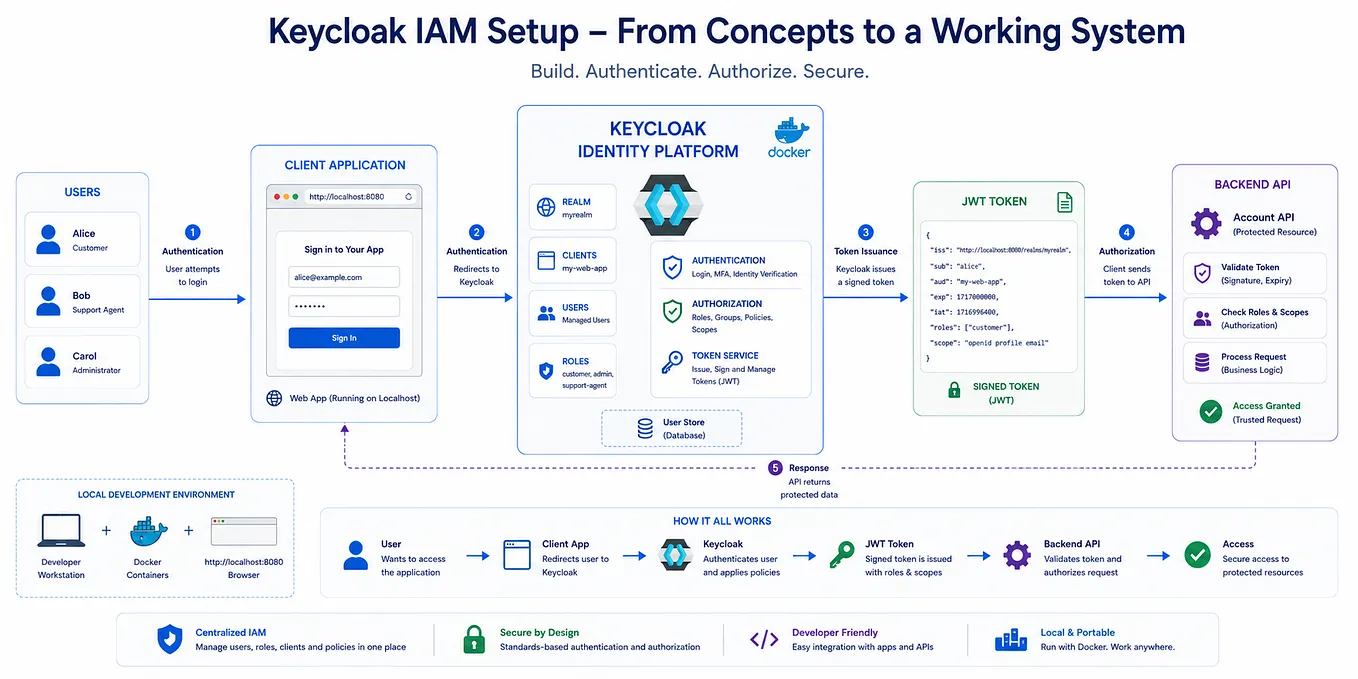
The core concepts of Keycloak along with its purpose is shown below.

A Simplified Identity Flow
At a high level, the flow inside Keycloak resembles like below :
User → Keycloak → Token → Application/APIBreaking this down:
- A user authenticates with Keycloak
- Keycloak verifies identity
- Keycloak issues tokens
- Applications and APIs trust those tokens
- Access decisions are made based on roles/scopes/claims
This simple flow is the foundation for many modern authentication systems.
Why These Concepts Exist
Each of the KeyCloak concept can be mapped to a real-world problem.
Realms: Need isolation between environments or organizations.
Clients: Need a way to represent applications and services.
Roles: Need centralized permission management.
Scopes: Need controlled access to identity and APIs.
Relating This to Real Systems
In enterprise and banking systems, this structure becomes extremely important.
A typical ecosystem may contain:
- Customer-facing applications
- Internal employee portals
- Mobile apps
- APIs
- Partner integrations
Without a centralized identity model:
- Authentication logic becomes duplicated
- Permissions become inconsistent
- Trust between services becomes difficult to manage
This is where systems like Keycloak provide structure and standardization.
In the next section , we will talk about Realm , one of the key concept of KeyCloak.
Understanding Realms
What a Realm Really Represents
A realm is essentially a self-contained identity ecosystem.
Inside a realm, Keycloak manages:
- Users
- Credentials
- Roles
- Clients
- Groups
- Authentication flows
- Tokens
Everything within the realm operates under its own isolated identity model.
This means:
- Users in one realm are separate from users in another
- Roles are isolated
- Tokens belong to a specific realm
- Authentication configurations are independent
In other words: A realm defines the scope within which identity and trust exist.
Why Isolation Matters
As I explored more real-world architectures, this idea of isolation started making much more sense.
Different systems often have completely different:
- Users
- Security requirements
- Authentication mechanisms
- Access policies
Trying to manage all of them in a single shared identity space quickly becomes difficult.
Realms solve this by creating clear boundaries.
A Banking Example
Thinking through this from a banking perspective helped me understand realms much better.
Imagine a banking ecosystem containing:
- Customer-facing applications
- Internal employee systems
- Partner integrations
These systems may require:
- Different user bases
- Different authentication policies
- Different access controls
- Different trust boundaries
Instead of mixing everything together, separate realms can isolate these concerns.
For example:
- Retail Banking Realm
- Internal Employees Realm
- Partner Integrations Realm
Each realm can independently manage:
- Users
- Roles
- Authentication flows
- Tokens
- Clients
without affecting the others.

Realms as Security Boundaries
One thing I found particularly important is that realms are not just organizational constructs.
They are security boundaries.
For example:
- Tokens issued in one realm are generally not trusted in another
- Authentication sessions are isolated
- Roles and permissions do not automatically cross realms
This separation helps reduce:
- Accidental trust leakage
- Authorization confusion
- Cross-system security risks
How Everything Connects Back to the Realm
As I explored Keycloak further, I noticed that almost every major concept exists within a realm:
- Clients belong to realms
- Users belong to realms
- Roles belong to realms
- Authentication flows belong to realms
Thus, understanding the realm helps explain the structure of the entire system.
In the next section, we will look at Clients.
Understanding Clients
A client is essentially: An entity that interacts with Keycloak to authenticate users, obtain tokens, or validate identity.
This can include:
- Web applications
- Mobile applications
- Backend APIs
- Internal services
- Partner systems
In other words: Clients are the consumers of identity.
Thinking About This in Real Systems
In a modern banking architecture, there may be many applications interacting with the same identity platform.
For example:
- Mobile Banking App
- Internet Banking Portal
- Internal Employee Dashboard
- Transaction APIs
- Partner Services
Each of these systems may:
- Redirect users to Keycloak for login
- Receive tokens from Keycloak
- Validate identity and permissions
- Enforce authorization rules
Inside Keycloak, each of these systems can be represented as a separate client.
Why Clients Exist
One thing that became clear while learning Keycloak is that different applications often have different security requirements.
For example:
- A mobile app behaves differently from a backend API
- Public-facing applications cannot securely store secrets
- Internal services may require stronger trust relationships
- APIs may only validate tokens without handling login directly
Clients help Keycloak model these differences in a structured way.
Different Types of Clients
As I explored further, I noticed that Keycloak categorizes clients based on how they interact with the identity system.
The general three types were:
Public Clients
Public clients are applications that cannot securely store credentials. These typically include Browser-based applications and Mobile Apps.
Since users can inspect these environments, storing secrets securely becomes difficult.
These clients typically:
- Redirect users to Keycloak for authentication
- Receive tokens after login
- Operate without client secrets
Confidential Clients
Confidential clients are applications that are capable of securely storing credentials. Examples include Backend services and Server-side applications.
These clients:
- Authenticate themselves to Keycloak
- Use client secrets or certificates
- Participate in more secure server-side flows
This model is common in enterprise backend systems.
Bearer-Only Clients
Get Aditya Ramaswamy’s stories in your inbox
Join Medium for free to get updates from this writer.
Bearer-only clients do not initiate login flows themselves. Instead they only validate incoming bearer tokens.
This is commonly used for:
- Backend APIs
- Resource servers
In this model: The API trusts Keycloak-issued tokens but does not handle user login directly.
How Clients Fit into the Bigger Picture
Clients essentially become the bridge between:
- Users
- Applications
- Tokens
- Authorization
inside the identity ecosystem.

Why Proper Client Configuration Matters
While exploring identity systems, I also realized how critical proper client configuration is.
Misconfigured clients can lead to:
- Token leakage
- Weak authentication flows
- Incorrect redirect handling
- Overly broad trust relationships
This is one reason identity systems become security-sensitive very quickly.
A Real-World Perspective
In banking systems, clients often map directly to business systems:
- Customer applications
- Internal operations portals
- API gateways
- Partner ecosystems
Managing them centrally through an identity platform provides:
- Consistent authentication
- Standardized token handling
- Better trust management
- Centralized security control
In the next section, we will take a look at how Keycloak decides what a user or application is allowed to do?
Roles, Groups, and Authorization
Once I started understanding how users and applications fit into Keycloak, the next question naturally became: How does the system decide what a user is allowed to do?
This is where concepts like:
- Roles
- Groups
- Authorization
started becoming much more meaningful.
And interestingly, this is also where identity systems begin moving beyond authentication into actual access control.
Inside Keycloak, roles and groups help model the permissions in a centralized and manageable way.
Understanding Roles
One simple way to understand roles is that it represents permissions or responsibilities within the system.
For example, in a banking environment , there can be the below roles:
- customer
- support-agent
- auditor
- admin
Each role may grant access to different capabilities.
For example:
- A customer may view personal account information
- A support agent may assist users but not perform transactions
- An admin may manage system-level operations
Instead of hardcoding these rules into every application, Keycloak allows them to be centrally managed.
Realm Roles vs Client Roles
Realm roles apply across the entire realm.
These are useful for:
- Broad system-wide permissions
- Shared organizational roles
Examples include admin, employee, auditor
Client roles are specific to a particular application or service.
For example: transaction-approver, report-viewer , account-editor
These permissions only make sense within that specific client/application context. This separation helps avoid overly broad access models.
Understanding Groups
Groups help identity systems manage users at scale.
Instead of assigning roles individually to every user:
- Users can be organized into groups
- Roles can then be assigned to groups
For example: Retail Customers , Corporate Customers , Operations Team ,
Fraud Monitoring Team
This creates a much more manageable authorization structure.
Why Groups Become Important
In real systems:
- Users change teams
- Responsibilities evolve
- Access requirements shift over time
Without groups:
- Role management quickly becomes difficult to maintain
Groups provide:
- Organizational structure
- Easier permission management
- Better scalability for large user bases
How Authorization Fits Into Tokens
An interesting part is that the authorization information eventually becomes part of the token itself.
For example, tokens may contain:
- Roles
- Group memberships
- Scopes
- Permissions
This allows backend services to make authorization decisions without repeatedly querying the identity provider.
A Banking Perspective
In banking systems, authorization becomes especially sensitive because access boundaries are critical.
For example:
- A teller should not access internal audit systems
- A support user may only view limited customer information
- Certain transactions may require elevated approval roles
Centralized authorization helps ensure:
- Consistent access control
- Reduced privilege leakage
- Easier auditing and governance
Identity systems become difficult not because authentication is hard, but because authorization becomes complex over time.
Managing:
- Roles
- Exceptions
- Organizational structures
- Cross-system permissions
at scale is often one of the biggest operational challenges.
This is why centralized identity and authorization systems become so valuable in enterprise environments.
In the next section we will explore Scopes which will connect KeyCloak to OAuth and Tokens.
Understanding Scopes and Claims
Scopes are deeply connected to how modern identity systems control access and share identity information in a structured way.
What a Scope Really Represents
One way to think about scopes is that it is A way of defining what information or level of access is being requested.
Instead of applications automatically receiving unrestricted access, they explicitly request specific scopes.
For example: openid profile email
This tells the identity system:
- What identity information the application needs
- What level of access is being requested
- What should be included in the resulting tokens
Why Scopes Exist
As systems become more distributed, applications rarely need unlimited access.
For example:
- A reporting service may only need read access
- A profile page may only require basic user information
- A payment API may require elevated permissions
Scopes help limit and structure this access. This aligns closely with one of the core ideas behind OAuth 2.0: Delegated and controlled access.
Understanding Claims
While scopes define what can be accessed, claims represent: The actual identity or authorization data carried inside tokens.
Claims are pieces of information embedded within tokens.
Examples include:
- Username
- Roles
- Groups
- User ID
- Token expiry
- Issuer information
In many ways: Claims become the context backend services use to make decisions.
How Scopes and Claims Work Together
One can think of scopes and claims as follows:
- Scopes → determine requested access/information
- Claims → carry that information inside tokens
For example:
- Requesting the
emailscope may result in an email claim being added to the token - Requesting
profilemay include user profile-related claims
This creates a standardized way for applications to receive identity information.
How Keycloak Uses Scopes
Inside Keycloak, scopes help control:
- What identity data appears in tokens
- What permissions are associated with tokens
- How applications interact with APIs
This becomes particularly important when different applications require different levels of access.
For example:
- A mobile app may only require basic profile information
- An internal admin portal may require additional authorization claims
- Partner systems may need restricted token scopes
Scopes help structure these access boundaries cleanly.

A Banking Perspective
In banking systems, limiting access becomes extremely important.
Not every application should receive:
- Full customer information
- Administrative permissions
- Broad API access
For example:
- A notification service may only require customer contact information
- A reporting application may only need read-only access
- Sensitive transaction APIs may require elevated scopes and authorization claims
This principle of limited and controlled access is one of the foundations of secure identity systems.
At this point, the major Keycloak building blocks started fitting together:
- Realms isolate identity
- Clients consume identity
- Roles and groups manage permissions
- Scopes and claims shape token access and information
The final piece was understanding: How authentication itself flows through the system.
Understanding Authentication Flows and Token Issuance
At this point we have explored the individual pieces of Keycloak:
- Realms
- Clients
- Roles
- Groups
- Scopes
- Tokens
So How does the entire authentication process actually flow through the system?
What an Authentication Flow Really Is
Initially, I assumed authentication was simply:
- User enters credentials
- System validates them
- Token gets issued
But modern identity systems are much more flexible than that.
An authentication flow is essentially: A sequence of steps that defines how identity verification happens.
Depending on the system requirements, this may include:
- Username/password validation
- Multi-factor authentication (MFA)
- OTP verification
- Social login
- Identity federation
- Conditional authentication rules
Effectively Authentication is not a single action — it’s an orchestrated process.
A Simplified Flow
One mental model that helped me visualize the process was:
User → Application → Keycloak → Authentication → Token → Application/APIBreaking this down:
- User tries to access an application
- Application redirects user to Keycloak
- Keycloak performs authentication
- Keycloak issues tokens
- Application/API trusts the token
- Authorization decisions happen using claims/roles/scopes
This simple flow powers many modern identity systems.

Token Issuance
One thing I found particularly interesting was how central token issuance is to the entire architecture.
Once authentication succeeds:
- Keycloak generates signed tokens
- Tokens carry identity and authorization information
- Applications and services trust those tokens
These tokens may include:
- User identity
- Roles
- Groups
- Scopes
- Expiry information
- Issuer details
In many ways: Tokens become the portable representation of trust.
Different Types of Tokens
The authentication flows often produce different kinds of tokens.
The most common ones are:
- Access Token: Used to access APIs and services
- ID Token: Carries user identity information
- Refresh Token: Used to obtain new access tokens
Understanding this distinction between these tokens makes it easier to understand OAuth and OIDC flows.
Why Authentication Flows Matter
The authentication flows allow identity systems to adapt to different security requirements.
For example:
- Customer login may require OTP verification
- Internal employee systems may require MFA
- Partner integrations may use federated identity providers
- APIs may use service-to-service authentication flows
Instead of every application implementing this logic independently: Keycloak centralizes and standardizes the process.
A Banking Perspective
In banking systems, authentication flows are rarely simple.
Different operations may require different trust levels:
- Viewing account details
- Performing transactions
- Approving high-value payments
- Accessing internal administrative systems
Authentication flows help enforce these trust boundaries consistently.
For example:
- Sensitive operations may trigger additional verification
- Internal systems may enforce stricter authentication policies
- Different user categories may follow different login flows
This flexibility becomes extremely important in enterprise identity systems.
Authentication flows, token issuance, scopes, and authorization all work together to maintain that trust model.
And that’s what makes identity platforms fundamentally different from simple login systems.
And with these foundations now in place, the next step is finally moving into the hands-on side of the journey:
- Setting up Keycloak
- Creating realms and clients
- Exploring authentication flows
- Issuing and validating tokens
- Integrating applications and APIs
That’s what I will write in the next post.