Why AI Strategies Fail Without Data Centralization: Lessons from the Frontlines

Part 1 of 5: The Wake-Up Call

Across boardrooms and strategy sessions, a familiar pattern emerges. Organizations launch ambitious Gen AI pilots with enthusiasm, only to hit an unexpected wall three months in. Not a technical wall - the models work fine. Not a talent wall - data scientists are onboard. They hit a data wall.
Finance departments want AI-powered forecasting. Marketing teams seek predictive customer insights. Operations demands anomaly detection. Each department maintains their own data lakes, their own schemas, their own “version of truth.” When cross-functional AI applications are attempted, teams spend 80% of their time hunting down data, reconciling conflicting versions, and debating which numbers are “right.”
This scenario plays out repeatedly across industries.
The Uncomfortable Truth About AI Readiness
Here’s what those exciting AI vendor demos don’t reveal: if an organization doesn’t know where its data is, what it means, and how it connects, it’s not ready for AI. Period.
Technology leaders consistently report similar experiences - AI initiatives stalling not because of algorithm complexity or compute power, but because organizations can’t answer basic questions:
- Which customer data is the source of truth?
- How is “revenue” defined across different business units?
- Where did this number actually come from?
The harsh reality? Most organizations treat data like a byproduct of operations rather than the strategic asset it actually is. Systems get built, data gets collected, and someone is expected to figure it out later. That approach might have worked in the past, but it’s proving fatal for AI initiatives.
The Turning Point
One CTO shared a telling moment: sitting in a room with their CFO, trying to explain why an “AI-powered” financial dashboard showed three different versions of quarterly revenue.
The CFO’s question was simple: “If we can’t trust this dashboard, why did we build it?”
There wasn’t a good answer.
That moment crystallized a critical insight shared by many leaders: treating data as an asset isn’t optional anymore - it’s existential. Organizations that can’t produce a single, trusted view of their data aren’t building AI applications. They’re building expensive confusion generators.
The Data Centralization Imperative
Data centralization isn’t about moving everything to one physical location. It’s about creating a unified understanding of data so that whether teams are building simple reports or training complex machine learning models, they’re working from the same foundation.
Here’s what “centralization” means in practice:
Get Ram Tyagi’s stories in your inbox
Join Medium for free to get updates from this writer.
Know Your Data
Organizations can’t centralize what they don’t understand. This means cataloging everything - not just the important systems, not just the “clean” databases, but every data source that matters to the business. One enterprise discovered they had 47 different customer databases across their organization during this exercise. Forty-seven.
Establish Single Sources of Truth
Every critical business entity needs an authoritative source. Who owns customer data? Where does the official product catalog live? What system defines an “order”? These aren’t technical questions - they’re business decisions that require executive buy-in.
Preserve the Journey
A lesson many data leaders wish they’d understood earlier: don’t just store final, polished data. Keep the raw data. Keep the transformed data. Keep every meaningful stage. Why? Because when building machine learning models, the patterns needed often live in the transformation process itself - in what changed, what was cleaned, what was merged.
Why This Matters More Now Than Ever
The explosion of Gen AI has created both an opportunity and a trap. The opportunity is obvious: AI can deliver insights, automation, and capabilities organizations have only dreamed about. The trap? Gen AI amplifies whatever gets fed into it.
Feed it fragmented, conflicting data, and the result is confident-sounding hallucinations that erode trust. Feed it centralized, well-understood data, and genuine business value emerges.
Leaders across industries report seeing both scenarios play out. The difference isn’t in the AI models or the talent — it’s in the foundation.
What’s Coming in This Series
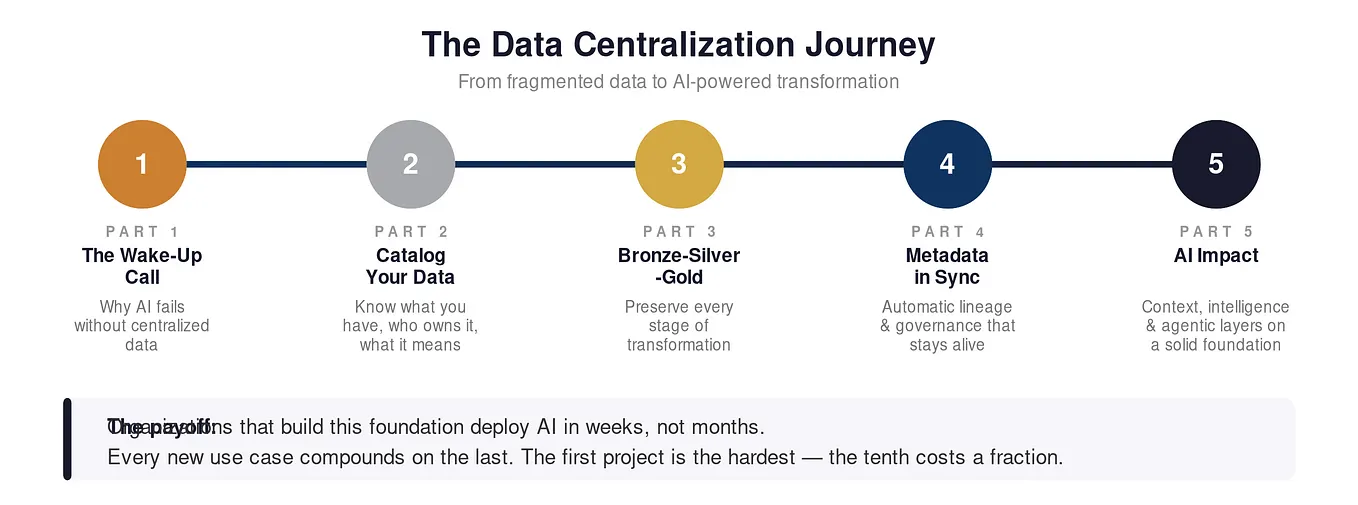
Over the next four articles, this series will explore what industry leaders have learned building data centralization strategies that actually work — not theory, but battle-tested approaches:
Part 2: Cataloging Your Data (The Right Way)
How to inventory data landscapes without multi-year projects. Coverage includes tooling options, proven approaches, and common pitfalls that derail cataloging initiatives.
Part 3: Building Your Bronze-Silver-Gold Pipeline
Why preserving every stage of data transformation is critical for AI, and how to architect this practically using modern data platforms.
Part 4: The Fabric-Purview Architecture
A deep dive into maintaining metadata lineage across transformation layers — the secret to trustworthy AI applications.
Part 5: From Centralization to AI Impact
How to leverage centralized data foundations to accelerate AI adoption and demonstrate measurable business value.
The Bottom Line
If technology leaders could offer one piece of advice to organizations before launching AI initiatives, it would be this: stop building AI pilots and start centralizing data.
That’s not the exciting answer. It’s not the answer that gets budget approved or makes headlines. But it’s the answer that actually works.
The reality is clear: organizations can have the best AI talent, the most sophisticated models, and unlimited cloud budget. But if data is fragmented, AI outcomes will be fragmented.
The good news? Once the foundation is fixed, everything gets easier. Every AI application becomes more reliable. Every insight becomes more trustworthy. Every business decision becomes more confident.
That’s why data centralization isn’t just an IT project. It’s the difference between AI theater and AI transformation.
Next in this series: Part 2 — Cataloging Your Data: Practical Tools and Hard-Won Lessons
What data centralization challenges are you facing in your organization? Share your thoughts in the comments.