Ego and the nuisance it creates


Lets first understand, what this Ego is , does it really exist and how it works.
Lets take a very common example of a movie playing in a theatre.
1. The Screen
The screen is always still. It doesn’t move, it doesn’t cry, and it doesn’t fight. Even if the movie shows a huge fire, the screen doesn’t get burnt.
The screen in the theatre can be compared to Brahman.
The screen does nothing. It just “is.” Without the screen, there is no movie, but the screen is not the “doer.”
Movie is nothing but the moving play of names and forms.
The Logic: The Brahman is like the sun. The sun doesn’t “do” the growth of plants, the evaporation of water, or the light in your room. But without the sun, none of those things could happen. The Brahman is the Presence that allows action to occur, but it remains untouched by the action itself.
2. The Movie Characters
The characters on the screen are running, talking, and chasing their desires (vasanas). They seem very busy.
This is your Gross Body and Mind. They are just “playing out” a script based on past habits. They are like biological robots. They act, but they have no power of their own.
The Logic: Your heart beats, your lungs breathe, and your brain processes thoughts based on past conditioning (vasanas). You don’t “do” your digestion; it happens.
Verdict: The body-mind complex is a machine running on the “fuel” of past karma.
3. The Projector (Subtle Body)
The subtle body holds the vasanas(the film strip). Just as a projector is useless without a film strip, the subtle body carries all your Vasanas (latent tendencies) and Samskaras (past impressions).
The “Film” is the data of your past lives, desires, and habits. Without the projector, these vasanas would just be dark, unmanifested seeds. The projector “runs” them so they can appear as a life story.
4. The Electricity (Ishwara)
The projector needs power to show the movie. This power follows the laws of physics and optics.
The Truth: This is Ishwara (Universal Intelligence). It is the energy and the “rules” that make the world work. It provides the “push” for everything to happen.
The Logic: Since your individual mind is part of the “Total Mind,” and your body is made of the same elements as the universe, the “Whole” is moving the “Part.” Not a leaf falls without the laws of Ishwara (gravity, cause, and effect).
Verdict: Ishwara is the “Grand Director” of the movie.
4. The Person in the Audience (Ego)
This is the “I” that gets confused. The “I” is sitting in the seat, watching the movie, and it gets so sucked in that movie that it starts yelling, “I am running!” or “I am winning!”
The Truth: This is the Ego. It doesn’t actually do anything, but it takes the credit (or the blame) for everything the characters do.
Why does the Ego do this ?
The Ego is scared. Because it is non-existent, it feels that if it doesn’t “claim” something, it will vanish. It makes demands and creates confusion just to prove to itself that it is “real.” It’s like a child throwing a tantrum just to get attention — the “nuisance” is its way of feeling alive.
The Ego doesn’t realize there is already a “Power” (Ishwara) running the projector and the script. It thinks if it stops worrying, the movie will stop playing.
It starts shouting instructions at the characters: “Don’t say that! Walk faster! Why did you fail?” This confuses the Intellect. Instead of the Intellect following the “Script of Dharma” (what is naturally right), it gets paralyzed by the Ego’s “Shoulds” and “Musts.”
Examples
- When a character in the movie feels hungry, the Ego doesn’t say, “The character is hungry.” It says, “I am hungry.” Because it claims the hunger as its own, it starts making demands: “I need the finest pasta right now or I will be miserable!” The poor character (the body) now has to work ten times harder to satisfy a “false demand” that wasn’t even there originally.
- The movie is made of change (birth, growth, decay). But the Ego demands: “This happy scene must last forever!” or “I must never get old!”. This is like an audience member jumping on stage and trying to glue the actors in place so the scene doesn’t end. It creates massive stress because the “Characters” are legally bound by the laws of nature to keep changing.
Ishwara-Brahman Connect
- Brahman provides the Existence (Sat) and Consciousness (Chit). It is why you can say “I AM.” Its mere presence allows everything to exist.
- Ishwara provides the Intelligence and Energy. It is why your heart beats and why your intellect can solve a coding problem. Ishwara is the “Administrator” who manages the laws of Karma, the flow of Prana, and the structure of the Intellect.
Is it the Intellect or the Ego talking ?
The tone and motive is what sets them apart.
- Ego is always driven by attachment and aversion.
The Motive: To enhance itself or protect itself.
The Tone: Desperate, loud, impulsive, and temporary.
The Test: If you don’t satisfy the demand, does the “I” feel offended, diminished, or anxious? If yes, it’s the Ego.
Example: “I must check my phone now because I might be missing out on something important.” (Fear-based / Self-importance).
2. The Intellect is driven by Dharma (Values) and Logic. it is objective and calm.
The Motive: To maintain balance, health, or growth.
The Tone: Quiet, firm, consistent, and detached.
The Test: If the action is delayed, the Intellect remains cool. It doesn’t throw a tantrum; it simply waits for the right time.
Example: “I will check my phone at 5 PM to respond to work messages so I can finish my project on time.” (Purpose-based / Orderly).
Ego-Vasana-Intellect Connect
Vasanas/tendencies in the causal body is triggered by internal/external(senses) stimulus. The vasana appears in the subtle body as a thought wave. This thought wave “I want to do X” is converted into a desire to do something/avoid something.
Lets say the external stimulus is a large piece of chocolate perceived by the eyes.
There is already an existing vasana for liking chocolates which triggers a thought and hence a desire to eat the chocolate.
The Ego will say that “I want the chocolate. It will make me happy”.
At this point, the intellect must be strong enough to do self-enquiry, where we question the existence of ego itself. You don’t enquire into the content of the ego (e.g., “Why do I want chocolates?”). That is psychology, not Self-Enquiry. Instead, you enquire into the source of the “I” that claims the chocolates.
You ask “Who is this I who wants the chocolates ? Who am I”. Since the ego does not exist, it cannot stand this inspection.
Now, the intellect steps in as the Objective Judge. It asks:
Is satisfying this desire helpful for my growth (Shreyas) or just momentarily pleasant?”
“Is this an old habit trying to trick me, or a genuine need of the body?”
The Intellect decides whether to allow the action or not, based on Wisdom, not Whim. Even if the Intellect decides to satisfy the vasana (e.g., “Yes, the body actually needs food right now”), the experience is completely different without the Ego’s claim.
Action performed by the intellect while ignoring the ego does not accumulate new karma. In fact, this is the only way to act in the world and remain Karma-free.
In Vedanta, this is called Akarma (Action-in-inaction). It looks like you are working, but spiritually, nothing is being “recorded.”
The Result: You are acting, but you are not “building” a future. You are finishing your old karma without creating any new debt.
If the intellect becomes a slave to the ego, then the intellect starts finding excuses to eat the chocolate: “I worked hard today, I deserve it.” The vasana gets satisfied and even more stronger.
The ego requires the satisfaction of the vasanas to survive. This also works vice-versa. The vasanas survive only as long as they are being satisfied.
Eventual downfall of vasanas
When the Ego is sidelined, the “fuel” that keeps the vasanas alive is cut off. In Vedanta, this process is often compared to a seeds being roasted. A normal seed (a vasana with ego) will sprout the moment it gets water (an opportunity). But a roasted seed (a vasana witnessed by the intellect) looks the same, but it can never sprout again.

Revision of how the non-existent ego creates a samsara/solid prison
- Your life begins with a “Subtle Body” full of Vasanas — latent tendencies from the past. They don’t force you to act, but they create a predisposition. If you have a “Music Vasana,” you will naturally be drawn to a guitar in a room full of objects.
- When a Vasana meets a sensory object (like seeing a phone or hearing a criticism), it vibrates. A thought (Vritti) arises in the mind.
- This is the critical moment. If the Ego jumps in and says, “This is MY thought, and I WANT this result.” then a simple thought is upgraded to a Binding Desire.
- Driven by the Ego’s demand, if the intellect is not strong enough to question the existence of the non-existent ego via self enquiry, it satisfies the ego’s demand. Because the Ego says “I am the doer,” every action you take carries the weight of your identity. This is called Agami Karma (newly created karma). Because you “owned” the action, you now “own” the consequence.
- This is where the “prison” is built. Every ego-backed action does two things simultaneously:
A. The External Result (Phala)
The world gives you a result (success, failure, praise, blame). Since the Ego claimed the action, it now suffers or enjoys the result. This creates your “External Life” (your circumstances).
B. The Internal Impression (Samskara)
This is the most dangerous part. The action leaves a new scratch on your mind. The original Vasana is now strengthened. Example: If you use your phone to escape boredom once (with Ego), the “Boredom-Phone” Vasana becomes 10% stronger. Next time, the urge will be harder to resist.
6. Your “Life” is simply the sum total of these loops.
- Character: Your character is just a bundle of your strongest Vasanas.
- Destiny: Your destiny is just the predictable path these Vasanas take when they meet the world.
- The “Nuisance”: The Ego makes you feel like you are “living” and “choosing,” but you are actually just a slave to the loop. You are reacting to the past over and over again.
Karma,Bhakthi and Jnana yoga helps break the loop ?
You don’t do Karma Yoga on Monday, Bhakti on Tuesday, and Jnana on Wednesday. You do them all at once, in every moment. You act (Karma),with love (Bhakti), while witnessing who is doing it (Jnana).
Think of them not as three separate paths, but as the three legs of a tripod. If one leg is missing, the “Camera of the Intellect” cannot stay steady enough to capture the truth of the Brahman.
Lets take an example of some work to be completed.
- Before the work begins, the intellect must wake up and do the discrimination.
Ego: “I want to do this because it will make me look good/rich/comfortable.”
Intellect: The intellect will question the existence of the ego using self enquiry/jnana yoga. The intellect, knowing the Ego is a “ghost,” it sidelines the ego. Intellect does not “fight” it; it just stops identifying with it. The intellect also sidelines the personal “Like/Dislike” (Vasanas) and choose the action based on what the situation requires of you. “Is this action my Dharma (Duty) in this moment?”
2. Once the work begins, the Ego tries to “re-enter” by claiming the effort.
Ego: “Look at how hard I am working. I am the one doing this.”
Intellect: You remind yourself that the body, the energy, and the intelligence all come from Ishwara. The body is running on the fuel of the past karmas. You act as a trustee and not the owner. You work with 100% intensity, but without the “Fever” of being the owner.
3. Once the action is done, the Ego tries to grab the “Fruit” (Success/Failure). This is where you use Bhakti (Devotion).
Ego: “I am doing this for my own future.”
Intellect: ”This result belongs to the Ishwara, not to this little ‘me’.”You give the outcome back to the Source as an act of love. This turns “Anxiety” into “Prasada” (Grace). If you love the Source more than you love the “Result,” then whatever happens is acceptable.
4. Moving to the result acceptance phase.
Ego: If the result is good: “I am great!” If the result is bad: “I am a failure!”
Intellect: You realize that while you controlled the Action, the Result is managed by the infinite laws of the Universe (Ishwara). You accept the outcome — whatever it is — as Prasada (a blessed gift). Because you don’t fight the result, no “resentment” or “pride” Vasanas are created.
Free will exists ?
Free will does exist. But free will isn’t the “Power to do whatever I want,” but rather the “Power to choose where I place my attention.”
Most of what we call “Free Will” is actually just Habit. If a sensory trigger hits a Vasana, and the Ego claims it, and the Body acts — that isn’t free will. That is a programmed response.
Your true Free Will exists in the Intellect (Buddhi), specifically in its ability to expose the existence of the ego and to practice Viveka (Discrimination).
The higher you go in spirituality, the more “Free Will” starts to look like Surrender.
When you are a slave to your Vasanas, you think you are free. When you are a servant of the Truth (Brahman/Ishwara), you are actually free, because you are no longer pushed around by cravings and fears.
How should the intellect approach other’s vasanas ?
f you treat vasanas — whether yours or someone else’s — with hatred or suppressed anger, you are actually feeding the Ego and creating more “sticky” Karma.
To the Intellect, a vasana is simply a mental illness or a habitual glitch.
- When you see your own bad habits, you treat yourself with Firm Discipline (like a good coach).
- When you see others’ bad habits, you treat them with Detached Compassion (like a doctor treating a patient with a fever).
Strategy for your own vasanas: Objective Observation
Treat your Vasanas like old software bugs. If a computer program crashes, you don’t beat the computer; you look at the code.
The Intellect says: “Ah, the ‘Boredom-Phone’ script is running again. Interesting. It arises from the subtle body because of past repetition. I see it, but I do not have to execute the command.”
Strategy for others vasanas
Next time someone treats you badly or acts from a “bad” Vasana:
- Look them in the eye (or visualize them).
- Silently say: “I see you, Brahman. I see the Vasanas pushing you, but I know who you really are.”
- Notice the shift: Suddenly, you don’t feel the need to “win” the argument. You feel a strange sense of safety because you realize that your Brahman and their Brahman are one and the same.
- If you get angry back, your Intellect has fallen asleep, and your Ego has jumped into the ring. Now, two sets of Vasanas are fighting, and both of you are accumulating Karma.
- If someone’s Vasanas are harmful to you, the Intellect may decide to walk away or set a boundary. But you do it without “Heat.”
- Ego boundary: “I hate you for doing this to me!” (Creates Karma).
- Intellect boundary: “This environment is not conducive to my peace. I am leaving.” (Zero Karma).
Purpose of the Intellect
The Intellect is like a ladder. You are training it with the 3 forms of yoga to use it to climb up to the roof (Realization). Once you are on the roof, you don’t need the ladder anymore.
Get SpiritualityEnthusiast’s stories in your inbox
Join Medium for free to get updates from this writer.
In Self-Enquiry, the Intellect’s final job is to realize its own limitation. It looks for its source, realizes it is just a reflection, and then merges into the Source.
When the vasana triggers:
- The Ego says: “I want the phone.”
- The Intellect says: “No, that’s just a Vasana. Stay still.”
- The True I (You): Silently observes the struggle between the Ego and the Intellect.
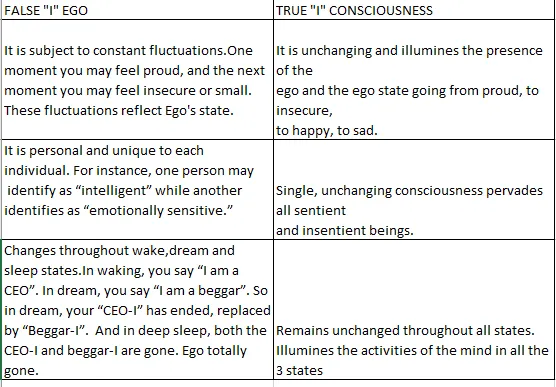
Why is the Ego called non-existent ?
The ego only “exists” because it steals its reality from two different sources:
- From the Brahman: It steals the sense of “I am” (Consciousness).
- From the Subtle Body: It steals the Vasanas, memories, and labels (Matter).
When you combine “I am” with “a developer,” “bored,” or “a father,” the ego is born. But if you separate the “I am” from the labels, the ego vanishes instantly. It has no “home” of its own.
To help your Intellect handle this, Vedanta uses three levels of reality:

We call the ego a “nuisance” precisely because it is a ghost that thinks it owns the house.
- The Problem: As long as you believe the ghost is real, it can scare you (anxiety, boredom, karma).
- The Solution: You don’t “kill” the ghost. You just turn on the light of the Intellect and see that the “ghost” was just a curtain blowing in the wind.
Is the intellect also non-existent ?
Imagine you are walking barefoot and a thorn (The Ego) gets stuck in your foot, causing great pain.
- You find a second thorn (The Intellect/Self-Enquiry/Knowledge).
- You use the second thorn to carefully dig out the first thorn.
- Once the first thorn is out, you throw both thorns away.
You don’t keep the second thorn just because it helped you. Similarly, once the Intellect has helped you realize the Atma, the Intellect itself is seen as just another temporary “wave” on the ocean of Brahman.
The Intellect is essentially caught in a “Tug-of-War”:
- From Below (The Vasanas): They pull the Intellect down, trying to turn it into a servant of the Ego. They say: “Use your logic to help me get that phone/promotion/revenge!”
- From Above (The Atma): It shines its light, inviting the Intellect to look upward and realize its source.
In its natural state, the Intellect (Buddhi) is made of Sattva — the quality of light, clarity, and stillness. Intellect does get swayed by Vasanas. When a strong desire (Vasana) hits, it’s like a gust of wind that shakes the window or a bucket of mud thrown against the glass. This is why the Intellect requires Jnana (Knowledge). Knowledge acts like a “Windshield Wiper.” It allows the Intellect to say: “Wait, I am being swayed right now. This desire isn’t ‘Me,’ it’s just a Vasana.”
The Ego (Ahamkara) is called “dirty” or “opaque” because its very nature is Tamastic and Rajasic — it is built on “I-ness” and “My-ness.” The Ego isn’t interested in the Truth; it’s interested in Survival.
Who is the “I” that does duty and surrenders/accepts the result ?
Lets see the 3 “I”’s:
1. The “Working I” (The Intellect)
When you say “I am doing my duty,” the one actually making the decision is the Intellect. It has realized that the Ego is a nuisance, so it takes the “steering wheel” of your life.
This “I” is technically part of the subtle body (a ghost), but it is a Refined Ghost. It is like a police officer in a movie who realizes he is in a movie and starts helping the actors find the exit.
2. The “False I” (The Ego — Being Sidelined)
This is the “I” that usually says “I am doing.”
- The Ego’s Version: “I am doing this so I can get a promotion.”
- The Karma Yoga Version: You have pushed this “I” into the passenger seat. It is still there, whispering cravings and fears, but the Intellect is ignoring it. When you “Surrender to Ishwara,” you are essentially saying to the Ego: “This result isn’t for you.”
3. The “True I” (The Brahman— The Screen)
This “I” isn’t actually “doing” anything.It is the silent, unchanging Witness of the Intellect performing the duty.
When the Intellect becomes very pure through Karma Yoga, it starts to feel like the Brahman. This is why you feel a sense of Peace even while working hard. You are operating from a place that is “closer” to your true nature.
How the “I” Shifts During the Act
Imagine you are coding a complex feature at work:
- The Start: You use your Intellect to say: “This is my Dharma (duty) as a developer. I will do to the best of my ability”
- The Middle: You work with 100% focus. If the Ego jumps in and says “I’m so smart,” the Intellect catches it and says “No, the intelligence and the energy comes from the Universal Source- Ishwara”
- The End: When the code is pushed, the Intellect says: “I surrender the success or failure of this feature to Ishwara.”
- The Realization: In that moment of surrender, the “Working I” (Intellect) becomes quiet. For a split second, there is only the True I — the silent, peaceful Screen.
- Who does the duty? The Intellect/Body complex.
- How it is able to do the duty ? Because the body itself, it’s intelligence and energy is given by Ishwara.
- Who surrenders the result? The Intellect.
- Who is Ishwara? The Total Intelligence that receives the result.
- Who are YOU? The one watching the whole process happen.
Owner and Trustee
To understand that your internal “equipment” (intelligence, energy, and body) belongs to Ishwara and not the “Ego,” you have to shift your perspective from being the Owner to being the Trustee. This is called recognizing the Macrocosm within the Microcosm.
Think of the entire Universe as a massive, central Super-Computer (Ishwara).
- The Terminals: Every human, animal, and plant is an individual terminal or “node” connected to this central server.
- The Intelligence: When you solve a coding problem or a life puzzle, you aren’t “creating” logic. You are simply accessing the pre-existing laws of logic and mathematics that govern the universe.
- The Ego’s Lie: The Ego is like a terminal that thinks it’s the one doing the processing, forgetting it has no power or data if the connection to the central server is cut.
The easiest way to see Ishwara’s energy is to look at what you don’t control.
- Automatic Energy: Are “You” beating your heart 100,000 times a day? Are “You” instructing your liver to filter toxins?
- The Manifestation: That energy is Prana-Shakti — the life force of Ishwara. It flows into your body whether you are awake, asleep, or distracted.
- The Insight: If Ishwara is intelligent enough to run your heartbeat and digestion without your help, why do you assume “You” (the Ego) are the one responsible for your thoughts and creative ideas? They are just more “subtle” versions of the same universal energy.

It is exactly like a smartphone: the hardware (Gross Body) is useless without the software (Subtle Body), but the software can’t even boot up without the battery/power grid (Brahman/Ishwara).
- The Gross Body: The “Hardwired” Vehicle
The physical body is made of the five elements (food, water, air, etc.). By itself, it is Jada (inert matter).
- The Dependency: It only appears “alive” because the Subtle Body (Prana, Mind, Intellect) is “wearing” it like a glove.
- The Proof: When someone dies, the Gross Body is still there, but the “Life” is gone. The “hand” is there, but the “glove” has been removed.
2. The Subtle Body: The “Software” and “Electricity”
The Subtle Body is where your “I-ness,” your Vasanas, and your intelligence live. But as you correctly noted, it is also not self-sufficient.
- The Dependency: The Subtle Body is like a Moon. The Moon has no light of its own; it only shines because it reflects the Sun.
- The Power Source: The Subtle Body functions because it is “plugged into” Ishwara.
The “Micro-Macro” Connection
To see how Ishwara runs your subtle body, look at the alignment between your individual equipment and the universal equipment:

Why this kills the “Nuisance Ego”
The Ego thrives on the lie of Independence. It wants to believe: “I am a self-made man with my own brain and my own energy.”
When your Intellect realizes your “Alive-ness” is a gift from Ishwara, the Ego is defeated by logic:
- If my body is just borrowed elements from the Earth…
- And my intelligence is just a borrowed reflection of Ishwara…
- Then where is this “I” that I am so worried about?
Surrendering to Ishwara isn’t a “religious” act; it’s an accuracy act. You are simply admitting that the power belongs to the Power Plant, not the lightbulb.
When you code, you realize: “The logic I am using is Ishwara’s logic; the energy to type is Ishwara’s energy.”
When you feel smart: Mentally say, “This logic is Ishwara’s; I am just the witness of it.”
When you feel energetic: Say, “This Prana is a loan from the Universe; I am using it for my duty.”
When you succeed: Say, “The results are the product of Universal Laws (Ishwara); I accept them as a gift (Prasada).”
When you realize that your energy and intelligence are borrowed, the Ego loses its two main weapons:
- Pride: “I am better because I am smarter.” (No, your ‘prism’ is just clearer today).
- Anxiety: “I must work hard to survive.” (No, the same Force that grows the grass is providing the energy for your work).
The Ego’s Hard Work: Driven by the thought, “If I don’t do this, I will be destroyed.” This creates tension, narrow-mindedness, and eventually burnout.
The Karma Yogi’s Hard Work: Driven by the thought, “This is my duty, and Ishwara has provided the intelligence and energy for me to do it perfectly.”
How Prarabdha decides our gross and subtle bodies ?
1. The Gross Brain (The Hardware)
Prarabdha dictates the physical “equipment” you were born with.
- Just as some people are born with a body designed for sprinting and others for endurance, the gross brain is physically wired differently for everyone.
- This includes processing speed, memory capacity, and the physical health of the neurons.
- This is why one person might grasp a mathematical concept instantly, while another takes days. The “machine” has different specifications.
2. The Subtle Equipment (The Software)
Beyond the physical brain, Prarabdha also shapes the Subtle Body, specifically the Vasanas (mental tendencies).
- One person might have “Vasanas for logic,” making it easy for them to focus on software engineering.
- Another might have “Vasanas for agitation,” making their intellect constantly “shaky” and hard to focus.
- The Result: Even if two people have the same “IQ,” the one with quieter Vasanas will seem “smarter” because their “window” is less cloudy.
3. Is the Intelligence the Same for Everyone?
Ishwara provides the “Total Intelligence,” but how much of that intelligence can manifest depends on the quality of your “water” (your subtle body/Prarabdha).
4. The “Energy” (Prana)
Like intelligence, Prana is universal, but its “flow rate” is determined by the plumbing.
- Ishwara is the “Water Pressure” in the city pipes.
- Your Subtle/Gross Body is the “Faucet.”
- If your pipes are clogged with Vasanas (stress, desires, physical illness), the flow of energy feels weak. If the pipes are clear (through Yoga), the flow is strong.
How to use this for Self-Knowledge
Understanding this prevents two great traps of the Ego:
- Inferiority: “I am not smart enough for this.” (Correction: My equipment is just processing at its own Prarabdha-speed).
- Superiority: “I am better than them because I grasp this faster.” (Correction: I just have a “clearer subtle body” by the grace of Ishwara/Prarabdha. Intelligence and energy provided by Ishwara).
Who is Responsible for Prarabdha?
Technically, Ishwara is the “Accountant” (the Law-Giver), but the Ego is the “Client.”
- The Ego’s Claim: Because the Ego says, “I am the doer,” it automatically signs the contract for the results.
- The Mechanism: Every time you act with the sense of “I-doership,” you create a tiny “seed” (Vasana). These seeds collect in the “cloud storage” of the total universe (Sanchita Karma).
- The Delivery: Prarabdha is simply the delivery of those specific seeds that are ready to sprout in this current life.
Responsibility: The Ego is responsible for planting the seeds, and Ishwara is responsible for delivering the fruit.
When the Ego is seen as non-existent (through Self-Enquiry), the entire structure of Karma collapses:
- Agami Karma (Future): Stops immediately because there is no “Doer” to claim new actions.
- Sanchita Karma (Past): Is “burnt” because the “Owner” of that bank account has vanished.
- Prarabdha Karma (Present): Continues to play out until the body dies, but it no longer affects “You.”